Argonne’s ChemGraph is Reshaping Materials Research
The materials that will decide the next decade of infrastructure, from longer-lasting batteries to cleaner-burning fuels and secure supplies of critical minerals, all begin life inside a simulation.
Designing them at the atomic level has long been the preserve of specialists, since building an atomically precise model of how a substance behaves demands a working command of computational chemistry and the tangle of scientific software that surrounds it. Researchers at the U.S. Department of Energy’s Argonne National Laboratory have now released a framework intended to loosen that constraint, and the commercial logic behind it reaches well beyond the laboratory bench.
The framework, called ChemGraph, is an open-source system that uses artificial intelligence to automate the workflows behind computational chemistry and materials science. It matters to industry because the bottleneck in materials innovation is rarely a shortage of ideas; it is the scarcity of people who can translate a research question into a correctly configured, physics-based simulation and interpret the result.
By compressing that specialist workflow, Argonne is effectively widening the pool of organisations, suppliers and engineers who can put advanced simulation to work on practical problems, and it is doing so at a moment when national policy and private capital are both moving decisively towards AI-driven science.
Briefing
- Argonne National Laboratory has released ChemGraph, an open-source, AI-driven framework that automates the setup, execution and analysis of computational chemistry and materials science simulations.
- The system pairs large language models for natural-language instruction with graph neural network foundation models and established simulation tools, targeting applications in next-generation batteries, more efficient combustion and critical materials.
- ChemGraph runs on the ALCF’s Aurora exascale supercomputer and draws on the ALCF Inference Service, using open-weight models to reduce cost and address data-security concerns.
- Because the framework calls real physics-based tools rather than relying on a model’s stored knowledge, it is designed to lower the risk of fabricated results, a persistent worry in scientific uses of AI.
- The work complements the DOE’s Genesis Mission, the national AI-for-science initiative launched in late 2025, aligning ChemGraph with federal priorities around critical materials and advanced manufacturing.
Lowering the Barrier to Advanced Materials Simulation
Running a serious atomistic simulation is not a single action but a sequence of judgement calls. A researcher has to select the right theoretical method, identify software compatible with that method, prepare input files, run the calculation, move the output into separate tools for analysis, then refine parameters and compare results before reaching a defensible conclusion. Argonne’s own description of the process frames it as requiring close to a doctorate’s worth of knowledge and dozens of discrete steps. ChemGraph reorganises that labour by letting a user describe a problem in plain language, after which the framework maps the request onto the tasks, tools and analyses needed to produce a result.
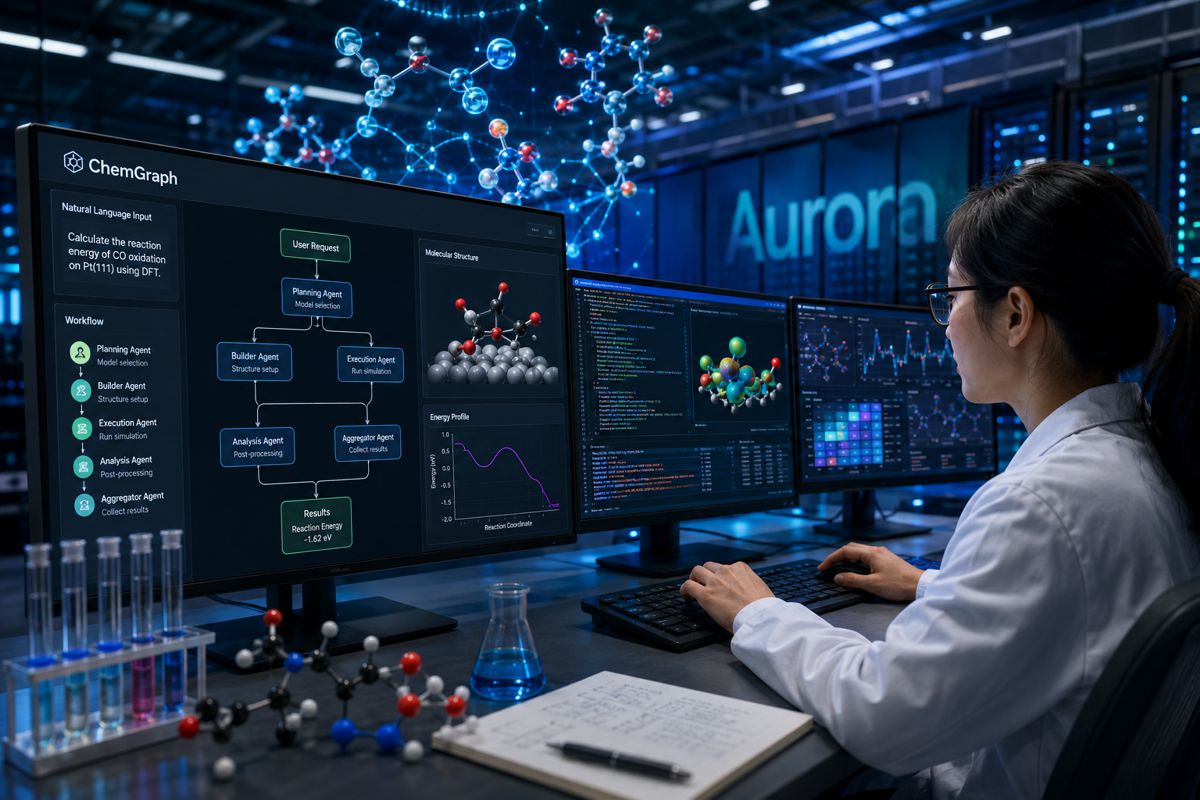
The design distributes the work across agents that behave like specialised assistants, handling planning, execution and data aggregation as distinct responsibilities. Underneath the conversational surface, the system leans on graph neural network foundation models for calculations that are accurate yet computationally efficient, while language models supply the reasoning and task-planning layer.
In its published evaluation the team tested the framework across thirteen benchmark tasks using a mix of open and proprietary models from providers including Alibaba, OpenAI and Anthropic, finding that smaller models coped well with simpler workflows while heavier problems benefited from larger ones. For industry, the significance is less about any single model and more about the pattern: the expertise that once lived only in a handful of specialists is being encoded into software that a far broader set of users can operate.
Where the Commercial Value Lands
The applications Argonne has flagged read like a shortlist of infrastructure’s material dependencies. Next-generation batteries sit at the centre of electrified construction fleets, grid-scale storage and the wider energy transition, and the pace of battery chemistry development is a direct constraint on how quickly heavy equipment and haulage can move away from diesel.
More efficient combustion speaks to cleaner engines and fuels, an area that still governs the emissions profile of much of the world’s plant, shipping and off-highway machinery even as electrification advances. Critical materials, the third named priority, cut straight to supply-chain resilience, since the magnets, cathodes and specialist alloys that infrastructure relies on are exposed to concentrated and often politically sensitive sources.
There is a further strand that connects the framework to the decarbonisation of construction itself. Among the example workflows shared with ChemGraph is the modelling of carbon dioxide capture in porous framework materials, the class of compounds increasingly studied for stripping emissions from industrial processes such as cement production.
Faster, cheaper screening of candidate materials shortens the distance between a promising molecule and a deployable product, which matters to any manufacturer, supplier or project owner trying to hit tightening carbon targets without waiting years for the underlying chemistry to mature. The commercial prize is not a single breakthrough but a compression of the discovery cycle across a whole family of industrial materials.
The Compute Behind the Framework
ChemGraph was developed on resources at the Argonne Leadership Computing Facility, including the Aurora exascale supercomputer, a system built by Intel and Hewlett Packard Enterprise that crossed the exascale threshold at just over one quintillion calculations per second on the standard benchmark and reaches considerably higher throughput on AI-oriented workloads.
Michael Papka, who directs the ALCF, said the team was “thrilled to see Aurora join the exascale club” when the machine reached that milestone, and the framework now uses that capacity to run the computationally demanding quantum chemistry simulations at its core. Alongside the raw compute, the ALCF Inference Service gives researchers cloud-like access to large language models running on the facility’s own systems, an arrangement that keeps sensitive data inside a controlled environment and holds down the cost of repeated model calls.
The architectural choice that should reassure industrial users is the decision to ground the framework in physics rather than in a model’s memory. Instead of asking a language model to recall an answer, ChemGraph directs it to call the appropriate scientific tools and libraries and to generate fresh data through simulation, an approach explicitly intended to reduce the risk of hallucinated results.
That distinction is what separates a credible engineering tool from a plausible-sounding guess, and it is central to whether commercial teams will trust automated workflows for decisions that carry real capital and safety implications. Argonne has already extended the framework beyond its initial release to support spectroscopy simulation and analysis, as well as high-throughput materials screening on Aurora, which points to a system built for adaptation rather than a fixed demonstration.
A National Bet on AI-Driven Science
ChemGraph arrives as the United States channels significant political and financial weight behind the same idea. The framework complements the Genesis Mission, launched by executive order in November 2025 and led by the DOE, which sets out to roughly double the productivity and impact of American science and engineering within a decade by binding together the national laboratories, supercomputers and scientific datasets into a single discovery platform.
The initiative directs the department to identify a slate of national science and technology challenges spanning advanced manufacturing, biotechnology, critical materials, nuclear energy, quantum information science and semiconductors, with early federal investment reported at several hundred million dollars across the laboratory system. Darío Gil, the DOE Under Secretary for Science appointed to lead the effort, has called it “a defining moment for the next era of American science.”
For investors and industrial strategists the alignment is the point worth watching. A tool that lowers the cost and skill threshold for materials research becomes considerably more valuable when a national programme is simultaneously prioritising the very domains it serves, since federal focus tends to pull procurement, standards and private capital in behind it.
The Genesis Mission leans heavily on public-private partnership, which opens a route for equipment makers, materials suppliers and technology firms to plug into shared infrastructure rather than shoulder the full cost of exascale computing alone. Read together, an open framework and a national mission point towards a period in which advanced simulation becomes a more routine input to industrial product development rather than a specialist luxury.
What Open Automation Means for the Industry Ahead
Because ChemGraph is released as open source, it can be adapted to tasks well beyond its first version, and that openness is what gives it durability as an industrial tool. Suppliers and research teams can build on the framework, tailor it to their own materials problems and integrate it with existing pipelines without licensing a closed product, which lowers the commercial risk of adoption and invites a community of users to extend it.
Argonne’s stated ambition is to make the system progressively more autonomous, so that it can plan, execute and refine complex workflows with minimal human intervention, a direction that would push materials discovery closer to a continuous, self-directed process.
For construction and infrastructure, whose progress on decarbonisation and resilience rests on the materials underneath, the strategic message is that the machinery of innovation itself is being industrialised, and the organisations that learn to use these tools early will help set the pace for everyone downstream.
Frequently Asked Questions
- What is ChemGraph and what does it actually do? ChemGraph is an open-source software framework developed at Argonne National Laboratory that automates the workflows behind computational chemistry and materials science. A user describes a scientific problem in ordinary language, and the framework translates that into the sequence of methods, software tools and analyses needed to produce a result. It coordinates specialised AI agents that handle planning, execution and data aggregation, while drawing on graph neural network foundation models and established simulation tools to keep calculations both accurate and efficient. In practical terms it removes much of the manual configuration that has traditionally required a specialist, turning a multi-step expert process into something closer to a guided, interactive exchange.
- How does ChemGraph reduce the risk of AI producing false results? The framework is deliberately built so that its language model does not answer from stored knowledge. Instead, it directs the model to call appropriate scientific tools and libraries and to generate new data through physics-based simulation, which anchors outputs in calculation rather than recall. This design targets the hallucination problem that has made many scientists wary of applying general-purpose AI to technical work. By separating the reasoning layer, which plans and interprets, from the computational layer, which actually runs the physics, ChemGraph aims to keep results verifiable and reproducible. That grounding is essential for any industrial setting where a simulated answer might inform decisions carrying financial or safety consequences.
- Why does this matter for construction and infrastructure specifically? Infrastructure depends on materials, and the pace at which better materials arrive is set largely by how quickly they can be modelled and tested. ChemGraph targets batteries, combustion and critical materials, all of which bear directly on electrified plant, energy storage, cleaner heavy engines and resilient supply chains. Its example workflows also include modelling carbon capture in porous materials, a field relevant to decarbonising cement and other emissions-intensive processes. By shortening the discovery cycle and widening access to advanced simulation, the framework can help suppliers and project owners bring lower-carbon, higher-performance materials to market faster, which feeds through to the cost, durability and emissions profile of infrastructure itself.
- Which materials challenges is ChemGraph aimed at first? Argonne has highlighted three initial priorities: more efficient combustion, critical materials and next-generation batteries. Each maps onto a pressing industrial need. Combustion efficiency affects the emissions and running costs of engines and fuels still central to much heavy machinery. Critical materials concern the minerals and specialist compounds whose supply is often concentrated and strategically exposed. Batteries underpin electrification across transport, construction equipment and grid storage. Beyond these, the framework has already been extended to spectroscopy analysis and high-throughput materials screening, indicating that its remit is expected to broaden as users adapt it to their own problems.
- What is the Aurora supercomputer, and why is it central here? Aurora is an exascale supercomputer housed at the Argonne Leadership Computing Facility, built by Intel and Hewlett Packard Enterprise and capable of more than a quintillion calculations per second, with far higher throughput on AI-focused workloads. It provides the computational muscle for the demanding quantum chemistry simulations that sit at the heart of ChemGraph. Aurora is paired with the ALCF Inference Service, which lets researchers run large language models on the facility’s own systems rather than external clouds. That combination keeps sensitive data within a controlled environment and reduces the cost of the repeated model calls that agent-based automation requires, making sustained, large-scale use practical.
- How does ChemGraph relate to the Genesis Mission, and what does that mean for investment? The Genesis Mission is a national initiative launched by US executive order in November 2025 and led by the Department of Energy, intended to accelerate scientific discovery through AI by uniting the national laboratories, supercomputers and datasets into one platform. It prioritises domains including critical materials and advanced manufacturing, the same territory ChemGraph serves, and relies heavily on public-private partnership. For investors, that alignment signals sustained federal attention and funding flowing towards AI-enabled materials research. Tools that lower the cost and skill threshold of that research stand to benefit as procurement, standards and private capital increasingly organise around the mission’s priorities over the coming years.
- Is ChemGraph free to use, and can companies build on it? Yes. ChemGraph is released as open source, with its code publicly available, which means companies and research groups can use, adapt and extend it without licensing a closed product. That openness lowers the commercial risk of adoption and allows the framework to be tailored to specific materials problems or integrated into existing research pipelines. It also invites a wider community to contribute improvements, which tends to accelerate a tool’s development and broaden its capabilities. Organisations should still weigh the compute and expertise needed to run advanced simulations at scale, but the licensing barrier that often deters early experimentation is absent here.
- What limitations should industry keep in mind? ChemGraph lowers the barrier to advanced simulation but does not remove the need for judgement. Running demanding quantum chemistry at scale still requires substantial compute, which is why the framework was developed on an exascale system, and smaller organisations may need cloud or shared-facility access to match that capacity. Performance also varies with the underlying models, with more complex tasks benefiting from larger ones. As with any automated scientific tool, results require validation before they inform costly decisions, and the framework’s grounding in physics-based calculation is intended to support, not replace, that verification. The system remains under active development as Argonne works towards greater autonomy.
Strategic Takeaways
- The scarce resource in materials innovation has been specialist expertise, not ideas; frameworks that encode that expertise into accessible software widen the field of organisations able to compete on advanced materials.
- ChemGraph’s decision to ground AI in physics-based calculation rather than model recall is the feature that makes automated scientific workflows credible for commercial decisions, and it sets a benchmark others will be measured against.
- The framework’s target applications, spanning batteries, combustion and critical materials, sit directly on the critical path for infrastructure decarbonisation, fleet electrification and supply-chain resilience.
- Alignment with the DOE’s Genesis Mission turns an individual tool into part of a national investment thesis, and industry players who engage with shared exascale infrastructure early may gain a durable advantage.
- Open-source release and a roadmap towards greater autonomy point to materials discovery becoming a faster, more continuous process, rewarding suppliers and manufacturers who build the capability to exploit it ahead of the market.