Montenegro Building a Digital Backbone for Safer and Smarter Roads
Montenegro’s decision to deploy intelligent transport systems across its national road network marks a shift from constructing individual pieces of infrastructure towards managing the network as a connected operational system. Backed by a sovereign loan of up to €30 million from the European Bank for Reconstruction and Development, the programme will combine traffic monitoring, weather sensing, tunnel control, traveller information and incident management within a national digital framework.
The commercial significance extends well beyond the value of the loan. Delivering the programme will require systems integration, communications infrastructure, roadside equipment, control-room technology, cybersecurity, software, specialist engineering and long-term maintenance. It therefore creates opportunities across the transport technology supply chain while establishing the digital foundations needed to operate Montenegro’s expanding road infrastructure more safely and efficiently.
For road authorities, the investment addresses a persistent problem: physical improvements deliver only part of their potential when operators cannot see conditions across the wider network or coordinate their response. Montenegro’s mountainous terrain, tunnels, variable weather, seasonal tourism and strategically important regional routes make real-time operational awareness particularly valuable. The programme promises to turn information collected across those environments into practical decisions for traffic management, maintenance and emergency response.
Briefing
- The EBRD will provide a sovereign loan of up to €30 million for ITS deployment across Montenegro’s national road network.
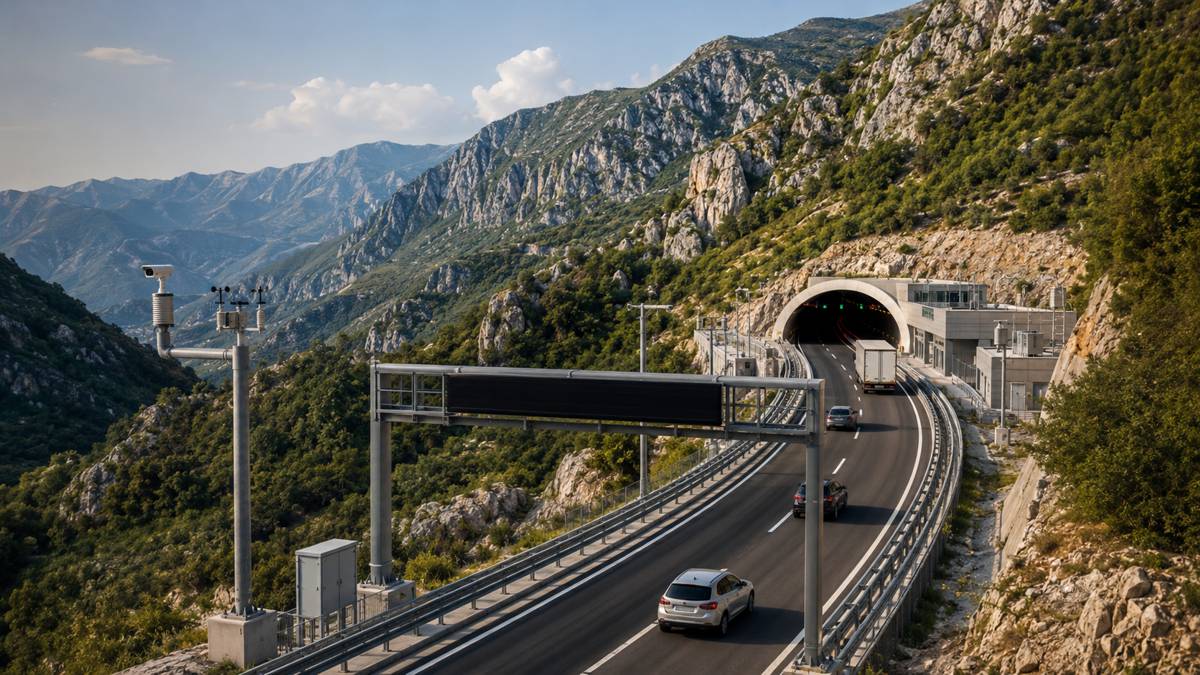
- Planned systems include traffic data collection, road weather monitoring, tunnel and traffic control, road-user information services and a national traffic management centre.
- Real-time information is expected to improve incident detection, emergency coordination and everyday network management.
- Cybersecurity and interoperability will form part of the infrastructure rather than being treated as later additions.
- The programme supports Montenegro’s alignment with EU transport standards and its wider digital transition.
Building One Operational View of the Road Network
The national traffic management centre is likely to become the programme’s most strategically important component. Roadside devices can count vehicles, identify deteriorating weather or detect disrupted traffic, but their value remains limited if the information stays within separate organisational or technical systems. A national centre provides the operational layer through which data can be combined, interpreted and distributed to the agencies responsible for roads, tunnels, emergencies and public information.
This changes the role of the road authority. Instead of responding primarily to reports from road users or maintenance teams, operators can develop a live view of traffic conditions and identify emerging incidents earlier. The centre can support decisions on warnings, traffic control, emergency dispatch and the prioritisation of field resources, provided the data and communications architecture is sufficiently reliable.
The concept is consistent with the direction of travel across the Western Balkans. The Transport Community has identified traffic control centres, coordinated incident response and trained ITS personnel as important elements of regional deployment. Its earlier technical work also emphasised that technology alone is insufficient, with planning, operational procedures and maintenance expertise required alongside the equipment. Transport Community guidance places particular importance on the ability of authorities to anticipate network demands and coordinate their response.
For Montenegro, that institutional dimension will be decisive. Monteput brings motorway and tunnel operating experience, while the Transport Administration manages the wider state road network. The Ministry of Transport must ensure that the resulting platform connects these responsibilities without creating another technological silo. Clear ownership of data, operating decisions, maintenance and system upgrades will be as important as the initial procurement.
A Broader Market Than Roadside Hardware
The €30 million programme represents a multidisciplinary infrastructure opportunity. Traffic sensors, automatic incident detection, cameras, weather stations, variable-message systems and communications equipment will form the visible part of the deployment. Behind them will sit data platforms, control-room applications, networking, storage, interfaces, cybersecurity controls and software for presenting information to operators and road users.
Contract packaging will determine how accessible the programme becomes to specialist suppliers. A single systems-integration contract could simplify accountability, while divided packages might allow greater participation by companies specialising in meteorological sensing, tunnel systems, communications or transport software. Whichever model is chosen, the interfaces between packages will require unusually careful definition because operational performance will depend on the complete chain from roadside detection to decision and public communication.
The programme is also likely to create a longer-term services market. Intelligent transport infrastructure requires calibration, communications support, software updates, cybersecurity monitoring, component replacement and technical training throughout its operating life. Procurement based too narrowly on initial capital cost could leave authorities exposed to proprietary systems, expensive upgrades or equipment that becomes difficult to support.
Whole-life evaluation is therefore particularly important. Montenegro will need to consider open interfaces, data portability, supplier support arrangements, spare-part availability and the ability to add future services without rebuilding the core platform. For bidders, evidence of interoperability and long-term operational support may prove as important as the specifications of individual devices.
Extending Digital Management Beyond the Motorway
Montenegro is not beginning from zero. Its strategy for developing ITS in road transport covered the 2022 to 2026 period, while the first Smokovac to Mateševo section of the Bar to Boljare motorway already incorporated ITS equipment. A Transport Community regional mobility report placed the value of that motorway technology at approximately €25 million. The regional strategy report also noted the need for investment assessment and further deployment on trunk and regional roads.
The new financing is important because it can extend digital management beyond one modern motorway corridor. A national road system contains many different operating environments, from high-standard tunnels and controlled-access roads to older trunk routes exposed to weather, congestion and mixed traffic. Bringing these environments into a shared information architecture offers a more complete picture of national mobility.
That wider coverage should also support better infrastructure planning. Consistent traffic data can improve understanding of vehicle volumes, seasonal variations, congestion patterns and network demand. These insights can influence maintenance programming, junction improvements, safety interventions and the preparation of future road investments.
Accurate network data also has commercial relevance. Freight operators, coach companies, tourism businesses and logistics providers all benefit from more dependable information about journey conditions and disruption. Montenegro’s road network serves domestic movement as well as connections between its Adriatic coast, neighbouring states and the wider Western Balkans, making reliable journey information part of the country’s economic infrastructure.
Safety Through Faster Detection and Better Coordination
Intelligent transport systems cannot remove every cause of road collisions, but they can reduce the time between an incident occurring and the network responding. Traffic monitoring may identify stopped vehicles, sudden speed reductions or abnormal flows. Tunnel systems can detect smoke, obstructions and other hazardous conditions, while road-user information platforms can warn approaching motorists before they encounter the affected section.
The operational sequence matters. Detection must trigger verification, classification, dispatch and public communication through defined procedures. If those links are well designed, police, emergency medical services, fire services, maintenance contractors and traffic operators can work from a common understanding of the incident rather than relying on fragmented reports.
Montenegro’s investment sits within a broader regional effort to apply the Safe System approach. The Transport Community’s Next Generation Road Safety Action Plan for 2025 to 2027 calls for stronger safety management, safer infrastructure, better protection of road users, safer vehicles and closer institutional cooperation. In July 2026, Montenegro also presented regional partners with developments covering legislation, emergency response, 112 and eCall implementation, and road safety data collection. That regional work shows how digital infrastructure can connect roadside operations with emergency systems and national safety policy.
ITS should therefore be treated as one layer of road safety rather than a substitute for engineering, enforcement or emergency care. Its strongest contribution comes from improving the evidence available to those other functions. Data can help authorities identify recurring incident locations, assess the effects of interventions and direct resources towards risks that might otherwise remain obscured.
Weather Intelligence Becomes Infrastructure Intelligence
Road meteorological monitoring is particularly relevant to Montenegro’s geography. Coastal, central and mountainous areas can experience markedly different conditions, while higher routes may face snow, ice, fog, heavy rainfall and rapid temperature changes. Localised sensor data can provide a more useful operational picture than a general weather forecast because it records conditions at the road surface and within the immediate transport corridor.
That information can guide winter maintenance, warning systems, speed management and temporary restrictions. It can also help road operators deploy crews and materials more selectively, improving readiness without treating the entire network as if it were experiencing identical conditions. Over time, archived observations can reveal patterns that inform maintenance specifications, drainage work, slope management and investment in vulnerable sections.
Climate resilience adds another layer to the business case. Extreme rainfall, flooding, heat, wildfire risk and slope instability can affect both the availability and condition of road infrastructure. The EBRD programme includes early-warning capabilities intended to improve the response to weather events, but effective implementation will depend upon links between road sensors, weather services, maintenance organisations and emergency authorities.
Monitoring does not prevent physical damage by itself. It helps operators recognise changing risks sooner and manage the network while engineering inspections, drainage improvements, slope protection and asset renewal address underlying vulnerabilities. The greatest value will arise when live information is connected to asset-management decisions rather than confined to a control-room display.
Cybersecurity Moves Into the Road Engineering Brief
A connected road network introduces digital dependencies that conventional highway projects did not need to manage. Communications links, field devices, servers and control platforms can all become potential points of disruption. If a system controls tunnel operations, communicates safety information or supports emergency response, its availability and integrity become matters of physical safety as well as information security.
The EBRD project explicitly includes stronger cybersecurity and alignment with international standards. This should influence the technical architecture from the outset. Network separation, access control, secure remote maintenance, logging, backup arrangements, incident recovery and disciplined software updating will need to form part of the design and acceptance process.
Procurement teams must also examine the supply chain behind the visible contractor. Roadside and control-room systems may incorporate equipment, firmware, cloud services and software libraries supplied by several organisations. Authorities need to know how vulnerabilities will be reported, who is responsible for remediation and how security patches will be applied without disrupting critical operations.
This requirement creates opportunities for cybersecurity specialists but also raises the competence threshold for traditional road contractors. Consortia may need to combine civil engineering, electrical systems, telecommunications, software integration and cyber-risk capabilities. The most credible delivery teams will be those able to demonstrate that safety, operational continuity and security have been engineered as a single system.
Interoperability Will Determine the Programme’s Lasting Value
Modern transport systems generate data in many formats and through equipment from different manufacturers. Without common interfaces, a national traffic management centre can become an expensive collection of separate screens. Montenegro’s objective of enabling different parts of the network to share information therefore depends on technical interoperability and common operating rules.
Standards-based procurement can reduce that risk. Specifications should define the information that must be exchanged, its quality, timing and availability, while avoiding unnecessary dependence on a single supplier. This will make it easier to add devices, integrate future road sections and connect external services as the network develops.
Interoperability also has a regional dimension. Montenegro’s roads do not operate in isolation from neighbouring transport corridors, freight movements or European traveller-information systems. Alignment with the EU acquis can support more consistent data exchange and operating practices, strengthening Montenegro’s position within the wider European transport environment.
The EU integration objective is commercially significant because it sets the direction for future procurement. Suppliers experienced in European ITS standards, tunnel operations, traffic data services and cross-border information exchange may find the market increasingly accessible. Montenegrin institutions and local engineering companies, meanwhile, have an opportunity to develop skills that can be applied to other national and regional programmes.
Delivery Capacity Is Part of the Investment
The ministries and state road bodies will be responsible for more than managing a construction contract. They will need to define operational requirements, oversee systems integration, test performance and establish procedures for daily use. Training must cover operators, engineers, maintenance personnel, emergency partners, IT teams and managers responsible for data and security.
Institutional continuity will matter because intelligent infrastructure evolves after commissioning. Software changes, traffic patterns alter and new equipment must be integrated. A system that cannot be adapted by the client risks losing effectiveness long before its physical components reach the end of their lives.
Performance indicators should consequently focus on operational outcomes as well as installation. Relevant measures could include system availability, incident detection times, time taken to issue warnings, response coordination, data quality and the percentage of the network visible to operators. These indicators would allow Montenegro to evaluate whether the technology is producing measurable benefits.
The financing builds on a substantial EBRD presence in the country. The Bank reported that it had invested €1.1 billion across 114 Montenegrin projects by the time of the ITS announcement. It also committed a record €215 million across 18 projects in 2025, including major transport and energy investments. The EBRD’s 2025 investment review illustrates how digital roads fit within a broader programme covering connectivity, resilience and economic modernisation.
A Digital Layer for Montenegro’s Next Transport Phase
Montenegro is simultaneously extending important physical corridors and strengthening the systems used to operate them. The EBRD has previously backed the next section of the Bar to Boljare highway, part of the country’s connection to the extended Trans-European Transport Network. Adding a national digital operating layer can help ensure that new and existing roads function as a coordinated network rather than as a succession of independently managed assets.
This distinction matters for future investment. Better traffic and incident data can improve project appraisal, demonstrate where capacity or safety work is needed and provide evidence about the performance of completed schemes. It may also enable authorities to make greater use of active traffic management before considering more expensive physical interventions.
Successful delivery would give Montenegro infrastructure that can accommodate further services, including enhanced freight information, connected-vehicle data and more sophisticated asset monitoring. Those possibilities should not distract from the immediate priorities of safety, weather resilience and reliable operations, but they strengthen the case for an extensible architecture.
The €30 million loan is therefore best viewed as investment in national operating capability. Roadside equipment will be necessary, but the durable asset will be the ability to turn distributed information into coordinated action. If Montenegro combines sound procurement with institutional capacity, interoperability and sustained maintenance, the programme can provide a practical model for smaller road administrations seeking to modernise an entire network.
Key Industry Questions
- What equipment is likely to be procured under Montenegro’s ITS programme? The announced scope covers traffic data collection, road meteorological monitoring, traffic and tunnel control, road-user information and a national traffic management centre. This may translate into traffic counters, cameras, weather stations, detection equipment, communications links, operator workstations, data platforms and roadside information systems. Detailed quantities, technologies and contract packages will depend on the procurement documents. Suppliers should also expect requirements concerning installation, testing, systems integration, cybersecurity, training and maintenance rather than a simple purchase of standalone hardware.
- Why does Montenegro need a national traffic management centre? A national centre can consolidate information that would otherwise remain divided between roads, tunnels, motorway operations and emergency organisations. It allows operators to identify incidents, understand their wider network effects and coordinate warnings or responses from a common operational picture. Its value depends on reliable data, clear decision-making authority and well-rehe-rehearsed procedures. The centre should therefore be considered an organisational capability supported by technology, rather than merely a control room containing screens and software.
- How will intelligent transport systems improve road safety? ITS can accelerate the detection of stopped vehicles, congestion, hazardous weather and tunnel incidents. Operators can verify the problem, alert emergency organisations and warn approaching road users sooner than would be possible through manual reporting alone. The data collected can also help identify recurring collision patterns and evaluate safety measures. These systems work most effectively alongside safe road design, vehicle standards, enforcement, speed management and emergency care, all of which form part of the Safe System approach supported across the Western Balkans.
- What climate-resilience benefits can the programme deliver? Road weather stations and early-warning tools can help authorities recognise ice, heavy rainfall, low visibility and other local hazards before they cause wider disruption. Live data can improve the deployment of winter maintenance and emergency resources, while long-term records can inform drainage, slope protection and renewal programmes. The technology will not replace physical adaptation, particularly where roads face flooding or geotechnical risk. Its role is to improve situational awareness and help agencies make faster, more targeted operational and investment decisions.
- What are the principal cybersecurity risks for connected roads? Potential risks include unauthorised access, disruption of communications, manipulation of traffic information, compromised remote-maintenance connections and software vulnerabilities in field equipment or central platforms. The consequences can extend beyond data loss if affected systems support tunnel safety or emergency response. Montenegro will need security controls covering system architecture, identities, network separation, monitoring, backups, patching and recovery. Procurement contracts should clearly allocate responsibility for vulnerability disclosure, updates and cybersecurity support throughout the equipment’s operating life.
- How important is interoperability to the project? Interoperability will determine whether Montenegro gains a coherent national system or a collection of incompatible installations. Devices and software must exchange information with the traffic management centre and, where appropriate, with emergency, meteorological and regional transport services. Open interfaces and recognised standards can make future expansion easier and reduce dependence on one supplier. Contract specifications should address data formats, communications protocols, performance, ownership and access so that interoperability can be tested during delivery rather than assumed.
- What opportunities does the project create for contractors and technology suppliers? The programme is relevant to ITS integrators, electrical and communications contractors, traffic-engineering consultancies, tunnel-system specialists, meteorological technology providers, software developers, control-room suppliers and cybersecurity companies. Local partners may contribute installation capacity, civil works, maintenance and institutional knowledge, while international firms can bring experience with European standards and large-scale integration. The strongest propositions are likely to combine proven technology with training, long-term support and credible plans for integrating new systems with Montenegro’s existing road infrastructure.
- How should Montenegro evaluate bids for an ITS programme? Evaluation should consider whole-life performance rather than hardware prices alone. Authorities will need to examine system availability, interoperability, cybersecurity, maintenance arrangements, software licensing, upgrade paths, spare parts, training and the bidder’s ability to integrate multiple technologies. Clear acceptance tests can establish whether data moves correctly from field devices to operators and public information channels. Contracts should also avoid unnecessary proprietary restrictions that could make later expansion expensive or prevent the government from accessing and reusing its own transport data.
- How does the investment support Montenegro’s EU integration? The programme supports closer alignment with EU transport, road-safety, data-management and interoperability requirements. It can improve the country’s ability to manage routes connected to the wider European and Western Balkan transport networks while strengthening administrative and technical capability. Alignment is not limited to purchasing compatible technology. It also requires appropriate legislation, institutional responsibilities, operational procedures and competent staff. Progress in these areas can make Montenegro’s infrastructure more consistent with European practices and improve the preparation of future transport investments.
Strategic Takeaways
- Montenegro’s €30 million ITS programme creates a market spanning roadside technology, communications, software, cybersecurity, systems integration and long-term support.
- The national traffic management centre will only deliver its full value if agencies establish shared data, clear authority and coordinated emergency procedures.
- Weather monitoring and early-warning capability can connect immediate operational decisions with longer-term climate adaptation and asset management.
- Open standards, data portability and whole-life procurement will be essential to avoiding vendor dependence and preserving the network’s ability to expand.
- Alignment with European transport practices can strengthen road safety while building technical capacity that supports future regional connectivity and investment.