ANCEL Brings Proactive Battery Management To Commercial Vehicles
The portable jump starter has always been a grudge purchase, bought in the expectation of failure and forgotten in a glovebox until the morning an engine refuses to turn over. ANCEL’s expansion of its Super Starter line-up is interesting less for the hardware itself than for what it says about where reliability thinking is heading, because the Shenzhen firm is trying to move the humble starting device from the reactive edge of vehicle care into its permanent, always-on core.
The pitch behind the new BS Series is that most starting failures are not sudden events but slow declines, driven by battery ageing and the short, stop-start journeys that never fully recharge a 12-volt battery, and that a device left permanently under the bonnet can manage that decline rather than merely rescue the driver once it has run its course. For a trade readership that spends heavily on uptime, that reframing matters more than another emergency gadget would.
It matters because the component in question is the single most reliable cause of unreliability on the road. Germany’s ADAC, Europe’s largest motoring organisation, attributed roughly 44 per cent of its 2023 breakdown call-outs to the 12-volt battery, a figure echoed by breakdown services across the UK, North America and Australia, where the battery consistently tops the list of reasons a vehicle stops moving.
ANCEL, founded in 2013 and best known for OBD diagnostic scanners sold to more than ten million users through Amazon, Walmart and its own channels, is not a heavy-plant supplier, and the BS Series is aimed at passenger cars through to light commercial diesel rather than the excavators and articulated haulers that define a construction site. Even so, the underlying argument, that starting reliability should be engineered and monitored rather than left to chance, tracks a much larger and more valuable shift already underway across professional fleets.
Briefing
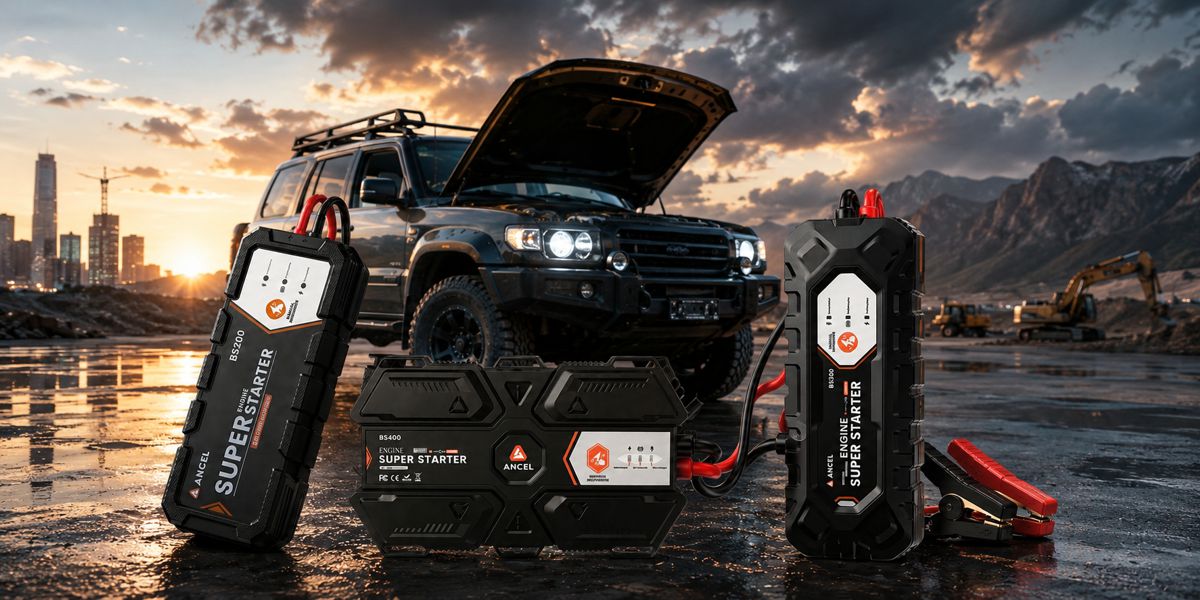
- ANCEL has expanded its Super Starter line-up with the BS Series, a permanently installed under-bonnet supercapacitor module offering the BS200 (up to 700A peak, engines to 3.0L), BS300 (up to 1000A, to 3.5L) and BS400 (up to 1300A, to 6.0L for diesel and light commercial use).
- The device uses supercapacitor rather than lithium chemistry, is rated by ANCEL for more than 500,000 cycles and operation from -40 to 80 degrees Celsius, and carries no onboard lithium cell, reducing storage and disposal risk.
- Rather than replacing the vehicle battery, the module rapidly stores energy from it to deliver high-current cranking support, which ANCEL says reduces battery stress and can extend primary battery life by up to three times.
- Battery health is monitored through the ANCEL App, positioning the product as a condition-monitoring tool that flags decline early rather than a purely emergency device.
- The launch brings a supercapacitor starting concept, already proven in heavy fleets by specialists such as Skeleton Technologies, Ioxus and Eaton, down into the mass passenger and light-commercial market at consumer price points.
The Economics Of A Vehicle That Will Not Start
For a private motorist a dead battery is an inconvenience; for anyone running vehicles commercially it is a cost that rarely appears as its own line in a budget yet compounds relentlessly. Data reported by FleetNet America and cited widely across the North American fleet sector puts the cost of unplanned commercial vehicle downtime at roughly 448 to 760 US dollars per vehicle per day, a figure that captures idle driver hours, lost or delayed loads, expedited repairs and towing rather than just the price of a new battery.
When the failure is something as mundane and as preventable as a starting fault, that cost feels particularly avoidable, and it is precisely the category of failure that a permanently fitted, self-monitoring starting aid is designed to remove from the schedule. The commercial case for the BS400, ANCEL’s heaviest unit, rests on exactly this logic for operators of vans, pickups and light commercial diesels who cannot afford a no-start morning.
Cold weather sharpens the problem considerably, which is why the technology has historically taken root in operators exposed to hard winters. Figures cited by the American Automobile Association indicate a battery can shed around a third of its cranking strength at freezing point and more than half in deeper cold, so a battery that limps through autumn can fail outright on the first genuinely cold morning.
Short-distance duty cycles make this worse, because a battery that is never driven far enough to recharge fully sits permanently below par and ages faster. A device that carries the peak cranking load, drawing stored energy from supercapacitors rather than dragging it out of a tired battery, addresses both the seasonal spike and the slow structural decline at once, which is the more valuable of the two effects for anyone trying to plan maintenance rather than react to it.
Why Supercapacitors Change The Calculation
The distinction that makes the BS Series worth attention is chemistry. A supercapacitor stores energy physically rather than through the chemical reactions that power a lead-acid or lithium battery, and that difference produces a set of properties that suit engine cranking almost ideally. Supercapacitors deliver very high current in short bursts, recharge in seconds rather than hours, tolerate extreme temperatures that flatten conventional batteries, and endure hundreds of thousands to a million charge cycles with little degradation.
ANCEL rates the BS Series for more than 500,000 cycles and for operation from -40 to 80 degrees Celsius, and while the firm’s figures sit below the very top of what specialist manufacturers claim, they place the product firmly within an established engineering category rather than at its speculative edge. The absence of an onboard lithium cell also removes the fire, storage and disposal concerns that dog portable lithium jump packs, a point that carries weight for fleets managing devices at scale and for depots thinking about warehousing risk.
This is not a new idea so much as a newly accessible one. Supercapacitor engine-start modules have been developed over more than a decade by specialists including Maxwell Technologies, which introduced an ultracapacitor start module for commercial trucks as early as 2011, alongside Ioxus, Eaton and Skeleton Technologies, the last of which bills itself as the world’s largest supercapacitor manufacturer.
Their modules, marketed under names such as SkelStart and uSTART, are already relied upon by haulage operators, bus fleets, marine users and mining groups, with the Canadian Malartic gold operation among the documented adopters, precisely because a supercapacitor is largely indifferent to the cold that cripples lead-acid batteries and can outlast the vehicle it is fitted to. Those products are engineered for large diesel engines and priced accordingly. ANCEL’s contribution is not to invent the approach but to shrink and cost-reduce it for the far larger population of passenger cars, SUVs, pickups and light commercial vehicles, which is where the addressable volume, and much of the untapped commercial value, actually sits.
Mapping The Range To The Vehicle Parc
The three-model structure reads as a deliberate attempt to match cranking capacity to the shape of the real-world fleet rather than to sell a single unit to everyone. The BS200, rated at up to 700A peak and specified for 12-volt petrol or diesel engines up to 3.0 litres, targets daily passenger cars and light SUVs, the segment where short journeys and infrequent long runs make premature battery decline most common.
The BS300 steps up to 1000A and 3.5 litres for larger SUVs and pickups, while the BS400 reaches 1300A and 6.0 litres and is explicitly positioned for diesel vehicles and light commercial applications, the users for whom a failed start translates directly into lost working hours. ANCEL sensibly notes that real performance depends on battery condition, temperature and vehicle specification, and that the listed displacement figures are a guide rather than a hard boundary, with suitability ultimately governed by whether a given engine’s cranking current falls within the module’s capability.
For an infrastructure and construction audience the honest read is that this range stops at the light commercial threshold and does not reach the heavy plant that defines a job site. A 6.0-litre ceiling covers pickups, crew-cab utilities, service vans and light tippers, the support vehicles that keep a project moving, rather than the machines doing the earthmoving.
That is not a weakness so much as a definition of scope, and it is a large and commercially serious scope in its own right, because the light commercial vehicles that shuttle crews, tools and materials are often the ones whose reliability nobody plans around until one fails. Positioned honestly, the BS Series is a fleet-support product for the vehicles at the edges of a construction operation rather than a solution for its core equipment, and it is most persuasive when read that way.
From Emergency Fix To Condition Monitoring
The feature that most clearly separates the BS Series from a conventional booster is the least glamorous one, namely that it talks. Battery health is monitored through the ANCEL App, which turns a passive lump of hardware into a source of the early warning that a starting battery almost never gives on its own. A lead-acid battery typically offers no useful notice of its own decline until the morning it fails, and the entire value of monitoring lies in converting that binary surprise into a gradual, visible trend that an owner or a fleet manager can act on during a planned service window rather than at the roadside.
This is the same logic that has driven professional fleets away from reactive maintenance and towards predictive approaches built on telematics and continuous diagnostics, where the object is to catch a failing component weeks before it strands a vehicle.
That parallel is the real significance of the announcement. The professional fleet sector has spent the past decade learning that catching failures early is dramatically cheaper than fixing them after the fact, with the gap between a scheduled repair and an emergency one running to several times the cost once towing, expedited labour and lost loads are counted.
ANCEL is essentially packaging a slice of that philosophy, focused narrowly on the most common failure point, into a device cheap enough for a private owner and simple enough to fit and forget. Combining cranking support that reduces battery stress with monitoring that surfaces decline early gives the product a coherent story: it is trying to keep the battery healthier for longer and to remove the element of surprise from the one component most likely to cause a breakdown. Whether the app’s diagnostics prove genuinely predictive or merely descriptive will determine how much of that promise is realised, and it is the aspect most worth scrutinising in independent testing.
Where Commercial Value Is Moving
Taken together, the BS Series is best understood not as a better emergency tool but as a small, early example of always-on reliability hardware migrating from specialist fleets into the mass market. The commercial value in vehicle care is steadily shifting away from the reactive repair, where margins are thin and the customer is already stranded, towards the systems and services that prevent the failure and the data that anticipates it.
Supercapacitor starting occupies a useful position in that shift because it attacks the statistically dominant failure mode with a technology that is durable, temperature-tolerant and largely maintenance-free, and because it lends itself naturally to the connected, monitored model that the rest of the vehicle is already moving towards. ANCEL’s role is to prove that this can be done at consumer scale rather than to lead the underlying engineering, which is a commercially astute place to stand.
For operators the practical guidance is measured rather than urgent. Fleets already running light commercial diesels in cold climates or on punishing short-cycle duty have the clearest case to trial an under-bonnet supercapacitor module, since they carry the highest exposure to the exact failures it targets, and they are also best placed to judge the app’s monitoring against their own maintenance data.
The wider signal, though, applies well beyond ANCEL’s catalogue, because the direction of travel is unmistakable: the components that fail most often are becoming the components that are watched most closely, and the value is accruing to whoever can make that watching cheap, permanent and reliable. A device that quietly manages the least glamorous failure on the vehicle, and reports on it before it happens, fits that trajectory rather neatly.
Key Industry Questions
- How is a supercapacitor starter different from a portable lithium jump pack? A portable lithium jump pack is a separate battery the driver charges, stores and connects manually after a vehicle has already failed to start. ANCEL’s BS Series is fitted permanently under the bonnet and uses supercapacitors, which store energy physically rather than chemically. That allows very rapid recharge, strong performance in extreme heat and cold, and a rated life of hundreds of thousands of cycles with little degradation. Crucially it works before failure rather than after it, drawing energy from the vehicle battery to carry the peak cranking load and reduce stress on the battery itself. The practical effect is a shift from carrying a rescue device to running a permanent starting aid that also monitors battery condition.
- Does the module replace the vehicle’s existing battery? No. The BS Series works alongside the standard 12-volt battery rather than replacing it, which is consistent with how supercapacitor start modules generally operate. The vehicle battery still handles low, steady electrical loads and keeps the system charged, while the supercapacitor stores energy from it and releases a high-current burst during cranking. This division of labour is the point: cranking is the most demanding moment for a battery and the one most likely to expose age or cold weakness, so offloading it to a supercapacitor reduces the stress that shortens battery life. ANCEL frames the device as battery protection rather than battery replacement, and that positioning matters for how buyers should evaluate it.
- Is the technology proven, or is this an experimental product? The underlying approach is well established. Supercapacitor engine-start modules have been sold for commercial trucks since around 2011, with Maxwell Technologies, Ioxus, Eaton and Skeleton Technologies among the specialists supplying haulage, bus, marine and mining fleets. Those products are trusted specifically because supercapacitors tolerate the cold that flattens lead-acid batteries and can outlast the vehicle. What is newer is the migration of that concept into a low-cost, app-connected form aimed at passenger cars and light commercial vehicles. ANCEL is therefore applying a mature engineering category to a broader market rather than launching an untested idea, though the specific performance and monitoring claims of the BS units warrant independent verification.
- How relevant is this to construction and infrastructure operators? Its relevance is real but bounded. The heaviest unit, the BS400, is rated to 6.0 litres and light commercial use, which covers service vans, pickups, crew-cab utilities and light tippers rather than the excavators, loaders and haulers at the centre of a construction operation. For the support fleet that keeps projects supplied and staffed, a starting failure still causes lost hours and disrupted schedules, so the product addresses a genuine operational pain point at the edges of a site. Operators should treat it as a light-fleet reliability measure rather than a heavy-plant solution, and match the specification carefully to each vehicle’s cranking requirement rather than to displacement alone.
- What is the commercial case against unplanned starting failures? The case is downtime economics. Data reported by FleetNet America places the cost of unplanned commercial vehicle downtime at roughly 448 to 760 US dollars per vehicle per day, covering idle driver time, delayed loads, expedited repairs and recovery, not just the replacement part. Because the 12-volt battery is the single most common cause of breakdowns, a preventable starting fault is one of the easiest sources of that cost to design out. Anything that reduces no-start events and gives advance warning of battery decline converts an unpredictable roadside emergency into a planned, cheaper workshop task. That conversion, from surprise to schedule, is where a monitored starting aid earns its keep for a commercial operator.
- Why does cold weather make starting reliability a bigger issue? Cold reduces a battery’s ability to deliver current at exactly the moment an engine needs more of it, because cold oil and stiff mechanicals raise the cranking effort required. Figures cited by the American Automobile Association suggest a battery can lose roughly a third of its strength at freezing and more than half in harder cold. A battery already weakened by age or short-journey duty can pass through mild weather and then fail on the first sharp cold morning. Supercapacitors are far less affected by temperature and can release their stored charge regardless, which is why the technology first gained traction with operators in cold regions. For fleets in northern climates, seasonal starting failure is a predictable annual cost rather than bad luck.
- What should buyers scrutinise before adopting the BS Series? Three things stand out. First, the monitoring: whether the ANCEL App genuinely predicts decline early enough to act on, or simply reports current state, which determines how much of the proactive promise is real. Second, the fit and specification: cranking capacity should be matched to each engine’s actual current demand, since displacement is only a guide, and installation quality under the bonnet affects both performance and safety. Third, the durability claims in service: rated cycle life and temperature range are encouraging, but real-world results depend on vehicle condition and climate. As with any new category entrant, independent testing and fleet trial data will matter more than headline figures, and operators should pilot before committing at scale.
- Where is the wider market value in this shift heading? Value is moving from reactive repair towards prevention and the data that enables it. The professional fleet sector has already learned that catching failures early is several times cheaper than fixing them after a breakdown, which has driven investment into telematics, diagnostics and predictive maintenance. Devices that target the most common failure points with durable, connected hardware fit squarely into that trend. The commercial opportunity lies less in the starter itself than in the model it represents: permanent, monitored components that anticipate failure. Whoever can deliver that anticipation cheaply and reliably, across the mass market rather than only for premium fleets, is positioned where purchasing power in vehicle reliability is steadily concentrating.
Strategic Takeaways
- Starting failure is the most common and most preventable cause of vehicle breakdown, so hardware that manages the 12-volt battery proactively targets a genuine and quantifiable source of downtime rather than a marginal one.
- Supercapacitor starting is a mature technology proven in heavy fleets; the strategic development here is its migration to consumer and light commercial price points, which opens a far larger addressable market than the specialist segment ever could.
- For construction and infrastructure operators the product’s scope is the support fleet, not the plant, so its value should be assessed against van, pickup and light diesel reliability rather than heavy equipment.
- The decisive feature is condition monitoring, not cranking power, because converting an unpredictable failure into a visible trend mirrors the reactive-to-predictive maintenance shift that already governs professional fleet economics.
- Commercial value in vehicle reliability is concentrating around prevention and data; permanent, monitored components that anticipate failure represent where purchasing power is heading, and this launch is an early mass-market marker of that direction.