JCB Hydromax Sets 368mph Record Ahead of FIA Hydrogen World Record Bid
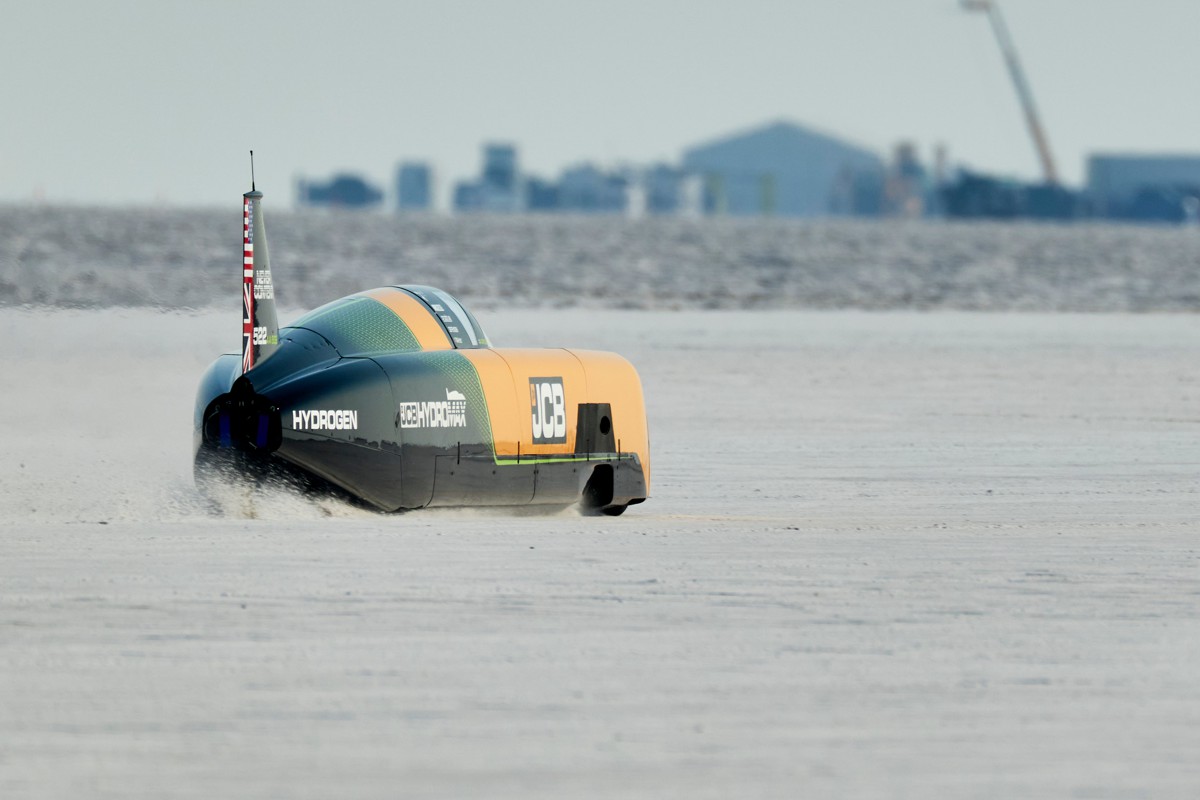
JCB’s Hydromax streamliner has clinched a Southern California Timing Association speed record on the Bonneville Salt Flats, averaging 368.347mph across two runs and breaking a class benchmark that had stood since 2010. The headline is a motorsport one, but the significance for construction, plant procurement and off-highway investment sits well beyond the timing beams.
The car is powered by two of JCB’s own production-based hydrogen internal combustion engines, the same architecture the company now type-approves and manufactures for its excavators and backhoe loaders, and the record is best read as a full-power endurance demonstration of a commercial powertrain rather than a one-off publicity stunt.
That distinction is what should hold the attention of fleet buyers and infrastructure owners weighing their decarbonisation options. JCB is the first construction equipment manufacturer in the world to bring a fully type-approved hydrogen combustion engine into series production, and it has chosen to prove the technology’s headroom in the most punishing way available, at sustained load, in thin desert air, in front of a global audience.
The timing is deliberate. The record arrives days before the company opens a $500 million factory in Texas and pushes deeper into the United States market, and it comes while most rivals are still hedging their bets across multiple fuels and consortium research. Against that backdrop, a salt-flats number becomes a commercial signal about where one of the sector’s largest privately owned manufacturers believes the diesel-replacement market is heading.
Briefing
- JCB’s Hydromax hydrogen streamliner set an SCTA Blown Gas Streamliner class record at Bonneville, averaging 368.347mph and surpassing the previous mark of 348.342mph set by the Spectre Streamliner in 2010.
- The car is driven by two production-based JCB hydrogen combustion engines tuned to 800hp each, sharing their core architecture with the 55kW (74hp) unit JCB fits to its commercial 3CX Hydrogen backhoe loader.
- The record precedes an outright FIA world record attempt the following week, with the twin engines to be turned up towards a combined 1,600hp.
- JCB’s wider hydrogen programme, backed by a £100 million investment, has reached full production, with the 3CX Hydrogen carrying EU type approval secured across eleven European licensing authorities.
- The speed campaign coincides with the opening of JCB’s $500 million, one-million-square-foot San Antonio factory, the largest investment in the company’s history, with production scheduled to begin in October 2026.
Reading the Numbers as an Engineering Argument
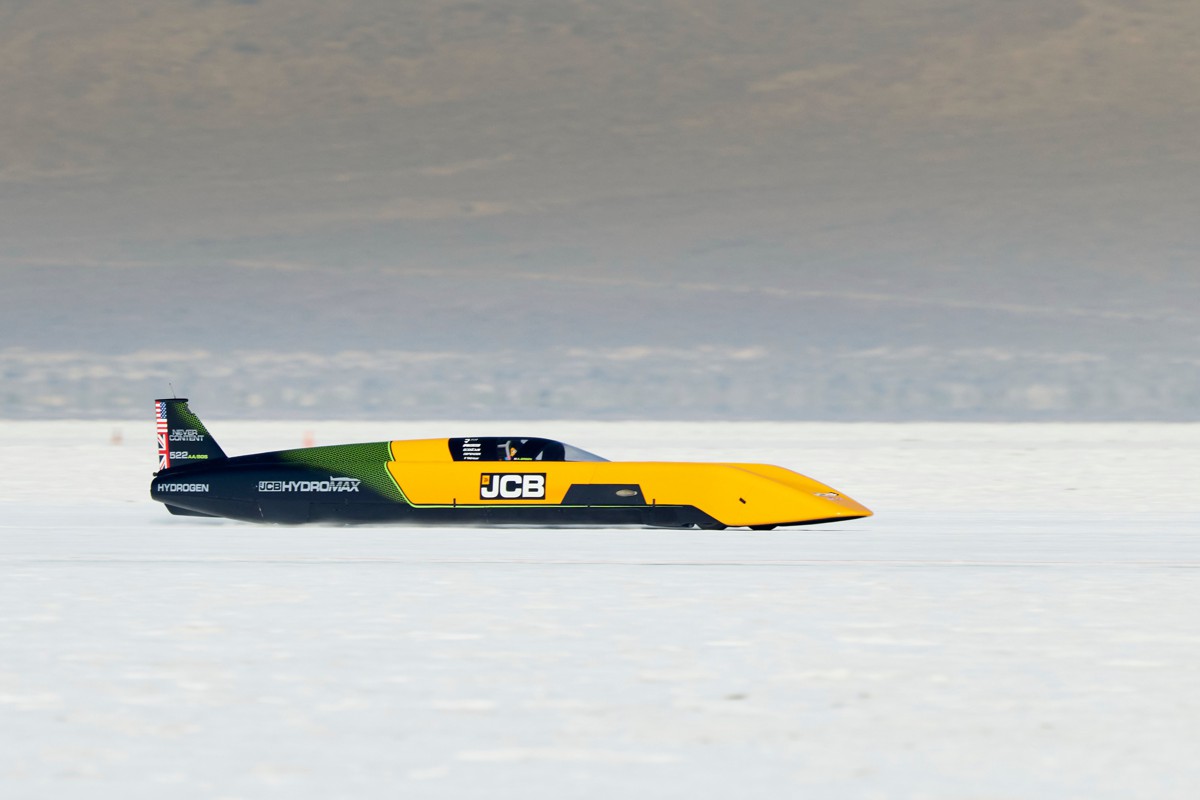
The raw figures repay closer inspection. The 32-foot Hydromax recorded 367.141mph on the first day and 369.554mph on the second, giving the 368.347mph average that Bonneville’s two-run format requires. That result surpasses the 348.342mph Spectre Streamliner mark from 2010, the first time in sixteen years the class record has fallen, and it also eclipses the 350.092mph that JCB’s diesel-powered Dieselmax set on the same salt in 2006. For a company whose commercial argument rests on hydrogen combustion matching diesel rather than compromising against it, beating its own celebrated diesel benchmark with the same engineering discipline is a pointed piece of evidence.
The more important number for plant buyers is the relationship between the race engines and the production ones. Each of the two power units has been tuned to 800hp, yet they share their architecture with the 4.8-litre hydrogen combustion engine that JCB fits to production excavators and to the 3CX Hydrogen backhoe loader at a far more modest 74hp. The point of running that architecture at more than ten times its commercial output, for repeated high-speed passes, is to demonstrate mechanical margin and thermal robustness under conditions no working site will ever impose. Reliability and predictable service life are the qualities that decide off-highway purchasing, far more than peak performance, and a durable showing at 369mph is a durability story dressed as a speed story.
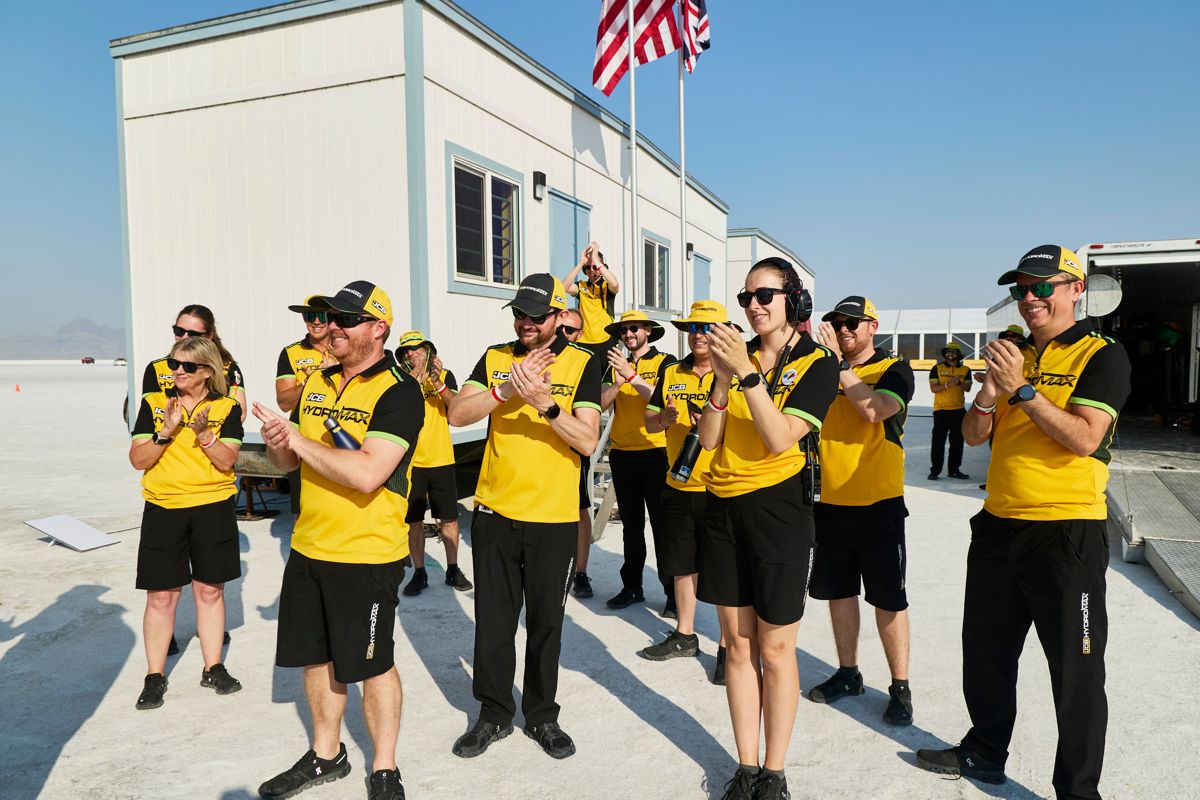
Lord Bamford, JCB’s chairman, framed the result in exactly those terms, describing it as evidence of engine capability rather than sporting achievement. “To reach 368.347mph is a fantastic achievement for the whole JCB Hydromax team. It shows just what JCB’s hydrogen engines are capable of ahead of our outright FIA world record attempt. This project is about proving that hydrogen power can perform at the very highest level with zero emissions, and today’s result is powerful evidence of that.”
The reference to zero emissions is not incidental. It restates the commercial proposition, that hydrogen combustion delivers diesel-equivalent work without carbon at the point of use, in the language of a motorsport headline that will travel far beyond the trade press.
From the Salt to the Sales Order
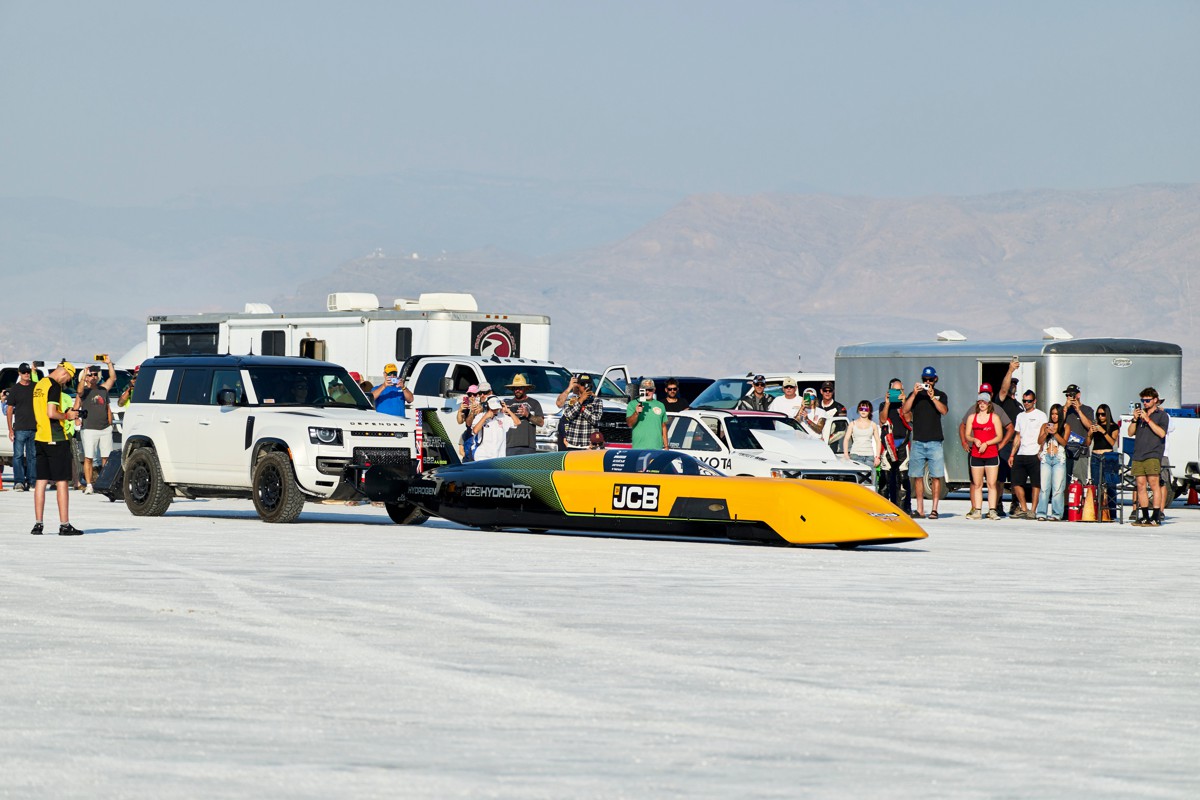
What separates this campaign from a conventional record attempt is that the underlying product is already on sale. JCB’s hydrogen combustion engine secured commercial type approval in Europe in early 2025, with the Netherlands’ vehicle authority RDW issuing the first certification and a further set of national authorities following, covering Great Britain, Germany, France, Spain, Belgium, Poland, Finland and others.
The 3CX Hydrogen backhoe loader, launched in production form in mid-2026, is billed as the world’s first production backhoe to use a fully approved hydrogen combustion engine, and JCB has produced more than 150 engines through its evaluation phase to reach that point. The land speed programme therefore sits on top of a live commercial platform rather than a laboratory prototype.
That regulatory position is a genuine competitive moat, and it is worth naming precisely because approvals, not press releases, determine when zero-emission machines can actually be sold and financed. Full EU engine type approval for non-road mobile machinery is a slow and unglamorous achievement, and it has allowed JCB to pair the 3CX Hydrogen with a conventional commercial offer, including a three-year operating lease and service contract through JCB Finance.
For infrastructure contractors and quarry operators who have watched a decade of zero-emission concepts arrive without a purchase order attached, the combination of a certified engine, a financed machine and a factory building it changes the nature of the conversation.
The Strategic Case for Combustion Over Batteries and Fuel Cells
JCB’s wager is that combustion, rather than electrification, is the practical route to zero-carbon construction power for high-utilisation work. The reasoning is operational rather than ideological. A hydrogen combustion engine can be refuelled on site in minutes using a mobile refueller, sidestepping the extended charging periods that constrain battery-electric machines on remote or intensive sites, and it retains a duty cycle familiar to operators and service technicians alike.
JCB has stressed that its 3CX Hydrogen feels the same to run as its diesel sibling, and that the approach relies on established diesel manufacturing processes and components while avoiding dependence on the rare earth materials associated with battery drivetrains.
This is a supply-chain argument as much as an emissions one, and it is where the commercial logic becomes clearest. By building hydrogen engines on architecture and tooling shared with its diesel lines, JCB protects the manufacturing base, the dealer network and the aftermarket economy that its business already depends on, while removing carbon at the point of use.
Battery-electric and fuel-cell pathways, by contrast, require new supply chains, new service skills and materials whose sourcing carries its own geopolitical exposure. For a manufacturer that sells intensively used machines into markets where charging infrastructure remains thin, combustion offers a decarbonisation route that disturbs the existing business model the least, and the Bonneville result is the most visible proof yet that the physics supports the strategy.
A Competitive Field That Is Still Hedging
The wider engine market makes JCB’s conviction look increasingly distinctive. Cummins has taken a fuel-agnostic route with its HELM platform and next-generation X15, an engine spanning roughly 400 to 700hp that can run on diesel, biofuels or hydrogen from a common base, deliberately keeping several fuel pathways open for construction, agriculture and mining customers.
Deutz and Liebherr, meanwhile, have pursued hydrogen combustion through the German-led PoWer research consortium alongside Mahle and a group of universities and suppliers, backed by public funding and framed as a multi-year investigation rather than a product launch. Komatsu has spread its bets differently again, testing a hydrogen combustion mining truck while also developing fuel-cell systems with GM and Toyota.
Set against that pattern of hedging, JCB’s position is unusual in both its commitment and its timing. Where competitors are keeping optionality across fuels and chemistries, JCB has picked a single path, taken it through full type approval, put it into series production and is now demonstrating it at the extreme edge of the performance envelope.
The commercial reading is that JCB is trying to convert a first-mover regulatory and manufacturing lead into market share before the field consolidates, and a global speed record is an efficient way to plant that flag with buyers and investors who may not follow the trade certification announcements. Whether hydrogen combustion becomes the dominant off-highway pathway or one of several, the manufacturer that reaches production and approval first captures the early orders, the reference sites and the financing relationships that shape a market’s direction.
The American Dimension and the Factory Behind the Record
The choice to chase the record on American salt is bound up with the largest commercial commitment in JCB’s history. The company is completing a $500 million factory in San Antonio, Texas, a project it doubled in scope to one million square feet after the United States introduced fresh tariffs on imported goods, with production of Loadall telescopic handlers and access equipment scheduled to begin in October 2026 and around 1,500 jobs attached. A land speed record set on US soil, in front of a US motorsport audience, is a carefully placed piece of brand-building for a British manufacturer stepping up its American manufacturing footprint at a moment of trade friction.
The San Antonio investment also reframes the hydrogen campaign as part of a growth strategy rather than a technology showcase in isolation. JCB is expanding physical capacity in its most important growth market while simultaneously demonstrating the powertrain it hopes will define the next generation of that market’s machines.
The two moves reinforce one another. A factory signals long-term commitment to American customers, and a record signals that the company arriving in Texas is one prepared to prove its engineering at the highest level. For US infrastructure contractors weighing future fleet decisions, the message is that JCB intends to be both a local manufacturer and a serious contender in the zero-emission transition.
What Is Riding on Next Week’s FIA Attempt
With the SCTA challenge banked and the class record secured, the team’s focus now turns to an outright world record bid under the Fédération Internationale de l’Automobile, the sport’s global governing body, with the engines to be turned up towards their full combined output of 1,600hp. The FIA attempt raises the stakes considerably. The current outright hydrogen land speed record, widely reported at around 303mph and set in 2009 by Ohio State University’s fuel-cell Buckeye Bullet 2, has stood for well over a decade, and the record specific to hydrogen combustion sits far lower still. Taking the outright hydrogen mark with a combustion engine, at a speed comfortably above the existing fuel-cell benchmark, would be a substantial statement about the maturity of the technology JCB now sells.
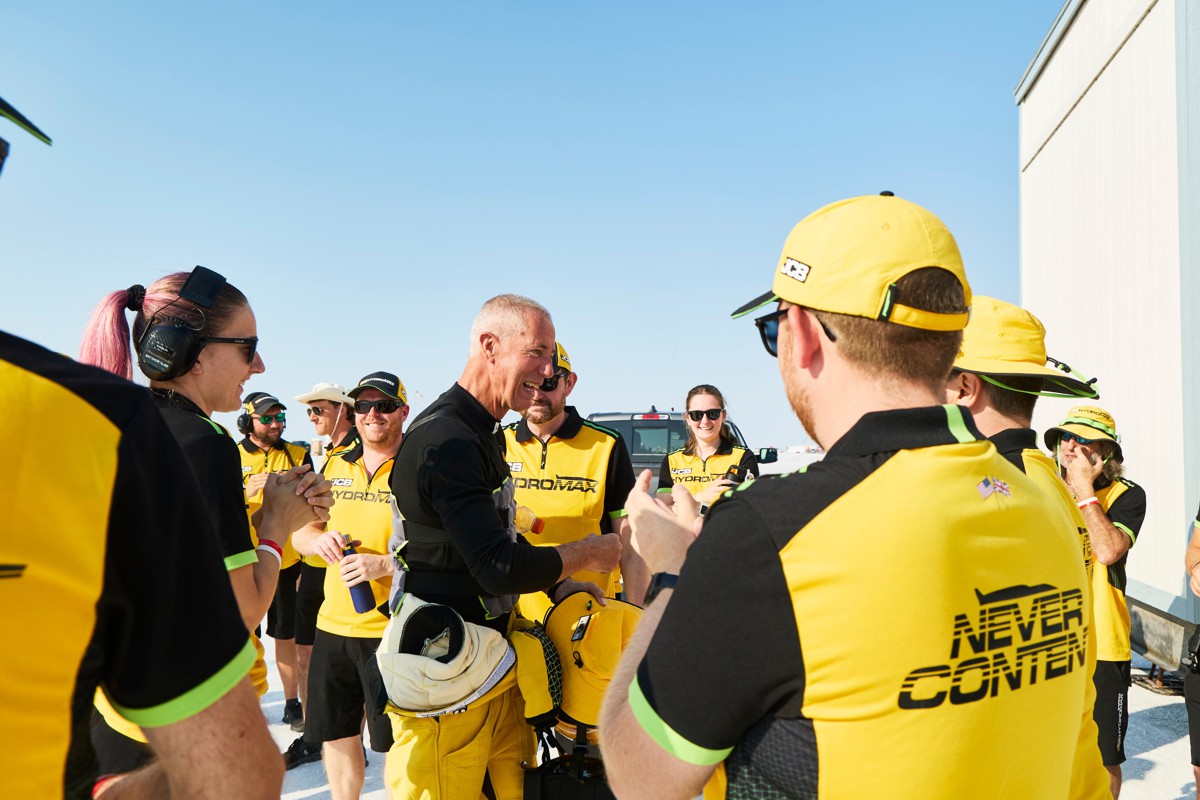
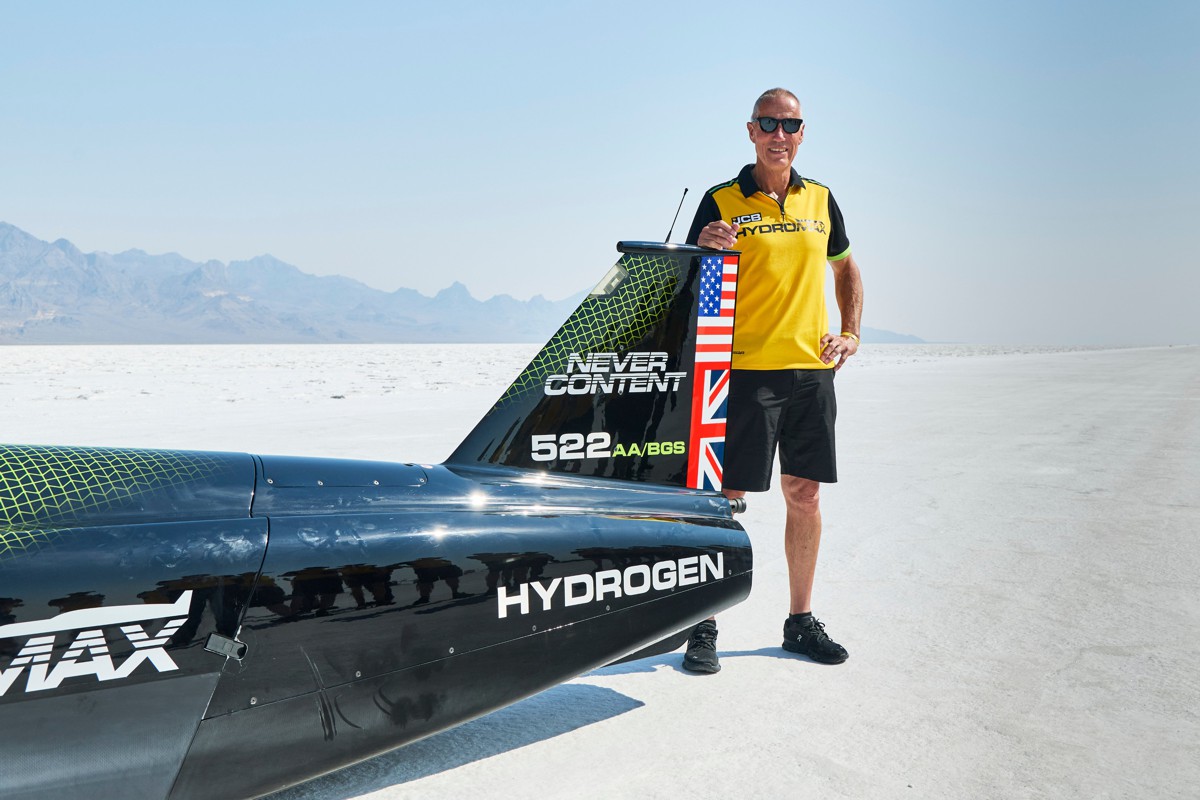
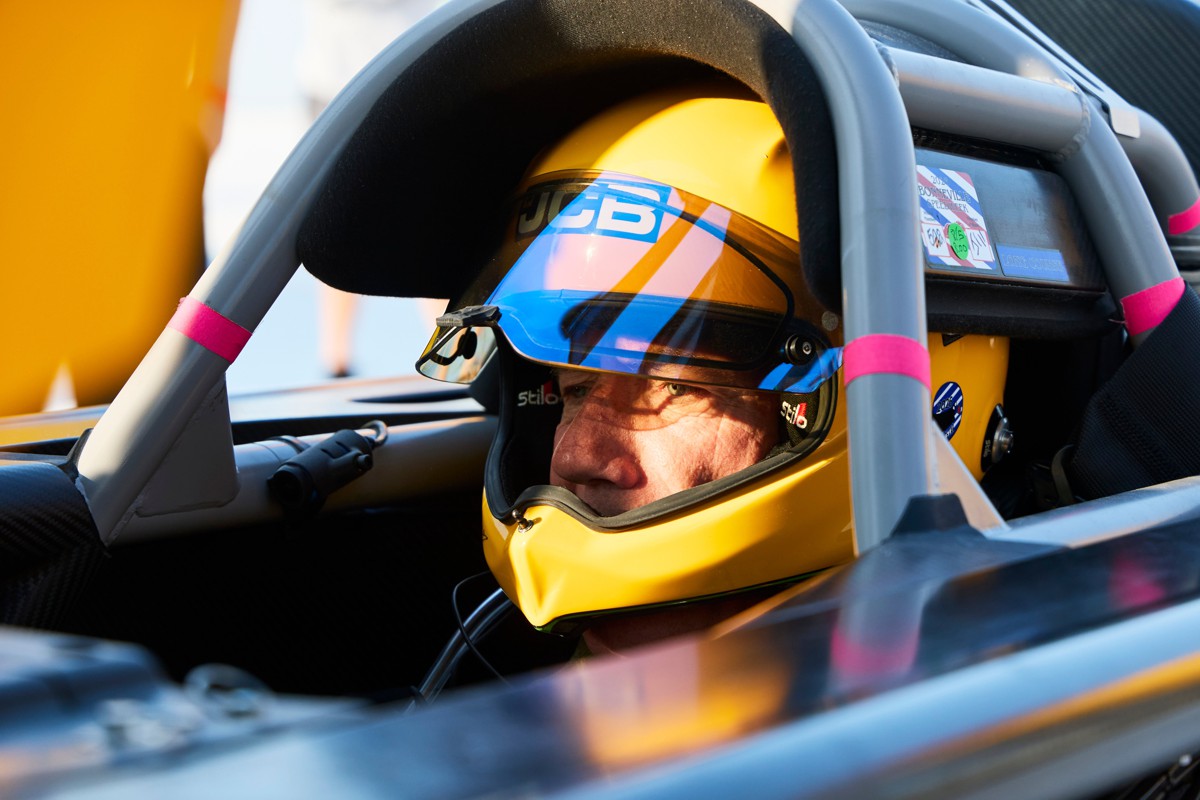
Andy Green, the driver and the only person to have broken the sound barrier on land, made clear that the data gathered so far has settled the team’s confidence ahead of that bid. “This record has given all of us huge confidence in the car, the team and the quality of the engineering. With our first record in the bag, we’re now turning up the power on the engines, aiming to go even faster next week.”
Beyond the sporting result, the value for JCB lies in what a global-audience win does for the credibility of hydrogen combustion as a serious industrial pathway. A world record would give the company’s sales teams, dealers and financiers a headline that reframes hydrogen from a subsidised experiment into a proven, high-performance reality, and it would do so precisely as the machines carrying the same engines reach customers across Europe and, before long, the United States.
Key Industry Questions
- Is the Hydromax engine really the same as JCB’s production hydrogen engine? The race and production units share the same core hydrogen combustion architecture, but they are tuned very differently. Each Hydromax power unit produces around 800hp, while the commercial engine in the 3CX Hydrogen backhoe loader is rated at 55kW, roughly 74hp, and is built on the same 4.8-litre platform. Running that architecture at more than ten times its production output demonstrates mechanical margin and thermal robustness rather than reflecting the settings a working machine would use. The relevance for buyers is that severe stress testing at the limit provides confidence in the durability of the far less stressed engines fitted to commercial plant.
- Why is JCB pursuing hydrogen combustion rather than batteries or fuel cells? JCB’s argument is operational and commercial. Hydrogen combustion allows on-site refuelling in minutes, retains a duty cycle familiar to diesel operators and technicians, and can be built on existing diesel manufacturing processes and components. It also avoids the rare earth materials associated with battery drivetrains, which reduces supply-chain and geopolitical exposure. For intensively used machines on sites without reliable charging infrastructure, the company sees combustion as the least disruptive route to removing carbon at the point of use while protecting its established manufacturing base, dealer network and aftermarket business.
- What does full type approval actually mean for construction buyers? Type approval is the regulatory clearance that allows an engine to be sold and used in commercial machines, and it is the practical difference between a concept and a purchasable product. JCB’s hydrogen engine has secured approval across eleven European licensing authorities, beginning with the Netherlands’ RDW. That certification lets the company offer the 3CX Hydrogen as a financed commercial machine, complete with an operating lease and service contract, rather than as a trial unit. For contractors, approval means a zero-emission machine can be procured, insured and financed through conventional channels.
- How does JCB’s position compare with rivals such as Cummins, Deutz and Liebherr? JCB has committed to a single hydrogen combustion pathway and taken it into full production, whereas most rivals are keeping their options open. Cummins offers a fuel-agnostic platform that runs on diesel, biofuels or hydrogen from a common base. Deutz and Liebherr are developing hydrogen combustion through a German research consortium framed as a multi-year investigation. Komatsu is testing both combustion and fuel-cell systems. JCB’s distinctiveness lies in reaching type approval, series production and a public performance demonstration ahead of a field that is still largely hedging.
- Why does the record coincide with the San Antonio factory opening? The two events are strategically linked. JCB is completing a $500 million factory in San Antonio, Texas, its largest ever investment, doubled in scope to one million square feet after new US tariffs, with production due to begin in October 2026. Setting a record on American salt in front of a US audience supports the company’s expansion into its most important growth market. It positions JCB simultaneously as a local manufacturer committed to American jobs and as an engineering firm capable of proving its technology at the highest level.
- What is the significance of the FIA world record attempt that follows? The SCTA result is a class record verified at Speed Week, while the FIA attempt targets an officially recognised outright world record under motorsport’s global governing body, with the engines turned up towards 1,600hp. The current outright hydrogen record, reported at around 303mph, was set by a fuel-cell vehicle in 2009. Taking that mark with a combustion engine would be a strong statement about the maturity of hydrogen combustion, and would give JCB a globally recognised headline as its commercial machines reach customers.
- Does breaking a diesel record with hydrogen prove anything commercially? It provides a concrete comparison rather than a marketing claim. JCB’s Dieselmax set a diesel land speed record of 350.092mph in 2006, and the Hydromax has now exceeded that figure using the company’s own hydrogen combustion engines. Because JCB’s commercial proposition is that hydrogen combustion matches diesel on power, torque and efficiency without carbon at the point of use, surpassing its own diesel benchmark with comparable engineering supports that message in a way trade audiences and buyers can readily grasp.
- How ready is the supporting hydrogen refuelling infrastructure for construction sites? On-site refuelling is central to JCB’s approach, and the company has developed a mobile hydrogen refueller to serve its machines directly at the point of work, avoiding dependence on fixed public infrastructure. That capability addresses one of the main practical barriers to zero-emission plant, since remote and intensive sites rarely have the grid capacity for fast charging or the access to permanent hydrogen supply. Broader hydrogen availability and cost remain the wider industry challenge, but JCB’s model is designed to function on the refuelling logistics a contractor can bring to a site rather than waiting for national networks to mature.
Strategic Takeaways
- The Hydromax record is best understood as a durability and headroom demonstration for a commercial powertrain, giving off-highway buyers a highly visible reliability signal for engines already entering their fleets.
- JCB’s full type approval across eleven European authorities is a genuine competitive moat, because certification, not announcements, determines when zero-emission machines can actually be sold, financed and deployed.
- By committing to a single hydrogen combustion pathway while Cummins, Deutz, Liebherr and Komatsu hedge across multiple fuels and chemistries, JCB is positioning to capture early orders and reference sites before the market consolidates.
- The combustion strategy is as much about protecting JCB’s diesel manufacturing base, dealer network and aftermarket economy as about emissions, offering decarbonisation with minimal disruption to an established business model.
- The record’s timing alongside the $500 million San Antonio factory frames hydrogen as central to JCB’s US growth, and infrastructure contractors should expect the company to compete as both a local manufacturer and a zero-emission powertrain contender.