The 12,400 Mile Highway That Refuses to Disappear
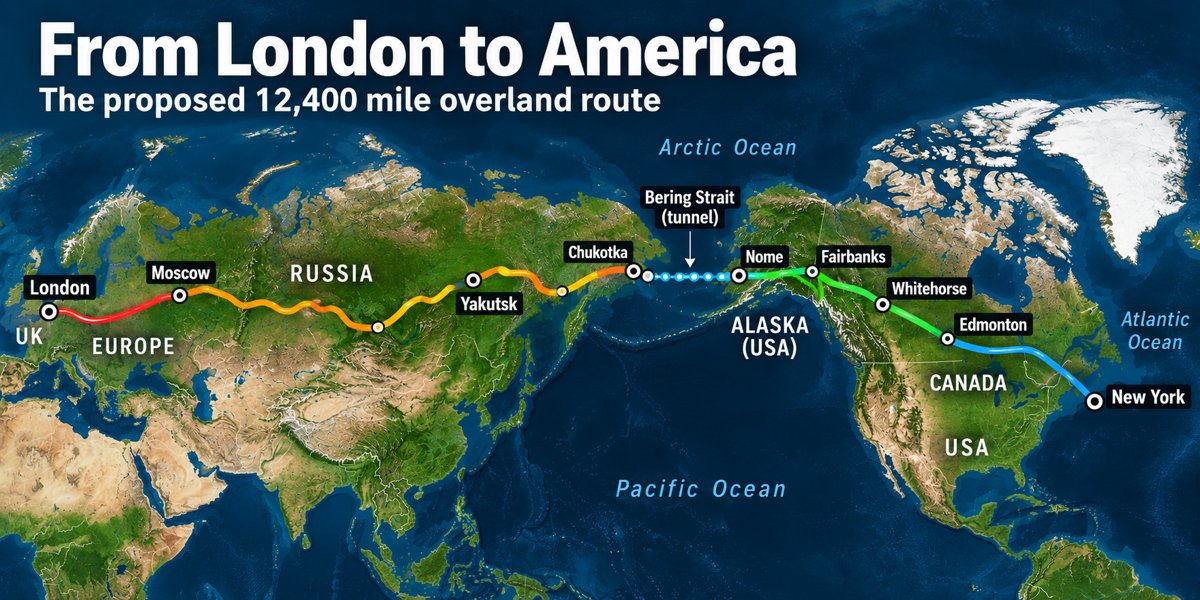
Ten years ago, before Highways.Today had really become Highways.Today, I published an article about one of the most extraordinary infrastructure proposals I had encountered. The premise was irresistible: a vast new transport corridor stretching across Russia and ultimately connecting Eurasia with North America. In theory, someone could get into a vehicle in London and keep driving east until, many thousands of miles later, they arrived in America.
The headline on 6 July 2016 was suitably uncomplicated: Drive from London to America on a 12,400 mile highway! It was one of the earliest articles on Highways.Today and, in many respects, an experiment. The publication itself was still an experiment. The article was short, enthusiastic and fascinated by the scale of the idea rather than particularly concerned with whether anyone could finance or build it.
A decade later, Highways.Today is still here, and rather unexpectedly, so is the idea.
The 12,400-mile highway never materialised, nor did the wider Russian development programme behind the proposal progress into anything resembling the continuous intercontinental transport system envisaged at the time. Yet the missing connection at the heart of the concept, a permanent crossing beneath the Bering Strait between Russia and Alaska, returned to international discussion in 2025.
By June 2026, Kirill Dmitriev, head of the Russian Direct Investment Fund and Russia’s special presidential representative for investment and economic cooperation with foreign countries, was saying that design work for a Bering Strait tunnel was continuing. RDIF subsequently announced an agreement concerning further design work.
That remains a considerable distance from an approved, financed and internationally agreed megaproject. There is no continuous railway waiting on either shore, no construction programme connecting Siberia with Alaska, and no demonstrated financial model capable of paying for the enormous amount of infrastructure that would have to accompany a tunnel. Yet after more than a century of proposals, the possibility of physically connecting Eurasia and North America refuses to disappear.
Briefing
- Highways.Today first covered proposals for a London-to-America land connection on 6 July 2016.
- The concept depended ultimately on creating a permanent transport link between Siberia and Alaska across the Bering Strait.
- Russian investment envoy Kirill Dmitriev revived the tunnel proposal publicly in October 2025, describing a roughly 70-mile rail and cargo connection.
- In June 2026, Dmitriev said design activity was continuing and RDIF announced an agreement concerning further design work.
- The engineering challenge extends far beyond the tunnel, requiring thousands of miles of additional railway and associated infrastructure across Russia, Alaska and Canada.
More Than a Century of Proposals
The proposal Highways.Today encountered in 2016 was associated with Vladimir Yakunin, then president of Russian Railways, and the Trans-Eurasian Belt Development concept. The ambition was much larger than another Russian motorway. It envisaged transport, energy and economic development corridors extending across the country and potentially creating a physical connection between Europe, Asia and North America.
Yakunin was far from the first person to look at a map and notice the tantalisingly narrow separation between Siberia and Alaska. Ideas for joining the continents emerged during the nineteenth century. William Gilpin, the first governor of Colorado Territory, proposed his Cosmopolitan Railway in 1890, imagining railways capable of knitting continents together. French engineer Léon Loïcq de Lobel subsequently became associated with an ambitious attempt around the turn of the twentieth century to promote an intercontinental railway incorporating a Bering Strait crossing.
The geographical attraction is obvious. At its narrowest, the Bering Strait separates Cape Dezhnev in Russia from Cape Prince of Wales in Alaska by only around 82 kilometres. The Diomede Islands sit between them and have repeatedly appeared in crossing concepts.
Viewed at continental scale, however, the narrow strip of water becomes the smaller problem. London and Paris already have railways. Moscow has railways. New York has railways. The extremities of northeastern Russia and western Alaska do not possess anything approaching the infrastructure required to turn those networks into one continuous system.
The Tunnel Is Not Really the Megaproject
Modern Bering Strait concepts generally envisage a railway rather than a highway. One contemporary private proposal promoted by InterBering describes a tunnel system of approximately 135 kilometres per tunnel, using two rail tunnels and a central service tunnel. Another InterContinental Railway concept envisages nearly 5,500 miles of new railway between existing networks around Yakutsk in eastern Russia and Fort Nelson in Canada.
A tunnel boring machine emerging successfully beneath the Bering Strait would still leave trains stranded in one of the least connected regions on Earth.
The railway would have to continue through Chukotka and across northeastern Russia towards the existing Russian network. On the American side, infrastructure would have to cross Alaska and connect through Canada before reaching the established North American rail system. Thousands of miles of track would require bridges, earthworks, tunnels, signalling, telecommunications, maintenance facilities, power and logistics support, much of it across remote territory where simply getting people, machinery and materials to the construction site would be a substantial undertaking.
The international railway would also encounter different railway systems. Russia predominantly uses 1,520 mm broad gauge, while the United States, Canada and much of Europe use 1,435 mm standard gauge. Freight already crosses gauge boundaries on Eurasian rail corridors, using transshipment, bogie exchange and other operational solutions, but every additional interface affects time, capacity and cost.
The tunnel beneath the sea attracts the headlines. The railway beyond its portals would determine whether it had a purpose.
From a Highway to a Freight Corridor
The proposition has changed considerably since Highways.Today wrote about it in 2016. The entertaining possibility was that someone might eventually drive from London to America. Contemporary versions concentrate much more heavily on rail freight, resources, energy and strategic connectivity.
Passenger traffic alone would struggle to support infrastructure of this scale, while bilateral Russia-US freight would also have to justify thousands of miles of new railway across lightly populated territory. Advocates therefore tend to think continentally, bringing China, Canada and the wider Eurasian and North American freight systems into the calculation.
A functioning corridor could theoretically allow freight originating in China or elsewhere in Asia to travel by rail through Russia, beneath the Bering Strait, across Alaska and Canada and into the continental United States. North American commodities and manufactured goods could move in the opposite direction towards Asian and European markets.
Such a railway would compete against established transport systems rather than an empty map. Container shipping already moves enormous quantities of freight between Asia and North America through mature ports and shipping lanes. Existing Eurasian rail freight services demonstrate both the possibilities and limitations of moving goods by train across multiple countries and railway systems.
Physical feasibility is therefore only the beginning. An intercontinental railway would need sufficient freight willing to pay enough for its combination of transit time, reliability and capacity to support infrastructure built across some of the world’s most difficult terrain.
The Cost Problem
The numbers attached to Bering Strait proposals vary enormously, partly because they often describe different projects.
When Dmitriev revived the concept in October 2025, he suggested that a roughly 70-mile tunnel could potentially be constructed for less than $8 billion using technology associated with Elon Musk’s Boring Company, compared with conventional estimates he placed at more than $65 billion. He also suggested construction might be completed within eight years.
The sub-$8 billion figure is Dmitriev’s proposition, not an independently validated engineering estimate. No detailed publicly tested engineering design, procurement programme or cost plan has demonstrated that a Bering Strait tunnel can be delivered for that amount.
Private proponents considering the entire intercontinental system arrive at much larger numbers because the railway does not end at the tunnel portals. InterBering currently presents an indicative programme costing around $250 billion, including the tunnel, Russian and North American rail construction, energy facilities, rolling stock and other infrastructure. That figure is also a promoter estimate rather than the budget of an approved international project.
Any credible assessment would have to combine construction cost with expected utilisation. A $250 billion corridor carrying large and dependable freight volumes presents a very different investment proposition from the same infrastructure carrying occasional trains.
Arctic Engineering
There is no obvious physical law preventing engineers from tunnelling beneath the Bering Strait. The Channel Tunnel demonstrated more than three decades ago that very long subsea railway tunnels can operate safely and intensively, while Japan’s Seikan Tunnel and subsequent tunnelling projects have expanded experience in excavation, waterproofing, ventilation, evacuation and underground railway operation.
None provides a direct template for the Bering Strait. Its remoteness changes construction logistics fundamentally. Tunnel components, machinery, fuel, personnel and emergency resources would have to reach locations with limited supporting infrastructure, while geological investigation would have to establish suitable alignments and ground conditions before credible construction costs could be produced.
The railway beyond the portals adds thousands of kilometres of Arctic and sub-Arctic construction. Permafrost can create significant problems for embankments and track geometry as ground conditions change, while bridges, communications, maintenance facilities and power systems would all have to function through severe winters in sparsely populated territory.
These are solvable engineering problems. Solving them across an intercontinental transport system would be expensive.
Infrastructure Without a Country
The Bering Strait concept possesses a characteristic uncommon among most megaprojects: neither side can build a particularly useful version independently.
Britain and France could justify the Channel Tunnel because dense transport networks, major cities and substantial cross-Channel trade already existed at both portals. Denmark and Sweden built the Øresund connection between established metropolitan and transport systems. The Brenner Base Tunnel connects into one of Europe’s busiest north-south corridors.
A Bering tunnel would initially connect remote Russia with remote Alaska.
Its usefulness would depend on infrastructure extending thousands of miles beyond both portals, requiring Russia, the United States and Canada to align transport planning, border procedures, customs systems, technical standards, security arrangements and long-term investment. China could also become commercially important if Chinese freight were expected to provide a substantial part of the traffic.
The planning, approval, financing and construction of such a system would span numerous political cycles. Geological risk can be investigated, construction risk can be priced and traffic can be modelled, however imperfectly. Predicting relations between major powers several decades into the future is rather more difficult.
Railways and tunnels are expected to operate for a century or more. Governments are not.
The 2025 Revival
In October 2025, Dmitriev publicly proposed what he called a “Putin-Trump Tunnel” connecting Russia and Alaska. The concept was presented as both infrastructure and diplomacy, with potential freight movement, resource development and economic cooperation between Russia and the United States. The political branding attracted much of the immediate attention, although the transport concept itself predates both men by generations.
By June 2026, Dmitriev was saying that design work was continuing. At the St Petersburg International Economic Forum, he announced that RDIF had signed an agreement relating to the design of a tunnel across the Bering Strait and indicated that further steps could become clearer by the end of the year.
There remains an enormous gap between design activity and the bilateral agreements, environmental approvals, detailed engineering, traffic forecasts, financing, procurement and connecting infrastructure required for construction. For a concept that has repeatedly surfaced and disappeared since the nineteenth century, however, continuing engineering work keeps the Bering Strait connection alive as an infrastructure proposition rather than purely a historical curiosity.
Build the Railway Before the Tunnel
There is a less spectacular route towards an intercontinental railway: do not start with the Bering Strait.
Alaska has repeatedly considered better rail connections with Canada. Russia has longstanding economic reasons to improve transport access across its vast eastern territories, while northern Canada has its own infrastructure requirements. Mineral deposits, communities, ports, energy projects and industrial developments could create demand for individual sections of railway without requiring an intercontinental tunnel to exist.
A railway extension connecting a mine or opening a regional freight corridor can be assessed against identifiable traffic. Another section might improve access to a port or connect isolated communities. Each economically useful extension would reduce the amount of missing infrastructure while producing value independently of any future Bering crossing.
Over several decades, that could fundamentally alter the calculation. Rather than spending an enormous sum on the spectacular centrepiece and then attempting to justify thousands of miles of infrastructure required to reach it, governments and investors could develop useful transport corridors progressively. If enough of those links eventually existed, the Bering Strait could become the missing connection between two functioning systems rather than the starting point for creating them.
Some contemporary promoters have moved towards this approach. InterBering itself argues for nearer-term attention to sections such as Alaska-Canada connectivity while retaining the tunnel as a longer-term objective.
The economics of each railway would still have to stand on its own. That is precisely the point.
A Different World from 2016
The world surrounding the proposal has changed during the ten years since Highways.Today first covered it. Arctic infrastructure has acquired greater strategic importance, while northern shipping, energy, minerals and defence have attracted increasing government attention. China has continued developing extensive Eurasian rail connections, and repeated supply-chain disruptions have reinforced the economic value governments attach to transport resilience.
Geopolitical tensions simultaneously make the international cooperation required for an intercontinental railway more difficult. Northern infrastructure has become more strategically important at the same time as jointly constructing it across the borders of major powers has become considerably more complicated.
Any Bering corridor would have to survive political cycles as well as Arctic winters.
Could You Actually Drive from London to America?
Probably not using the infrastructure currently being discussed. The renewed Bering proposals are predominantly railway concepts, and there is no active programme to construct the continuous 12,400-mile road imagined in the headline Highways.Today published ten years ago.
A theoretical road journey also encounters considerably more than the missing crossing beneath the Bering Strait. Road networks thin dramatically towards northeastern Russia, while western Alaska lacks the connections required to turn a Bering crossing into a continuous highway towards Canada and the rest of the United States.
A vehicle could conceivably be transported through a future rail tunnel aboard a shuttle service, much as vehicles travel through the Channel Tunnel today, but suitable roads would still have to reach the railway system. The romantic image of setting a satnav in London for New York therefore remains exactly that.
The more serious proposition is a freight train.
Ten Years Later
Looking back at that 2016 article is slightly strange. Highways.Today was young and so was its editorial approach. The attraction of the story was the audacity of the engineering: imagine being able to drive from London all the way to America.
Ten years of writing about infrastructure changes the questions. Who would use it? What freight would support it? Who finances the railway approaching the tunnel? How would different networks connect? Which sections make economic sense independently? How would governments divide risk, and what happens when political relationships change halfway through a programme expected to take decades?
Those questions make the Bering Strait idea more interesting, rather than less. The tunnel itself may eventually prove technically achievable. Building an investable transport system around it is considerably harder.
Perhaps that is the biggest difference between the article Highways.Today published in 2016 and the one being written ten years later. The original story saw an extraordinary piece of infrastructure and wondered how far the road might go. A decade later, the better question is whether enough useful infrastructure can be built along the way to make the final connection worth digging.
More than a century after engineers first seriously contemplated joining Siberia and Alaska, nobody has yet answered that question. They have not stopped trying.
Key Industry Questions
- Is a Bering Strait tunnel currently approved for construction? No. Russian officials have reported continuing design activity and an agreement concerning further design work, but there is no approved, fully financed international construction programme connecting Russia and the United States across the Bering Strait.
- How long would a Bering Strait tunnel be? The figure depends on the alignment and tunnel configuration. Recent proposals commonly describe a crossing of roughly 70 miles, while the current InterBering concept describes approximately 135 kilometres per tunnel within a larger multi-tunnel system.
- Could engineers build a tunnel that long? There is no established technical reason why a Bering Strait railway tunnel should be impossible, but its length, remoteness, logistics, geology, safety requirements and Arctic environment would make it an exceptional engineering undertaking.
- Why would so much new railway be required? Neither side of the Bering Strait connects directly into the principal continental rail networks. An intercontinental system would require thousands of miles of additional railway through northeastern Russia, Alaska and Canada.
- Could the tunnel carry cars? Current proposals primarily envisage rail freight and passenger operations. A future railway tunnel could theoretically incorporate vehicle shuttle services, but this is not the central proposition currently being advanced.
- How much could the complete project cost? There is no reliable approved project budget. Dmitriev has suggested a tunnel could potentially cost less than $8 billion using alternative tunnelling technology, while private promoter InterBering presents an indicative figure of around $250 billion for a much larger infrastructure programme. Neither figure constitutes a validated construction budget for an approved project.
- What would the railway carry? Proponents envisage international freight, potentially including traffic between Asia and North America, alongside passengers and possible supporting energy and communications infrastructure. Whether sufficient freight exists to support the investment remains one of the fundamental commercial questions.
- Why build the connecting railways first? Sections providing independent economic benefits could potentially be developed without waiting for the tunnel. Improving Alaska-Canada connectivity or opening resource corridors would reduce the missing infrastructure while allowing individual investments to be assessed on their own merits.
- When could the Bering Strait tunnel be built? There is currently no dependable construction timetable. Claims that a tunnel could be delivered within a particular number of years describe proposed construction periods rather than an established project schedule.
Strategic Takeaways
- The Bering Strait tunnel is only one component of a much larger intercontinental transport system; the missing railway networks may present the greater investment challenge.
- Freight economics rather than passenger travel would probably determine whether a permanent Eurasia-North America corridor could become commercially credible.
- Regional railway sections capable of producing independent economic value offer a more realistic development pathway than treating the entire corridor as a single megaproject.
- Technical feasibility does not establish financial viability. Traffic, financing, political cooperation and long-term utilisation remain unresolved.
- Renewed design activity has returned the Bering Strait concept to serious discussion, but it remains far from an approved construction programme.