Magnetic Thermal Textile Targets Overheated Railway Tracks
Railway engineers in South Korea have demonstrated a removable thermal barrier that KRRI says reduced summer rail temperatures by as much as 10.9°C, without water, electrical power or permanent modification to the track.
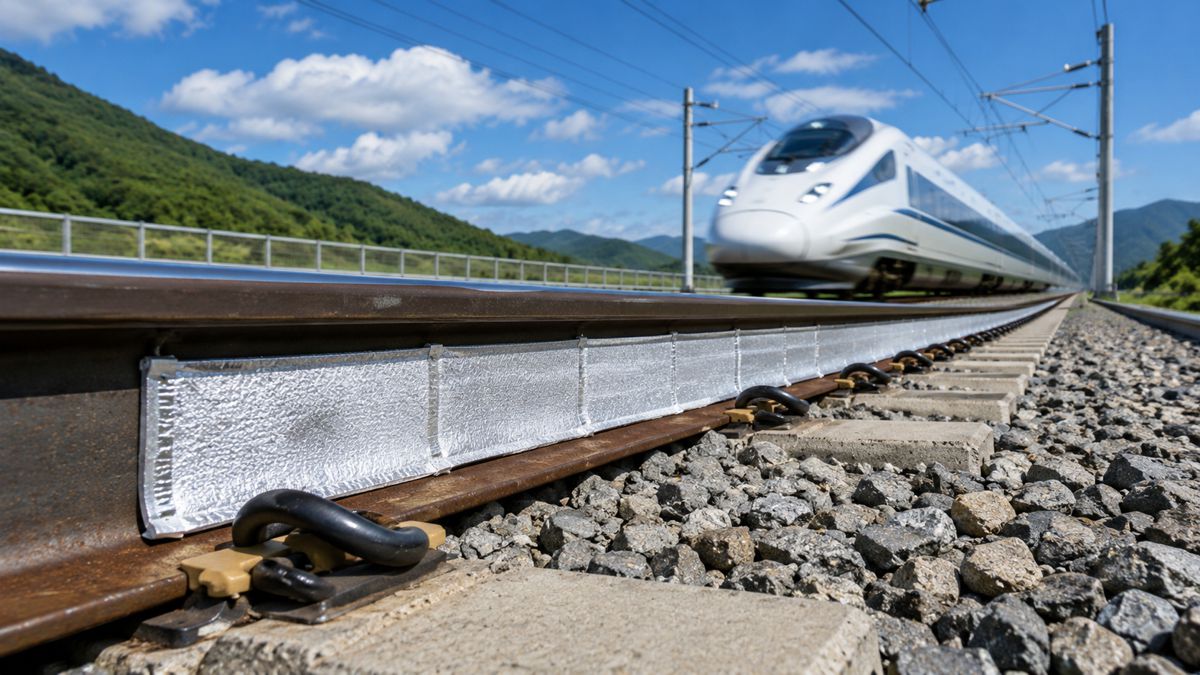
Developed by the Korea Railroad Research Institute (KRRI), the system uses a reflective multilayer textile attached magnetically to the rail. Field trials have now been completed on conventional and high-speed railway infrastructure, while mechanised equipment has been developed to install and recover the material at more than 2 km/h.
The approach tackles a familiar railway engineering problem. Steel rails exposed to direct sunlight can become substantially hotter than the surrounding air, increasing compressive forces within continuously welded rail and, under unfavourable track conditions, the risk of buckling. Infrastructure managers respond through rail stressing, monitoring, maintenance, reflective treatments and, when necessary, temporary speed restrictions.
The Korean work adds a removable option to that toolkit, with the engineering extending beyond the thermal material itself to the practical problems of attaching, installing and retrieving it on an operational railway.
Briefing
- KRRI reports a maximum rail-temperature reduction of 10.9°C from its wider demonstration programme.
- Published research recorded average reductions of approximately 4–5°C and a maximum reduction of 9.7°C during field testing.
- The thermal textile incorporates a solar-reflective coating, fibreglass and magnetic layers and requires no water or power once installed.
- Trials were undertaken on the conventional Gwangju Line in 2024 and the Jungbu Inland High-Speed Line in 2025, including testing around KTX trains travelling at 300 km/h.
- KRRI has transferred the textile and its automated installation and retrieval technology to PITCHCABLE Co., Ltd. for commercialisation.
Controlling Solar Heat Gain
KRRI’s approach is based on preventing solar energy from reaching the steel rather than trying to cool the rail after it has heated.
The textile incorporates a specialist reflective coating, fibreglass layers and magnets that secure it to the rail. KRRI says the coating reflects more than 85% of incoming solar radiation, while the installed material requires neither a water supply nor an external energy source.
The underlying research provides a more detailed picture of the development work. Researchers examined the coating thickness and positioning of the material, settling on a 100 μm coating and finding that treatment of the rail web could provide an effective reduction in temperature without requiring the entire rail section to be covered.
Published field research recorded average rail-temperature reductions of around 4–5°C and a maximum reduction of 9.7°C. KRRI subsequently reported a maximum of 10.9°C from its wider demonstration programme, which included testing on the Jungbu Inland High-Speed Line in 2025.
Those figures sit within an established family of reflective rail treatments. Network Rail uses white-painted rails at vulnerable British locations and reports typical reductions of 5–10°C, while Austrian Federal Railways has also tested reflective coatings with reductions of roughly 5–8°C reported in trials.
The textile therefore does not introduce the principle of solar reflection to railway engineering. Its difference lies in packaging that principle into a removable treatment that can be deployed seasonally and recovered afterwards.
KRRI first demonstrated the system on the Gwangju Line conventional railway in summer 2024 before moving to the Jungbu Inland High-Speed Line in summer 2025. The programme covered conventional 50 kg/m rail and 60 kg/m high-speed rail.
Certified testing by the Korea Testing & Research Institute indicated that the material could maintain its performance for more than ten years, although this does not represent ten years of operational railway service. The published research also reported approximately 3% degradation in performance following a one-year outdoor exposure test.
Staying Attached at High Speed
Cooling the rail is only part of the engineering problem. Material fixed beside the running surface must remain secure when exposed to pressure changes and turbulent airflow from passing trains.
KRRI says the textile remained attached during testing involving KTX trains travelling at 300 km/h. The magnetic fastening system was designed to withstand wind speeds of up to 66 m/s, with an additional secondary fastening arrangement incorporated to protect against detachment.
That requirement becomes particularly important on high-speed infrastructure. A thermal treatment that performed well in stationary testing but could not reliably withstand train-induced aerodynamic loads would have little practical value and could introduce a new trackside hazard.
Testing on the Jungbu Inland line therefore provided an operational challenge quite different from measuring surface temperature. The textile had to maintain its position and integrity while repeatedly exposed to the aerodynamic environment generated by high-speed trains.
Installing the Textile at Railway Scale
KRRI developed the installation machinery alongside the thermal material rather than treating deployment as a separate problem.
Its all-in-one system prepares the rail surface, installs the textile and retrieves it after the hot-weather season. The modular equipment is designed to be transported, assembled and dismantled by two operators and can work at more than 2 km/h.
A thermal barrier requiring extensive manual fitting would be difficult to justify on a working railway, particularly where engineering possessions are short and track labour is expensive. Mechanised installation makes the textile closer to a seasonal maintenance operation than a permanent infrastructure project.
It also creates the possibility of targeted deployment. Heat vulnerability varies across a railway according to rail stress, track condition, ballast stability, geometry, exposure and local temperature. Infrastructure managers already identify locations requiring closer monitoring or intervention during periods of extreme heat.
A removable treatment could therefore be concentrated on vulnerable sections, exposed locations or areas where operational restrictions occur repeatedly, rather than applied across an entire route.
Its commercial value will depend heavily on that deployment model. At more than 2 km/h, installation is mechanised, but substantial networks still represent significant lengths of railway to treat, inspect and recover. The economics are likely to look very different for a handful of persistent hot spots than for hundreds of kilometres of track.
Rail Temperature and Operations
Network Rail says rails exposed to direct sunlight can become around 20°C hotter than ambient air. When rail temperatures approach location-specific critical levels, temporary speed restrictions can be introduced to reduce the forces exerted by passing trains on track already under increased thermal compression.
Reflective treatments are therefore only one part of railway heat management. Rail stressing, track condition, ballast consolidation, temperature monitoring and weather forecasting all influence how much thermal stress a section of railway can tolerate.
There is also a fundamental engineering compromise in continuously welded rail. Raising the stress-free temperature can increase resistance to compressive forces during hot weather, but it also increases tensile stresses as temperatures fall.
A removable thermal barrier can be installed during the period when solar heating presents the greatest problem and recovered when it is no longer required, without changing the underlying stress regime of the rail.
Whether that translates into operational savings remains to be demonstrated at scale. The useful measure will not ultimately be the number of degrees removed from a laboratory specimen or demonstration section, but whether treated railway requires fewer heat-related interventions, inspections or speed restrictions.
Moving Towards Commercial Deployment
The Korean programme ran from May 2022 until December 2025 as part of KRRI’s research activities under the National Research Council of Science & Technology, with Chief Researcher Kang Dong-hoon serving as principal investigator.
The technology has progressed through conventional and high-speed field demonstrations and KRRI has now concluded a technology-transfer agreement with PITCHCABLE Co., Ltd. covering both the thermal textile and its installation and retrieval system.
The project also received South Korea’s New Excellent Technology certification, while patents associated with the textile and installation equipment received awards at the 2025 Seoul International Invention Exhibition. Commercialisation, however, will provide a more demanding test than certification or awards.
Chief Researcher Kang Dong-hoon said: “This technology goes beyond simply lowering rail temperatures—it presents a new paradigm for protecting railway safety in the era of climate crisis. We plan to expand its application beyond railways to various fields that require heat mitigation, such as building exteriors and roadside facilities.”
KRRI President Sagong Myung added: “This is a demand-driven research outcome that allows the public to use railways with confidence even during extreme summer heat. In an era where climate crisis directly translates into national risk, we will further advance this technology to ensure safe railway operations and expand its application to overseas markets.”
The next evidence will need to come from longer operational deployments: kilometres rather than demonstration sections, repeated seasonal installation and recovery cycles, different climates and track forms, and enough operating data to establish whether lower peak rail temperatures translate into fewer interventions and speed restrictions.
Key Industry Questions
- How much can the KRRI thermal textile reduce rail temperature? KRRI reports a maximum reduction of 10.9°C from its demonstration programme. Published research from the development work recorded average reductions of approximately 4–5°C and a maximum of 9.7°C.
- How does the railway thermal textile work? A reflective multilayer material is magnetically attached to the rail, reducing the solar radiation reaching the steel and therefore limiting heat gain.
- Does the system require electricity or water? No external electricity or continuous water supply is required once the textile has been installed.
- Where is the material fitted to the rail? Research into the system found that applying the thermal-blocking material around the rail web could provide effective temperature reduction without covering the entire rail section.
- Can the system be used on high-speed railways? KRRI tested it on the Jungbu Inland High-Speed Line and reports that the textile remained secure around KTX trains travelling at 300 km/h.
- How is the textile installed? KRRI developed automated equipment that prepares the rail surface, applies the textile and retrieves it. The equipment can operate at more than 2 km/h and is designed for handling by two operators.
- Why are high rail temperatures a problem? Heating increases compressive forces in continuously welded rail. Combined with unfavourable track conditions, those forces can increase the risk of track buckling.
- Are reflective treatments already used on railway tracks? Yes. Railway operators including Network Rail and Austrian Federal Railways have used or tested reflective rail coatings to reduce solar heat gain.
- Is the Korean technology commercially available? KRRI has completed a technology-transfer agreement with PITCHCABLE Co., Ltd. covering the textile and its installation and retrieval technology. The scale and timetable of commercial deployment have not yet been established.
Strategic Takeaways
- KRRI’s textile applies an established reflective-cooling principle in a removable form designed for seasonal railway deployment.
- The automated installation and retrieval equipment may prove as important commercially as the thermal performance of the material itself.
- Testing around trains travelling at 300 km/h addresses the attachment and aerodynamic safety questions created by placing removable material close to operational high-speed track.
- Targeted treatment of persistent heat-sensitive locations may offer a more practical deployment model than attempting to cover extensive railway networks.
- Commercial performance will ultimately be judged by avoided interventions, speed restrictions and disruption rather than maximum temperature reduction alone.