Where Do Oil and Gas Really Come From?
Crude oil contains an extraordinary chemical record. Within the black mixture pumped from a reservoir are molecules whose structures preserve traces of organisms that lived hundreds of millions of years ago. Petroleum geologists can compare these compounds with organic matter in particular sedimentary rocks and, in favourable cases, identify the geological formations from which an oil migrated.
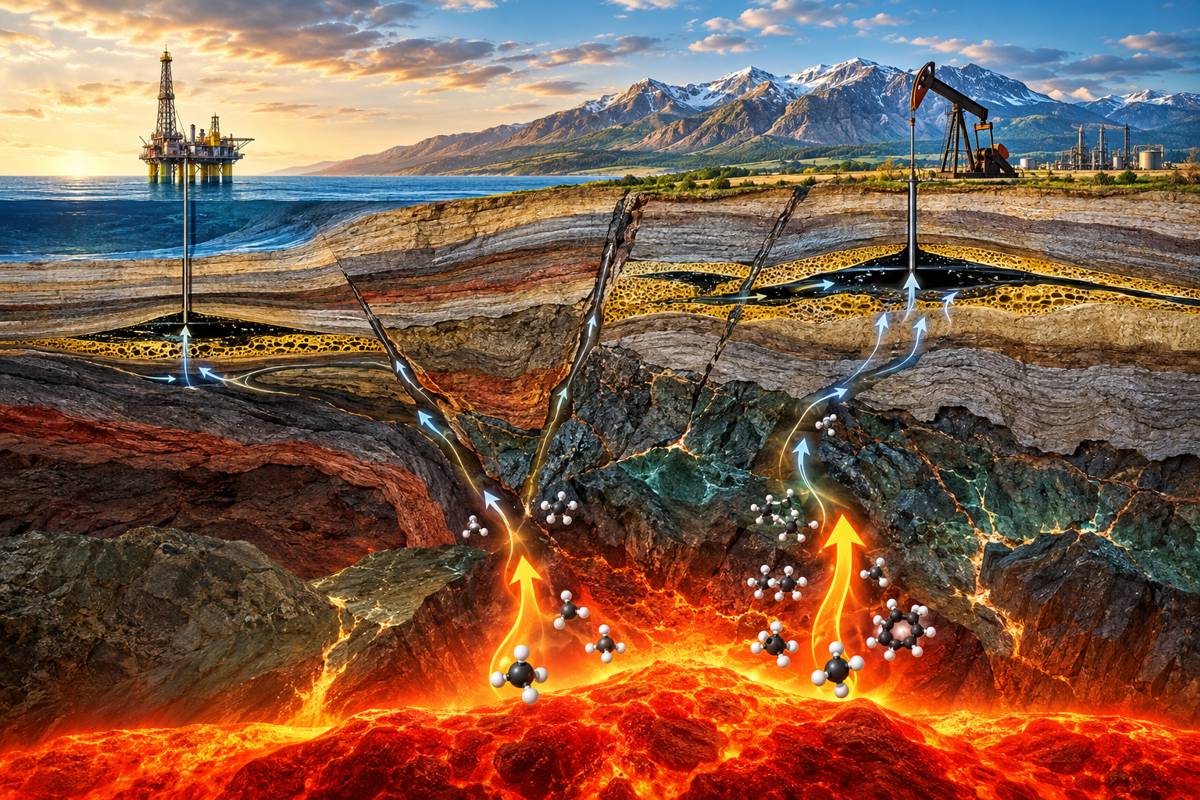
Several kilometres below those sedimentary basins, however, another hydrocarbon factory exists. Water reacting with mantle rocks can produce hydrogen. Carbon-bearing compounds can react with that hydrogen to produce methane. Experiments at the pressures and temperatures found in the upper mantle have produced ethane, propane and butane without biological material being present, while methane of apparently non-biological origin has been identified in rocks associated with ancient pieces of oceanic mantle.
Research into subduction zones suggests that hydrogen and methane can also be generated deep within the Earth. More recently, research published in 2025 reported evidence of abiotic polycyclic aromatic hydrocarbons, relatively complex carbon compounds, within material originating in the sub-oceanic mantle.
The familiar explanation that fossil fuels are simply the compressed remains of ancient plants and animals is therefore incomplete. The alternative claim sometimes drawn from these discoveries, that the world’s oil and gas fields are actually supplied by enormous inorganic hydrocarbon systems deep within the Earth, goes considerably further than the evidence currently allows.
The two processes are not mutually exclusive. They are different parts of a planetary carbon system operating across enormous ranges of depth, temperature and geological time.
Briefing
- Coal is predominantly derived from ancient terrestrial vegetation, while most conventional crude oil originates from organic matter including algae, plankton and microorganisms preserved in sediment.
- Petroleum geologists can connect many oils with their source rocks using biomarkers, isotopes and other geochemical evidence.
- Abiotic hydrocarbons are nevertheless real, with methane occurring naturally through geological processes that require no biological precursor.
- Laboratory experiments show that heavier hydrocarbons including ethane, propane and butane can form under upper-mantle conditions.
- Evidence that the Earth can make hydrocarbons abiotically does not establish that commercially important oil and gas reservoirs are predominantly supplied from the mantle.
Oil Was Never Really Made From Dinosaurs
The popular image of a dinosaur somehow becoming petrol was never a particularly good description of petroleum geology. Coal comes closer to the traditional fossil-fuel story, with much of it originating as vegetation accumulated in ancient wetlands before burial, pressure, temperature and geological time progressively transformed the material.
Oil generally has a different ancestry. Many important petroleum source rocks were deposited in ancient seas, lakes and other sedimentary environments where microscopic life accumulated alongside mineral sediments. Algae, phytoplankton, bacteria and other organic material survived decomposition under favourable conditions and became incorporated into the sedimentary rock.
As those rocks were buried, increasing temperature transformed their organic material. Kerogen, the insoluble organic matter within the rock, can generate liquid and gaseous hydrocarbons as it passes through suitable temperature ranges over geological timescales.
The resulting petroleum does not necessarily remain where it formed. Oil and gas can migrate through permeable formations, fractures and faults before becoming trapped beneath sufficiently impermeable rock. A producing reservoir may consequently lie a considerable distance vertically or horizontally from the source rocks in which its hydrocarbons originated.
That migration has been studied in remarkable chemical detail.
The Chemical Fingerprints Inside Crude Oil
Crude oils contain biomarkers, sometimes described as molecular fossils. These are compounds whose structures retain recognisable relationships with molecules once produced by living organisms.
Steranes are related to biological sterols, while hopanes have biological precursors associated particularly with bacteria. Other compounds and their relative abundances can provide evidence about the organisms and environment associated with the original organic material.
Petroleum geochemists can compare these molecular patterns between different oils and between an oil and potential source rocks. Combined with thermal maturity, geological relationships and isotope measurements, this allows oils found in reservoir rocks to be correlated with sedimentary formations from which they migrated.
Carbon isotopes provide another line of evidence because different processes can fractionate carbon isotopes in different ways. Petroleum geochemists can therefore investigate both the source of the carbon and some of the processes it has subsequently experienced.
The evidence is not always clean. Petroleum can be altered by heat, microorganisms, migration, mixing and interactions with surrounding rocks. Several oils can enter the same reservoir, while natural gases can have multiple origins. Source rocks, biomarkers, maturation chemistry, isotopes and oil-source correlations nevertheless provide a substantial body of evidence for the biological ancestry of conventional petroleum.
They do not require all hydrocarbons to have a biological origin. The Earth is capable of making hydrocarbons without life.
The Other Hydrocarbon Factory
Abiotic, or abiogenic, hydrocarbons are carbon-hydrogen compounds produced through processes that do not require biological organic matter as their starting material. Their existence is well established, particularly for methane.
One of the best understood routes begins with ultramafic rocks, the magnesium and iron-rich rocks characteristic of the upper mantle. When water encounters suitable examples of these rocks, a collection of chemical reactions known as serpentinisation can occur.
Olivine and other minerals react with water and are transformed into new minerals. During the process, iron can be oxidised and molecular hydrogen produced. Under sufficiently reducing conditions, that hydrogen can subsequently react with carbon-bearing compounds such as carbon dioxide, providing a route to methane.
This chemistry occurs around some hydrothermal systems and in geological environments where mantle rocks have been exposed to circulating water. Abiotic methane associated with ultramafic rocks has been identified in several parts of the world.
Research into ophiolites in Greece provides a particularly useful example. Ophiolites are pieces of ancient oceanic crust and upper mantle that tectonic processes have effectively stranded on land, allowing rocks that originated beneath an ocean to be examined directly. A 2018 study of Greek ophiolites reported methane, hydrogen and heavier hydrocarbons in chromitites, with molecular and isotopic characteristics interpreted as evidence of an abiotic origin.
The chemistry is not restricted to mantle material subsequently exposed at the surface. Plate tectonics can carry the ingredients in the opposite direction, taking water and carbon-bearing material deep into the Earth.
Hydrocarbons Beneath the Crust
At subduction zones, one tectonic plate descends beneath another, carrying rocks, water and carbon-bearing material into progressively hotter and higher-pressure environments. Research published in Nature Communications in 2020 examined rocks that had experienced subduction-zone conditions and combined the observations with thermodynamic modelling. It found that serpentinisation at depths of roughly 40 to 80 kilometres could generate hydrogen and abiotic methane.
Experiments have pushed the chemistry further. Research published in Nature Geoscience in 2009 subjected methane to pressures above 2 gigapascals and temperatures of 1,000 to 1,500 kelvin, conditions relevant to parts of the upper mantle. Some of the methane reacted to form ethane, propane and butane, together with hydrogen and graphite. Related experiments using ethane also produced methane, indicating that hydrocarbon reactions under these conditions can operate in more than one direction.
The experiments demonstrated that hydrocarbons containing more than one carbon atom can be produced without biological material under conditions found inside the Earth. They did not demonstrate that the world’s major commercial petroleum provinces were created through the same process.
That requires considerably more than chemistry.
From Abiotic Methane to Abiotic Oil
Methane is the simplest hydrocarbon, containing one carbon atom and four hydrogen atoms. Producing methane through inorganic chemistry is therefore a different proposition from generating the extraordinarily complex mixture found in a barrel of crude oil.
Petroleum can contain thousands of different compounds, ranging from relatively simple hydrocarbons to large molecules containing sulphur, nitrogen, oxygen and metals. Discovering heavier abiotic hydrocarbons is consequently interesting because it demonstrates that inorganic geological chemistry need not stop at methane.
Research published in Scientific Reports in 2025 added another piece to that picture. Scientists studying inclusions associated with sub-oceanic mantle material reported polycyclic aromatic hydrocarbons that they interpreted as abiotic. Their work indicated that formation did not depend on the serpentinisation mechanism normally invoked to explain abiotic organic synthesis in oceanic lithosphere.
The range of carbon chemistry available within the Earth may therefore be considerably broader than a simple progression from serpentinisation to hydrogen and methane suggests.
Creating hydrocarbons inside mantle rocks is still only the beginning of an oilfield. A commercial accumulation requires hydrocarbons to be generated in substantial quantities, survive their geological environment, migrate through the crust, become concentrated rather than dispersed, enter suitable reservoir rocks and remain beneath an effective seal.
Conventional petroleum systems provide extensive geological evidence for that sequence in sedimentary basins. Establishing an equivalent deep-Earth petroleum system requires evidence for the same chain at commercially meaningful scales.
The Abiogenic Petroleum Hypothesis
The proposition that substantial petroleum resources originate deep within the Earth has existed in several forms. Some versions propose that hydrocarbons were incorporated into the planet during its formation and remain within the mantle, while others emphasise inorganic chemical reactions occurring at depth. In either case, hydrocarbons could migrate upwards along faults and fractures before accumulating in shallower reservoirs.
The hypothesis became particularly associated in the West with astrophysicist Thomas Gold, who argued that substantial quantities of hydrocarbons could rise from deep within the Earth. Gold also proposed an extensive deep biosphere in which microorganisms lived far beneath the surface, an idea that anticipated later discoveries showing that microbial life can survive at remarkable depths.
His petroleum hypothesis received an unusual practical test at the Siljan Ring in Sweden. Siljan is a large impact structure created by an asteroid hundreds of millions of years ago. The impact extensively fractured the underlying crystalline rocks, making the structure an intriguing location in which to test whether hydrocarbons migrating from great depth might accumulate within fractured basement rock rather than conventional sedimentary reservoirs.
Deep wells were drilled into the structure during the late 1980s and early 1990s. Hydrocarbons were encountered, and the drilling programme generated continuing debate about their origin, including questions surrounding hydrocarbon-bearing materials associated with the drilling operation itself. What the programme did not establish was the large commercially productive deep petroleum system required to demonstrate the stronger version of Gold’s hypothesis.
Siljan therefore occupies an unusual place in the argument. It did not show that abiotic hydrocarbons cannot exist in crystalline basement, something modern research demonstrates independently. Nor did it provide convincing evidence that deep abiogenic petroleum offers an alternative explanation for the world’s conventional oilfields.
Faults, Fractures and Petroleum Migration
Oil and gas fields are frequently associated with faults, which can make a deep-hydrocarbon explanation intuitively attractive. If hydrocarbons are migrating upwards from the mantle, a deep fault appears to offer an obvious route towards the surface.
The same geological structures are fundamental to conventional petroleum systems. Faults can provide pathways through which oil and gas migrate out of source rocks and into reservoirs. They can also become barriers when movement places impermeable material against reservoir rock or when minerals seal the fault.
Faulting can create traps, divide reservoirs into compartments and breach accumulations that had previously remained intact for millions of years. A reservoir associated with a major fault therefore reveals relatively little by itself about the original source of its carbon.
Petroleum commonly migrates upwards. Determining where it came from requires the chemistry of the fluid to be considered alongside the rocks through which it travelled, its isotopic composition and any relationship with identifiable source formations.
Can Oilfields Refill Themselves?
Reports of supposedly exhausted reservoirs subsequently producing additional petroleum have sometimes been offered as evidence that oilfields are being replenished from deep within the Earth. Reservoir behaviour provides several other mechanisms capable of producing much the same observation.
An oilfield is not an underground lake with a simple level that falls as petroleum is pumped out. It is a three-dimensional body of porous and permeable rock, frequently divided into compartments and containing oil, gas and water under complex pressure conditions. Production changes those pressures and can alter the way fluids move through the reservoir.
Oil can migrate from less permeable sections into areas connected to producing wells. Previously poorly drained compartments can begin contributing. Fluids can move across faults, while additional petroleum can continue migrating from surrounding formations. Improved drilling, seismic imaging and recovery techniques can also make oil accessible that earlier operations could not economically produce.
Petroleum systems remain geological systems after humans drill into them. Migration does not cease simply because production has started, and hydrocarbons can continue moving through connected formations over very long periods.
Rate is the critical constraint. A reservoir receiving a continuing supply of hydrocarbons over tens of thousands or millions of years is very different from a reservoir replenishing itself at the rate of commercial extraction. Demonstrating that a field was being materially recharged from the deep Earth would require both geochemical evidence for the source of the new hydrocarbons and measurements showing that the volumes and rates were significant.
The existence of natural replenishment therefore would not, by itself, make petroleum renewable on a human or industrial timescale.
Gas Is More Complicated Than Oil
Natural gas makes the distinction between biological and geological origins still less tidy. Methane can be generated biologically by microorganisms, form thermogenically when buried organic material is heated, or be produced abiotically through water-rock reactions and other geological processes.
A single gas accumulation can contain methane from more than one source. Researchers therefore use carbon and hydrogen isotopes, molecular composition, geological context and increasingly detailed measurements of isotopologues, molecules containing particular combinations of isotopes, to investigate its origin.
The presence of natural gas in crystalline rock does not automatically demonstrate an abiotic origin, just as methane in sedimentary rock does not automatically demonstrate a biological one. Its geological setting and chemical signature have to be considered together.
Tectonics and the Deep Hydrocarbon Cycle
Subduction carries water and carbon-bearing materials deep into the planet. Mantle rocks undergo chemical reactions, serpentinisation can produce hydrogen, and carbon compounds can be reduced to methane. Hydrocarbons can become trapped in microscopic inclusions or migrate with geological fluids. Mid-ocean ridges, subduction zones, ophiolites and ancient crystalline rocks all provide environments in which these processes can be investigated.
Some research suggests that the quantities involved may be substantial, although global estimates remain uncertain. The 2020 Nature Communications study of deep serpentinisation proposed that subduction zones could represent significant sources of geological hydrogen and abiotic methane while also acknowledging the difficulty of estimating production on a planetary scale.
These processes form part of the Earth’s deep carbon cycle, the movement of carbon between the atmosphere, oceans, crust and mantle. Life participates extensively in that cycle but is not required for every reaction within it.
Carbonates can be carried into the mantle by subduction. Diamonds crystallise from carbon-bearing fluids at depth. Methane can form through inorganic reactions. Carbon that originally passed through living organisms can itself be transported deep into the planet and subsequently transformed.
After hundreds of millions of years of tectonic recycling, the distinction between surface carbon and deep carbon can become considerably more complicated than the term “fossil fuel” suggests.
Where the Evidence Currently Points
Research published in Nature in 2002 described abiogenic formation of hydrocarbons in the Earth’s crust while characterising it as a minor source for global hydrocarbon reservoirs. Subsequent research has expanded knowledge of the environments in which abiotic methane and other hydrocarbons can form, strengthening the evidence for an active deep hydrocarbon cycle without displacing the extensive geochemical evidence connecting conventional petroleum with organic-rich sedimentary source rocks.
Coal can largely be traced to ancient terrestrial vegetation. Much of the world’s conventional petroleum can be traced through organic geochemistry to biological material deposited in ancient sedimentary environments. Natural gas has a more varied history, with microbial, thermogenic and abiotic methane all occurring in nature.
The mantle and crust possess their own carbon chemistry. They can manufacture methane and heavier hydrocarbons without a plant, plankton cell or dinosaur being involved. The remaining questions increasingly concern scale, migration and concentration: how much hydrocarbon the deep Earth produces, how much reaches the upper crust, how often it mixes with thermogenic petroleum and whether unusual geological settings can concentrate predominantly abiotic hydrocarbons in commercially significant quantities.
Those questions remain open to observation, drilling, experiments and increasingly sophisticated geochemistry. They do not require the extensive evidence already accumulated from conventional petroleum systems to be discarded.
The Earth possessed abiotic carbon chemistry long before forests appeared and continues to produce hydrocarbons through geological processes today. Yet the oilfields developed around the world carry biomarkers, isotopic signatures and relationships with sedimentary source rocks that overwhelmingly connect the petroleum extracted from them with ancient life.
Key Industry Questions
- Is crude oil really made from dinosaurs? No. Most conventional oil is associated primarily with microscopic organisms, algae and other organic material accumulated in ancient marine, lake and sedimentary environments. The dinosaur explanation is a popular simplification rather than a serious description of petroleum formation.
- Is coal made from ancient trees? Broadly, yes. Coal predominantly originated from terrestrial vegetation accumulated in ancient wetlands and subsequently altered by burial, pressure, temperature and geological time. The vegetation was not necessarily composed of trees in the modern sense, particularly in deposits formed from ancient plant communities very different from those found today.
- Can oil and gas form without biological material? Methane and several other hydrocarbons can form abiotically. Natural observations and laboratory experiments have demonstrated non-biological routes to methane and heavier hydrocarbons. Whether these processes create commercially significant petroleum accumulations is a separate question.
- What is serpentinisation? Serpentinisation is a collection of chemical reactions occurring when water interacts with certain iron and magnesium-rich rocks, particularly ultramafic rocks. The reactions alter the minerals and can produce molecular hydrogen, creating conditions favourable for abiotic methane formation.
- Can tectonic processes generate natural gas? Yes. Research indicates that geological processes associated with tectonic environments, including serpentinisation in subduction zones and oceanic lithosphere, can produce hydrogen and abiotic methane at substantial depths.
- Have scientists produced hydrocarbons without organic matter? Yes. Experiments under upper-mantle pressures and temperatures have produced hydrocarbons including methane, ethane, propane and butane through abiotic chemistry.
- How can scientists tell whether petroleum came from ancient life? Petroleum geochemists use biomarkers, carbon and hydrogen isotope ratios, molecular composition, thermal maturity and comparisons between oils and potential source rocks. Multiple techniques are generally used because individual signatures can be modified by geological processes.
- Could an oilfield be replenished from deep within the Earth? Hydrocarbons can continue migrating through geological formations, so reservoirs are not necessarily completely isolated systems. Apparent replenishment does not establish a mantle source, however. Petroleum can move from surrounding formations, poorly drained reservoir sections or connected compartments. Establishing deep abiotic replenishment would require supporting geological and geochemical evidence.
- Are there commercially important abiotic oilfields? Abiotic hydrocarbons have been demonstrated in nature, but current evidence does not establish abiogenic processes as the dominant origin of the world’s conventional commercial oilfields. Whether particular geological environments could contain commercially useful predominantly abiotic accumulations remains a legitimate research question.
- Would discovering more abiotic hydrocarbons make oil renewable? Not necessarily. Natural formation or migration does not establish that hydrocarbons are generated at anything approaching the rate at which a commercial reservoir can be depleted. The relevant comparison is between the rate of geological replenishment and the rate of extraction.
Strategic Takeaways
- Petroleum geology does not require a choice between biological and abiotic hydrocarbon formation because both processes occur naturally.
- Biomarkers, isotopes and oil-source correlations provide strong evidence linking conventional crude oil with organic-rich sedimentary rocks.
- Abiotic methane is sufficiently well established that its existence should be separated from the much stronger claim of predominantly abiogenic commercial petroleum.
- Subduction zones, ultramafic rocks and serpentinisation form part of a natural deep-Earth hydrogen and hydrocarbon system whose global scale is still being investigated.
- Evidence of continuing petroleum migration or reservoir recharge does not establish renewability unless the source, volume and rate of replenishment can also be demonstrated.