Comdata MAX Connects Fuel Purchasing with Freight Factoring
For a small trucking business, buying diesel and waiting to be paid for completed loads pull cash in opposite directions. Fuel has to be paid for continuously, while freight invoices can remain outstanding for weeks. Comdata is trying to bring those two sides of the working-capital equation closer together with Comdata MAX, a platform combining its commercial fuel card network with freight factoring provided through BridgeHaul.
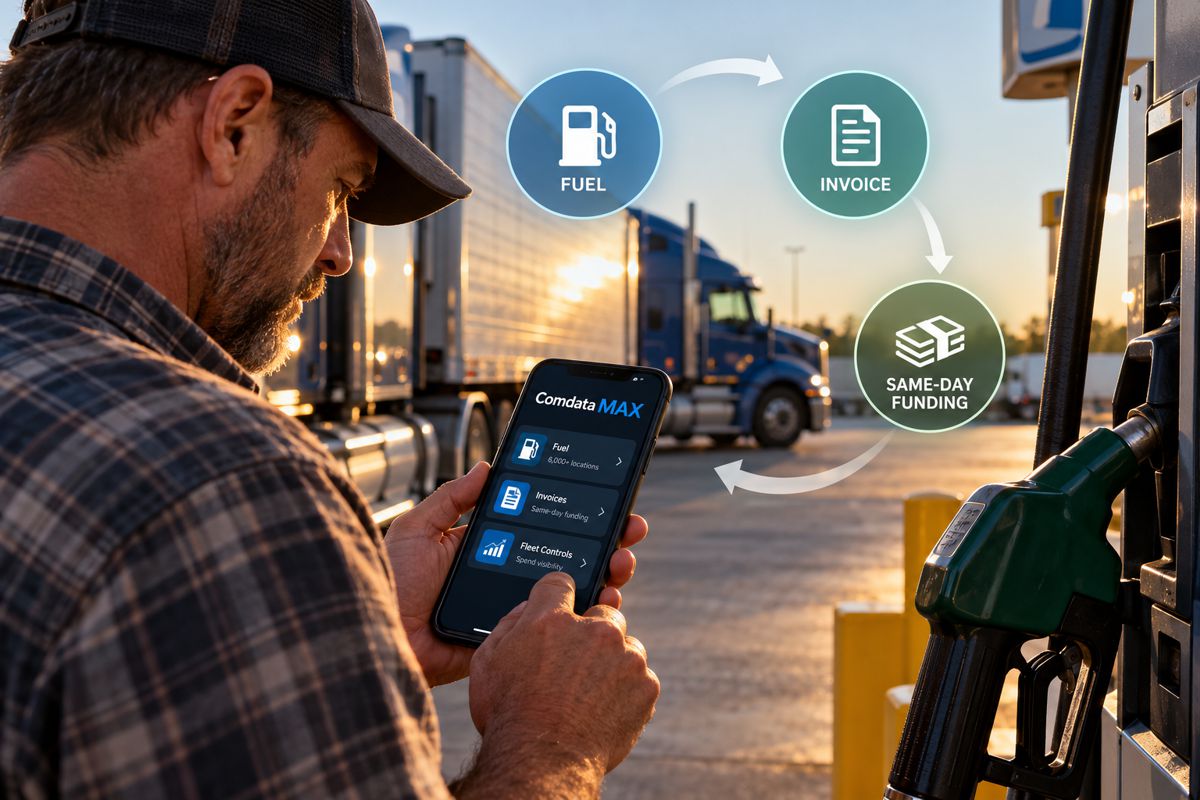
The arrangement allows carriers to manage fuel expenditure and submit invoices for funding through a connected service rather than maintaining separate relationships for the two functions. Comdata says the platform provides access to more than 6,000 fuel discount locations, alongside factoring with same-day funding available on approved invoices.
The proposition addresses an operating problem familiar to smaller carriers and owner-operators. A truck may have completed a profitable load, but the carrier still needs cash for diesel, wages, maintenance, insurance and the next journey long before the invoice for the previous one is settled. Comdata MAX brings fuel purchasing and invoice finance into the same operating cycle.
Briefing
- Comdata MAX combines Comdata fuel cards with freight factoring services provided through BridgeHaul.
- Comdata says its network provides more than 6,000 discount fuel locations, with potential diesel savings of up to $0.50 per gallon.
- Approved invoices can qualify for same-day funding, with payment available through fuel card, Express Pay or ACH.
- BridgeHaul operates a non-recourse factoring model, although individual invoices remain subject to eligibility and credit approval.
- The platform also provides fuel controls, expenditure visibility and access to credit information on more than 14,000 brokers and shippers.
Closing the Gap Between Delivery and Payment
Freight factoring exists because delivering a load and receiving payment for it are rarely simultaneous events. BridgeHaul describes conventional broker payment periods of 30, 60 or even 90 days, during which the carrier has already incurred most of the costs associated with moving the freight.
Factoring converts an eligible receivable into working capital sooner. The factoring company purchases the invoice at a discount and handles collection, allowing the carrier to receive the funds without waiting for the broker or shipper’s normal payment cycle. BridgeHaul says its programmes can provide a 100% advance, while its published guidance puts factoring rates across the industry at below 1% to around 4%, depending on the carrier, programme and volume. Its own website currently advertises an introductory 2.5% rate for the first 90 days, followed by rates adjusted according to monthly factoring volume.
Faster access to money therefore carries a cost, but insufficient working capital has costs of its own. A carrier unable to fund fuel, repairs or another load while waiting for customers to pay can find that an otherwise profitable freight operation is constrained by cash flow. Fuel is particularly suited to integration with factoring because diesel expenditure follows the truck continuously rather than appearing as an occasional capital purchase.
Comdata MAX allows factored funds to be directed to the fuel card as well as through Express Pay or ACH bank transfer. The result is a relatively short financial loop between completing a load, submitting the associated documents, obtaining funding and putting some of that money back into the truck.
Fuel Purchasing as a Financial Control
The fuel component extends beyond paying for diesel. Comdata says MAX provides real-time visibility of fuel expenditure together with configurable spending limits for individual drivers or vehicles. Those controls become increasingly useful as a carrier moves beyond a single owner-operated truck, allowing fuel cards to restrict where and how company funds are used while producing transaction data that would otherwise have to be assembled from receipts and separate payment records.
Comdata claims MAX users can access discounts at more than 6,000 locations nationwide, with diesel savings of up to $0.50 per gallon. Actual savings will depend on location, route, prevailing pump prices and the stations used, so the maximum discount should not be read as typical across every transaction.
The scale of the network broadens the proposition compared with a fuel programme tied to a relatively narrow group of truck stops. For long-distance fleets, geographical coverage can be as important as the headline discount because a cheaper fuel price has limited value if reaching it requires a significant diversion from the planned route.
Comdata has been operating in commercial payments since 1969, giving the fuel side of the partnership an established infrastructure, while BridgeHaul contributes the factoring and carrier-management technology. There is already overlap between their services: BridgeHaul has offered fuel cards alongside factoring and its transport management platform, while its existing documentation refers to Comdata as a partner in the fuel-card application process. MAX formalises that relationship into a Comdata-branded integrated proposition rather than introducing fuel and factoring as an entirely new combination.
Factoring Still Depends on the Invoice
Integration does not remove the underwriting behind freight factoring. Comdata describes MAX as offering straightforward approvals and non-recourse factoring without long-term contracts or setup fees, but BridgeHaul’s published terms provide more detail about how the underlying process works.
BridgeHaul retains discretion over which accounts it purchases and can establish overall receivable purchase limits as well as credit limits for individual debtors. Those limits can be adjusted according to factors including credit evaluation and payment performance. An invoice submitted through the platform is therefore not automatically eligible for funding simply because the carrier has been accepted onto the service.
BridgeHaul also operates a broker and shipper credit-checking system. Its guidance assesses counterparties using factors including payment history, authority and credit risk, and warns carriers that invoices involving higher-risk brokers may not be purchased. Access to more than 14,000 pre-approved brokers and shippers consequently gives carriers a way to examine payment risk before accepting work, rather than discovering after delivery that the resulting invoice is difficult to factor.
Financial information can therefore become part of the dispatch decision. A load may offer an acceptable rate per mile, but the quality and speed of the resulting receivable can affect its real commercial value, particularly for a carrier dependent on regular factoring to maintain working capital.
One Platform, Fewer Interfaces
A carrier using separate fuel-card and factoring providers has two accounts, potentially two sets of fees, separate applications and different systems for tracking expenditure and funding. MAX is intended to reduce that administrative separation.
“Fleets have been forced to juggle two sets of relationships, two platforms, and two sets of fees just to fuel their trucks and get paid on their loads. Comdata MAX ends that,” said Feras Chami, President & GM, Corpay North America Trucking. “We built this partnership with BridgeHaul to offer fleets one trusted app for everything that keeps their business moving with fuel savings and fast access to cash, together in one place.”
Comdata says MAX has no monthly card fee, setup fee or truck-stop fee, while the factoring service carries no long-term contract. Carriers can select how funded invoices are paid and obtain real-time visibility of fuel spending. There can still be costs associated with factoring and the method used to receive funds. BridgeHaul’s existing service, for example, publishes payout charges varying according to payment method, making the detailed terms more important to a prospective customer than the simplicity of the headline proposition.
For smaller operators, reducing the number of systems can have practical value. Large fleets can maintain specialist accounting, treasury, procurement and fuel-management functions, while an owner-operator or small fleet may have the same financial processes compressed into a handful of people. In some businesses, the person driving the truck may also be responsible for paperwork, invoicing and purchasing.
Connecting Fleet Operations
BridgeHaul has already been moving towards this type of integration through its existing carrier platform. Its mobile application supports invoice submission, document uploads, fuel location and load management, while its transport management system provides factoring and broker credit functions. Comdata MAX connects those capabilities more directly with Comdata’s fuel infrastructure.
Software used by smaller transport businesses is increasingly absorbing functions once handled through separate suppliers and administrative processes. Dispatch, documentation, payments, fuel purchasing, credit assessment and invoice finance can now occupy the same digital environment. Integration does not necessarily make each underlying service cheaper, nor does it remove credit risk, underwriting or the need to understand factoring agreements, but it can reduce the administrative distance between work performed on the road and the money required to keep vehicles operating.
For carriers working with narrow margins and limited cash reserves, the practical test will be how efficiently that connection works in everyday operation. Trucks consume fuel long before many freight invoices reach their normal payment date, leaving carriers to bridge the gap. Comdata MAX is an attempt to shorten that gap by moving completed freight, invoice funding and fuel purchasing into a more closely connected financial cycle.
Key Industry Questions
- What is Comdata MAX? Comdata MAX is an integrated fuel-card and freight-factoring platform combining Comdata’s commercial fuel network with factoring services provided through BridgeHaul.
- What is freight factoring? Freight factoring allows a carrier to sell eligible invoices to a factoring provider in return for faster payment rather than waiting for the broker or shipper to settle the invoice directly.
- Does Comdata MAX guarantee same-day payment? No. Comdata advertises same-day funding options for approved invoices. BridgeHaul’s terms allow it to determine which receivables it will purchase and to apply credit and funding limits.
- Is the factoring non-recourse? BridgeHaul describes its factoring programme as non-recourse. The precise allocation of risk and circumstances applying to individual invoices remains governed by the factoring agreement.
- How large is the Comdata MAX fuel network? Comdata says MAX provides access to more than 6,000 discount locations nationwide.
- How much can fleets save on diesel? Comdata advertises savings of up to $0.50 per gallon. This is a maximum claim rather than a guaranteed saving, with actual discounts dependent on fuel location and transaction.
- Can factoring proceeds be placed directly onto the fuel card? Yes. The company says carriers can choose between fuel-card funding, Express Pay and ACH bank payment.
- Does MAX remove the need to check brokers before accepting freight? No. Broker credit remains relevant because invoice eligibility depends partly on the quality of the debtor. BridgeHaul provides credit checks and access to a network of pre-approved brokers and shippers.
- Who is the platform likely to suit? The combination is principally relevant to owner-operators and small to medium-sized fleets where fuel expenditure and delays in receiving freight payments place pressure on working capital.
Strategic Takeaways
- Connecting factoring directly with fuel purchasing shortens the operational cash cycle between completing one load and funding the next.
- Broker credit quality becomes part of load selection when carriers depend on factoring to maintain working capital.
- Fuel-network coverage can be as commercially relevant as the maximum advertised discount for fleets operating over long routes.
- Integrated financial platforms can reduce administrative workload without removing factoring costs, underwriting or counterparty risk.
- The strongest appeal is likely to be among smaller carriers that lack the treasury and back-office resources available to large fleets.