Robotics and AI Bring Self-Driving Scientific Laboratories Closer to Reality
At one of the world’s most advanced scientific research facilities, an X-ray beam can be adjusted with extraordinary precision and detectors can generate more than a terabyte of data every second. Yet preparing an experiment may still involve hours of painstaking adjustments, with scientists moving between control rooms, positioning delicate samples and repeatedly checking whether the equipment is behaving as intended.
Some adjustments require the experiment to stop altogether. At the SLAC National Accelerator Laboratory in California, experimental stations must be sealed whenever powerful X-ray beams are operating, so even a minor manual alteration can mean shutting down the beam, entering the enclosure, repositioning equipment and restarting the process. For researchers working within tightly allocated periods of beamtime, these interruptions consume hours that could otherwise be spent investigating materials, molecules and physical processes.
The US Department of Energy is now supporting a project that could substantially change how these facilities operate. Led by SLAC, the Source-to-Discovery Platform for Instrumentation, Robotics and Embodied AI in DOE Photon Science Facilities, known as SPIRE, will bring together intelligent robotics, automated instrument control and real-time data analysis to develop laboratories capable of responding to their own experimental results.
Rather than automating individual procedures in isolation, the researchers want to connect the entire experimental process. Robotic systems would position samples and adjust instruments, artificial intelligence would interpret incoming measurements, and the results would inform what the equipment does next. Several of these capabilities are already operating independently at SLAC, providing the foundations for a much more ambitious effort to make scientific experiments increasingly autonomous.
Briefing
- SPIRE is a new Department of Energy-backed research project led by SLAC National Accelerator Laboratory to develop autonomous scientific laboratories.
- The collaboration includes Stanford University, the University of Chicago, Argonne, Brookhaven and Lawrence Berkeley national laboratories, alongside industry advisers.
- The programme concentrates on robotic sample handling, self-correcting X-ray and electron beams, and real-time experimental data analysis.
- Existing SLAC systems can reconstruct detailed particle-beam information in approximately five minutes, while AI agents are already assisting with selected scientific experiments.
- The project aims to create reusable autonomous laboratory technologies while retaining established hardware safety systems and human control of scientific objectives.
Teaching Laboratory Robots to Adapt
Robots are already familiar equipment in some of the world’s most sophisticated scientific laboratories, particularly where experiments involve large numbers of samples that must be handled with exceptional consistency. At SLAC’s Stanford Synchrotron Radiation Lightsource (SSRL), automated systems mount and centre fragile protein crystals for structural biology research, while a sample-changing robot supports investigations into new materials through a programme that allows researchers to send specimens to the facility for analysis.
These machines are highly effective at the procedures for which they were designed, but their precision comes with limitations. A robot programmed to handle a particular sample or follow a specific sequence cannot necessarily cope when the next experiment involves unfamiliar equipment, a different material or an object requiring a more delicate touch. Researchers may therefore find themselves returning to manual operations whenever an experiment falls outside the robot’s established capabilities.
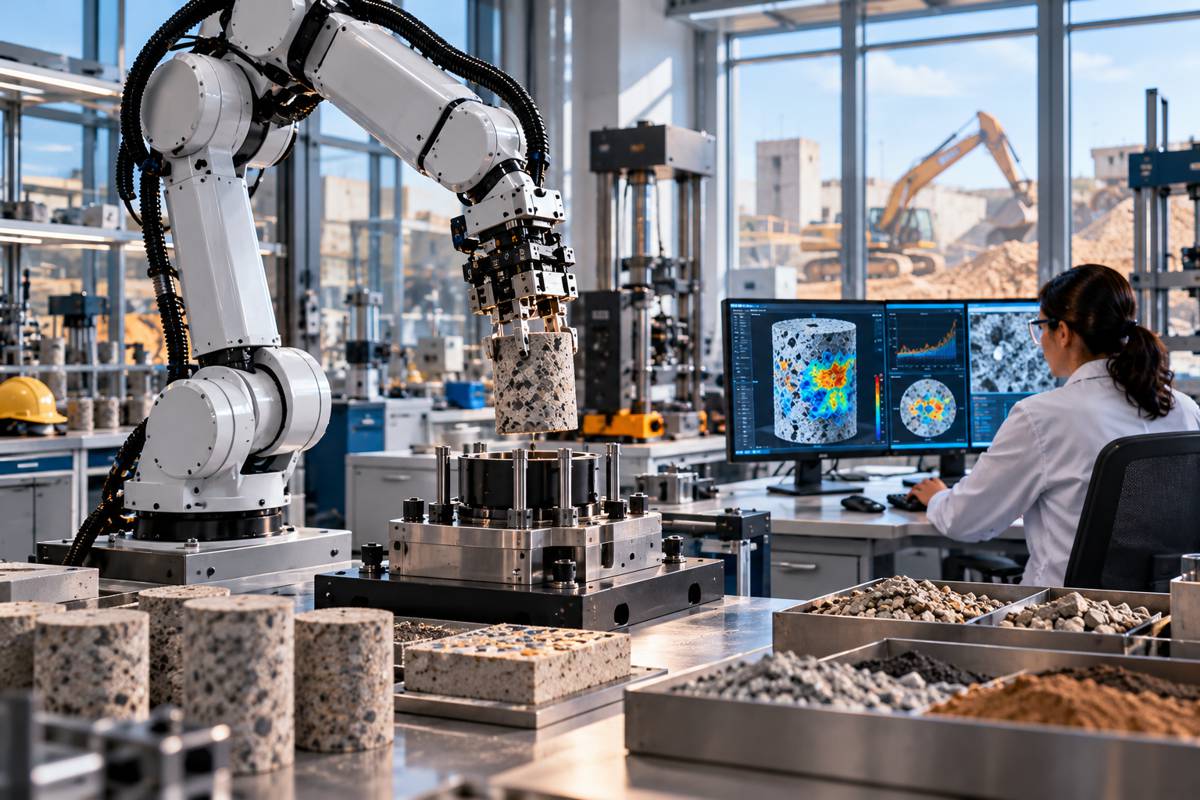
SPIRE intends to extend this flexibility through embodied AI, combining intelligent decision-making with sensors and robotic controls that allow machines to respond to their physical surroundings. Working with Stanford University’s Movement Lab and ARMLab, SLAC researchers are developing systems that could recognise different experimental conditions and adapt their movements rather than relying entirely on predefined instructions.
Dean Skoien, a staff engineer at SSRL and SPIRE co-principal investigator, explained the limitations of existing equipment: “Today, we have robotic controls that can do one very specific task within tight boundaries, over and over again with incredible consistency.” The next generation, he said, would be “far more dynamic, able to handle heterogeneous tasks with tactile sensing and a delicate, precise touch.”
Developing that capability for a scientific laboratory is considerably more demanding than automating a repetitive industrial process. Samples may be microscopic, fragile, unusually shaped or sensitive to environmental conditions, while the instruments surrounding them often require extremely accurate positioning. A robotic system must be able to recognise these constraints and respond without compromising the experiment.
The work could also address the interruptions caused by adjustments inside sealed experimental stations. Instead of stopping an X-ray beam whenever an instrument needs repositioning, suitable robotic equipment could make changes within the protected enclosure while researchers remain outside. Such operations would still have to comply with the facility’s established safety systems, but they could remove some of the repeated manual interventions that currently interrupt experimental work.
Making Particle Beams Self-Correcting
The machinery producing the beams presents another demanding problem. At SLAC’s Linac Coherent Light Source (LCLS), scientists use intense X-ray pulses to investigate the behaviour of atoms and molecules, with each experiment requiring carefully selected beam characteristics. Energy, brightness, dimensions and pulse duration must be adjusted to suit the material and the process under investigation, often involving several interconnected sections of the accelerator.
Historically, achieving the required conditions could involve lengthy exchanges between operators working in different control rooms. An adjustment upstream might affect the beam reaching an experimental station further along the machine, requiring new measurements and additional corrections before the experiment could proceed.
Dionisio Doering, a SLAC staff engineer and SPIRE co-principal investigator, described how operators previously approached the task: “Historically, operators tackled this tuning in pieces, iterating between subsystems and coordinating by phone between the accelerator and experimental control rooms to see how small upstream changes affected the experiment downstream.”
SLAC has already made progress in automating parts of this work. Existing systems capture images of the beam downstream and transfer the measurements to the SLAC Shared Science Data Facility, where machine learning and detailed physics simulations reconstruct its behaviour. The resulting information can be returned to the control room in approximately five minutes, giving operators a much clearer picture of how the beam is performing.
The proposed SPIRE architecture would take this further by introducing an intelligent control layer capable of coordinating adjustments across multiple subsystems. Instead of following a fixed tuning sequence, the system would examine live detector measurements, consider the scientific objectives and determine which controls or algorithms should be used to refine the beam.
Frederic Poitevin, head of AI for science and operations at LCLS and SPIRE co-principal investigator, described the intended distinction: “Where an automatic workflow follows a fixed script, an autonomous system incorporates SI agents that understand high-level scientific goals and determine which tools, algorithms and parameters to use, without manual human intervention.”
SLAC has already demonstrated machine-learning techniques that accelerate beam tuning in its ultrafast electron camera, where adjustments previously required hours of expert attention. Extending that capability across an entire accelerator, however, introduces additional complications. The behaviour of interconnected equipment must be understood well enough for the controller to make reliable adjustments, recognise unusual conditions and remain within the operating limits established by the facility.
The research therefore combines advances in machine learning with the physics models and control systems already used to operate these instruments. SPIRE’s proposed autonomous layer would sit above existing subsystem controls rather than replace the underlying machinery and its established protections.
When Experimental Data Directs the Next Measurement
Even a perfectly adjusted instrument presents researchers with a formidable problem once measurements begin. Modern scientific facilities can produce information at a rate that overwhelms conventional analysis workflows, leaving scientists with enormous datasets that may take days, weeks or considerably longer to process.
At full power, detectors associated with SLAC’s upgraded X-ray laser are expected to generate more than a terabyte of data per second. Handling information at that scale requires substantial computing infrastructure, but transferring and storing the measurements is only part of the challenge. Researchers must also determine which observations are useful, whether the experimental conditions remain suitable and what additional measurements might be needed.
Traditionally, much of this interpretation takes place after the experimental session. Scientists collect their measurements, process the results and may discover that a different sample position, beam setting or acquisition sequence would have provided more useful information. By then, their allocated time at the facility may have ended.
SLAC is developing systems that bring analysis much closer to the instruments themselves, allowing experimental measurements and operational information to be processed while the experiment continues. Data describing sample alignment, beam conditions and scientific observations can be streamed to computing facilities, where machine-learning models reconstruct results and provide information that can guide subsequent operations.
Early versions of this approach are already moving live experimental data from SSRL to SLAC’s Shared Science Data Facility. In selected applications, AI agents can interpret incoming measurements alongside information about the experiment and adapt the acquisition process, including determining when sufficient information has been collected.
The laboratory is also investigating intelligent detector electronics capable of making initial decisions about data within millionths of a second. Processing information close to the point of collection could help manage the enormous data streams generated by advanced instruments, while more sophisticated analysis continues on dedicated computing systems.
A demonstration involving battery imaging provides a practical example of how these technologies are beginning to work together. During a Department of Energy American Science Cloud demonstration, SLAC researchers used a team of AI agents to coordinate the analysis of measurements collected at an SSRL beamline.
The agents transferred raw experimental data to a computing facility at another national laboratory, reconstructed the battery sample in three dimensions and applied a foundation vision model to identify individual particles within the resulting images. Throughout the process, large language model-based agents coordinated the different tools, examined intermediate results and checked their quality before allowing the workflow to proceed.
The demonstration brought together several activities that would ordinarily demand continuous attention from researchers familiar with the instruments, reconstruction software and image-analysis techniques. Although the system did not independently operate the entire physical experiment, it showed how AI agents could manage a complex scientific computing workflow spanning different facilities.
The same agent-based framework has since been deployed on another SSRL beamline, where agents have monitored an operating instrument continuously for weeks while a human remained at the controls.
Tim Dunn, a SLAC staff engineer and SPIRE co-principal investigator, said: “The same agentic framework is now deployed on a second SSRL beamline, where agents have kept watch over a working instrument around the clock for weeks while a human stays at the controls. It is the groundwork for experiments that can eventually run themselves.”
SPIRE will attempt to connect these analytical capabilities directly with robotic manipulation and instrument control. Measurements could then influence how a sample is positioned, how a beam is adjusted or whether another observation is required, creating a continuous exchange between the physical experiment and the computing systems interpreting its results.
Extending Autonomous Research Across Different Facilities
SLAC’s scientific instruments differ considerably in their design and operation. The Stanford Synchrotron Radiation Lightsource, Linac Coherent Light Source and MeV-UED instrument use different technologies to investigate materials and physical processes, while other Department of Energy laboratories operate their own specialised accelerators, detectors and experimental stations.
Despite these differences, researchers encounter many of the same practical problems. Samples must be prepared and positioned, instruments calibrated, measurements collected and results analysed before decisions can be made about the next stage of an investigation. SPIRE’s developers hope to create software and control methods that can accommodate these recurring activities without requiring every facility to develop an entirely separate autonomous system.
Auralee Edelen, SLAC’s lead scientist and head of the Accelerator Directorate’s Machine Learning Department, said: “Our goal is to build tools for generalizable autonomous labs that can be applied to many different experimental scenarios.”
She added: “These same workflow patterns show up again and again across facilities, so what we are building here can translate broadly to other cases.”
The approach has similarities with advanced industrial automation, where robotic equipment, sensors and production machinery increasingly exchange information through interconnected control systems. Scientific laboratories present a more unpredictable environment, however, because experiments are often designed to investigate behaviour that is not yet fully understood. The equipment may need to respond to unexpected measurements, unfamiliar samples or operating conditions that change during the investigation.
Building systems capable of handling that uncertainty is one of SPIRE’s principal challenges. A successful autonomous laboratory must be sufficiently flexible to accommodate different scientific objectives while remaining reliable enough for routine operation on complex and expensive instruments.
SLAC researchers are therefore examining how AI systems can be tested, supervised and maintained as they move beyond individual demonstrations. The laboratory intends to retain the hard-wired safety mechanisms that already protect personnel and equipment, with autonomous controls operating within those boundaries and scientists continuing to establish the objectives of each experiment.
The work also builds on SLAC’s existing research into accelerator optimisation, machine learning, edge computing and scientific data processing, alongside the Department of Energy’s wider Genesis Mission. The SPIRE collaboration includes Stanford University, the University of Chicago, Argonne National Laboratory, Brookhaven National Laboratory and Lawrence Berkeley National Laboratory, with additional input from industry advisers.
Much of the technology needed for autonomous experimentation has already been demonstrated in individual applications. Robots can manipulate delicate samples, machine-learning systems can help tune particle beams, and AI agents can coordinate scientific data processing across computing facilities. Bringing those capabilities into a dependable system that can operate across different instruments is the task now facing SPIRE’s researchers.
For scientists arriving at a major research facility with only a limited period of access to its instruments, the practical ambition is straightforward: spend less of that time preparing equipment, correcting settings and waiting for analysis, and more of it conducting experiments. Whether autonomous systems can eventually manage that process from beginning to end will depend on how successfully SLAC translates its existing demonstrations into the demanding environment of everyday scientific research.
Key Industry Questions
- What is an autonomous laboratory? An autonomous laboratory combines robotics, artificial intelligence, scientific instruments and computing systems to conduct experiments with reduced human intervention. Researchers define the scientific objectives while automated systems manage selected experimental operations and respond to measurements.
- What is the SPIRE project? SPIRE is a research programme led by SLAC National Accelerator Laboratory to develop autonomous experimental systems for Department of Energy photon science facilities. Its principal areas are robotic sample handling, intelligent beam control and real-time data analysis.
- How does embodied AI differ from conventional laboratory robotics? Conventional laboratory robots generally perform predefined procedures. Embodied AI aims to enable robotic systems to interpret sensor information, respond to changing physical conditions and adapt their movements to unfamiliar tasks.
- Can artificial intelligence control particle accelerators? Machine-learning systems already assist with accelerator optimisation and beam tuning. SPIRE aims to extend these capabilities through autonomous controllers that coordinate adjustments across multiple subsystems while operating within established safety limits.
- Why is real-time data analysis useful in scientific experiments? It allows researchers to interpret measurements while an experiment remains active, making it possible to adjust instrument settings, collect additional information or stop an acquisition once sufficient data has been obtained.
- Which industries could benefit from autonomous laboratory technologies? Battery development, semiconductor research, pharmaceuticals, advanced materials and energy technology could benefit from faster experimental characterisation and more efficient use of specialised scientific instruments.
- Have fully autonomous scientific laboratories already been demonstrated at SLAC? SLAC has demonstrated individual capabilities, including automated beam tuning, robotic sample handling and AI-coordinated data processing. SPIRE aims to integrate these into more comprehensive autonomous experimental systems.
- Will autonomous laboratories replace scientists? The SPIRE programme is designed to automate repetitive and technically demanding operations while scientists retain responsibility for research objectives, experimental oversight and scientific interpretation.
Strategic Takeaways
- Connecting sample handling, instrument control and data analysis could improve the productivity of expensive scientific research facilities.
- Embodied AI offers a route towards laboratory robots capable of handling varied samples and experimental tasks rather than repeating narrowly programmed procedures.
- Real-time data processing could allow experiments to adapt while measurements are being collected, reducing the need for subsequent experimental sessions.
- Reusable autonomous control systems may help laboratories share developments across different instruments and research facilities.
- Reliable operation, compatibility with existing equipment and established safety controls will determine how quickly autonomous laboratories become practical research tools.