ESAB Introduces ROBBI AI for Adaptive Robotic Welding
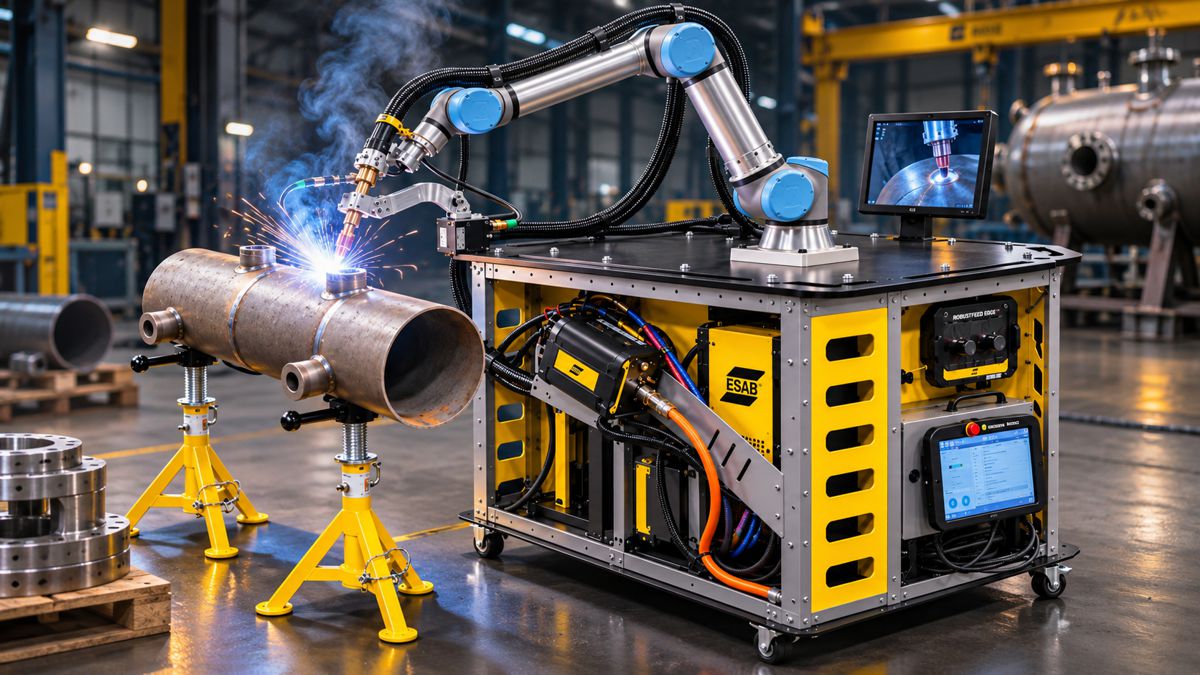
ESAB has introduced a collaborative robotic welding system that can identify weld joints, generate welding paths and adjust its movements as conditions change. Known as ROBBI AI, the system is designed to automate MIG and TIG welding operations that have traditionally required extensive programming or experienced manual welders.
Using camera and laser sensing, the system assesses joint geometry and determines how to proceed within established welding procedures. Its intended applications include pipe fabrication, specialist manufacturing and workshops handling varied components in small production batches.
Introduced by ESAB, ROBBI AI uses locally processed artificial intelligence to control welding operations without requiring an operator to teach every movement. The system can also respond to variations in joint fit-up, adjusting its welding motion and selected process parameters while work is underway.
Briefing
- ESAB has introduced ROBBI AI, a collaborative robotic welding system using physical AI for MIG and TIG applications.
- Camera and laser sensing allow the system to identify joints and generate welding paths without conventional manual path teaching.
- Welding motion and process parameters can be adjusted in response to changing joint conditions.
- Local AI processing, weld recording and integration with welding procedure controls are intended to support quality management.
- The system uses Universal Robots collaborative arms and supports selected ESAB and EWM welding power sources.
Moving Beyond Pre-Programmed Welding Paths
Conventional robotic welding depends heavily on preparation. Components must be positioned consistently, welding paths established and the process configured to accommodate the expected geometry. Seam-tracking systems can compensate for some variation, but significant differences in joint gaps or component alignment may still require intervention.
These requirements are manageable in repetitive manufacturing, where programming and fixturing costs can be spread across thousands of identical parts. They become less attractive when a fabrication workshop handles numerous different components, short production runs or assemblies that vary from one job to the next.
ROBBI AI is designed to reduce that preparation burden. The operator positions the robot at or near the intended joint and supplies the relevant welding procedure information, including material, consumables and joint type. The system then uses its sensing equipment to identify the joint and generate the required welding path.
ESAB says the process can accommodate multiple components positioned on a welding table without requiring each path to be taught manually.
Dan Colvin, Vice President, Advanced Technology Solutions at ESAB, explained the approach. “Physical AI brings intelligence directly into the welding process,” says Colvin. “Instead of programming every movement and anticipating every possible variation, ROBBI AI assesses the joint, determines how to proceed and can make adjustments while welding.”
If the gap between components increases or decreases during welding, the system can modify travel motion, torch oscillation or welding parameters within the limits established for the application.
Keeping Artificial Intelligence Within Welding Procedures
Allowing a robot to make welding decisions introduces an engineering constraint that is less obvious than the ability to identify a joint.
Welding quality depends on controlling the process within an approved set of parameters. Depending on the application, these can include current, voltage, travel speed, consumable selection and other variables that influence weld characteristics.
An AI system capable of adjusting those variables must therefore operate within the boundaries of the applicable welding procedure specification, or WPS. Greater freedom to adapt cannot automatically take precedence over the requirements governing the finished weld.
ESAB has integrated its existing InduSuite software into the approach to help maintain those boundaries.
“We use our existing InduSuite software to help keep AI-driven welding decisions within predefined welding procedure specifications and qualification requirements,” says Colvin. “ESAB’s approach is designed to reduce the risk of AI-driven adjustments that could result in welding outside those specifications or with an unapproved procedure.”
The distinction between adaptive control and unrestricted decision-making is particularly relevant in infrastructure fabrication, pressure systems and other applications where weld quality must be demonstrated against defined requirements.
ROBBI AI is also designed to recognise conditions that could compromise a weld and stop the operation rather than continue outside acceptable parameters.
The manufacturer’s announcement does not provide independent qualification results for specific welding applications. Fabricators would still need to establish how the system fits their own procedure approval, inspection and quality assurance arrangements. AI-assisted process control does not itself establish that a completed weld meets the applicable acceptance criteria.
Learning from Completed Welds
ESAB describes ROBBI AI as a system capable of improving its recognition of welding conditions through accumulated operating experience.
Before deployment, the AI undergoes simulation-based learning. Once installed in a fabrication facility, it collects welding data and associated video, creating a record of completed operations and the conditions encountered during welding.
These records can be used to investigate defects, review process behaviour and provide feedback intended to improve the system’s response to similar situations. If a potentially unacceptable condition is detected, the system can stop welding and allow an operator to examine the recorded information.
The AI processing takes place on a computer within the customer’s facility rather than relying on continuous communication with a remote cloud service. This arrangement supports local decision-making and allows welding data to remain onsite.
Video and operating records can provide additional evidence for investigating recurring defects, reviewing production conditions and understanding how a particular weld was executed.
The extent to which ROBBI AI improves its performance through continued learning, and whether those improvements translate into measurable reductions in defects or rework, has not yet been established through independently published production results.
Applications in Pipe Fabrication and Specialist Manufacturing
Pipe fabrication is one of the applications ESAB has identified for the system, including work associated with data centres and other infrastructure developments.
Such fabrication can involve numerous joints, different pipe geometries and demanding quality requirements. Depending on the materials and specification, TIG welding may be required for particular operations, while MIG processes can be used elsewhere in the production sequence.
The commercial challenge is familiar to specialist fabrication workshops. Skilled welders require extensive training, and their expertise is often needed on jobs where production volumes are too small to justify elaborate conventional automation.
In pipe fabrication, the practical difficulties extend beyond following a weld seam. Joint preparation, component alignment, access around the circumference and the position in which welding takes place can all influence the operation. Some assemblies can be rotated or repositioned to simplify welding, while others require the welding equipment to work around a fixed component.
ROBBI AI’s ability to assess joint geometry and adapt its movement could reduce programming requirements for suitable workpieces. The manufacturer has not, however, established which pipe positions, joint configurations or access constraints have been qualified for automated operation.
Joint preparation, material condition, component positioning and inspection requirements remain part of the fabrication process. Nor does adaptive welding eliminate the need for qualified personnel to establish procedures, supervise production and assess completed work.
The system may be particularly attractive where a workshop can combine skilled welding supervision with a steady flow of varied fabrication work, allowing the robot to handle suitable operations without extensive programming for each new component.
Collaborative Robot and Welding Equipment Configuration
ROBBI AI is based on an ESAB collaborative welding arrangement using either a Universal Robots UR10e or UR20 robotic arm.
The system can be configured with a seventh axis to extend its operating envelope, while a wheeled cart arrangement allows equipment to be repositioned around the workshop.
Supported welding power sources include the EWM Titan XQ, EWM Tetrix XQ and ESAB Aristo Edge 500R.
The Titan XQ supports conventional and advanced welding processes, including EWM React, which actively controls wire movement and droplet transfer. EWM claims the process can deliver faster welding and reduced heat input compared with conventional short-arc welding under specified conditions.
For TIG applications, the Tetrix XQ can be combined with EWM’s tigSpeed wire-feeding technology, which supports continuous cold-wire and hot-wire feeding. EWM claims its hot-wire arrangement can increase deposition rates by up to 60% compared with manual TIG welding.
These performance figures relate to the welding processes and equipment rather than independently demonstrated results for ROBBI AI as a complete system.
ESAB also retains conventional cobot operation as an option, allowing operators to disable full-AI functionality and use more traditional robot control methods where appropriate.
The Economics of Flexible Welding Automation
The financial case for robotic welding has traditionally been strongest where equipment utilisation is high and the same operations are repeated frequently.
High-mix fabrication presents a different calculation. A robot may weld considerably faster than a manual operator, yet spend much of its available production time waiting for new programmes, fixture adjustments or component changeovers.
In a workshop producing hundreds of identical assemblies, that preparation can be justified by the volume of subsequent work. For a fabricator producing ten different assemblies in a day, programming overhead can consume much of the potential productivity advantage.
By reducing manual path teaching and accommodating variation during welding, ROBBI AI is intended to address some of those costs.
The actual return will depend on component complexity, changeover frequency, welding time, supervision requirements and the amount of rework avoided. ESAB has not provided comparative production trials, system pricing or payback figures in the announcement.
Fabricators will also need to consider the cost of integrating the equipment into existing welding procedures and production arrangements. The ability to generate a weld path automatically is only one part of a production process that includes preparation, handling, inspection and quality documentation.
For specialist fabrication businesses supplying construction, energy and infrastructure projects, the commercial test will be straightforward: whether ROBBI AI can produce consistently acceptable welds across varied workpieces while reducing the time and cost spent preparing the robot for each job.
Key Industry Questions
- What is ESAB ROBBI AI? ROBBI AI is a collaborative robotic welding system that uses artificial intelligence, cameras and laser sensing to identify weld joints and adapt welding operations.
- Which welding processes does ROBBI AI support? The system supports MIG and TIG welding through compatible ESAB and EWM power sources.
- Does ROBBI AI require manual path programming? It is designed to generate welding paths automatically, reducing the need for conventional manual path teaching.
- Can the system compensate for inconsistent joint gaps? According to ESAB, it can adjust welding motion and selected process parameters as joint conditions change, within established procedure limits.
- Does ROBBI AI require cloud connectivity? ESAB states that AI processing takes place locally without requiring continuous cloud communication. The announcement does not specify every connectivity requirement for the complete installation.
- Can ROBBI AI replace qualified welders? The system automates aspects of welding execution, but qualified personnel remain necessary for procedure selection, production supervision and quality assurance.
- Which robotic arms are supported? The announced configuration uses Universal Robots UR10e or UR20 collaborative robot arms.
- Can the system record welding operations? Yes. ESAB says it collects welding data and associated video for review, defect investigation and feedback.
- Is ROBBI AI suitable for pipe fabrication? ESAB identifies pipe fabrication as a target application. Suitability for particular joints and operating conditions depends on the relevant welding procedures, qualifications and inspection requirements.
- Has ESAB published productivity results for ROBBI AI? The announcement does not provide independently verified productivity, defect-rate or payback figures for the complete system.
Strategic Takeaways
- Automatic weld-path generation could reduce programming overhead in workshops handling varied components and short production runs.
- Adaptive welding control must remain compatible with approved welding procedures and qualification requirements.
- Local AI processing offers an alternative to cloud-dependent control for fabrication environments handling sensitive production data.
- Pipe fabrication and specialist TIG work are plausible early applications because of their technical demands and dependence on skilled labour.
- Demonstrated weld quality, changeover time, equipment utilisation and total operating cost will determine the system’s commercial competitiveness.