Is AI About to Reinvent How Construction Professionals Learn?
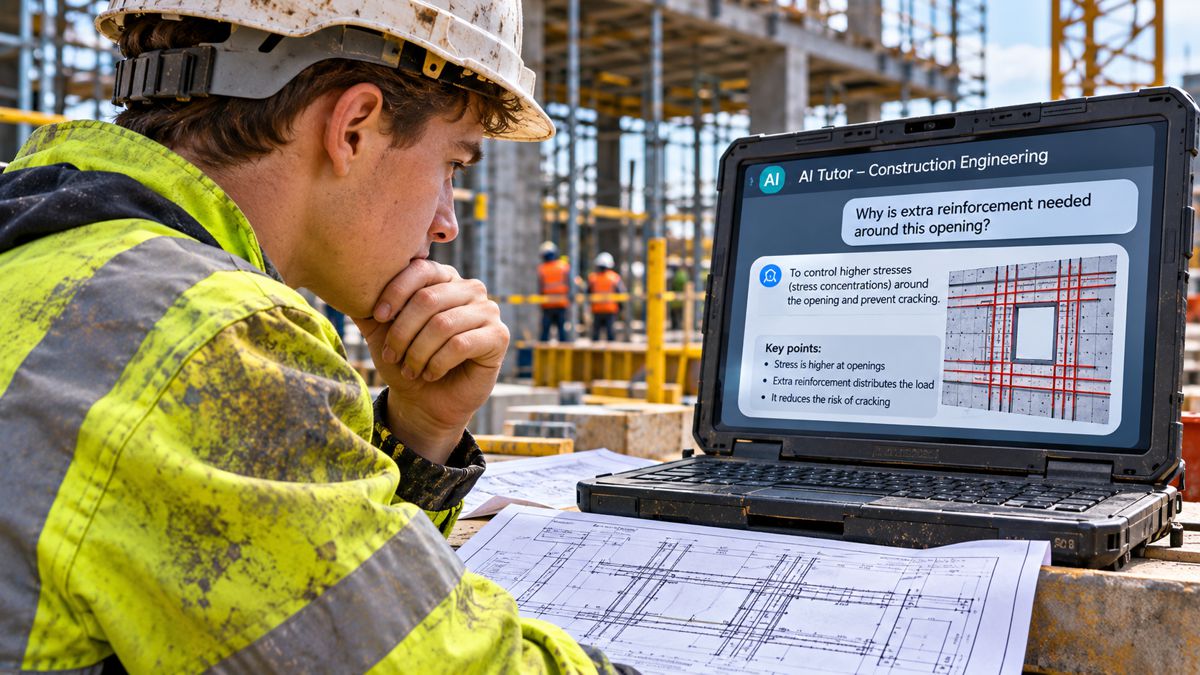
A young construction worker examining a structural drawing may understand where the reinforcement needs to go without fully appreciating why it has been specified. They can see the arrangement of steel, follow the dimensions and carry out the work, but the engineering principles behind the design may remain something of a mystery. Until recently, understanding those principles would usually have meant asking an experienced colleague, consulting a technical manual or enrolling in further education.
Today, the same worker could ask an artificial intelligence system to explain how reinforced concrete behaves under load, why additional steel might be required around an opening or how bending moments influence structural design. They could explore the calculations, ask follow-up questions and work through examples at their own pace. The explanations would still need to be checked against reliable technical sources, but an opportunity to learn that once depended on access to a specialist is becoming much more widely available.
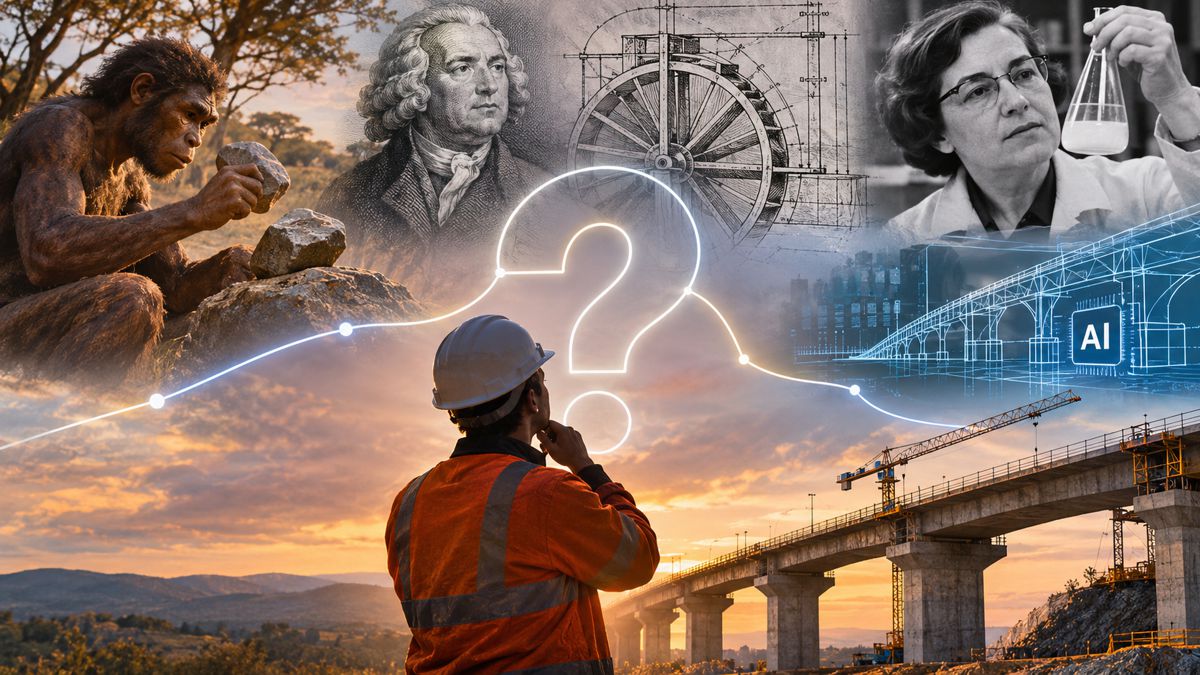
For an industry built on practical experience, technical knowledge and the transfer of skills between generations, this raises a substantial question about how people should be educated. AI could make it easier for construction professionals to develop their understanding throughout their careers, potentially changing the relationship between apprenticeships, formal education, mentoring and professional qualifications.
Briefing
- AI tutoring systems can provide personalised explanations, exercises and feedback adapted to individual learning needs.
- The UK’s Construction Industry Training Board estimates that 41,200 additional construction workers will be needed annually between 2026 and 2030.
- A 2025 Harvard University study involving 194 students found stronger learning outcomes using a purpose-built AI tutor than through conventional active classroom learning.
- Practical experience, mentoring and independently assessed competence remain essential for engineering and safety-critical construction work.
- AI could make advanced technical education more accessible to experienced tradespeople, equipment operators and construction professionals seeking career progression.
The Problem with Learning Everything Before Starting Work
Construction has always offered different routes into professional employment. Apprenticeships, vocational training, technical colleges and universities provide varying combinations of theoretical knowledge and practical experience. Yet the sequence in which people acquire these skills has often depended more on established educational pathways than on when they are best prepared to understand the material.
A university graduate may understand the mathematics of structural loading without having seen how a reinforcement cage is assembled on a difficult site. An experienced groundworker may recognise the warning signs of unstable excavation conditions immediately, despite having little formal knowledge of soil mechanics. Both possess valuable expertise, although their understanding has developed through very different experiences.
Formal education frequently expects young people to absorb considerable amounts of information before they encounter the circumstances in which it becomes useful. Subjects such as mathematics, mechanics and materials science can seem remote from everyday experience, particularly when students have little practical exposure to the industries in which those principles are applied.
Consider someone who has spent five years working with asphalt production and paving operations. They may have observed how material temperature affects compaction, how different aggregates influence mixture behaviour and how weather conditions complicate pavement construction. When that person subsequently studies bitumen rheology, materials engineering or pavement design, the theoretical concepts have an immediate connection to situations they already understand.
The same applies to plant operators who progress into mechanical engineering, survey technicians moving into civil engineering or experienced supervisors studying construction management. Their practical experience gives them a foundation on which more advanced academic knowledge can be built.
There is a strong argument for allowing more people to enter technical occupations, acquire meaningful experience and specialise academically later. This does not diminish the value of university education or the need for properly qualified engineers. It recognises that learning can be more effective when people understand why they need the knowledge being taught.
AI could make these transitions easier by helping workers refresh forgotten subjects, develop academic confidence and prepare for recognised qualifications without having to return immediately to full-time education.
A Personal Tutor for Every Construction Worker
Individual tutoring has long offered advantages over teaching large groups, particularly when learners have different levels of knowledge and experience. The difficulty has been providing that attention affordably and consistently.
Generative AI offers a possible alternative. A suitably designed tutoring system can ask questions, identify gaps in understanding, provide additional exercises and adjust explanations according to the learner’s responses. Someone struggling with the fundamentals of hydraulic pressure might receive a practical explanation based on an excavator circuit, while an experienced maintenance technician could explore pump efficiency, pressure losses and electronic control systems.
There is already evidence that carefully developed AI tutors can improve educational outcomes.
In a 2025 randomised controlled study published in Scientific Reports, researchers at Harvard University examined the effectiveness of a purpose-built AI tutor in undergraduate physics education. The study involved 194 eligible students and found that participants using the AI system achieved stronger learning outcomes in less time than those receiving conventional active classroom instruction. Students also reported higher engagement and motivation.
The research is particularly interesting because the tutoring system was designed around established educational principles rather than simply allowing students to question a general-purpose chatbot. It provided structured guidance and feedback intended to encourage learning rather than merely supply answers.
The findings should nevertheless be interpreted carefully. The experiment involved university physics students, not construction apprentices or experienced engineers, and it did not test practical competence. Its results demonstrate the potential of a particular educational approach rather than proving that AI tutoring will be equally effective across every technical occupation.
For construction training, the opportunities extend well beyond answering questions from textbooks. A learning system could draw on verified engineering references, manufacturer documentation, training materials and approved technical standards. Learners could work through progressively more difficult exercises while instructors monitor their understanding and identify areas requiring additional support.
Such systems would be particularly valuable where specialist instruction is difficult to access. A worker in a remote infrastructure project could study technical principles between formal training sessions, while someone preparing for a professional qualification could concentrate on the subjects they find most difficult.
Learning from Problems Encountered on Site
A substantial proportion of construction knowledge is acquired when something does not go according to plan. Ground conditions differ from the site investigation, a concrete pour becomes difficult because of restricted access, or the intended construction sequence proves impractical once temporary works and equipment movements are considered.
These situations require observation, judgement and an appreciation of how decisions affect other activities. They also create valuable opportunities for learning, particularly when less experienced workers can discuss the problem with knowledgeable colleagues.
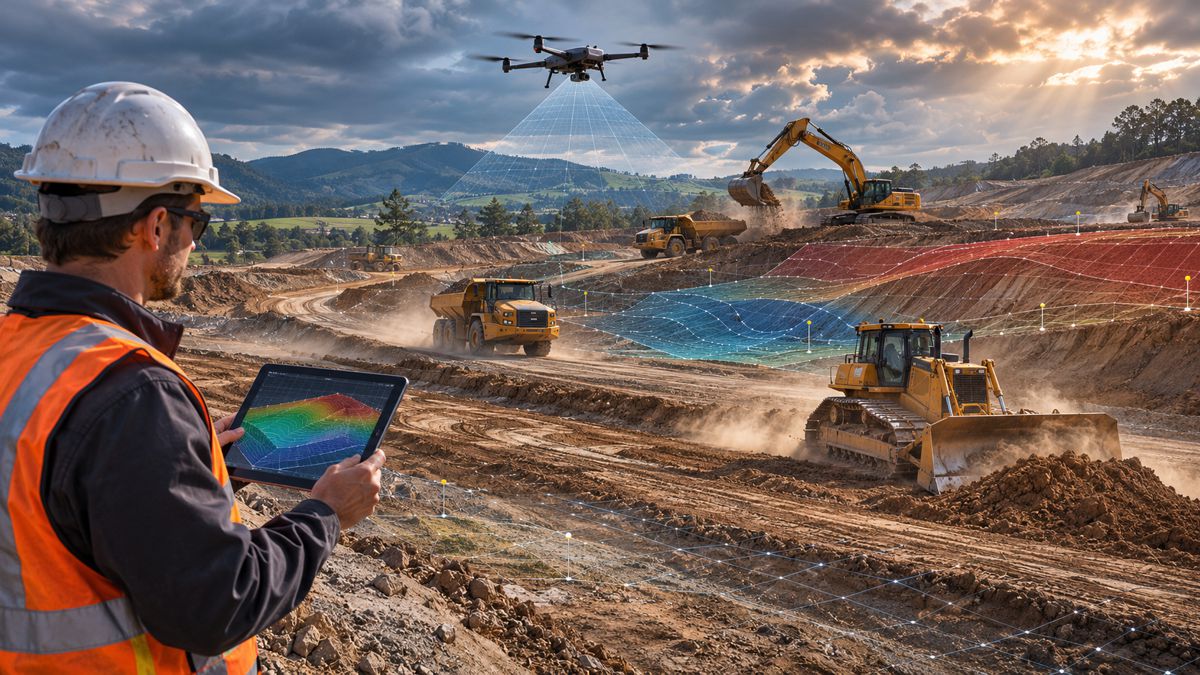
An excavator operator moving into GPS-guided machine control provides a useful example. Someone who has spent years operating conventional equipment already understands excavation, grading and the practical limitations of working around other machinery. What may be unfamiliar are coordinate systems, digital terrain models, positioning accuracy and the relationship between survey control and the machine’s guidance display.
AI-supported learning could help explain those principles using practical examples familiar to the operator. The learner could explore how positioning systems work, why calibration and verification are necessary, and how errors in digital design information might affect the finished work. Formal equipment training and competent supervision would still be required, but the underlying technology could become considerably easier to understand.
A similar opportunity exists in asphalt and pavement engineering. An experienced paving technician may recognise changes in mixture behaviour from years of practical work without being familiar with the laboratory tests and material models used by pavement designers. AI could provide structured explanations of binder properties, aggregate grading, air voids and the relationship between temperature, compaction and long-term performance.
These applications would need clearly defined boundaries. An AI-generated explanation is not an approved engineering design, a substitute for manufacturer instructions or permission to modify a construction procedure. Technical decisions must continue to follow applicable standards, established approval processes and competent professional supervision.
Used appropriately, however, the technology could help workers understand the reasoning behind decisions they encounter every day. That knowledge can make discussions with supervisors, engineers and specialist contractors more productive.
Universities and the Changing Role of Technical Education
Universities and technical colleges have traditionally combined knowledge transfer with assessment, experimentation and professional development. AI could alter the balance between these activities, particularly in subjects where learners benefit from repeated explanations and opportunities to practise.
Recorded lectures, online courses and digital textbooks already allow students to study independently. AI adds an interactive element, enabling learners to question explanations, explore alternative approaches and work through difficulties without waiting for the next scheduled teaching session.
Engineering education is well suited to this kind of support. Mathematics, fluid mechanics, structural analysis and materials science frequently require students to build their understanding progressively. A misunderstanding in one area can prevent them from following more advanced material, even when they are otherwise capable of completing the course.
An AI tutor could identify weaknesses through targeted exercises and provide further instruction before the learner progresses. Teachers would then have more opportunities to concentrate on practical demonstrations, laboratory work, collaborative projects and the application of engineering principles.
The approach could also make advanced education more accessible to people already working in construction. Part-time degrees, distance learning and degree apprenticeships provide established alternatives to conventional full-time university attendance, but returning to academic subjects can still be intimidating after several years away from formal education.
An experienced site supervisor preparing for a construction management qualification might need to revise mathematics before studying cost forecasting or project controls. A survey technician pursuing an engineering degree could refresh trigonometry, coordinate geometry and statistics before attempting more demanding modules. AI-supported preparation could help them identify and address weaknesses at their own pace.
Educational institutions would still need to establish whether students can perform calculations, evaluate evidence and exercise independent judgement. Assessment methods may increasingly have to distinguish between work completed with AI assistance and the knowledge individuals can demonstrate without it.
The opportunity is to use technology to make the process of acquiring knowledge more flexible while preserving rigorous standards for demonstrating competence.
Bringing Mentoring Back into the Training Process
Experienced engineers, tradespeople and equipment operators carry knowledge that is rarely captured completely in textbooks.
A skilled paving supervisor can recognise changes in material behaviour, weather conditions or compaction performance that a novice may overlook. An experienced crane operator understands how ground conditions and site restrictions influence a lifting operation. A senior civil engineer may identify weaknesses in a proposed construction sequence because they have encountered similar problems on previous projects.
Such understanding develops through repeated exposure to real situations, including mistakes, unusual conditions and decisions made under pressure. Much of it is difficult to transfer through conventional classroom teaching because the circumstances that produced the knowledge cannot easily be recreated.
As experienced personnel retire, construction businesses risk losing this accumulated expertise. Employers therefore face a challenge that goes beyond recruiting replacements. They also need to preserve the practical understanding that allows experienced teams to anticipate problems before they become expensive or dangerous.
AI could support more structured mentoring by helping organisations organise lessons learned, technical explanations and training exercises around real construction experiences. Senior personnel might contribute practical examples to an internal learning system, allowing younger workers to examine recurring problems before discussing them with a mentor.
A trainee who has spent the day working alongside an experienced engineer could revisit the principles behind particular decisions, prepare questions and explore related technical subjects. The mentor would still explain professional judgement and correct misunderstandings, but the learning would continue beyond their time together.
There are practical considerations. Project records may contain commercially sensitive information, personal data or details that cannot be shared outside the organisation. Lessons learned would also require technical review before being incorporated into training materials, particularly where they concern safety, engineering decisions or regulatory compliance.
The most useful role for AI may be to extend the reach of experienced professionals as teachers, allowing their knowledge to support more people without pretending that decades of judgement can be reduced to a collection of documents.
Professional Qualifications and Demonstrated Competence
Professional qualifications serve different purposes across construction. Some establish basic occupational competence, others demonstrate specialist technical knowledge, while professional registration may involve recognised education, practical experience, examinations and continuing development.
These distinctions become increasingly important when AI can assist with calculations, technical questions and examination preparation.
In the United States, for example, the National Council of Examiners for Engineering and Surveying identifies education, examinations and acceptable professional experience as central elements of the most common engineering licensure pathway. Most states require four years of progressive, verifiable engineering experience, although individual requirements and alternative pathways vary.
AI can help someone acquire the knowledge necessary to prepare for such qualifications, but it cannot independently establish that the person is competent to practise engineering. Applicants must demonstrate their own understanding, experience and ability to accept professional responsibility.
Training providers may therefore need to place greater emphasis on how competence is assessed. Oral examinations, supervised practical tasks, independently completed calculations and documented workplace experience can help establish whether learners genuinely understand the material.
There is also an opportunity to improve access to qualifications for experienced construction workers who possess considerable practical knowledge but have not followed a conventional academic route. Flexible preparatory education could help them develop the additional mathematical, scientific or management knowledge required for career progression.
The qualifications themselves would remain subject to the requirements of the relevant professional bodies, educational institutions and regulatory authorities.
A Skills Shortage That Training Alone Cannot Resolve
Construction’s workforce challenge provides a strong incentive to reconsider established approaches to education and professional development.
The Construction Industry Training Board’s 2026–2030 workforce outlook estimates that the UK will need an average of 41,200 additional construction workers annually during the five-year period, equivalent to approximately 206,000 people. The requirement reflects projected construction activity alongside the need to replace workers leaving the industry.
Recruitment is only part of the difficulty. Construction businesses must also retain experienced personnel, provide credible career pathways and support employees as working methods and technical requirements change.
Research by the Royal Institution of Chartered Surveyors provides another perspective. Its 2025 global report on AI in construction found that 46% of respondents identified a lack of skilled personnel among their three leading barriers to adopting AI. Integration with existing systems was selected by 37%, while 30% highlighted problems with data quality and availability.
The research also revealed considerable variation in organisational readiness. Approximately 45% of respondents reported no AI implementation, while another 34% were undertaking early pilot activities. In a separate question about future applications, 13% identified skills training as the area where they expected AI to have its greatest impact over the following five years.
These findings reveal a complicated relationship between technology and workforce development. Construction companies need people with sufficient knowledge to use AI effectively, yet AI itself may offer new methods of delivering some of that training.
Smaller contractors can find it difficult to release employees for extended courses, particularly when projects are operating under tight programmes. Workers in remote areas may have limited access to specialist instructors, while experienced personnel seeking additional qualifications often have to balance education with employment and family responsibilities.
Flexible tutoring could reduce some of these barriers by allowing learners to study in shorter sessions, revisit difficult subjects and concentrate on knowledge relevant to their next career step. Employers would still need to provide appropriate training time, competent supervision and opportunities for practical application.
AI cannot resolve poor working conditions, unattractive career pathways or shortages of apprenticeship placements. It may, however, help construction businesses make better use of the people and experience they already have.
Learning to Recognise When AI Is Wrong
The accessibility of AI-generated explanations introduces an educational problem that deserves particular attention in engineering. Receiving a convincing answer is not the same as understanding whether that answer is correct.
A trainee can ask an AI system to explain a structural calculation, estimate a material quantity or describe a construction method. If the response sounds technically competent, an inexperienced learner may have little reason to question it, particularly when unfamiliar terminology and calculations are presented confidently.
An experienced engineer approaching the same answer may immediately recognise a missing loading condition, an inappropriate assumption or a conflict with established engineering practice. Their ability to challenge the information comes from knowledge developed through education, practical experience and previous mistakes.
This creates a difficult question for technical education. AI could help students acquire knowledge, but they must also develop the independent competence required to identify errors in the same systems that support their learning.
Consider a hypothetical AI-generated explanation of temporary excavation support. The principles discussed might be broadly correct while failing to account for groundwater, nearby foundations, construction loads or the actual ground conditions. A novice could regard the explanation as sufficient, whereas an experienced geotechnical engineer would recognise that essential information was missing.
The problem becomes more serious when educational explanations influence operational decisions. Incorrect assumptions about lifting capacity, electrical isolation, structural stability or equipment maintenance can have consequences far beyond the classroom.
UNESCO’s guidance on generative AI in education and research emphasises human oversight, appropriate educational design, privacy protection and the responsible use of these technologies. Construction training must apply these principles within an environment where technical information frequently carries safety implications.
Effective AI tutoring should therefore encourage learners to explain their reasoning, recognise uncertainty and question unsupported assumptions. Rather than immediately supplying a complete solution, a system might ask students to identify the information required, compare alternative approaches or explain why a particular answer could be wrong.
Training organisations must also consider the accuracy and currency of the material used by AI systems. Engineering standards, equipment specifications and legal requirements vary between jurisdictions and change over time. Approved reference materials, version control and review by competent specialists would help reduce the risks, although they cannot eliminate them entirely.
The ability to challenge AI may become an important professional skill in its own right. Engineers and technicians will need to understand enough about both their disciplines and the technology to recognise when an apparently useful answer requires further investigation.
Learning Throughout a Construction Career
Construction careers rarely follow a perfectly defined educational sequence. An equipment operator may progress into maintenance engineering, a tradesperson may establish a contracting business, and a site supervisor may move into project management or specialist consultancy.
Others develop expertise in technologies that barely existed when they began working, from digital surveying and machine control to automated construction processes. These changes create a continuing demand for education long after initial qualifications have been completed.
AI could help organise learning around the next stage of a person’s career. Someone with considerable practical experience might begin with targeted technical instruction before entering a recognised college or university programme. Another worker could develop specialist knowledge through continuing professional development while remaining in employment.
There is an opportunity for employers and educational institutions to work together more closely, connecting modular study with practical training, mentoring and recognised assessment. The educational journey would become less dependent on age or the particular route someone followed when first entering the industry.
Construction has always relied on people learning through observation, practice and the guidance of experienced colleagues. AI could give them another way to explore the principles behind their work, revisit unfamiliar subjects and prepare for responsibilities that would once have seemed beyond their reach.
A young person entering the industry through an apprenticeship might eventually become a chartered engineer, technical specialist or project director. Another may discover an interest in materials science, structural engineering or machinery design only after years of working with the equipment and materials involved.
The opportunity is to make those ambitions easier to pursue without assuming that every person’s education must be completed before their working life begins. Practical experience and academic study have always complemented one another, and AI could help more construction professionals benefit from both.
Key Industry Questions
- Can artificial intelligence replace traditional construction training? AI can support theoretical education, technical revision and personalised instruction, but it cannot replace supervised practical experience, recognised competence assessment or mandatory safety training. Construction occupations often require physical skills and professional judgement that must be developed and demonstrated in real working conditions.
- How could AI help construction apprentices? AI tutors could provide additional explanations of technical subjects, reinforce classroom lessons and offer exercises adapted to individual learning needs. Their effectiveness would depend on the quality of the learning materials, the tutoring design and continued support from qualified instructors.
- Is there evidence that AI tutoring improves educational outcomes? A 2025 Harvard University study found that a purpose-built AI tutor improved learning outcomes in undergraduate physics education compared with active classroom instruction. The findings demonstrate potential but do not establish equivalent results for practical construction training.
- Could experienced tradespeople use AI to prepare for engineering qualifications? AI could help workers refresh mathematics, physics and other academic subjects before entering recognised programmes. Professional engineering qualifications and registration would still require the appropriate education, examinations and practical experience.
- How could AI improve training for construction equipment operators? Structured AI learning could explain machine control, hydraulics, electronic systems and other technical principles using examples relevant to equipment operation. Manufacturer-approved training and practical competence assessment would remain necessary.
- Can AI help construction companies preserve experienced workers’ knowledge? Organisations could develop reviewed training materials from documented lessons learned, approved procedures and contributions by experienced personnel. Practical mentoring would remain essential for transferring judgement and skills that are difficult to capture in written explanations.
- What are the principal risks of AI in engineering education? Inaccurate technical information, outdated standards, excessive reliance on generated answers, confidential data exposure and inadequate assessment of independent competence are significant concerns.
- Will AI reduce the cost of professional development? AI may reduce certain costs associated with tutoring, travel and access to educational materials. Total costs will depend on software, content verification, instructor involvement, practical training and formal assessment requirements.
- Could AI help address construction skills shortages? AI-supported learning could improve access to professional development and help existing workers acquire additional skills. Workforce shortages will still require recruitment, retention, apprenticeship opportunities and effective practical training.
- Will AI change the role of universities and technical colleges? Educational institutions may increasingly use AI to support independent study while placing greater emphasis on practical projects, laboratory work and verified competence. Formal qualifications and professional standards will continue to govern entry into regulated engineering roles.
Strategic Takeaways
- Practical experience could become a stronger foundation for advanced education. AI-supported learning may help experienced construction workers pursue technical and engineering qualifications later in their careers.
- Personalised tutoring could improve access to professional development. Flexible learning would allow employees to address specific knowledge gaps while continuing to work and gain practical experience.
- Experienced personnel remain essential to technical education. AI could help organisations preserve lessons learned and support mentoring, but professional judgement must still be developed through supervised practical work.
- Independent technical competence will become increasingly important. Engineers and construction professionals must be able to recognise inaccurate AI-generated information and challenge unsupported assumptions.
- Construction employers have an opportunity to rethink career progression. Combining practical experience, flexible academic study, mentoring and recognised qualifications could create more accessible routes into specialist engineering and management roles.