Wood is making a comeback in construction
We’ve been using wood to build things for a very long time. According to the recently discovered remains of a half-a-million-year-old wooden structure in Africa, we’ve been building with wood before we were even fully human.
From those early beginnings to the stave churches of Scandinavia to Lincoln’s log cabin, wood as a construction material has been favoured for its abundance, its workability and its beauty.
Yet in the past 150 years, as cities and skyscrapers have boomed, wood has been eclipsed by newer materials such as concrete and steel. These materials can support more weight, allowing for bigger buildings, and aren’t as susceptible to fire, earthquake and moisture damage. However, they cost more to produce, are not renewable and exact a heavy carbon footprint; steel and concrete production accounts for more than 10% of global emissions.
But talk to University of Utah engineering professor Chris Pantelides, and he’ll tell you that we shouldn’t accept the dominance of the steel-and-concrete jungle just yet. Thanks to the work of civil engineers like Pantelides, our oldest building material is experiencing a revival—one that can even withstand earthquakes.
Wood represents both the past and the future for building
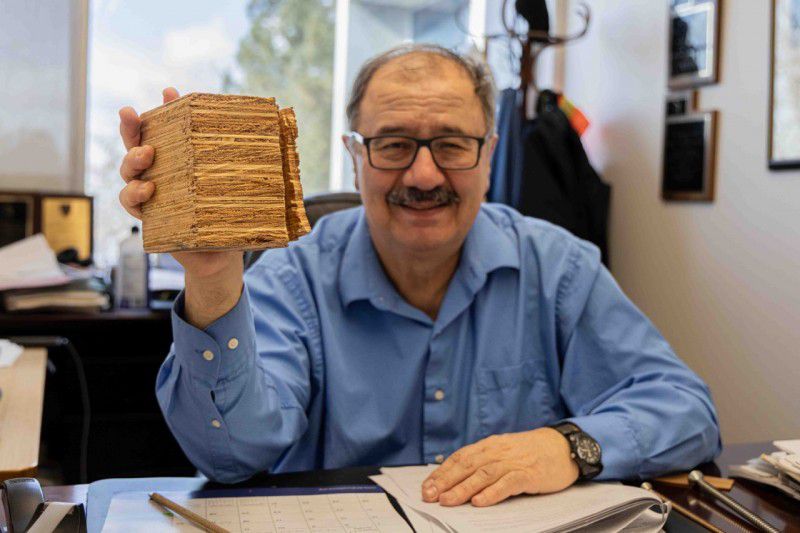
Sitting in his office at the John and Marcia Price College of Engineering’s Department of Civil and Environmental Engineering, he held up a block of composite wood, about 12 inches long and 10 inches wide, and smiled.
“What you’re looking at here is the future,” Pantelides said.
The deceptively simple piece of lumber is an example of “mass timber” technology, a category of “engineered wood product” set to revolutionize the construction industry, which Pantelides has spent the last seven years studying and developing.
On the desk before him, among other pieces of wood and long metal dowels, sat his latest research paper, titled “Design and Cyclic Experiments of a Mass Timber Frame with a Timber Buckling Restrained Brace,” published in the Journal of Structural Engineering. It explores the best ways to build a Buckling Restrained Brace (BRB)—a type of building support that protects against earthquake damage—with mass timber.
As a construction technique, mass timber is defined by its use of columns, beams and boards made of multiple wood layers or pieces tightly laminated or otherwise bound together. The two mass timber types Pantelides works with are known as mass plywood panel and mass ply lam, which have several advantages, environmental and structural, over the usual building materials.
“The timber that we’re talking about, it’s very strong. It can take the place of steel or concrete in many building frames, but it’s much lighter,” Pantelides explained. “A mass timber building is one quarter the weight of a concrete building too, requiring a much smaller foundation.”
Thanks to its super-compressed makeup, mass timber is effectively fireproof, resistant to moisture damage and highly durable. With today’s sustainable forestry techniques, using wood is more sustainable and “renewable” than ever.
Wood sequesters carbon while concrete emits it
“It takes only seven seconds for European forests to grow enough timber required for a three-bedroom apartment,” Pantelides said. “Canada alone has enough timber to house a billion people in perpetuity, with forested trees replenishing faster than the population.”
Every ton of timber grown sequesters 1.8 tons of carbon dioxide from the atmosphere. A mass timber building could be 25% faster to build compared to a concrete building and result in 90% less construction traffic. Once the structure is finished, the wood goes from benefiting nature to having natural benefits.
“People simply like to be in buildings that have lots of exposed wood,” Pantelides said. “The sense of being connected to nature, the biophilic design, makes for healthier living and working environments.”
Thanks to its ability to bend and not break under pressure, steel remains the go-to for tall buildings, especially in areas with high risk of earthquakes or hurricanes. Maintaining a building’s structural integrity relies on a deep understanding of such properties—an understanding we don’t have with stiffer mass timber. This is where Pantelides’s research comes in.
With its varied compositions, mass timber is far from one-size-fits-all; the type of wood used, the size and shape of the wood particles, how they’re stuck together, or even whether individual layers are stacked parallel or perpendicular to each other will greatly influence how the finished product reacts under stress.
Since he first started investigating mass timber, Pantelides has been troubleshooting and experimenting with different “recipes,” eventually arriving at one that calls for shaving dark fir wood into chips, tightly compressing the chips together into planks or boards and then laminating those layers together with ultra-strong glue. The resulting plywood can then be securely fastened to other pieces of wood with joints made of steel dowels and plates.
Using this formula, Pantelides and his team experimented with mass timber versions of earthquake-resistant architectural elements, including the Timber Buckling Restrained Brace (T-BRB)—the focus of Pantelides’ most recent publication.
How to make mass timber hold up in natural disasters
In traditional architecture, non-timber BRBs absorb the seismic force of an earthquake away from the building frame and redirect it to a steel core within the brace, which is usually encased in a concrete-filled steel tube. Instead of a whole building’s structural integrity being jeopardized, only the braces will sustain major damage and need to be replaced. Pantelides focused on developing a BRB that, while still using a strip of steel for the core, is made of mass timber and tailored for mass timber frames.
That focus requires specialized equipment. In one of the college’s hangar-like labs in the Layton Building, a hulking rectangular metal tower, an actuator, stretches from the ceiling to beneath the concrete floor. This gigantic red contraption simulates the effects of seismic activity on whatever is placed inside by rocking it back and forth. It is here where Pantelides and his team can put “lateral force resisting systems” (LFRS), like the T-BRB, to the test.
He and his grad student Emily Williamson, a co-author on the new paper, developed several different configurations of this T-BRB before inserting each individually into a timber frame, which was then placed within the actuator. Then, horizontal shaking, and a lot of it—with forces equivalent to a magnitude 7.0 earthquake, for nine tests. Sensors attached to the T-BRB and frame recorded how different elements warped or shifted as the tests progressed.
Afterward, the frame and braces were dismantled and further inspected and measured. Pantelides’s study, co-authored by industry researchers Hans-Erik Blomgren of Timberland and Douglas Rammer of Forest Products Laboratory, presents the resulting data, analysed, graphed and compared between the different subassemblies. This information will help accelerate the use of mass timber, enabling it to become tougher and taller.
While mass timber construction has been in use in Europe for several decades, the U.S. has been slower to adopt it, in part because strict building codes were focused on steel and concrete, treating any use of wood to construct tall buildings with caution.
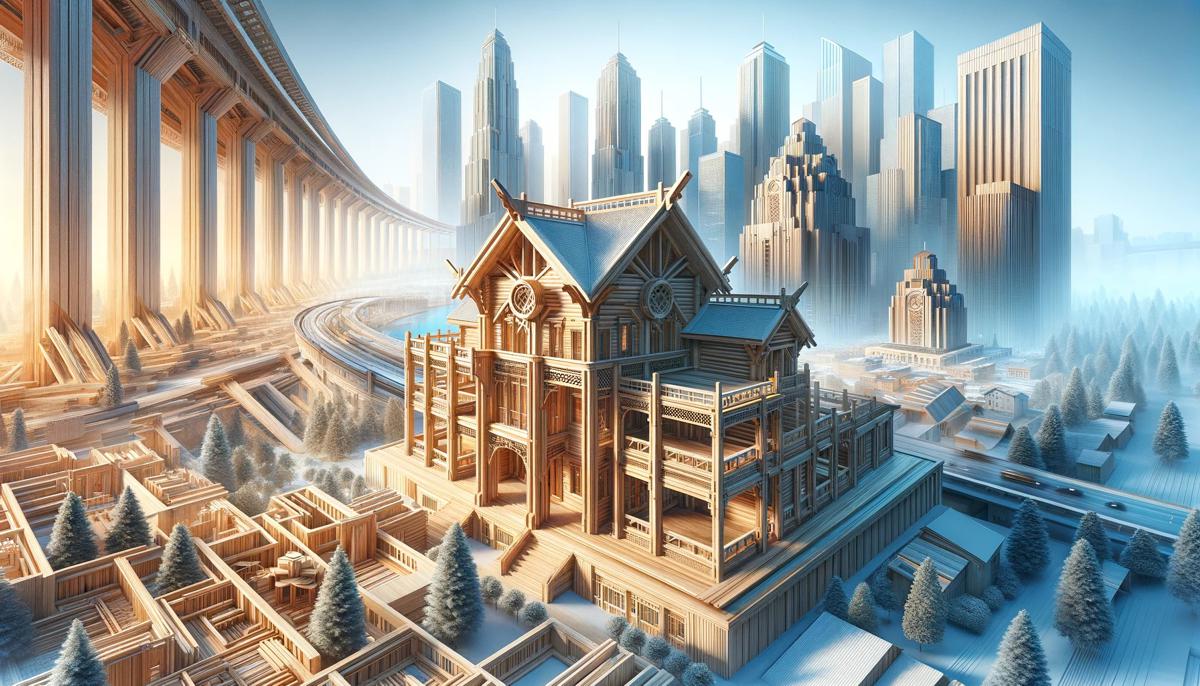
But now, thanks to recent changes in these codes, along with research into components like Pantelides’s T-BRB, mass timber is expected to proliferate in even disaster-prone areas, responding to the increased demand for more sustainable construction materials. The most recent version of the International Building Code, the central set of building regulations in the U.S., included a construction type in buildings up to 18 stories. A record-setting 25-story-tall hybrid mass timber and concrete building has been built in Wisconsin, and Utah has a five-story building under construction in Draper.
“The whole world’s waking up! People are going to look back and say, ‘Hey, why didn’t we build that with mass timber?’” he said. “I think in the next 20 years, there won’t be many buildings less than 12 stories or maybe even 18 stories built with steel and concrete. It just won’t be feasible anymore. In the near future, we will even see skyscrapers, over 50 stories tall, that are built using mass timber.”