Motif Design Takes AI Agents Into the Building Model
Motif has launched the product that reveals what a team of former Autodesk executives has been building with $46 million of investment: a browser-based BIM authoring platform designed from the outset for architects and AI agents to work on the same live building model.
Motif Design combines parametric building modelling, coordinated documentation, real-time collaboration and AI agents within a shared environment. Revit and Rhino models can be streamed into the platform, while IFC and other industry formats provide routes for exchanging structured project information.
Behind the software is a team with unusually direct experience of the generation of BIM technology it is attempting to challenge. Motif was founded in 2023 by Amar Hanspal, formerly co-CEO and Chief Product Officer at Autodesk, and Brian Mathews, previously Autodesk’s Vice President of Platform Engineering. The wider founding team includes Matt Jezyk and Lira Nikolovska, while Motif says its team collectively has more than 300 years of experience developing BIM software.
The company has raised $46 million, including a Series A led by CapitalG and a seed round led by Redpoint Ventures. Rather than building another application around established BIM platforms, Motif is attempting the considerably harder job of creating a new foundation for architectural modelling and documentation.
Briefing
- Motif Design combines browser-based parametric BIM, documentation, collaboration and AI agents in one platform.
- AI agents work with the live project model and can answer questions, make changes, evaluate requirements and generate project content.
- Revit and Rhino models can be streamed into the platform, with IFC and other industry formats also supported.
- Motif was founded by former Autodesk executives Amar Hanspal and Brian Mathews and has raised $46 million.
- Agent actions are logged and reversible, while Motif says project data remains owned by the firm and is not used to train third-party AI models.
AI Inside the BIM Architecture
The phrase “agent-native” is central to Motif’s proposition. In conventional software, an AI assistant is typically added to an existing application and given access to selected commands, data or APIs. Motif has designed the underlying environment so that the user interface, APIs and AI agents can work with the same project data.
An agent can therefore operate as another participant in the modelling environment. It can answer questions about a project, make changes, evaluate information against requirements and generate models, assets and documents. Agent workflows can also be saved as reusable skills.
The underlying software remains based on recognisable BIM principles. Parametric and associative relationships connect building elements so changes propagate through related geometry and documentation. Moving a wall, for example, can update associated floors, ceilings, dimensions and drawings. Sections, elevations and reflected ceiling plans remain connected to the model rather than becoming separate outputs requiring manual reconciliation.
This gives the agents structured information to work with. A building model contains geometry, properties, relationships and dependencies, allowing an agent to act on the project rather than merely answer questions about it.
There are limits to how much can be judged from a product launch. Mature BIM platforms have accumulated decades of specialised functions, integrations, object libraries and organisational workflows, and professional adoption will provide a much tougher test than demonstrations of individual capabilities. Hanspal himself acknowledged in 2025 that rebuilding BIM would require years of sustained development and incremental progress.
Motif Design now puts that ambition into a working authoring environment.
Browser-Based BIM
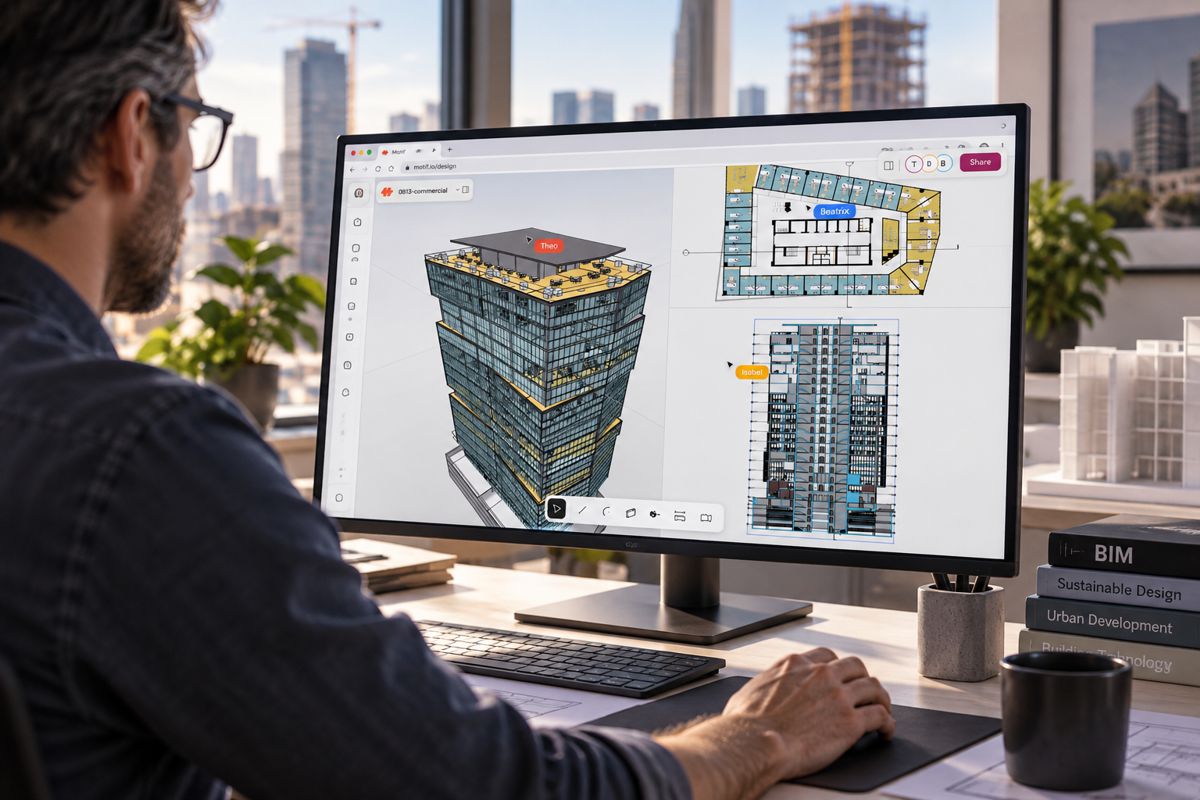
Running the modelling environment in a browser allows the building model to become a shared workspace rather than an artefact primarily controlled by specialist operators. Motif is aiming for principals, project architects, designers and clients to work in the same environment without requiring everyone involved to become an expert user of a conventional desktop BIM package.
Comments, model changes and AI activity can therefore remain within the project context instead of travelling through screenshots, exports, email chains and separate review applications. Motif Design includes parametric building elements, model visualisation, coordinated documentation, change history and simultaneous collaboration, with cloud computing and GPU resources used to handle building-scale models.
The browser also provides access to information beyond the model. Motif says the platform can connect with communication and file systems including Microsoft Teams, Slack, OneDrive, SharePoint, Notion and email, giving agents access to project information that would otherwise remain scattered across different applications and repositories.
That information is often where design decisions actually live. Models may be highly structured while requirements, discussions, approvals and changes are spread across correspondence, meeting notes, specifications and document systems. Bringing those sources closer to the model gives both designers and agents more of the context behind a project.
Working With Existing BIM
Motif is not demanding an immediate break with the software already embedded in architectural and engineering practices. Revit and Rhino models can be streamed into the environment without a conventional export-and-convert cycle, while IFC provides another route for exchanging structured building information.
The distinction between interoperability and replacement is important at this stage. Independent technical reporting on Motif Design indicates that full geometry write-back to Revit is not available at launch, while established Revit family libraries cannot simply be transferred wholesale into the new environment. Firms with years of investment in templates, families, automation, standards and specialist workflows therefore have practical reasons to retain their existing BIM infrastructure.
Motif’s initial opportunities are correspondingly focused. Workflows such as interior fit-outs and test fits offer a more contained entry point, while practices working extensively in Rhino have another route through modelling and into documentation. These are environments where a new platform can demonstrate useful production capabilities without first reproducing every function accumulated by established BIM software.
Large projects add another complication because architects rarely control the entire software environment. Structural engineers, building-services consultants, contractors, specialists and clients may all use different combinations of applications, making reliable data exchange as important as the capabilities of any single authoring platform.
For Motif, coexistence is therefore part of the route into professional practice. The longer-term ambition may be a new foundation for building design, but adoption can begin while established systems remain firmly in place.
Turning Practice Knowledge Into Skills
Motif is also looking beyond the formal building model to the knowledge accumulated inside architectural and engineering practices. The company says the platform will progressively incorporate a firm’s standards, preferred products and working methods, allowing agents to apply that knowledge across projects.
Its skills system provides a mechanism for packaging repeatable instructions and workflows. A practice could potentially encode particular checking procedures, design standards or recurring processes and make them available to teams without waiting for the software developer to turn each one into a conventional product feature.
Much of professional design knowledge, however, is difficult to formalise. Experienced architects and engineers make decisions using regulatory knowledge, previous projects, client preferences, office standards and judgement acquired over years of practice. Turning that into instructions an agent can apply consistently requires firms to decide which knowledge can be codified, where exceptions apply and how different standards should operate across building types, clients and jurisdictions.
The result could be a growing library of firm-specific digital skills rather than one universal AI workflow. That would make the quality of the firm’s own knowledge and the discipline with which it is maintained part of the performance of the software.
Control over that information will be closely watched. Motif says project data belongs to the customer, its data model is open and queryable, and AI providers working with the company are contractually prevented from training models on customers’ projects. Agent activity is recorded and actions can be reversed, providing a history of changes as automated work becomes part of the project record.
Taking on Established BIM
Replacing incumbent design software has historically proved difficult. BIM platforms sit inside professional training, project delivery methods, company standards and contractual requirements, surrounded by large ecosystems of complementary applications, specialist content and automation.
Motif’s founders know that environment from the inside. Hanspal spent three decades at Autodesk and Mathews led platform engineering there. Their decision to start again with a browser-based, agent-native architecture gives the project technical credibility, but it does not remove the enormous engineering task involved in matching the depth of mature BIM systems.
The competitive field is also becoming more interesting. Newer platforms including Snaptrude, Qonic, Arcol and Hypar are exploring different approaches to cloud-based modelling, automation and building information, while incumbent software developers are adding their own AI capabilities. The contest is therefore developing on two fronts: established BIM platforms are becoming more intelligent while newer companies are questioning whether the underlying software architecture should be rebuilt.
Motif has approached that problem in stages. Motif Review, launched in 2025, provided a browser-based workspace for model presentation, visualisation, rendering, markup and feedback. Motif Design extends the environment into creation and documentation, bringing the people reviewing a building and those authoring it closer to the same project information.
Professional responsibility remains with the designer. Motif says agents can follow instructions or take a more active role, but their actions are logged and reversible. As those agents become capable of performing more substantial modelling and documentation tasks, review and traceability will become part of everyday production rather than a separate discussion about AI governance.
The immediate test is more practical. Architects need modelling depth, dependable documentation, interoperability, performance and reliable handling of real projects. They also have existing libraries, standards, consultant relationships and years of accumulated BIM knowledge that cannot simply be discarded because a newer platform has a better architecture.
Motif does not need to replace all of that at once. If it can establish itself in workflows where browser collaboration, Rhino integration and agent-assisted modelling provide a clear advantage, the platform can earn its way into larger parts of the design process.
The $46 million behind the company and the Autodesk experience within its founding team give Motif the resources to make a serious attempt. Motif Design now provides the more important test: whether an agent-native BIM architecture can survive the complexity of designing and documenting real buildings.
Key Industry Questions
- What is Motif Design? Motif Design is a browser-based BIM platform combining parametric building modelling, coordinated documentation, real-time collaboration and AI agents in a shared project environment.
- What does “agent-native” mean? Motif uses the term for software designed so AI agents can work directly with project data and take actions within the building model, rather than operating solely through a separate chatbot or assistant.
- Can Motif Design work with Revit? Yes. Motif can stream Revit models into its environment, although independent technical reporting indicates that full geometry write-back to Revit is not available at launch.
- Does Motif support Rhino and IFC? Yes. Motif supports live Rhino models and IFC data alongside connections to other sources of project information.
- Can AI agents modify a BIM model? Yes. Motif says its agents can answer model questions, make changes, evaluate requirements and generate models, assets and documents. Agent actions are logged and reversible.
- Does Motif Design replace Revit? Motif is developing a full BIM authoring environment, but existing Revit workflows, family libraries and specialist functions cannot simply be transferred wholesale. Initial adoption is therefore likely to involve coexistence with incumbent BIM platforms.
- Who founded Motif? Motif was founded in 2023 by Amar Hanspal, formerly co-CEO and Chief Product Officer at Autodesk, and Brian Mathews, formerly Autodesk’s Vice President of Platform Engineering.
- How much funding has Motif raised? Motif announced $46 million in funding in 2025, including a Series A led by CapitalG and a seed round led by Redpoint Ventures.
- Is customer project data used to train AI models? Motif states that customer project data is not used to train third-party AI models and that its AI providers are contractually committed not to train on customer projects.
Strategic Takeaways
- Agent-native BIM gives AI direct access to structured project information rather than adding an assistant around an established modelling application.
- Revit, Rhino and IFC interoperability gives Motif a practical route into firms without requiring immediate wholesale software replacement.
- Interior fit-outs, test fits and Rhino-based workflows provide more achievable early adoption opportunities than attempting to reproduce the entire established BIM ecosystem.
- Firm-specific agent skills could turn repeatable design knowledge and procedures into reusable digital workflows, although codifying professional judgement remains difficult.
- Motif’s long-term prospects will depend on modelling depth, documentation, interoperability and reliability as much as the capabilities of its AI agents.