Turning Shell Waste into Smart Thermal Storage Materials
Energy efficiency isn’t just a policy ambition anymore. It’s become a commercial necessity across construction, infrastructure, and industrial systems. From high-performance buildings to electrified transport networks, the ability to store and release thermal energy efficiently is now central to reducing operational costs and carbon footprints.
At the heart of this shift lies latent heat storage, a technology built around phase change materials, commonly referred to as PCMs. These materials absorb and release heat as they change phase, typically from solid to liquid and back again. The concept is simple, but the engineering challenge has always been far more complex. Organic PCMs, while stable and safe, have a long-standing weakness. When they melt, they leak.
That single limitation has held back wider adoption in construction materials, thermal regulation systems, and infrastructure-scale energy storage. Now, new research suggests that a solution may come from an unlikely source. Biological waste.
From Marine Waste to High Performance Carbon Structures
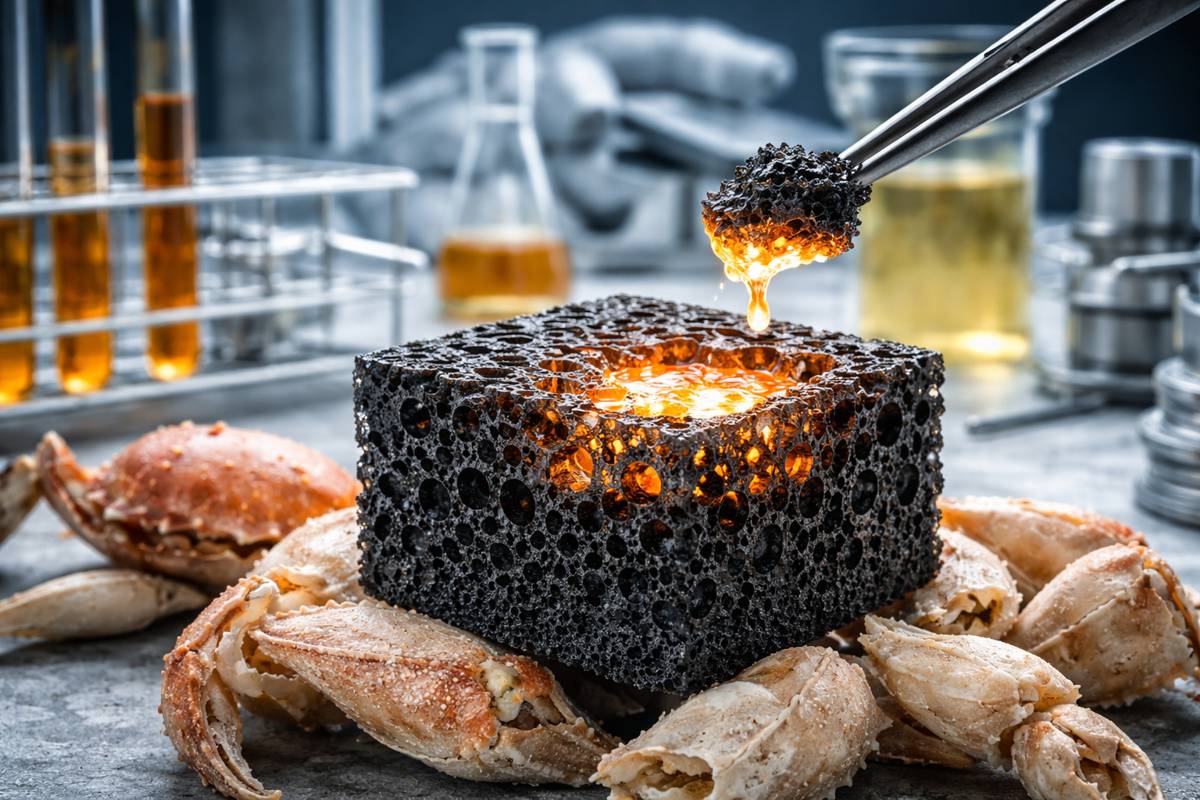
A research team led by Hui Li at Shandong Jianzhu University has developed a method to transform chitin, a natural polymer found in crustacean shells, into a highly porous carbon aerogel. This material acts as a structural scaffold capable of stabilising molten PCMs without leakage.
Chitin is abundant, renewable, and often discarded as waste from the seafood industry. By converting it into a carbon-based aerogel through controlled processing and carbonisation, the researchers have effectively created a material that combines sustainability with high-performance engineering.
The resulting aerogel forms an interconnected carbon network with a tailored pore structure. These pores aren’t just passive voids. They actively anchor the liquid PCM through capillary forces and interfacial interactions, preventing leakage even during repeated melting cycles.
This approach shifts the conversation away from synthetic, energy-intensive materials such as expanded graphite or metal–organic frameworks. Instead, it introduces a scalable and environmentally responsible pathway for producing advanced thermal storage systems.
Solving the Leakage Problem Without Compromise
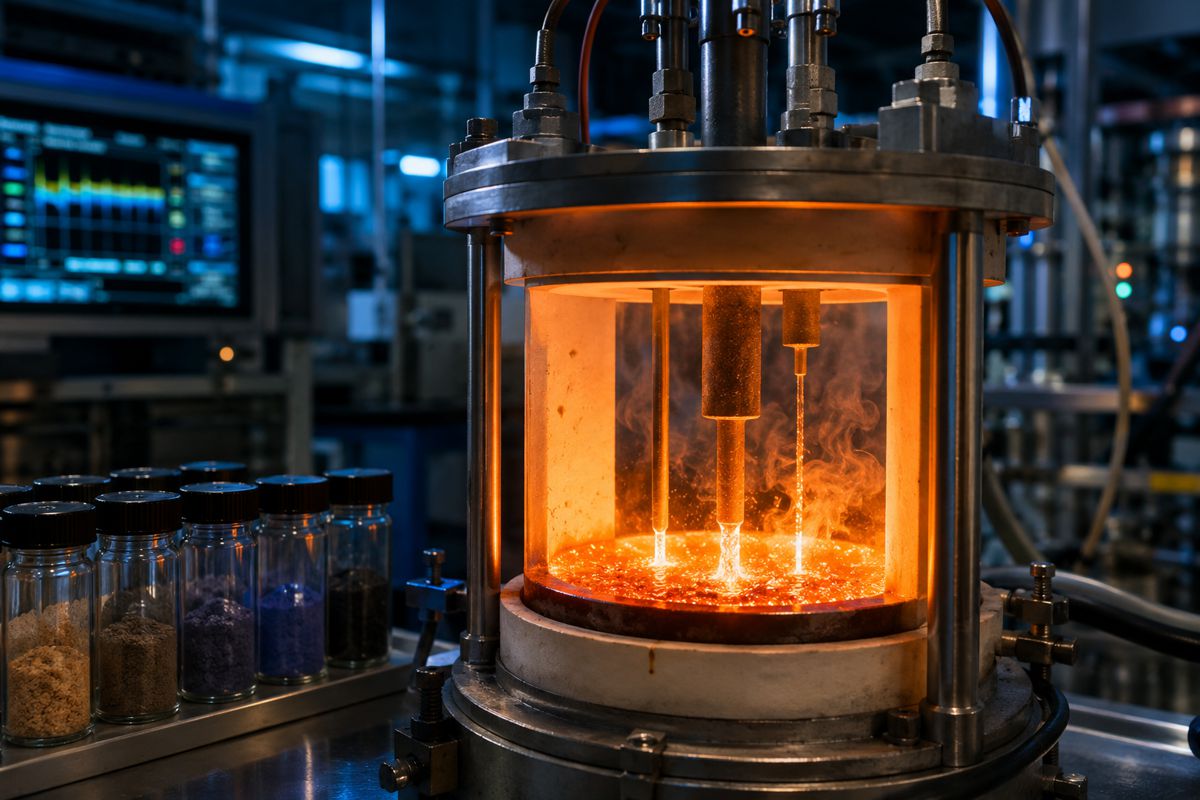
The core innovation lies in how the carbon aerogel interacts with the PCM. In this case, stearic acid was used as the model organic PCM, embedded within the chitin-derived carbon framework.
The results are notable. The composite material achieved complete leakage suppression under optimal processing conditions, specifically at a carbonisation temperature of 500 degrees Celsius. At this level, the aerogel maintains a stable pore structure that holds the liquid PCM securely in place.
However, the study also highlights a delicate balance. Increasing the carbonisation temperature improves certain thermal properties but can collapse the pore structure, leading to reduced stability and increased leakage. This interplay between structure and performance underscores the importance of precise material engineering.
What emerges is a clear takeaway for industry. It’s not just about selecting sustainable materials. It’s about controlling their microstructure to deliver reliable, real-world performance.
Improving Thermal Performance Where It Matters
Beyond leakage control, the material demonstrates measurable improvements in thermal performance, which is critical for infrastructure and building applications.
Thermal conductivity, often a limiting factor in PCM systems, increased significantly in the composite material. While pure stearic acid exhibits relatively low conductivity, the carbon aerogel enhances heat transfer through graphitised pathways. This means faster charging and discharging of thermal energy, a key requirement for practical deployment.
At the same time, the material maintains a high thermal storage capacity. Although confinement within the porous structure slightly reduces the theoretical enthalpy, optimisation of the carbonisation process raises the effective energy storage values. The balance between capacity and stability appears well managed.
Equally important is the reduction in supercooling. The study reports a supercooling degree of less than 1.48 degrees Celsius, which is significantly lower than many conventional PCM systems. This improvement is attributed to the aerogel’s ability to promote heterogeneous nucleation, ensuring that the material solidifies predictably and efficiently.
In practical terms, this translates into more reliable thermal cycling and improved system performance across a wide range of applications.
Engineering for Longevity and Reliability
Durability is often the make-or-break factor for new materials in infrastructure applications. Laboratory performance is one thing. Long-term reliability under repeated thermal cycling is another.
Here, the chitin-derived carbon aerogel shows strong potential. After 100 thermal cycles, the composite material retained its phase change temperature and experienced only around 3 percent loss in enthalpy. That level of stability suggests a material capable of operating over extended lifetimes without significant degradation.
The study also indicates an increase in activation energy for thermal processes, pointing to enhanced thermal stability. In essence, the material becomes more resistant to structural or chemical breakdown under repeated heating and cooling.
For construction professionals and system designers, this kind of reliability is essential. Whether integrated into building envelopes, district heating systems, or industrial heat recovery units, materials must perform consistently over years, not months.
Implications for Buildings, Infrastructure and Energy Systems
The potential applications for this technology extend across multiple sectors. In buildings, shape-stabilised PCMs can be integrated into walls, floors, or ceilings to regulate indoor temperatures and reduce reliance on mechanical heating and cooling systems.
In infrastructure, the material could play a role in thermal management for transport systems, including electric vehicle charging stations or temperature-sensitive logistics networks. The improved thermal conductivity and stability also make it suitable for electronics cooling, where overheating remains a critical challenge.
Perhaps most significantly, the material aligns with broader trends in renewable energy systems. Thermal energy storage is increasingly used to balance supply and demand in solar and waste heat recovery systems. By offering a sustainable and scalable storage medium, chitin-derived aerogels could help bridge gaps in energy availability and improve overall system efficiency.
This is particularly relevant as construction and infrastructure projects face mounting pressure to meet net zero targets while maintaining economic viability.
A Circular Economy Opportunity for Construction Materials
There’s also a compelling circular economy narrative underpinning this development. Chitin is widely available as a by-product of seafood processing, often treated as waste. Converting it into a high-value engineering material creates a new supply chain opportunity while reducing environmental impact.
For the construction industry, which is under increasing scrutiny for its material footprint, this represents a shift towards more responsible sourcing and production methods. Biomass-derived materials could complement traditional construction inputs, offering performance benefits alongside sustainability credentials.
Moreover, the scalability of the process suggests that it could be adopted at industrial levels without prohibitive costs. That’s a critical factor in moving from laboratory innovation to commercial deployment.
Bridging the Gap Between Materials Science and Industry Adoption
What sets this research apart is its focus on practical performance rather than theoretical potential. By combining detailed material characterisation with real-world testing, the study provides a clear pathway towards application.
Techniques such as differential scanning calorimetry, thermal conductivity analysis, and long-term cycling tests offer a comprehensive understanding of how the material behaves under operational conditions. This level of validation is essential for gaining industry confidence.
At the same time, the work highlights the importance of interdisciplinary collaboration. Advances in materials science must be aligned with engineering requirements, manufacturing processes, and economic considerations. Only then can innovations move beyond academic interest and into widespread use.
Unlocking the Future of Sustainable Thermal Storage
As global infrastructure systems evolve, the demand for efficient, reliable, and sustainable energy storage solutions will only increase. Thermal storage, often overlooked in favour of electrical systems, has a vital role to play in balancing energy flows and reducing emissions.
The development of chitin-derived carbon aerogels offers a glimpse into how this future might take shape. By addressing longstanding challenges such as leakage, thermal conductivity, and durability, the material provides a practical solution with clear advantages.
More importantly, it demonstrates that innovation doesn’t always require new resources. Sometimes, the answer lies in rethinking what we already have.