MathWorks and Renesas Accelerate Simulation for Real Time Embedded Control
The race to build smarter vehicles, more autonomous industrial machinery and increasingly intelligent infrastructure systems is putting enormous pressure on engineering teams. Development cycles are shrinking, software complexity is rising and embedded systems are expected to perform flawlessly in environments where safety, reliability and real-time responsiveness are non-negotiable.
Tighter integration between simulation software and embedded hardware is becoming strategically important across automotive, robotics and industrial automation sectors. Engineering firms are no longer satisfied with disconnected workflows that require multiple manual integration stages between algorithm development and hardware deployment. Instead, the industry is steadily moving toward unified Model-Based Design environments capable of reducing engineering friction while accelerating validation and deployment.
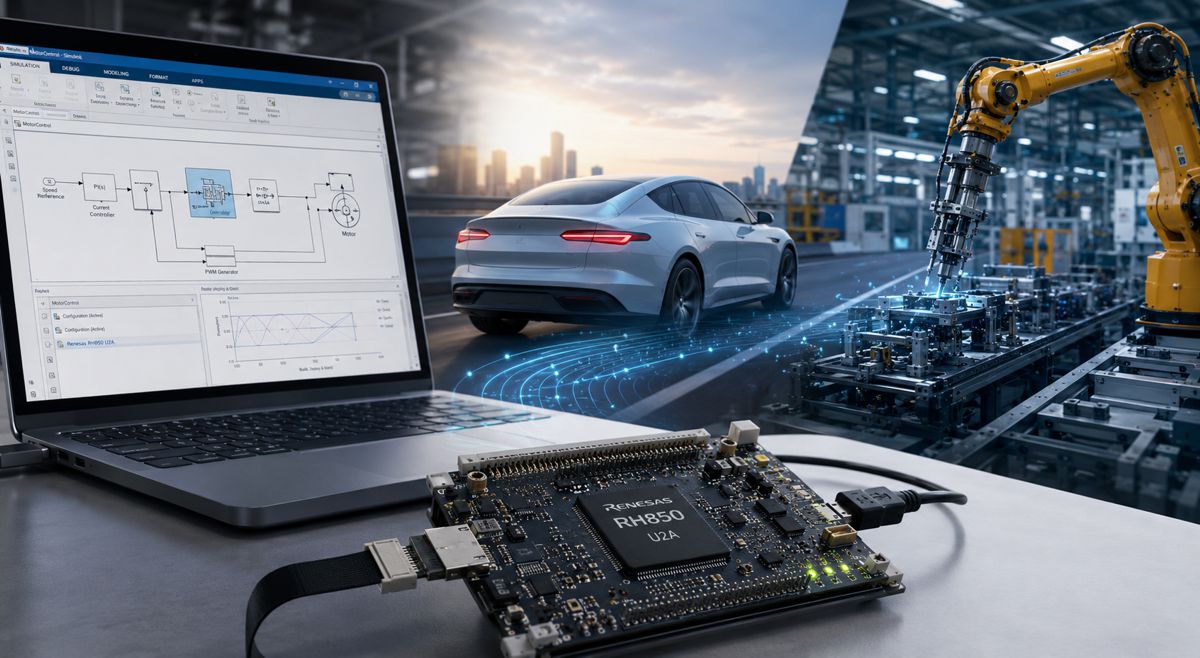
It is within this wider transformation that MathWorks and Renesas Electronics have expanded their collaboration through new Hardware Support Packages that connect MATLAB and Simulink directly to Renesas RH850/U2A and RA6T2 microcontrollers.
The announcement may appear technical on the surface, yet its significance stretches far beyond software compatibility. It reflects a much broader shift taking place across the global infrastructure, automotive and industrial technology ecosystem, where digital engineering workflows are becoming central to competitiveness, product reliability and time-to-market performance.
Briefing
- MathWorks and Renesas have introduced new Hardware Support Packages for RH850/U2A automotive microcontrollers and RA6T2 industrial controllers
- The integration enables direct deployment from MATLAB and Simulink to embedded hardware with automated build and flashing workflows
- Automotive applications include EV motor control, regenerative braking and ADAS electronic control systems
- Industrial applications include robotics, servo control and variable-speed drive systems
- The collaboration supports the wider industry trend toward software-defined vehicles and intelligent industrial automation
Embedded Engineering Is Becoming a Strategic Battleground
Modern infrastructure systems increasingly depend on embedded intelligence. Electric vehicles, smart transport corridors, robotics platforms, industrial machinery and connected utility systems all rely on millions of lines of embedded software running inside increasingly sophisticated microcontrollers.
This shift has dramatically changed how engineering teams operate. Hardware development alone is no longer enough. Competitive advantage increasingly comes from software capability, algorithm optimisation and the speed at which ideas move from simulation into functioning physical systems.
Historically, however, transitioning from simulation environments into production hardware has often been cumbersome. Engineering teams frequently needed to manually configure toolchains, write device drivers, assemble build scripts and manage multiple layers of hardware abstraction before testing algorithms on target devices.
Those fragmented workflows introduce delays, increase integration risks and create opportunities for costly software defects. In safety-critical sectors such as automotive systems and industrial automation, even small inefficiencies can have significant financial consequences.
The latest integration between MATLAB, Simulink and Renesas hardware attempts to simplify this process by allowing developers to move directly from simulation models to deployed embedded code using automated workflows.
Automotive Development Is Becoming Increasingly Software Defined
The automotive sector represents one of the most important battlegrounds for Model-Based Design technologies. Vehicles are rapidly evolving into rolling software platforms packed with sensors, controllers and real-time decision-making systems.
Modern electric vehicles contain dozens of electronic control units responsible for everything from traction motor management and battery optimisation to stability control and driver assistance systems. Each subsystem must operate reliably under rapidly changing conditions while meeting strict safety standards.
The Renesas RH850/U2A microcontroller family has already established a strong position within automotive electronic control applications, particularly in systems requiring deterministic performance and functional safety compliance.
The new MathWorks integration allows automotive engineers to deploy field-oriented motor control algorithms and regenerative braking systems directly from Simulink into RH850/U2A-based ECUs without manually writing initialisation code or custom build scripts.
That reduction in workflow complexity matters enormously in electric vehicle development, where calibration cycles are expensive and engineering resources remain under intense pressure.
Global EV competition is intensifying rapidly. Chinese manufacturers, European OEMs and American technology-led vehicle companies are all pushing for faster software iteration cycles and increasingly integrated digital engineering workflows. Any reduction in development overhead offers potential commercial advantages.
The ability to shorten concept-to-testing timelines also supports faster validation during vehicle drive-cycle testing, where motor response, torque delivery and regenerative performance require continuous refinement.
Industrial Automation Demands Faster Iteration Cycles
The industrial controls sector is undergoing a similar transformation. Factories, logistics hubs, ports and infrastructure facilities are steadily adopting more intelligent automation systems driven by robotics, AI-assisted control logic and digitally managed machinery. Motion control systems are becoming more sophisticated as operators demand higher precision, lower energy consumption and greater operational flexibility.
Renesas positions its RA microcontroller platform toward industrial and robotics applications requiring real-time responsiveness and scalable embedded control.
The new integration enables rapid prototyping for servo systems and variable-speed drives while simplifying hardware bring-up and closed-loop tuning workflows.
This is particularly relevant as industries confront labour shortages and productivity challenges. Manufacturers are under mounting pressure to automate repetitive processes while maintaining operational reliability in increasingly data-driven environments.
Industrial automation investment continues to rise globally. According to the International Federation of Robotics, industrial robot installations remain near historic highs, driven largely by automotive, electronics and logistics sectors. At the same time, edge computing and AI-enabled industrial systems are increasing the complexity of embedded software requirements across automation hardware.
As a result, engineering teams need tools capable of reducing friction between simulation, prototyping and deployment.
Model Based Design Continues to Expand Across Infrastructure Sectors
Model-Based Design itself is hardly new. Aerospace, automotive and defence industries have relied on simulation-driven engineering for decades. What is changing now is the scale of adoption across broader industrial sectors.
Infrastructure systems are becoming increasingly software-centric. Smart traffic management platforms, rail signalling systems, intelligent utility networks and autonomous construction equipment all depend heavily on embedded control systems operating in real time.
This trend is also being reinforced by digital twin technologies, predictive maintenance systems and AI-enhanced operational analytics. Simulation environments increasingly serve as the foundation for testing operational scenarios before deployment into live infrastructure environments.
MATLAB and Simulink remain deeply embedded within these workflows across engineering disciplines worldwide. Universities, research institutions and industrial engineering teams continue using the platforms extensively for algorithm development, simulation and embedded systems engineering.
The integration with Renesas hardware therefore reflects a wider market demand for tighter interoperability between software modelling environments and production-ready embedded hardware.
Reducing Engineering Complexity Has Become Commercially Valuable
One of the less visible but increasingly valuable aspects of modern engineering platforms is workflow simplification.
Engineering talent shortages remain a challenge across both automotive and industrial sectors. Companies are struggling to recruit embedded systems specialists with expertise spanning software development, hardware integration and systems validation.
Reducing manual integration requirements can therefore deliver substantial commercial benefits. Fewer disconnected workflows mean reduced engineering overhead, lower validation complexity and faster onboarding for development teams.
“Our customers expect a straightforward path from simulation model to microcontroller, and the new integration with MATLAB and Simulink delivers exactly that,” said Brad Rex, Senior Director of System Solution Team, UX Group at Renesas. “By working with MathWorks, we’ve removed the need to assemble toolchains and device drivers by hand so teams can simulate and validate designs earlier, iterate faster, and reduce integration effort across ECU and industrial-control projects.”
The emphasis on workflow reduction reflects broader market realities. Companies increasingly compete on engineering velocity as much as on hardware performance itself.
Interoperability Is Becoming Essential Across Engineering Ecosystems
The engineering software market is also shifting toward increasingly interconnected ecosystems rather than isolated standalone tools.
Vehicle manufacturers, industrial OEMs and infrastructure technology providers now rely on highly integrated software environments involving simulation platforms, CAD tools, cybersecurity systems, embedded compilers, cloud analytics and AI-driven development pipelines. Interoperability has therefore become strategically important.
“Our collaboration with Renesas strengthens the level of interoperability that engineers expect when using MATLAB and Simulink,” said Anuja Apte, India Product Marketing Manager, MathWorks. “By providing a direct path from Simulink models to optimized microcontroller deployment, we help engineering teams move from design to hardware more efficiently while staying integrated with the broader toolchains they rely on.”
That interoperability becomes increasingly important as software-defined vehicles, autonomous industrial systems and AI-assisted infrastructure platforms continue expanding.
The future engineering environment is unlikely to revolve around isolated software products. Instead, it will depend on tightly integrated ecosystems capable of supporting continuous iteration across software, hardware and operational systems.
Engineering Workflows Are Quietly Being Rewritten
The significance of this collaboration ultimately extends beyond microcontrollers or simulation software alone.
It highlights how engineering itself is evolving across infrastructure, industrial automation and transport sectors. Embedded intelligence is becoming foundational to modern economies, while software integration increasingly determines how quickly innovation can move from concept into operational systems.
Vehicles, industrial robots, transport networks and infrastructure assets are steadily becoming software-centric platforms managed through increasingly sophisticated embedded control architectures.
In that environment, reducing friction between simulation and deployment is no longer simply a convenience. It has become a competitive requirement.
Quietly, beneath the headlines surrounding AI, automation and electrification, the engineering workflows underpinning global infrastructure development are being fundamentally rewritten.