Hyperloop Moves Closer to Reality as Swisspod Sets New Speed Benchmark
The race to transform long-distance transport is entering a new phase. While high-speed rail networks continue expanding across Asia, Europe and parts of the Middle East, a handful of companies remain focused on an even more ambitious goal: moving passengers and freight through low-pressure tubes at aircraft-like speeds using fully electric propulsion.
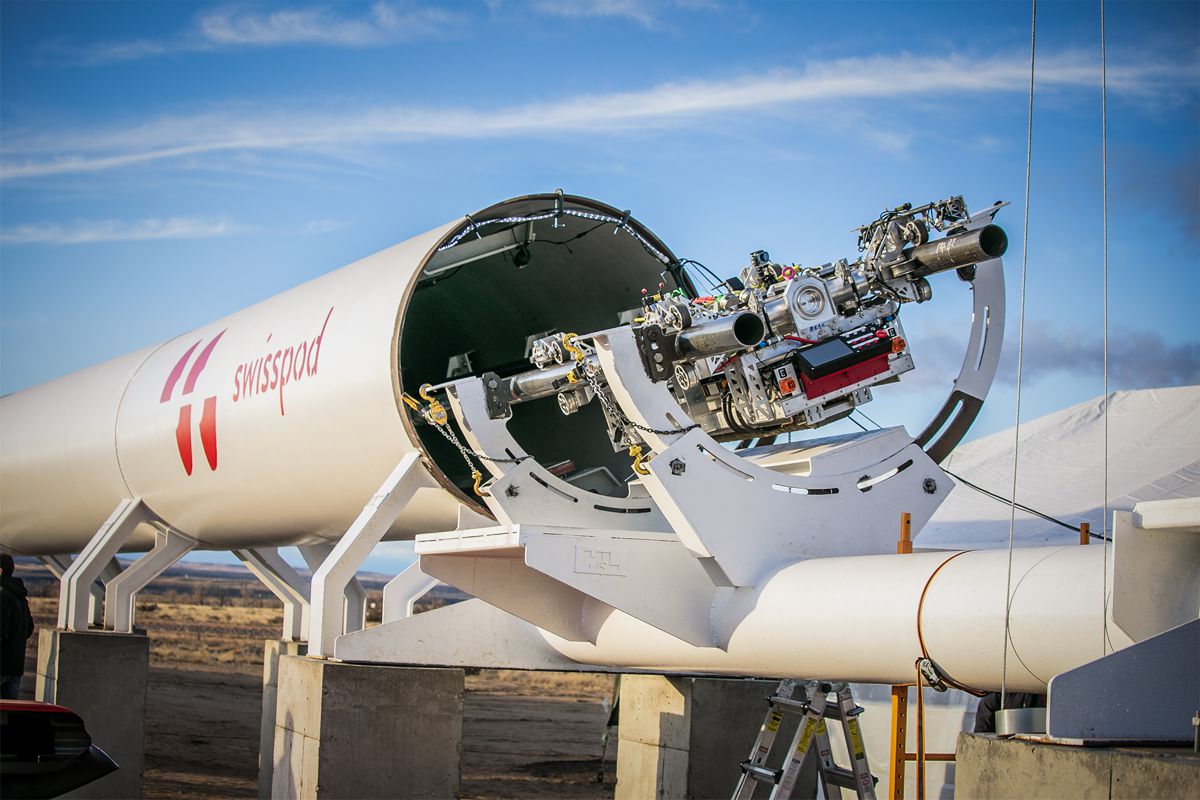
Swiss-American hyperloop developer Swisspod has now reached a notable milestone in that journey. During testing at its facility in Pueblo, Colorado, the company recorded a speed of 146 km/h with its full-scale AERYS 1 capsule, establishing what it describes as a new hyperloop speed record and concluding the first phase of its vehicle development programme.
Although the speed achieved remains far below the near-sonic velocities envisioned for commercial hyperloop systems, the significance lies elsewhere. The achievement demonstrates that critical technologies including propulsion, vehicle guidance and autonomous control systems can operate successfully under real-world testing conditions rather than solely within computer simulations. For infrastructure investors, transport planners and policymakers, that distinction matters considerably. The challenge facing hyperloop has never been theoretical potential alone. It has been proving that the technology can work safely, reliably and economically outside the laboratory.
With AERYS 1 now retired as a validation platform, Swisspod is turning its attention towards a second-generation vehicle intended to push performance significantly further while advancing the broader commercialisation pathway for hyperloop transport.
Briefing
- Swisspod achieved a hyperloop speed of 146 km/h during testing in Pueblo, Colorado.
- The run concludes the testing programme for the company’s first full-scale capsule, AERYS 1.
- Development efforts are now focused on the next-generation AERYS 2 vehicle.
- Swisspod is raising CHF 17 million through a Series A funding round to expand testing and certification activities.
- The company continues promoting a hyperloop architecture that places more technology within the vehicle and relies on simpler passive infrastructure.
Hyperloop’s Long Road from Concept to Infrastructure Reality
Few transport concepts have generated as much attention during the past decade as hyperloop. Popularised in 2013 through proposals advocating high-speed travel inside low-pressure tubes, the idea promised journey times capable of competing with aviation while consuming less energy and producing fewer emissions.
The concept attracted substantial investment and triggered a wave of research programmes across North America, Europe, Asia and the Middle East. Governments, universities and private-sector innovators explored everything from vacuum technologies and magnetic levitation systems to autonomous vehicle control and passenger safety protocols.
Progress, however, has proved more complex than early headlines suggested. Several prominent hyperloop ventures have scaled back ambitions, shifted priorities or disappeared altogether as economic realities and engineering challenges emerged. Building hundreds or thousands of kilometres of specialised infrastructure remains an enormous undertaking requiring significant capital investment, regulatory support and technical validation.
Consequently, many observers have become increasingly interested in practical demonstration projects rather than futuristic renderings. Every successful test contributes valuable data concerning vehicle dynamics, propulsion performance, energy consumption, system reliability and operational safety.
Swisspod’s latest achievement fits squarely within that context. The headline figure may attract public attention, but industry stakeholders are often more interested in what lies beneath the number: repeatability, control, system integration and engineering maturity.
From Validation Platform to Development Accelerator
Swisspod describes AERYS 1 as a first-generation validation platform designed to move core technologies from theoretical modelling into physical operation. Throughout its testing campaign, the capsule completed multiple record-setting runs and numerous validation missions focused on propulsion systems and autonomous operation.
The approach reflects a methodology commonly used throughout advanced transportation sectors. Aerospace companies, automotive manufacturers and railway developers routinely employ prototype platforms to identify weaknesses, refine designs and gather operational data before committing to commercial-scale deployment.
Speaking about the programme’s completion, Swisspod CEO and Co-Founder Denis Tudor said: “AERYS 1 served its purpose: to move the technology out of simulations and into reality. It allowed us to test, iterate, improve and prove that the core systems work under real operating conditions. The milestones we’ve reached are more than just numbers, they are proof that hyperloop technology is maturing. Now it’s time to shift our focus on the next-generation capsule, AERYS 2, which brings major, exciting upgrades.”
For transport engineers and infrastructure planners, this iterative process remains crucial. Emerging mobility technologies rarely arrive fully formed. Instead, they evolve through cycles of experimentation, validation and refinement, gradually reducing technical risk while improving performance.
A Different Approach to Hyperloop Infrastructure
One aspect of Swisspod’s strategy that may attract particular industry interest is its infrastructure philosophy.
Many hyperloop concepts developed over the past decade have relied upon highly sophisticated guideways, extensive active infrastructure systems and substantial fixed installations. While technically impressive, such approaches can dramatically increase construction costs and operational complexity.
Swisspod proposes a different model. According to the company, much of the intelligence and technological complexity resides within the vehicle itself while the infrastructure remains comparatively passive.
This distinction could prove significant from a commercial perspective. Infrastructure projects are often constrained not by technological capability but by economics. Simpler infrastructure potentially reduces capital expenditure, lowers maintenance requirements and shortens deployment timelines.
The broader transportation sector offers numerous examples supporting this principle. Advances in autonomous driving, aircraft avionics and intelligent logistics increasingly rely upon sophisticated onboard systems rather than major infrastructure modifications. Applying similar thinking to hyperloop development could help address one of the industry’s most persistent challenges: affordability.
Whether such an architecture ultimately proves advantageous at commercial scale remains to be demonstrated. Nevertheless, reducing infrastructure complexity is an approach likely to resonate with investors and public-sector authorities evaluating future transport technologies.
AERYS 2 Takes Centre Stage
With the AERYS 1 programme complete, Swisspod has shifted development resources towards AERYS 2, its next-generation capsule currently progressing through the design phase.
The company states that the new vehicle is being engineered for substantially higher operating speeds and improved efficiency. Production is expected to commence later this year. Swisspod has also indicated that an additional feature will be revealed during a future Hyperloop Day event.
Although technical specifications remain limited, second-generation vehicle programmes typically benefit significantly from lessons learned during prototype testing. Engineering teams gain a clearer understanding of system interactions, component durability, thermal management requirements and operational constraints.
Historically, transformative transportation systems have advanced through precisely this pattern. Early railways, commercial aircraft and high-speed trains all evolved through successive generations of prototypes before achieving widespread adoption.
For hyperloop technology, the transition from proof-of-concept demonstrators towards increasingly capable operational vehicles represents an essential step in building industry confidence.
Investment Signals Growing Commercial Intent
Technology milestones alone are insufficient to create transport revolutions. Funding remains equally important.
Swisspod is currently pursuing a CHF 17 million Series A fundraising round aimed at expanding its testing infrastructure in the United States, advancing AERYS 2 development and supporting certification activities.
Certification represents one of the most critical yet frequently overlooked aspects of next-generation transportation systems. Regulatory approval frameworks must address passenger safety, emergency procedures, operational resilience, cybersecurity requirements and interoperability standards before commercial deployment becomes feasible.
Around the world, regulators are gradually engaging with hyperloop developers to explore potential standards and governance models. The European Union, through initiatives involving the European Hyperloop Center and other research organisations, has supported investigations into safety frameworks and technical standards for future systems.
Swisspod’s involvement in collaborative European grant activities suggests recognition that commercial success will depend not only on engineering breakthroughs but also on regulatory integration and international cooperation.
Sustainability Driving Interest in New Mobility Models
The continuing interest in hyperloop is closely linked to broader sustainability objectives shaping transport policy worldwide.
Transport remains one of the largest contributors to greenhouse gas emissions globally. According to the International Energy Agency, transport accounts for a substantial share of global energy-related emissions, with aviation and long-distance freight presenting particularly difficult decarbonisation challenges.
Governments are therefore evaluating multiple pathways towards cleaner mobility. Electrified rail, sustainable aviation fuels, battery-electric freight transport and hydrogen-powered vehicles all form part of the conversation.
Hyperloop advocates argue that electrically powered, low-resistance transport systems could eventually complement these solutions, particularly across medium-distance corridors where speed, capacity and energy efficiency intersect.
Whether hyperloop ultimately becomes a mainstream transport mode remains uncertain. Large-scale deployment will require overcoming technical, economic, regulatory and political barriers. Yet the underlying drivers supporting research into new mobility systems continue to strengthen.
Building Momentum Through Measured Progress
Grand visions alone rarely reshape infrastructure. Real progress tends to emerge through incremental achievements that gradually reduce uncertainty and build confidence among investors, regulators and the public.
Swisspod’s latest record will not transform global transport overnight. Nor does it guarantee commercial success for hyperloop technology. What it does provide is another data point in an industry striving to demonstrate practical viability rather than theoretical possibility.
The completion of the AERYS 1 programme and the launch of AERYS 2 development represent the next chapter in that effort. As testing becomes more sophisticated and certification activities accelerate, stakeholders across the infrastructure sector will be watching closely to determine whether hyperloop can evolve from experimental technology into a credible component of future transport networks.
For now, the milestone in Colorado serves as evidence that development continues moving forward. The journey towards near-sonic transportation remains long, but each successful test brings the industry one step closer to discovering whether hyperloop can eventually claim a place alongside rail, road, aviation and maritime transport in the infrastructure systems of tomorrow.