Construction 3D Printing Moving to Everyday Business in Germany
The headline from Selsingen is not that a German contractor has printed a building. Concrete printing has been printing buildings in Germany since Beckum in 2020, and the novelty of a two-storey office shell has worn thin. What matters commercially is the decision that followed the print. Matthäi Schlüsselfertigbau, a subsidiary of one of Germany’s twenty largest construction groups, looked at its finished headquarters and chose to stand up a permanent construction 3D printing division rather than file the project away as a marketing exercise. That step, from a single asset to an in-house line of business, is the part of the story that infrastructure owners, contractors and their suppliers should be reading closely.
The distinction is more than semantic. For most of the past decade, construction 3D printing has been the province of specialist startups, research institutes and pilot programmes underwritten by public subsidy. When a mainstream general contractor with more than 3,300 staff and roughly a billion euros of annual turnover decides the technology belongs on its own balance sheet as a repeatable capability, the centre of gravity shifts.
The question stops being whether the technology works and becomes who controls it, who profits from it, and how quickly it migrates from novelty structures into the functional buildings, logistics halls and commercial units that make up a working contractor’s order book.
Briefing
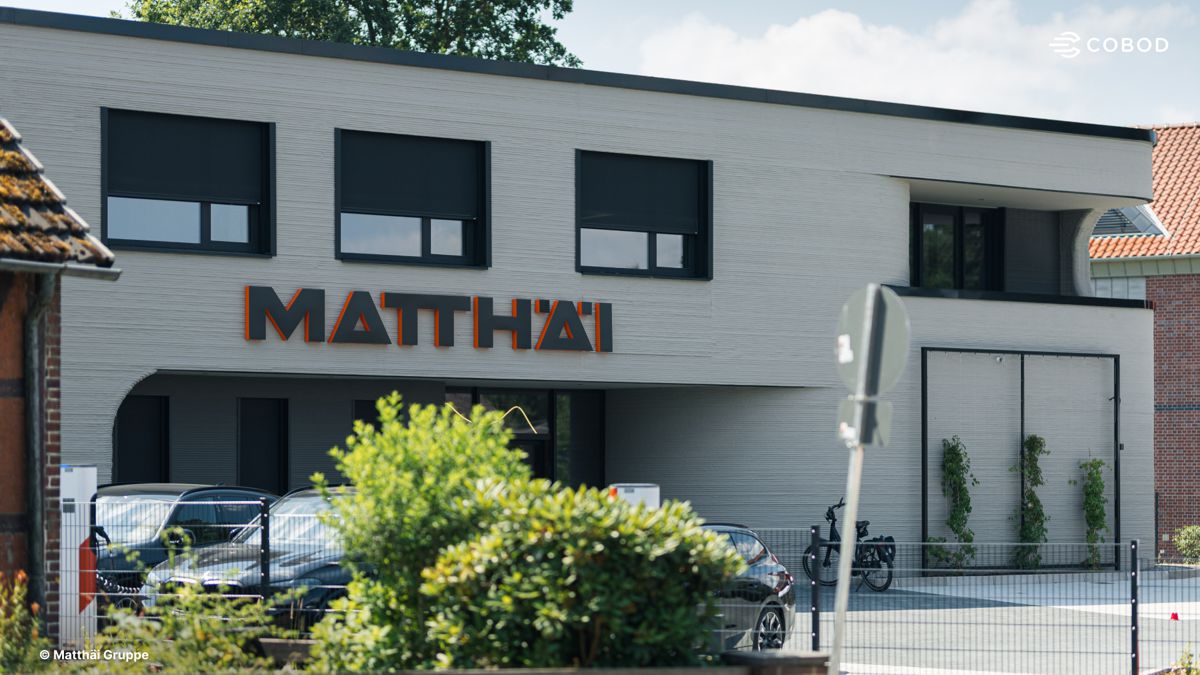
- Matthäi Schlüsselfertigbau, part of a top-twenty German construction group, has established a permanent construction 3D printing division after printing its own two-storey, 364 m² headquarters in Selsingen, Lower Saxony, occupied in July 2026.
- The walls of both floors were printed in around 105 hours on a COBOD BOD2 gantry using Holcim’s TectorPrint mortar, with PERI 3D Construction supervising, while the foundation, base slab, floors and roof were built by conventional means.
- The commercial significance lies in the conversion of a one-off demonstration into standing in-house capability at a mainstream contractor rather than a startup or a university spin-out.
- COBOD’s shareholders include General Electric, CEMEX, Holcim and PERI, meaning the printer, the printable material and the operating know-how increasingly sit with established building-materials and formwork incumbents.
- The decision lands against a German skilled-labour shortage that has, by some estimates, pushed average construction times from 20 to 26 months and left a substantial housing backlog, sharpening the case for labour-light methods.
A Headquarters Built To Prove A Business Case
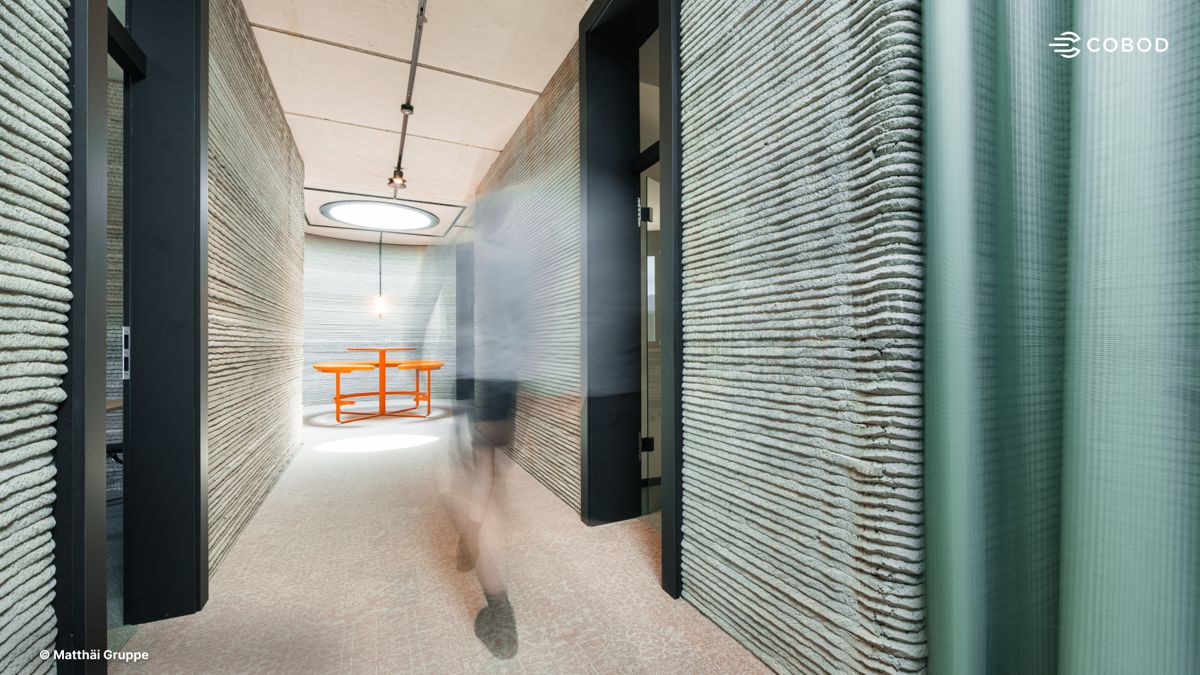
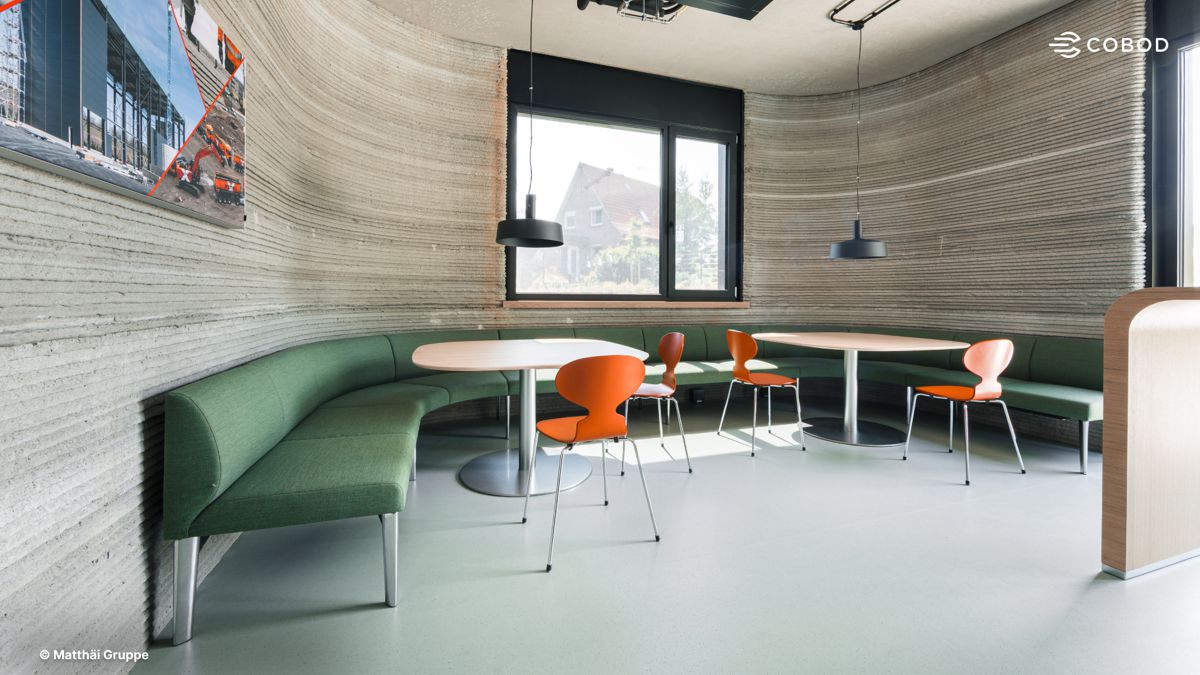
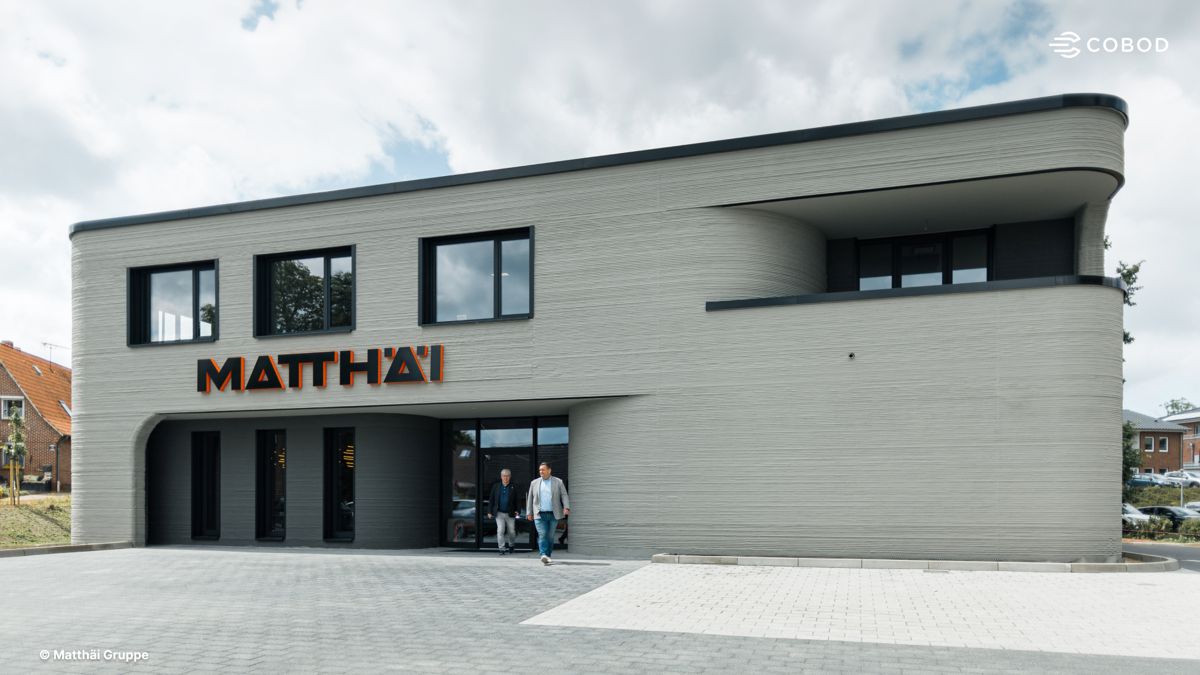
The building itself is a competent piece of work rather than a spectacle, and that restraint is precisely the point. It stands around 7.4 metres high, 22.5 metres long and 13.5 metres deep across two full storeys, providing 364 m² of usable space split between 170 m² on the ground floor and 194 m² above. The walls took roughly 105 hours of printing time using Holcim’s TectorPrint, a printable cementitious material, with the form and facade produced directly from the digital model designed by the architectural office Schulenburg and the planning firm Mense-Korte.
Crucially, the foundation, base slab, floors and roof were built using conventional methods, which is the honest reality of almost every printed building delivered to date and a useful corrective to the impression that a whole structure emerges from a nozzle.
That hybrid nature is not a weakness in the commercial argument, it is the argument. Matthäi did not need the technology to build everything to justify keeping it. It needed the printed element to demonstrate that formwork-free wall geometry, faster shell erection and reduced reliance on scarce skilled trades could be delivered on a real project with a genuine occupancy date.
Bernd Mergard, Managing Director of Matthäi Schlüsselfertigbau, framed the completion in terms of the group’s wider trajectory, saying: “The entire Matthäi Group is proud to be able to realize the first 3D-printed building in Northern Germany. Together with our partners at PERI 3D Construction, we are taking an important step into the future of construction. Once again, this shows how strongly Matthäi combines entrepreneurial growth with innovation and progress.” The decisive detail is what came after the ribbon-cutting, when the printer stopped being a project cost and became a service the company intends to sell.
Where Purchasing Power And Capability Are Consolidating
Look past the individual firms and a clearer market pattern emerges around who now owns the ability to print at scale. The printer came from COBOD, the Copenhagen manufacturer that describes itself as the global leader in construction 3D printing with more than 90 printers deployed across 35 countries. The material came from Holcim, whose TectorPrint is a proprietary printable “ink” the cement major has been developing since its collaboration with COBOD began in 2019, followed by a direct investment in the printer maker.
The operating expertise came from PERI 3D Construction, the additive-manufacturing arm of one of the world’s largest formwork and scaffolding suppliers. What binds these three together is not coincidence. Holcim, PERI, CEMEX and GE are all COBOD shareholders, which means the machine, the mortar and the method are increasingly the property of the same building-materials establishment that already dominates conventional construction.
For a contractor weighing adoption, that consolidation cuts two ways. On the reassuring side, it lowers the perceived risk of committing to a technology when the supply chain is backed by companies of the scale of Holcim and GE rather than thinly capitalised newcomers, and it makes financing, material supply and long-term support far more credible.
On the strategic side, it signals that the value pooling around 3D printing is being captured by incumbents rather than disruptors, and that a contractor which builds its own capability early, as Matthäi has, secures a seat closer to that value than one which waits to buy the service in later. The absence of proprietary lock-in helps here too, since COBOD’s printers are designed to run on locally sourced concrete rather than a mandated proprietary mix, giving operators room to negotiate on material cost even as the machine platform consolidates.
The Labour Arithmetic Driving Adoption
The commercial logic behind internalising a printing capability becomes far sharper when set against the German labour market. Construction remains one of the most persistently understaffed sectors in the country, with around 30 per cent of construction firms still reporting they cannot find the workers they need as of early 2026, and forecasts from employer bodies pointing to a national shortfall of up to 768,000 skilled workers by 2028.
The consequences are already visible in project economics, with analysis of the German market indicating that average construction times have stretched from 20 to 26 months and a backlog of unrealised housing has climbed toward 760,000 units. A method that lets a small team supervise a machine printing walls, rather than a full trades crew laying blocks, is not a novelty in that context. It is a direct answer to the constraint that most limits a contractor’s throughput.
This is why the German industry response has been to pivot toward serial and modular delivery, with firms using modular methods reporting productivity gains of up to 30 per cent, described as a critical advantage in addressing the skilled-labour shortage. Construction 3D printing sits naturally within that turn toward manufacturing-style repeatability.
A printed shell reduces the number of separate trade handovers, compresses the programme for the structural envelope, and shifts labour from physically demanding site work toward machine operation and digital planning. For a group like Matthäi, which specialises in functional buildings such as offices, commercial units and logistics halls, the appeal is obvious. Those are exactly the standardised, geometrically straightforward structures where a printer earns its keep fastest, and where a repeatable in-house process compounds in value across a pipeline rather than paying off only once.
A European Deployment Record That Is Maturing
The Selsingen project does not stand alone, and its significance is amplified by how far the European track record has moved in a short span. PERI printed Germany’s first 3D-printed residential house in Beckum in 2021 using a COBOD printer and a HeidelbergCement material developed specifically for the process, a project that leaned heavily on regional subsidy to prove the concept.
The trajectory since then has been toward larger and more commercially serious work. In Heidelberg, PERI 3D Construction and its partners have delivered what has been billed as Europe’s largest 3D-printed building, an IT server hotel around 54 metres long, printed with a low-carbon binder, and separately a cluster of three DREIHAUS multi-family houses creating 21 residential units, marketed as the start of serial 3D housing construction in Germany.
The maturing extends well beyond Germany’s borders and beyond single-storey demonstrators. In France, Holcim and COBOD completed ViliaSprint², a 12-unit residential building finished in around 12 months and described as the largest 3D-printed residential project in Europe, printed directly on site rather than from pre-printed elements. The three-storey Bezannes scheme used a COBOD gantry with just three operators managing the process via tablets, replaced conventional reinforcement with synthetic macro-fibres, and finished wall printing roughly twice as fast as a comparable conventional build on the same site.
Set alongside COBOD’s larger-format deployments, including the installation of the outsized BODXL machine in Qatar to print a school for a public works authority, the pattern is one of a technology moving out of the pilot phase and into repeatable, revenue-bearing delivery across housing, retail, data centres and public buildings. Matthäi’s decision to build a division reads as a rational response to that evidence rather than a leap of faith.
Materials, Carbon And Lifecycle Economics
Much of the durable commercial value in printed construction sits in the material science rather than the robotics, and this is where the incumbent suppliers are concentrating their effort. Formwork elimination is the immediate saving, since printing complex geometry directly from a digital model removes the timber, plywood and labour that conventional curved or irregular walls demand. Beyond that, the printable mortars are being engineered to carry a lower embodied-carbon load, which matters increasingly as European regulation tightens on the environmental performance of buildings.
Holcim’s own reporting on the Bezannes project notes that optimising the mix design achieved a carbon reduction of around 30 per cent compared with standard concrete of the same strength, aligning the building with the 2025 threshold of France’s RE2020 standard. That is a material commercial lever in markets where carbon ceilings increasingly govern what can be built and let.
The German projects have pushed this further still. In Heidelberg, the DREIHAUS programme became a proving ground for advanced binders, with Heidelberg Materials’ evoZero, described as the world’s first net-zero cement based on carbon capture and storage, used for the first time in Germany during construction. The strategic reading is that cement majors see printable materials not as a side venture but as a channel for their lowest-carbon products, where the precision of additive placement lets them put expensive high-performance mortar only where structural function requires it.
A recurring supporting cast reinforces the point that a specialist ecosystem is forming rather than a scatter of one-off experiments, with the Mense-Korte planning practice, also trading as Korte-Hoffmann Gebäudedruck, appearing across the Matthäi headquarters, the Heidelberg data centre and the DREIHAUS scheme. Design capability, material science and machine operation are coalescing into something that looks like an industry rather than a series of demonstrations.
Reading The Direction Of Travel
The signal worth acting on is the one COBOD itself identified. Philip Lund-Nielsen, the company’s Co-founder and CCO, put the Matthäi decision in market terms, saying: “Matthäi printed a two-story office building and then set up its own printing division. That step, from one project to an in-house capability, is exactly what we want to see. It shows construction 3D printing has moved from demonstration into everyday business.” Whatever discount one applies to a supplier’s enthusiasm, the underlying observation holds.
When contractors internalise a technology, they change the demand curve for it, because an in-house division needs a pipeline of projects to justify its overheads and will actively seek work that suits the method. That is how a capability stops being a curiosity and becomes a standing competitive advantage.
For infrastructure owners, developers and rival contractors, the practical implications are worth weighing now rather than later. The near-term opportunity is concentrated in exactly the buildings Matthäi builds, the standardised commercial and industrial structures where geometry is simple, volumes are repeatable and labour is the binding constraint.
Tim Schulenburg, Managing Director of the architectural office behind the design, captured the ambition of the firms committing to it, saying: “3D concrete printing allows us to completely revolutionize traditional construction processes. As a company, we see in this innovation not only a technological advance, but the creation of an entirely new sector within construction. With this technology we are shaping the future of building: faster, more flexible and more sustainable.”
Market forecasters continue to disagree sharply on the pace, with published estimates of the printing-in-construction market spanning wildly different definitions and headline numbers, yet they agree on direction and on strong compound growth. The safer conclusion for industry leaders is that the technology has crossed from proving whether it works to deciding who owns it, and that the contractors building capability today are positioning for a market their competitors will eventually have to buy their way into.
Key Industry Questions
- Why does an in-house 3D printing division matter more than the printed building itself? A printed building demonstrates that the technology functions on a real site with a real occupancy date. A permanent division demonstrates that a contractor believes the method will pay off repeatedly across future projects. The difference is between a marketing exercise and a business decision. When a top-twenty German group commits overheads to a standing capability, it must feed that division a pipeline of work, which changes the demand for the technology and signals that adoption has moved past experimentation. For competitors, it means the window to build early-mover expertise is narrowing while the capability is still a differentiator rather than a baseline expectation.
- How much of a printed building is actually printed? Less than the marketing implies, and the Matthäi project is candid about it. The printer produced the walls of both storeys in around 105 hours, but the foundation, base slab, floors and roof were built conventionally. This hybrid reality is standard across the sector today. The commercial value therefore concentrates in the wall-erection phase, where printing removes formwork, compresses the programme and reduces reliance on scarce trades. Buyers should assess the technology on that basis, evaluating where it displaces cost and labour rather than expecting a fully automated structure, since the honest gains are real even though they are partial.
- Who controls the construction 3D printing supply chain? Increasingly, the same building-materials establishment that dominates conventional construction. COBOD, the leading printer manufacturer, counts General Electric, CEMEX, Holcim and PERI among its shareholders. Holcim supplies the printable TectorPrint material and is also an investor, while PERI, a global formwork giant, both operates printers and holds a stake. This concentration lowers adoption risk for contractors, because the supply chain is backed by large, well-capitalised firms, but it also means the value created by the technology is being captured by incumbents rather than startups. Contractors that build capability early sit closer to that value than those who wait to buy the service later.
- What is driving German contractors toward printing now? Labour scarcity is the dominant factor. Around 30 per cent of German construction firms reported unfilled skilled positions in early 2026, and employer bodies forecast a shortfall of up to 768,000 workers by 2028. Skill shortages have lengthened average build times and swollen the housing backlog. A method that lets a small team supervise a machine printing walls, rather than a full crew laying blocks, directly addresses the constraint that most limits throughput. This is why German industry is pivoting toward serial and modular delivery, where printing sits naturally, and where productivity gains of up to 30 per cent have been reported for related industrialised methods.
- Does 3D printing reduce a building’s carbon footprint? It can, though the saving depends on the material and the design. Printing places material only where it is structurally needed, avoiding the over-design common in conventional construction. The printable mortars are being engineered for lower embodied carbon, with one Holcim project in France reporting a 30 per cent carbon reduction against standard concrete of equivalent strength, enough to meet France’s RE2020 threshold. German projects have gone further, deploying Heidelberg Materials’ evoZero, a net-zero cement based on carbon capture and storage. For developers facing tightening carbon regulation on what buildings may be constructed and let, this material lever is becoming a genuine commercial consideration rather than a sustainability footnote.
- Is construction 3D printing commercially proven or still experimental? The evidence points firmly toward commercial deployment. COBOD reports more than 90 printers across 35 countries, and European projects have progressed from single subsidised demonstrators to serial housing, multi-unit residential buildings, data centres and public schools. France’s ViliaSprint² delivered 12 residential units in around 12 months, printed on site with only three operators. Germany’s DREIHAUS scheme created 21 units marketed as the start of serial printed housing. Larger-format machines are printing public buildings in the Gulf. The technology is no longer proving whether it works, it is establishing which building types it suits best and who will own the capability at scale.
- Which building types suit 3D printing best? Standardised, geometrically straightforward structures where volumes are repeatable and labour is the binding constraint. Functional buildings such as offices, commercial units, logistics halls and low-rise housing are the natural fit, which is precisely Matthäi’s specialism. These structures reward the method’s strengths, namely fast shell erection, formwork-free walls and reduced trade handovers, without demanding the structural complexity that printing cannot yet deliver economically. Highly bespoke or tall structures remain better suited to conventional methods for now. Contractors evaluating adoption should map the technology against their existing order book and prioritise the repeatable, envelope-simple projects where a printer’s economics compound across a pipeline.
- Should contractors invest now or wait? The case for early positioning is strengthening. The supply chain is consolidating around large, credible incumbents, which reduces the risk of committing. Labour constraints are structural rather than cyclical and unlikely to ease materially within the decade. Early adopters accumulate operating expertise, digital-planning capability and material knowledge that later entrants will have to acquire from scratch or buy in at a premium. The counter-argument is that the technology’s economics still favour a narrow band of building types, so a wholesale commitment would be premature. The balanced position, which Matthäi appears to have taken, is to build capability deliberately around the projects where it already pays, then scale as the addressable range widens.
Strategic Takeaways
- The commercially significant event is not the printed headquarters but a mainstream contractor converting a one-off into a permanent division, which marks the technology’s move from subsidised pilot to standing business capability.
- Value in construction 3D printing is consolidating among incumbents, with the printer, the material and the operating expertise increasingly owned by COBOD’s shareholder bloc of Holcim, PERI, CEMEX and GE, so early-moving contractors secure a stronger position than late buyers.
- Germany’s structural labour shortage, not sustainability rhetoric, is the primary adoption driver, making labour-light printed delivery a direct answer to lengthening build times and a large housing backlog.
- The addressable near-term market is concentrated in standardised functional buildings, offices, commercial units and logistics halls, where repeatable geometry and simple envelopes let a printer’s economics compound across a pipeline.
- Low-carbon printable mortars, including net-zero cements now entering German projects, are becoming a regulatory and commercial lever as carbon ceilings increasingly govern what may be built and let, giving material science as much strategic weight as the robotics.