Membrane Refining Crosses from Chemistry into Engineering
A cluster of research results published in the first half of 2026 has quietly moved membrane-based crude oil separation out of the materials-science laboratory and towards the refinery fence line. For most of the past decade the idea of separating hydrocarbons by pushing them through a polymer film, rather than boiling them apart in a distillation column, has been treated as an elegant but distant prospect.
The economics were never the real obstacle, because thermal distillation is one of the most energy-hungry operations in heavy industry and almost any credible alternative promised savings. The obstacle was productivity, since early membranes moved crude oil far too slowly to justify the capital cost of a plant-scale installation. That barrier has now been breached from two directions at once, and the commercial conversation has shifted from whether membrane refining can work towards where it should be installed first.
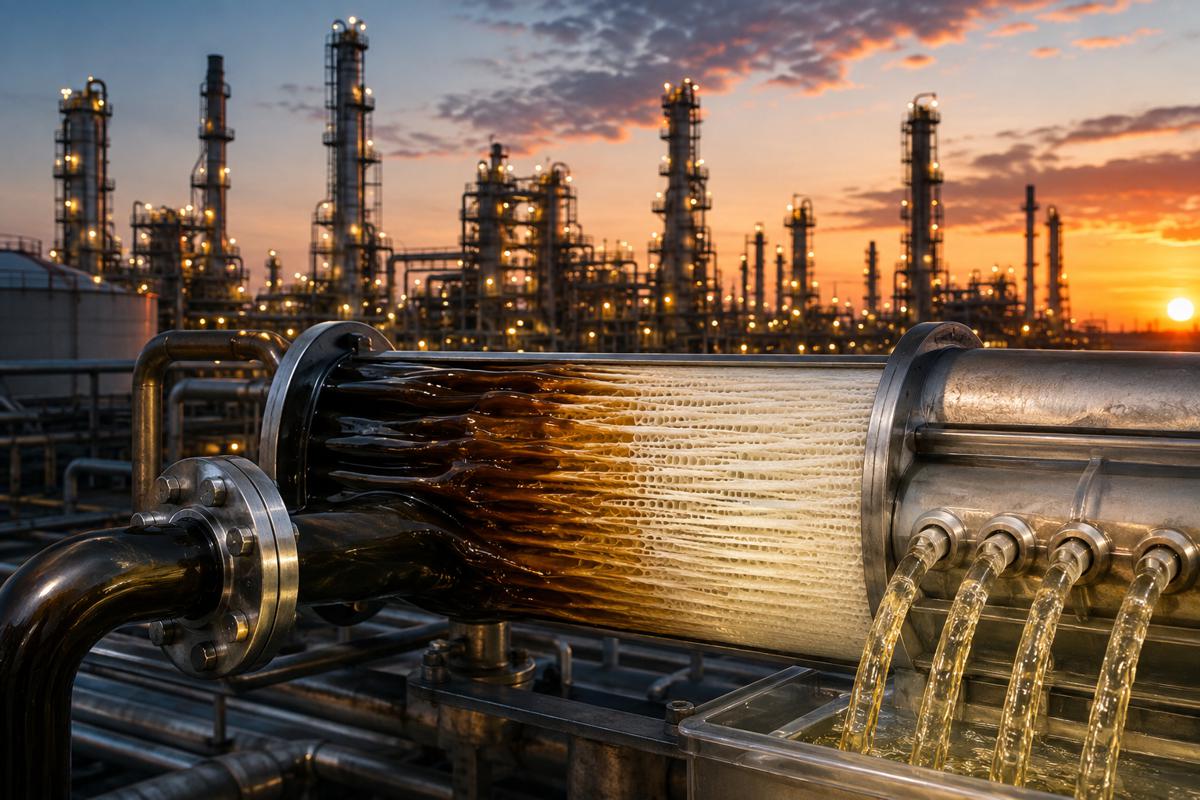
The most credible near-term role for these membranes is not the wholesale replacement of the crude distillation unit, an asset that sits at the heart of every refinery and represents decades of sunk investment. It is as a pre-fractionation stage that strips lighter fractions ahead of the column, cutting the thermal load, the fuel gas burned and the carbon emitted, while lifting the effective throughput of the existing distillation train. Framed that way, the technology becomes a retrofit and a debottlenecking opportunity rather than a threat to installed capacity.
That distinction is precisely what makes it interesting to refiners, membrane manufacturers and the engineering contractors who would design the integration, and it explains why a review paper on polymer chemistry has landed with more commercial weight than its subject might suggest.
Briefing
- A review in the Chinese Journal of Polymer Science, published online on 9 April 2026 by a University of Science and Technology of China team, mapped the design logic for microporous polymer membranes weeks before two flagship demonstrations pushed the field towards industrial viability.
- Researchers at KAIST and Georgia Tech reported crude oil permeance of up to 0.591 litres per square metre per hour per bar in Nature, a more than 23-fold jump over the previous benchmark, using inexpensive polyacrylonitrile membranes normally treated as inert support layers.
- A Queen Mary University of London team, working with the spin-out Exactmer, produced metre-wide membranes by roll-to-roll processing and fitted them into standard spiral-wound modules, removing 99.8% of heavy hydrocarbons and 93% of sulphur compounds from Arabian Extra Light crude.
- Atmospheric and vacuum distillation consume more than 1,100 terawatt hours a year and emit over 160 million tonnes of carbon dioxide equivalent, so even partial displacement carries material commercial and environmental value.
- Organic solvent nanofiltration is already commercial in pharmaceutical manufacturing through Evonik and Exactmer, giving the crude oil application a proven industrial template rather than an untested one.
From Laboratory Curiosity To Retrofit Strategy
The framing of membrane fractionation as a complement to distillation rather than its rival is not a marketing softening of a disruptive claim. It has been the working assumption of the field’s most industrially serious participants from the outset. When ExxonMobil, Georgia Tech and Imperial College London first demonstrated organic solvent reverse osmosis on hydrocarbon streams, the lead academic, Ryan Lively, described the membrane concentrate being fed into a conventional thermal process for finishing, with the total energy input falling sharply as a result. The point was never to demolish the crude distillation unit but to reduce how hard it has to work, and that logic has only strengthened as the numbers have improved.
The 2026 Nature study makes the retrofit case explicit. Its authors, a KAIST group led by Dong-Yeun Koh in collaboration with Lively’s laboratory at Georgia Tech, describe membrane-based pre-fractionation as a compelling strategy for lowering the energy and carbon intensity of petroleum refining, positioning the membrane as a front-end stage that hands a partially separated stream to the existing column.
Lively noted that the work grew directly out of the challenges the team had identified in its earlier findings, a reminder that this is a sustained industrial research programme rather than a one-off result. For a refiner, the commercial translation is straightforward. A pre-fractionation membrane that removes naphtha and kerosene-range molecules before the crude reaches the furnace reduces the volume that has to be heated, frees column capacity for additional throughput, and lowers the fuel and cooling water bills that dominate a distillation unit’s operating cost.
The Productivity Barrier Has Fallen
For years the honest objection to membrane refining was that the membranes were too slow. A film that separates crude oil beautifully but processes only a trickle of it per square metre is an academic curiosity, because a refinery handling two hundred thousand barrels a day would need an impractical membrane area to keep pace. The decisive change in 2026 is that productivity, measured as permeance, has risen by more than an order of magnitude while selectivity has held or improved.
The KAIST and Georgia Tech team achieved crude oil permeance more than twenty-three times higher than the previous benchmark by exploiting an effect that filtration engineers normally treat as a failure. Heavy hydrocarbons deposit inside the roughly fifteen-nanometre surface pores of a cheap polyacrylonitrile membrane and progressively narrow them to below two nanometres, so the membrane in effect tunes its own separation channels during operation.
The Queen Mary and Exactmer result attacks the same barrier from the materials side and arrives with the manufacturing evidence that refiners will want to see. By locking the pore structure of a rigid polymer in place with an in-situ crosslinking step during film formation, the team stopped the microporosity collapsing when the film met organic solvents, the swelling problem that had blunted earlier candidates.
The resulting membranes delivered roughly ten times the permeance of state-of-the-art materials on synthetic crude and, more importantly for scale-up, were made as metre-wide sheets by roll-to-roll processing and packaged into the spiral-wound modules already standard across the water and gas industries. Zhiwei Jiang, who led that work as head of membrane research at Exactmer, summarised the breakthrough as stabilising the structure before the polymer had a chance to swell. Once the productivity gap closes and the module format matches existing plant hardware, the remaining questions become engineering and commercial rather than fundamental.
A Field Converging Rather Than A Single Breakthrough
The Chinese review that prompted this analysis is best read not as a standalone announcement but as the theoretical spine of a field arriving at maturity. Its authors classify the major families of microporous polymer membranes, including dibenzodioxane-based polymers, polytriazoles, polyimides, polyimines and polyureas, and set out the central design tension between permeance and selectivity that every research group is trying to resolve. The review’s contribution is a unifying design logic, the argument that backbone rigidity, side-chain chemistry, solvent swelling and pore connectivity have to be engineered together rather than optimised in isolation. Landing in April, weeks ahead of the Nature and Science demonstrations, it reads in hindsight as a map published just before the territory was crossed.
What gives the moment its commercial significance is the geographic and institutional spread of the groups now converging on the same target. The lineage runs through ExxonMobil, Georgia Tech and Imperial College London, whose 2016 and 2020 Science papers established organic solvent reverse osmosis on real crude, and continues through King Abdullah University of Science and Technology, whose polytriazole and, with the Massachusetts Institute of Technology, polyimine membranes advanced the chemistry in 2022 and 2025.
It now includes KAIST in South Korea, Queen Mary and its Exactmer spin-out in the United Kingdom, and the University of Science and Technology of China. When laboratories backed by an oil major, two of the world’s largest crude economies and several leading engineering schools independently reach comparable conclusions within a few years, the pattern signals a technology approaching the point where licensing, procurement and pilot deployment follow. Markets tend to move once the risk of backing a single fragile result has been diversified across many, and that diversification has now happened.
Where The Commercial Value Concentrates
The strongest argument that membrane refining is a real business rather than a perpetual promise is that the underlying separation platform is already commercial elsewhere. Organic solvent nanofiltration moved from the laboratory into pharmaceutical and fine-chemical manufacturing years ago, first through Membrane Extraction Technology, acquired by Evonik and now trading as Evonik MET, and more recently through Exactmer, which runs solvent-stable membranes as spiral-wound modules to manufacture oligonucleotides and peptides at regulated scale.
The crude oil application is simply the largest and most demanding target for a technology that has already proven it can survive organic solvents, be manufactured continuously and be packaged in industry-standard hardware. That heritage lowers the perceived risk for any refiner or licensor evaluating a first installation.
Value in a membrane pre-fractionation retrofit concentrates in several places at once, which is what makes it attractive across the supply chain rather than to a single incumbent. Membrane and module manufacturers gain a vast new addressable market in the highest-volume liquid separation on earth. Refiners capture lower energy and cooling costs, additional distillation capacity without new column construction, and a measurable reduction in carbon intensity that increasingly carries a price under emissions regulation.
The sulphur removal demonstrated on Arabian Extra Light crude, at ninety-three per cent, is commercially significant in its own right, because sulphur compounds degrade downstream catalysts and corrode equipment, so a front-end membrane that strips them protects assets that cost far more than the membrane itself. Engineering and construction firms, meanwhile, would own the integration, the pressure systems, module skids and process control that turn a laboratory film into a refinery unit.
The Chemistry That Makes It Durable
For an industrial buyer the interesting property of these membranes is not that they separate hydrocarbons, which many materials can do briefly, but that they keep doing so under conditions that destroy weaker films. Crude oil is a hostile medium, chemically complex and rich in molecules that swell and plasticise polymers, and durability under that assault is the reliability threshold refiners actually purchase against. The design strategies emerging across the field all address this.
Rigid, awkwardly shaped building blocks such as spirobifluorene and triptycene units prevent polymer chains packing tightly, creating the intrinsic micropores that do the sieving, while fluorine-rich side chains, crosslinked networks and molecular gating effects hold that pore structure open when the film is immersed in solvent.
The two 2026 demonstrations show two routes to the same durability goal, and both are instructive for anyone assessing lifecycle cost rather than headline performance. The Queen Mary approach locks the microporosity chemically so the pores resist swelling from the start, delivering stable operation on real crude. The KAIST approach turns fouling into function, allowing heavy molecules to build the selective layer in place and sustaining separation at steady state rather than degrading towards it.
Both point to the same conclusion the Chinese review reaches from theory, that the next generation of membranes should not merely contain more pores but should contain pores that remain stable in demanding hydrocarbon environments. Durability, not peak selectivity in a clean laboratory test, is the property that will decide which chemistries reach a refinery and how long they last once installed.
What Refiners And Investors Should Weigh Now
The trajectory is set, but the remaining obstacles are the practical ones that separate a strong result from an operating asset, and they deserve clear-eyed attention rather than dismissal. Cost-efficient fabrication at genuine plant scale has been demonstrated in principle by roll-to-roll manufacturing and spiral-wound packaging, yet the economics of coating many thousands of square metres to a consistent specification remain to be proven at commercial volume. Long-term stability across the full variability of real crude slates, rather than a single well-characterised feed, is the durability question every refiner will insist on answering through extended pilot operation. The permeance and selectivity balance, though hugely improved, still involves trade-offs that process designers will have to optimise for each specific application and feedstock.
None of this diminishes the strategic significance for the industries that surround refining. A pre-fractionation membrane that reduces the energy intensity of the world’s dominant separation process is a modernisation and competitiveness story, not a disruption narrative, because it strengthens existing assets and extends their working life while cutting their carbon footprint.
There is a further consideration for the heavier end of the barrel, since membranes that pull light fractions forward concentrate the residual streams that feed lubricant, asphalt and bitumen production, leaving those value chains dependent on the same distillation and vacuum units they use today.
Refiners would be wise to commission feasibility studies on membrane pre-fractionation for suitable light crude streams, membrane and module suppliers should treat refining as the volume prize that justifies serious manufacturing investment, and investors tracking industrial decarbonisation should watch for the first licensed pilot retrofits, which will convert a decade of laboratory progress into a bankable process the market can price.
Key Industry Questions
- Will membrane fractionation replace crude distillation columns? Not in any foreseeable timeframe, and the leading research groups do not claim it will. The realistic role is pre-fractionation, where a membrane strips lighter naphtha and kerosene-range molecules from crude before it reaches the distillation column. This reduces the volume that must be heated, lowers fuel and cooling costs, and frees capacity in the existing column for additional throughput. The crude distillation unit remains the workhorse, particularly for heavier fractions that membranes are not designed to separate. Positioning the technology as a retrofit that de-loads and debottlenecks existing assets, rather than a replacement, is both the honest engineering assessment and the reason refiners find it commercially approachable.
- What was actually holding membrane refining back? Productivity, expressed as permeance, was the binding constraint. Early membranes could separate crude oil selectively but processed it far too slowly to be economic, since a refinery would have needed an impractically large membrane area to match column throughput. The 2026 advances broke that barrier, with a KAIST and Georgia Tech membrane achieving permeance more than twenty-three times the previous benchmark, and a Queen Mary team reaching roughly ten times state-of-the-art productivity while improving durability. Swelling was the related materials problem, because organic solvents caused polymer pores to dilate and lose selectivity. Locking the pore structure chemically, or allowing it to self-assemble during operation, addressed both issues simultaneously and shifted the field from a chemistry problem to an engineering one.
- How much energy and carbon could this realistically save? The scale of the prize is set by distillation itself, which globally consumes more than 1,100 terawatt hours a year and emits over 160 million tonnes of carbon dioxide equivalent for atmospheric and vacuum processing alone. Individual studies report a range of savings depending on scope, with the polyacrylonitrile membrane approach indicating around thirty per cent lower energy and emissions for naphtha-range separation, and locked-microporosity membranes suggesting reductions of up to ninety per cent against distillation for the separation step they perform. Actual plant savings will depend on how much of the separation duty a membrane takes on and how it integrates with the existing column, so the credible near-term figure is a meaningful reduction in a very large number rather than wholesale elimination.
- Which companies and institutions are leading this technology? The field spans an unusually broad set of well-resourced players. ExxonMobil, working with Georgia Tech and Imperial College London, established organic solvent reverse osmosis on real crude in 2016 and 2020. King Abdullah University of Science and Technology advanced the chemistry with polytriazole and, alongside the Massachusetts Institute of Technology, polyimine membranes. KAIST in South Korea and Georgia Tech delivered the 2026 productivity breakthrough, while Queen Mary University of London and its spin-out Exactmer demonstrated scalable manufacturing. The University of Science and Technology of China provided the design synthesis that ties the approaches together. This convergence across an oil major, major crude economies and leading engineering schools is itself a signal of commercial seriousness.
- Why does sulphur removal matter as much as fractionation? Sulphur compounds are among the most damaging contaminants in crude oil, poisoning downstream catalysts and corroding refinery equipment that is expensive to maintain and replace. A front-end membrane that removed ninety-three per cent of sulphur species from Arabian Extra Light crude therefore delivers value beyond separating fuel fractions, because it protects high-cost assets further along the process chain and can reduce the severity required of dedicated desulphurisation units. For refiners, that asset-protection benefit may prove as commercially compelling as the energy saving, since it touches catalyst replacement cycles, equipment lifespan and unplanned maintenance, all of which weigh heavily on operating margins in a competitive refining market.
- Is the underlying technology proven anywhere at industrial scale? Yes, which is why the crude oil application is credible rather than speculative. Organic solvent nanofiltration is already commercial in pharmaceutical and fine-chemical manufacturing, first through Membrane Extraction Technology, acquired by Evonik and now Evonik MET, and more recently through Exactmer, which operates solvent-stable membranes as spiral-wound modules to produce oligonucleotides and peptides at regulated scale. This establishes that the membranes can survive organic solvents, be manufactured continuously and be packaged in standard industrial hardware. The crude oil challenge is one of volume, feed complexity and cost per square metre rather than of inventing an entirely new industrial capability, and that inheritance materially lowers the deployment risk.
- What does this mean for heavy fractions, lubricants and bitumen? Membrane pre-fractionation targets the lighter end of the barrel, pulling naphtha and kerosene-range molecules forward, which by definition concentrates the heavier residual streams left behind. Those heavy fractions, the basis of lubricants, heavy fuel oil, asphalt and bitumen, continue to depend on atmospheric and vacuum distillation, so the membrane trend does not displace the processing that heavy-product value chains rely on. If anything, a refinery that recovers light fractions more efficiently at the front end may run its distillation and vacuum units in a more focused way on the heavy end. Producers and buyers in the bitumen and lubricant markets should therefore see membrane pre-fractionation as adjacent to their supply base rather than as a direct threat to it.
- What should refiners and investors do with this information now? Refiners should commission feasibility and pilot studies on membrane pre-fractionation for suitable light crude streams, focusing on integration with existing columns, membrane lifespan under real feed variability, and total installed cost. Membrane and module manufacturers should treat refining as the volume market that justifies serious manufacturing investment, given the addressable scale of global crude processing. Investors tracking industrial decarbonisation should watch for the first licensed pilot retrofits, since those will convert laboratory performance into a priced, bankable process. The prudent stance is engagement and evaluation rather than either dismissal or overcommitment, because the technology has crossed a genuine threshold but still has to prove its economics at commercial scale.
Strategic Takeaways
- Membrane crude fractionation has passed a genuine inflection point, with productivity gains of more than an order of magnitude in 2026 turning it from a chemistry problem into an engineering and commercial one that refiners can now realistically evaluate.
- The winning deployment model is pre-fractionation as a retrofit that de-loads and debottlenecks existing distillation, which protects installed refining capacity and reframes the technology as modernisation rather than disruption.
- The commercial value spreads across the whole supply chain, benefiting membrane and module manufacturers, refiners seeking lower energy and carbon costs, catalyst and equipment owners protected by upstream sulphur removal, and the engineering firms that would deliver integration.
- The convergence of independent, well-funded groups across the United States, South Korea, the United Kingdom, Saudi Arabia, China and an oil major is a stronger market signal than any single result, and it points towards licensing and pilot deployment within the coming years.
- Heavy-product value chains, including lubricants and bitumen, remain anchored to distillation and vacuum processing, so the membrane trend should be read as adjacent to those markets rather than as a threat, while the first licensed retrofit will be the moment the industry can price the opportunity.