The Construction Marketing Playbook Has Changed
New tools are giving ambitious specialist companies greater reach, intelligence and freedom to experiment, but established brands still begin with formidable advantages
For decades, the marketing formula for an ambitious construction business was reasonably straightforward. Build a professional website and make sure it appears in Google. Employ an SEO agency, issue press releases when something interesting happens, exhibit at the important trade shows, advertise in the right publications, build an email database and keep LinkedIn active. Behind all of that, support the sales team with brochures, case studies, presentations and whatever else helps turn an introduction into a conversation.
None of those things has suddenly become obsolete. Websites and search still matter, exhibitions remain valuable in an industry built heavily around relationships, machinery, materials and physical assets, and trade media continues to reach audiences that companies cannot necessarily assemble themselves. Email remains one of the few digital channels where a business can maintain a direct relationship with its audience, while LinkedIn has become deeply embedded in professional communication.
What has changed is the environment connecting all of them.
A construction buyer researching a specialist manufacturer, engineering technology, materials supplier, software platform or piece of equipment now has access to an extraordinary amount of information before ever contacting the company concerned. Search engines increasingly attempt to answer questions rather than simply provide lists of links, while generative AI can compare technologies, summarise unfamiliar subjects, investigate terminology and help users explore markets and suppliers they previously knew little about.
At the same time, producing basic marketing material has become dramatically easier. Any competent company can create a steady stream of blog posts, social updates, newsletters, product descriptions and variations of the same corporate messaging. Information has never been easier to produce, but abundance does not necessarily make a company easier to understand. If anything, the growing volume of material makes genuine expertise harder to distinguish from competent-looking marketing.
For ambitious mid-sized companies across construction, infrastructure, equipment, materials, engineering and industrial technology, this creates both an opportunity and a problem. The multinational continues to enjoy the larger budget, stronger brand recognition and a much deeper existing information footprint. The specialist cannot wish those advantages away, but it now has access to research, analytical and publishing capabilities that would have required far greater resources only a few years ago. It can also move quickly, adapt its positioning and experiment without navigating layers of corporate approval.
The old assumption that an ambitious construction company eventually needs to market like a multinational deserves another look.
Briefing
- Gartner found B2B buyers used an average of seven information sources during a recent purchase.
- In the same research, 45% had used generative AI, primarily to gather information about vendors and products.
- 6sense found buyers evaluated an average of 5.1 vendors but had previous experience with 3.8 of them.
- Google’s early AI Mode users were asking questions two to three times longer than traditional search queries.
- New research tools are lowering some barriers for specialist companies, but established brands retain substantial advantages in familiarity and existing authority.
From being found to being understood
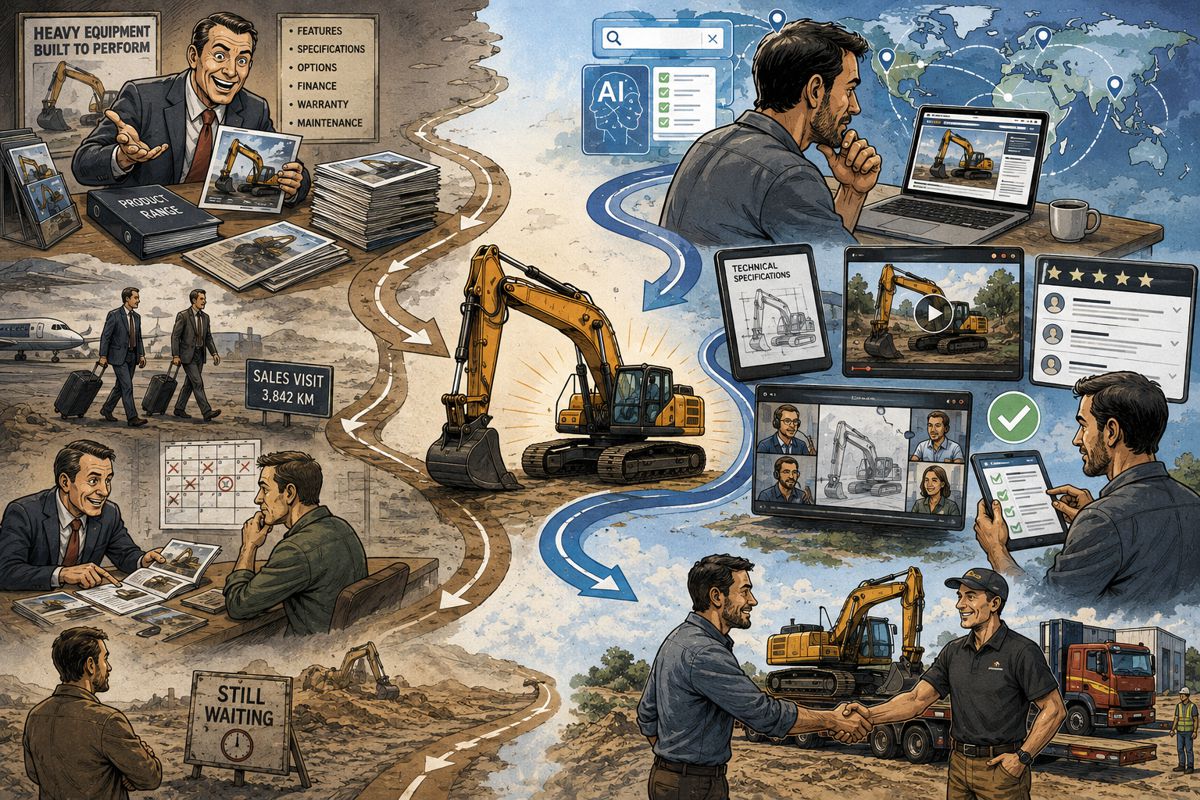
The traditional digital marketing model placed enormous emphasis on being found. Someone typed a relevant phrase into Google, a company appeared prominently enough in the results, the prospect visited its website and the marketing process continued from there. Search rankings, website traffic and enquiries provided a reasonably understandable route from visibility towards a potential sale.
That journey is becoming less predictable. Google reported in 2025 that early users of its AI Mode were asking queries two to three times longer than traditional searches, with conversational follow-up questions allowing users to continue investigating a subject rather than repeatedly returning to a conventional list of search results.
The change can readily be imagined in construction. A procurement manager researching asphalt recycling technology may no longer search only for a product category, while an engineering consultant could investigate which technologies are suitable under particular operating conditions. A quarry operator might explore alternative screening methods before knowing which manufacturers supply them, and a contractor entering a new market could investigate available equipment, terminology, regulations, established suppliers and competing approaches before visiting a manufacturer’s website.
Conventional search remains firmly part of that process. Gartner research published in January 2026, based on a survey of 377 US consumers, found that only around a third regarded generative AI chatbots as being as effective as search engines for learning new information, while more than two-thirds continued researching beyond Google’s AI Overview. Search behaviour appears to be broadening rather than migrating wholesale from one platform to another.
The emerging journey may involve Google, an AI assistant, a manufacturer’s website, an industry article, LinkedIn, a technical paper, YouTube, a trade association, a distributor and eventually an exhibition or conversation with a salesperson. Buyers can move backwards and forwards between those sources without following anything resembling the neat marketing funnel companies have spent years trying to construct.
Marketing therefore has to work across parts of the journey the company does not control. Being visible remains necessary, but visibility alone is a weak achievement if the information surrounding a business does not help somebody understand what it knows, where it operates, which problems it solves, how its technology differs and whether its claims deserve attention.
Many excellent specialist construction companies remain surprisingly difficult to understand from the outside. Their websites have been organised around internal product structures rather than the questions buyers ask. News sections consist largely of appointment announcements, exhibition previews and product launches. Technical knowledge remains inside the heads of engineers and product specialists, while decades of practical experience may be represented by a handful of generic paragraphs written several website redesigns ago.
The business itself knows precisely why its technology is different. The challenge is making that expertise understandable to somebody encountering the company for the first time.
Research before the sales conversation
B2B purchasing has been moving towards self-directed research for years, and artificial intelligence adds another layer by lowering the effort required to explore unfamiliar subjects, compare information and investigate suppliers.
Gartner research published in May 2026, based on a survey of 645 B2B buyers conducted in August and September 2025, found that they used an average of seven information sources during a recent purchase. Forty-five per cent had used generative AI, primarily to gather information about vendors and products. Human validation remained important, with 69% preferring to validate AI-generated insights with sales representatives.
The combination provides a more credible picture of the immediate future than predictions that AI will simply replace traditional B2B selling. Buyers can conduct substantial research independently and involve sales when they need technical clarification, commercial detail, reassurance or greater certainty. By the time that conversation begins, the potential customer may already know a considerable amount about the company, its products and its competitors.
There is also good reason to be cautious about assuming that easier access to information automatically creates a level playing field.
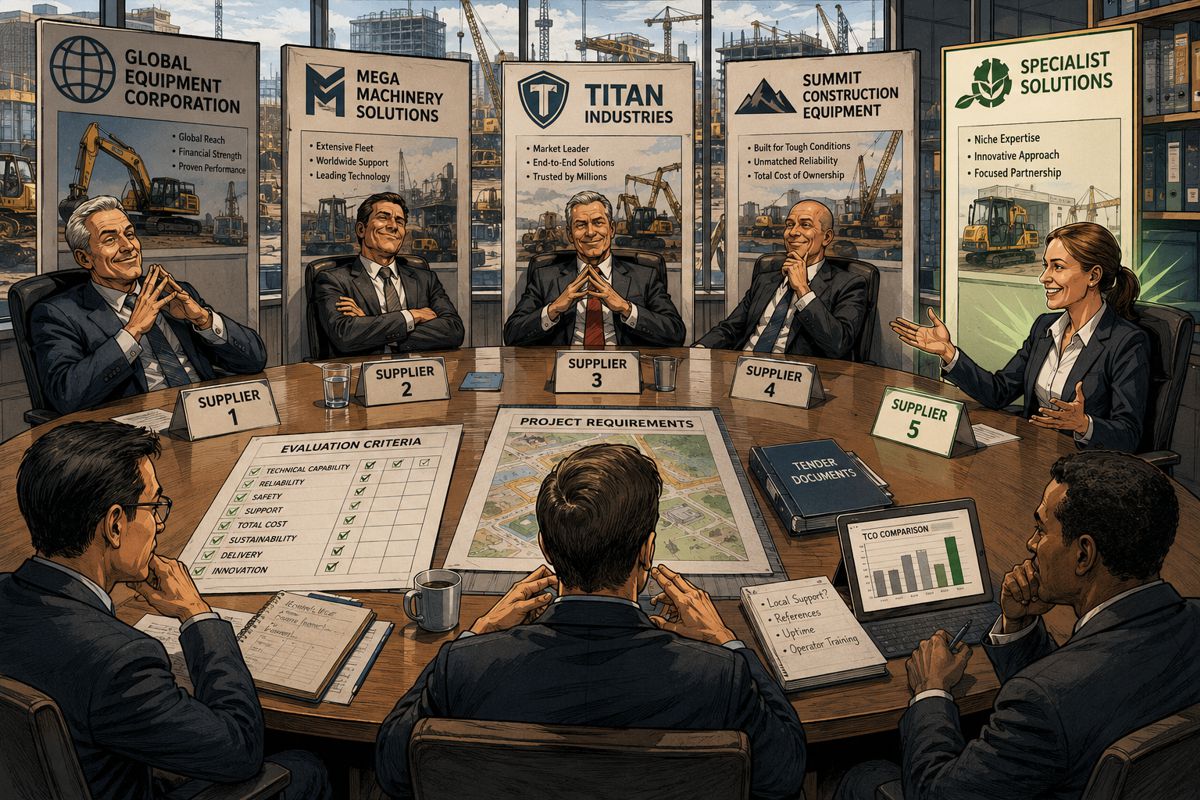
Construction procurement cannot be mapped neatly onto broad B2B studies, particularly where capital equipment, approved suppliers, technical specifications, local service, certification and previous project experience influence purchasing. Even so, research from 6sense offers a revealing picture of how powerful familiarity can be. Its 2025 Buyer Experience Report, based on nearly 4,000 B2B buyers, found that buyers evaluated an average of 5.1 vendors but had previous experience with 3.8 of them. Most of the eventual shortlist was already in place on the first day of the buying journey, and 95% of purchases went to a vendor from that initial shortlist.
For a lesser-known specialist, that is the uncomfortable side of modern discovery. By the time active research begins, familiarity may already have done much of the work.
AI-assisted research could broaden the field by making it easier to investigate unfamiliar companies and technologies, but there is no reason to assume that it will automatically favour them. Established manufacturers begin with decades of accumulated advantages: brand recognition, customers, distributors, case studies, media coverage, technical documentation, external references and a vast amount of public information connecting their names with the markets they serve. AI does not erase any of that.
Yet the same 6sense figures contain a more encouraging detail. Buyers evaluated an average of 5.1 vendors while having previous experience with 3.8. Those averages cannot be treated as a fixed shortlist formula, but they suggest that familiarity does not occupy the entire field. Somewhere in that research process there is still room for companies the buyer did not previously know.
That is where discoverability becomes commercially interesting for the specialist. It does not need to become more famous than the multinational across an entire industry. It needs to become credible and understandable when a buyer investigates the particular problem, technology or capability in which the specialist genuinely has something to offer.
The opportunity is narrower than the idea that AI will somehow democratise procurement, but also more realistic. A specialist company still has to earn its way into consideration. The changing research environment simply gives it more tools, and potentially more routes, through which to do so.
Discovery beyond the domestic market
That opportunity becomes particularly interesting when viewed internationally.
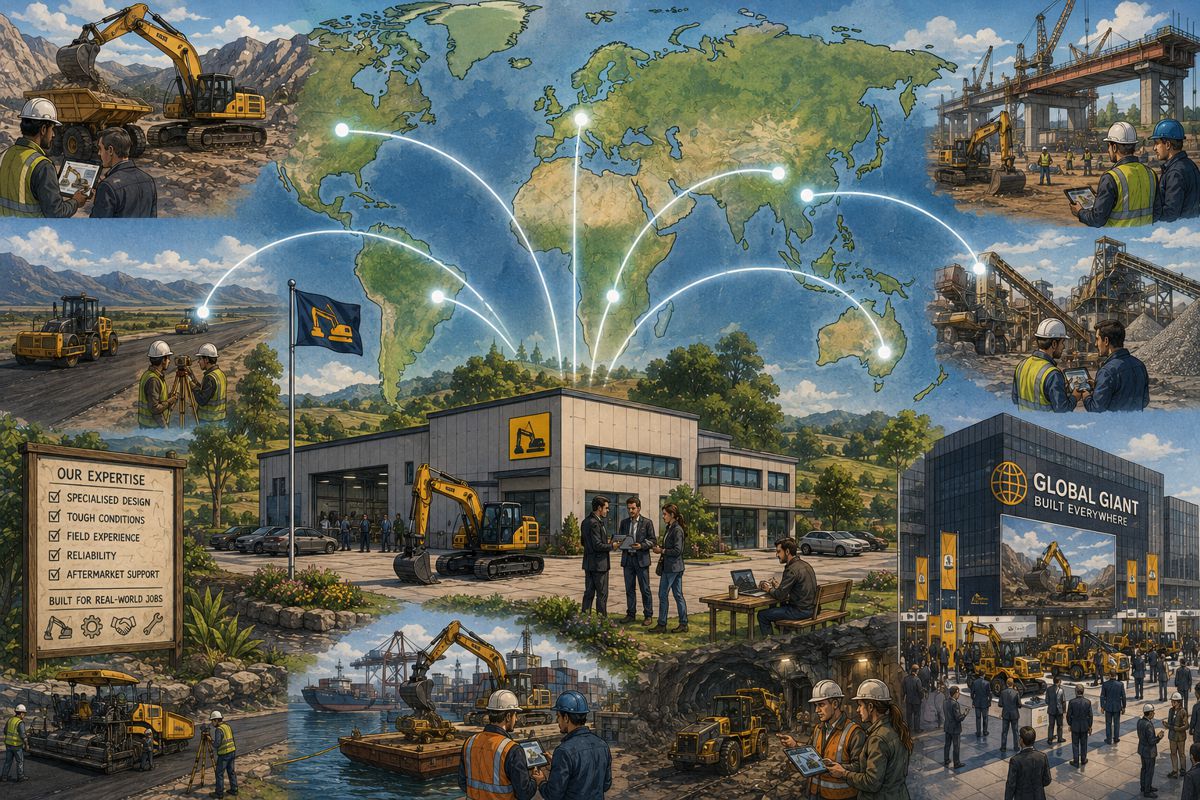
Construction is full of specialist companies whose reputation is much smaller than their expertise. An Italian manufacturer may dominate a narrow piece of road construction technology without being widely recognised outside Europe. An Indian engineering company may possess expertise relevant to African infrastructure projects, while a British industrial technology business could have developed something useful to an Australian contractor. A Brazilian materials company may have experience applicable in South-East Asia, or a South Korean manufacturer may solve a problem that a European buyer has only recently started investigating.
Historically, expanding those businesses internationally required substantial market development. International exhibitions remain expensive, dealer networks take years to establish, overseas advertising requires repeated investment and PR agencies may understand one geographic market well while having limited influence elsewhere. Translating a website does not automatically create international awareness.
Digital discovery has already weakened some of those barriers. AI-assisted research could weaken them further because somebody in one part of the world can investigate expertise in another without necessarily knowing which companies to look for at the beginning. Yet the incumbency problem remains: the company cannot be discovered through information that does not exist.
A business that has spent twenty years supplying municipal road maintenance equipment in one country may describe itself almost entirely through the language, regulations and purchasing structures of that domestic market, even though the engineering problem it solves is universal. A specialist materials company may possess decades of knowledge about durability, climate, aggregates, binders or coatings but present itself online largely through product codes. An equipment technology business may own genuinely interesting intellectual property while its public information consists of little more than specifications and exhibition announcements.
In each case, the expertise exists but the discoverable explanation of that expertise does not necessarily travel with it.
Is your marketing explaining your company only to the market you already serve, or also to the markets you could serve?

A new purpose for the familiar marketing mix
The temptation whenever digital behaviour changes is to declare the previous generation of marketing obsolete. That would be particularly misguided in construction, where purchasing decisions often combine digital research with longstanding relationships, physical demonstrations, engineering judgement, dealer support, reference projects and face-to-face conversations.
The better response is to reconsider what each part of the existing marketing operation is there to achieve.
The corporate website remains the definitive source for products, capabilities, locations, specifications and contact information. Its role is increasingly to provide clear first-party information about the company and its expertise rather than functioning merely as a collection of pages designed around search keywords.
SEO remains important because conventional search continues to play a major role in research. The weakness in the old approach is not search itself, but the assumption that yesterday’s keyword strategy will necessarily answer tomorrow’s more complicated questions.
Exhibitions provide something digital platforms cannot reproduce: machines, products, demonstrations, customers, engineers, conversations and human relationships concentrated into one place. Their marketing value can also extend far beyond the exhibition hall. The knowledge exchanged there can become technical explanations, photography, video, interviews, customer insight and editorial material that continues working after the stand has been dismantled.
LinkedIn offers access to professional networks, although the relationship with that audience remains mediated by somebody else’s platform and algorithms. Email may appear remarkably old-fashioned beside generative AI, but a permission-based mailing list remains one of the strongest direct audience assets a company can build. Advertising can create visibility quickly, while PR and industry media can place a company within conversations and audiences it would struggle to create alone.
The familiar channels still have jobs to do, but their strategic purpose is becoming clearer. The website explains. Search supports discovery. Exhibitions create relationships and knowledge. Social media extends conversations. Email builds a direct audience. Advertising creates visibility. PR and independent editorial provide reach, context and external credibility.
Treating those activities as an interconnected information environment is a more useful starting point than asking which traditional marketing channel AI is going to kill next.
The mid-market advantage, with limits
The largest construction companies will adapt to this environment. They have substantial communications departments, agency networks, research budgets, advertising relationships and global brand recognition, and many are already experimenting extensively with AI.
Scale also brings process. Large organisations require approvals, regional teams have boundaries, global campaigns need consistency, legal departments scrutinise claims and brand systems impose structure. A specialist business employing a few hundred people may have considerably less money but a much shorter distance between an idea and a decision.
That difference becomes useful while the rules are moving.
AI is already reducing the time required to research markets, investigate competitors, explore positioning and develop ideas. Used intelligently, it can give a capable marketing manager access to analytical resources that would previously have required more people, more agencies or considerably more time. That does not confer authority, reputation or international recognition automatically, but it lowers the cost of learning and experimentation.
Mid-sized companies therefore have little reason to recreate the multinational marketing structure on a smaller budget. They can build something different around their own advantages, combining internal knowledge and faster decision-making with external specialists where those specialists bring expertise, relationships, editorial judgement or technical capability the business does not possess itself.
The multinational still has the larger information footprint, stronger brand recognition and greater capacity to sustain campaigns over many years. The specialist has speed, focus and increasingly sophisticated tools with which to decide where to concentrate its resources.
Those are different competitive advantages, and they call for different marketing strategies.
Authority beyond the corporate website
Competing for that unfamiliar place in the buyer’s research requires more than being technically capable. The market needs enough credible information to recognise that capability.
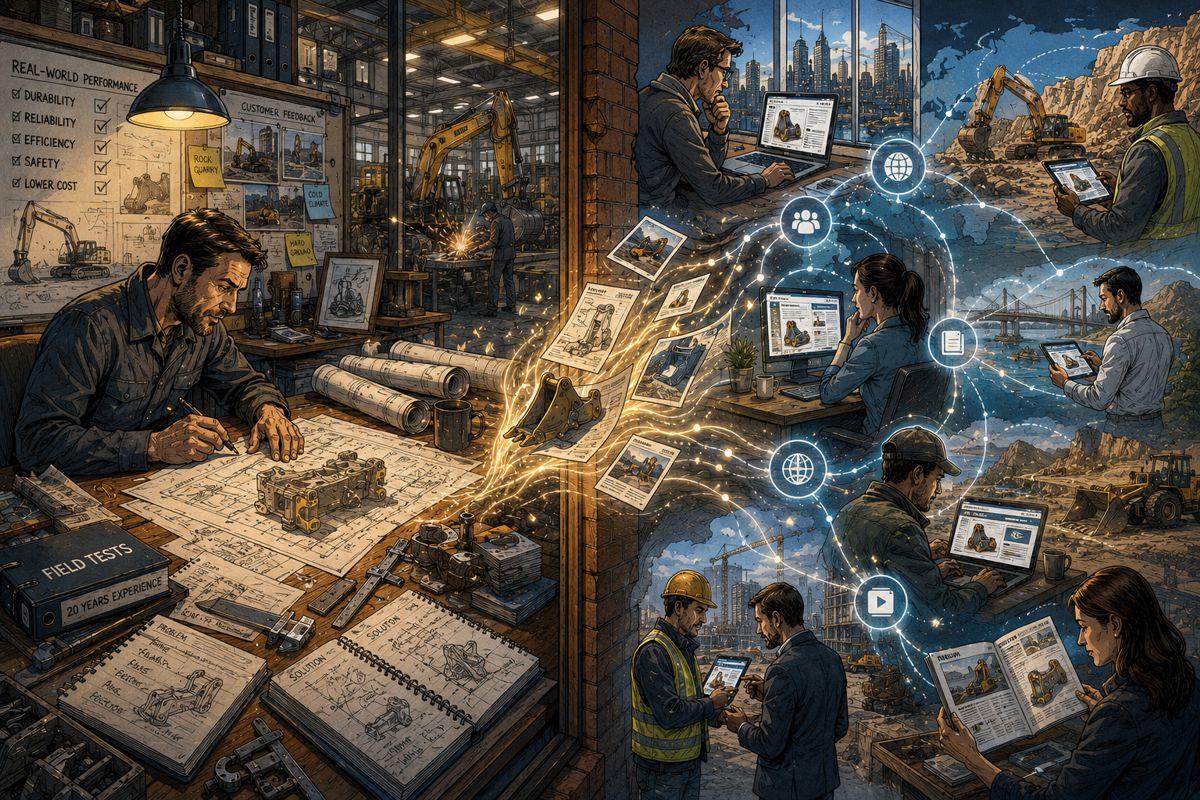
Almost everything on a corporate website is necessarily self-published. That is entirely reasonable: the company owns the website and should explain its products, expertise and capabilities confidently. Buyers researching an unfamiliar supplier, however, can move between corporate information, search, AI tools, industry sources and direct conversations before deciding which companies deserve closer attention.
Independent industry coverage performs a different role from corporate marketing. A manufacturer’s website can explain its technology in detail, while external editorial can place that expertise within a broader technical, operational or commercial context. The subject rather than the supplier becomes the starting point, allowing engineering knowledge, practical experience and informed opinion to exist somewhere beyond the company’s own sales environment.
That distinction may become more useful as generic content becomes easier to produce. Construction companies contain enormous reserves of genuine knowledge in their engineers, product specialists, service teams and management, yet much of it never becomes part of the company’s public information footprint. Capturing and explaining that expertise properly gives potential customers another way to understand what sits behind the products and corporate claims.
Editorial note: Construction Marketing Month examines changes in construction marketing and industry communications. Highways.Today also provides commercial Expert Article Writing and Publishing services to companies in the sectors covered.
Highways.Today encounters the gap between expertise and public visibility regularly. Some of the industry’s most interesting specialist companies possess far more knowledge than their public profile suggests, which is one reason Highways.Today developed its Expert Article Writing and Publishing service. The process begins with the company’s actual expertise, researches the wider subject, develops the strongest editorial angle and publishes the resulting feature as serious industry journalism to a global construction and infrastructure audience.
The proposition is deliberately different from generic content production. It combines expertise, research, editorial judgement, industry context, independent publication and international distribution, creating an external record of what a company knows and where that knowledge fits within the wider industry. It cannot guarantee AI recommendations, search rankings, enquiries or contracts, nor should any credible publisher pretend otherwise. Its purpose is more straightforward: to make genuine industry expertise easier to discover, understand and evaluate.

A playbook built for what comes next
Construction marketing is entering an awkward but potentially productive period. Search is changing without disappearing, AI is becoming another layer through which markets are researched and information interpreted, and buyers can investigate companies long before speaking to sales. At the same time, digital discovery allows specialist expertise to travel further beyond its traditional geographic boundaries.
Producing generic content is also becoming extraordinarily easy. The response does not need to be another wholesale reinvention of the marketing department. Websites, search, exhibitions, email, advertising, social media, PR and trade publishing all retain useful roles. The companies likely to benefit most will be those prepared to reconsider what those channels are supposed to accomplish and how they combine to make the business understood, trusted and discoverable.
The multinational will continue to have more money, more people, greater brand recognition and a vastly larger existing information footprint. AI does not erase those advantages, and there is no reason to assume that new forms of search and discovery will automatically favour smaller companies.
What has changed is the capability available to everybody else. A specialist manufacturer no longer needs a multinational research department simply to investigate a new market, an enormous publishing operation to explain its expertise or an international office network before it can begin understanding opportunities beyond its home territory.
The opportunity lies in using those capabilities better: explaining the business clearly, making its expertise visible beyond the corporate website, building direct audiences and credible external authority, researching markets earlier and experimenting without turning every idea into a six-month corporate initiative. The objective is not to reproduce the multinational marketing machine on a fraction of its budget, but to build a more agile one suited to the company that actually exists.
The multinational still has scale. The specialist has never had better tools with which to challenge it.
Key Industry Questions
- How is construction marketing changing? Construction buyers can increasingly research companies, technologies and suppliers through a combination of conventional search, AI tools, corporate websites, industry media, professional networks and other sources before making direct contact.
- Is traditional SEO becoming obsolete? No. Conventional search remains a major discovery channel. Search behaviour is becoming more complex and answer-led, requiring companies to consider whether their information answers broader research questions as well as conventional search queries.
- Are B2B buyers already using AI to research suppliers? Yes. Gartner research published in May 2026 found that 45% of surveyed B2B buyers had used generative AI, primarily to gather information about vendors and products. Buyers continued to use multiple other sources and frequently sought human validation.
- Does AI level the playing field for smaller construction companies? Not automatically. Established companies retain major advantages in brand recognition, existing customers, third-party references and the amount of information already published about them. AI gives smaller businesses more capable tools, but they still have to establish authority and recognition.
- Can an unfamiliar supplier still make the shortlist? The 6sense averages suggest there remains room for unfamiliar vendors within the research process, although this should not be interpreted as a fixed number of available shortlist positions. For specialist companies, the opportunity is to become relevant and credible when buyers investigate the particular problems and technologies in which they have genuine expertise.
- Why does international discovery matter for specialist construction companies? Digital research allows buyers to investigate companies beyond the suppliers they already know. This creates opportunities for specialist businesses whose expertise is internationally relevant but whose brand recognition remains concentrated in their established markets.
- Do construction companies need to abandon traditional marketing channels? No. Websites, search, exhibitions, email, advertising, social media and PR continue to perform useful roles. The strategic question is how those channels work together as buyer research becomes more fragmented.
- Why does independent industry editorial matter? Corporate websites provide first-party information about products and capabilities. Independent editorial can place a company’s expertise within a broader technical, operational or commercial context and create an external source through which that expertise can be discovered.
- Will producing more content make a company more visible to AI? There is no reliable basis for assuming that content volume alone will guarantee inclusion in AI-generated answers or recommendations. Accurate, useful and credible information is a more defensible long-term strategy than simply increasing publishing volume.
Strategic Takeaways
- Construction marketing is moving beyond a predominantly visibility-led model towards one where companies also need to be understood across multiple research environments.
- Buyers can investigate suppliers long before contacting them, while existing familiarity continues to give established companies a powerful advantage.
- AI does not automatically democratise attention, but it gives mid-sized businesses more capable tools for research, experimentation and international market development.
- Traditional marketing channels remain useful, although their purpose and relationship with one another need to evolve.
- Specialist companies have an opportunity to compete through expertise, agility and focus rather than trying to reproduce multinational marketing structures.