Flannery Adds 97 Kubota Excavators in Major Fleet Investment
Utility work places different demands on construction equipment from a conventional building or major infrastructure site. Machines may move repeatedly between small excavations, roadside interventions and emergency repairs, making transport speed and attachment availability almost as important as digging capacity.
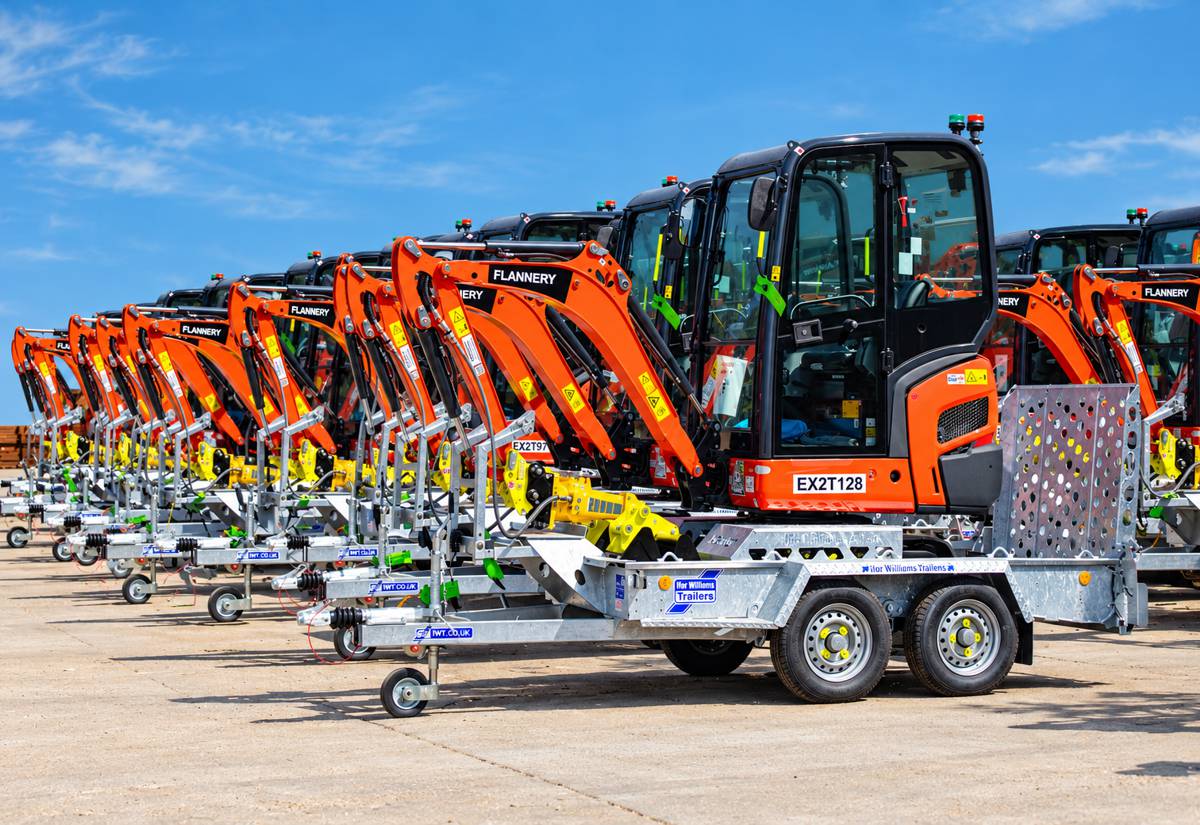
Flannery Plant Hire has responded by adding 62 Kubota KX016-4 mini excavators configured specifically for a utility customer. Rather than supplying standalone machines, each excavator has been paired with an Ifor Williams Digadoc trailer and equipped with a Whites quick hitch, Epiroc SB102 hydraulic breaker and selection of buckets.
The arrangement creates a self-contained excavation package that can be moved behind a suitable light commercial vehicle, allowing crews to take the excavator and its principal attachments directly between jobs without relying on conventional plant transport.
The 62-machine deployment forms part of a wider 97-machine Kubota order supplied through Boss Plant Sales. Flannery has also taken 20 U50-5 midi excavators and 15 U27-4 mini excavators as it renews and selectively expands its fleet.
Briefing
- Flannery Plant Hire has acquired 97 Kubota excavators through Boss Plant Sales.
- A dedicated group of 62 KX016-4 mini excavators has been configured for a utility customer.
- Each utility machine is paired with a Digadoc trailer, quick hitch, hydraulic breaker and buckets.
- The wider order includes 20 Kubota U50-5 and 15 U27-4 excavators.
- Flannery says its fleet currently has an average age of approximately 24 months, with replacement decisions based on utilisation, condition, reliability, demand, whole-life cost and residual values.
Configuring Plant Around the Job
At 1.5 tonnes, the KX016-4 sits at the small end of the excavator market, but its dimensions suit the work Flannery has in mind. Kubota lists the cab version at 1,540 kg, with an adjustable overall width of 990 to 1,240 mm and maximum digging depth of 2,250 mm. Power comes from a 9.6 kW Stage V diesel engine.
The variable-width undercarriage allows the machine to be narrowed for restricted access and extended where additional stability is required. Its compact dimensions make it suitable for trenches, service connections, reinstatement work and other relatively small excavations where space can be limited.
The more distinctive part of the specification sits outside the excavator itself. Pairing each machine with its own trailer and working attachments changes how the equipment can be deployed.
Utility work can be geographically dispersed, with individual interventions relatively short. Time spent arranging machine transport can therefore become disproportionate to time spent excavating. A compact package travelling with the crew gives the contractor greater control over mobilisation and reduces dependence on separate plant movements.
The hydraulic breaker extends that capability. Road and pavement excavation frequently involves breaking asphalt, concrete or other hard surfaces before conventional digging begins, so carrying the breaker alongside the buckets allows the same package to tackle several stages of the excavation.
A Wider 97-Machine Investment
The remaining Kubota machines cover larger operating envelopes.
Kubota’s U27-4 has a machine weight of approximately 2.5 tonnes, a maximum digging depth of 2.82 metres and a zero-tail-swing configuration for confined working areas. Kubota’s UK specification also describes the model as capable of being transported on a standard trailer while remaining within the 3.5-tonne towing limit when appropriately configured.
The U50-5 moves the fleet into the five-tonne class. Kubota specifies a maximum digging depth of 3.37 metres, reach of 5.85 metres and overall width of 1.96 metres. Its load-sensing hydraulic system and compact tail configuration provide greater excavation capacity while retaining characteristics useful on restricted urban and infrastructure sites.
Together, the three models provide overlapping capability from small utility excavations through to more substantial civil engineering work.
Operations Director Paul Hester said the company already operates a substantial Kubota fleet across several models: “We continually invest in modern, efficient equipment to support customer demand, while maintaining a young fleet profile. The purchases this year represent a combination of fleet replacement and measured fleet growth.”
For a large hire business, replacement and expansion are separate calculations. Hours worked are only part of the equation. Reliability, maintenance requirements, utilisation, customer preferences and the likely value of a machine when it eventually leaves the fleet all influence when equipment is bought and sold.
Managing a Young Hire Fleet
Flannery says its average fleet age currently stands at 24 months, although it does not operate a fixed replacement cycle.
“Fleet replacement decisions are based on utilisation, condition, reliability, customer demand and whole-life cost considerations. Residual values are an important factor within our purchasing decisions.” Hester said.
Flannery has maintained a relatively young fleet for some time. In 2019, the company announced a £30 million purchase of 230 Caterpillar machines as part of a wider fleet refurbishment programme, which at the time brought its average fleet age to around 1.8 years.
Maintaining that profile requires substantial capital expenditure, but hire economics are not governed by purchase price alone. Newer equipment can reduce exposure to unscheduled downtime and rising maintenance requirements while giving customers access to more recent machine technology. Disposal timing forms part of the calculation, balancing remaining productive life, depreciation, maintenance costs and prevailing resale conditions.
The latest Kubota purchase therefore sits within a longer fleet-management strategy rather than representing an isolated equipment order.
Flannery says it currently operates more than 7,000 assets supporting construction, infrastructure and utility projects. Its equipment catalogue spans excavators, articulated dump trucks, dozers, loaders, graders, rollers, telehandlers and specialist machinery from numerous manufacturers.
Dealer Support and Fleet Economics
Boss Plant Sales provides Flannery with technical product support, parts and specialist service assistance alongside the company’s own engineering operation. According to Boss Plant Sales, the relationship between the companies has lasted more than 40 years.
For a hire company operating thousands of assets, dealer capability becomes part of the purchasing calculation. Parts availability and technical support affect downtime, while familiarity among engineers and operators can simplify maintenance and deployment across a large fleet.
Hester cited reliability, fuel efficiency and operator acceptance, alongside dealer support, among the reasons for Flannery’s continued investment in Kubota equipment.
The 62-machine utility package demonstrates the procurement logic more clearly than the size of the overall order. Equipment gains value when its specification reflects the way the customer actually works. Here, the excavator, trailer, hitch, breaker and buckets have effectively been treated as one operational unit.
For crews moving between numerous small excavations, having the right machine already packaged for transport may deliver more practical productivity than simply putting a larger excavator on the job.
Key Industry Questions
- Why has Flannery selected the Kubota KX016-4 for the utility fleet? Its compact dimensions, approximately 1.5-tonne machine weight and variable-width undercarriage suit confined excavations and relatively frequent transport between jobs.
- How many Kubota excavators are included in the order? The order comprises 97 machines: 62 KX016-4, 20 U50-5 and 15 U27-4 excavators.
- What equipment accompanies the utility excavators? Each KX016-4 is paired with an Ifor Williams Digadoc trailer, Whites quick hitch, Epiroc SB102 hydraulic breaker and buckets.
- Why are compact excavators useful for utility contractors? Their small footprint suits restricted roadside and urban sites, while transportable configurations can simplify frequent movement between relatively short-duration jobs.
- What is the digging depth of the KX016-4? Kubota specifies a maximum digging depth of 2,250 mm.
- How old is Flannery’s fleet on average? Flannery currently puts its average fleet age at approximately 24 months.
- Does Flannery replace machines at a fixed age? No. The company says utilisation, condition, reliability, customer demand, whole-life costs and residual values contribute to individual replacement decisions.
- How large is Flannery Plant Hire’s fleet? The company reports a fleet of more than 7,000 assets.
Strategic Takeaways
- Configuring excavators, trailers and attachments as complete working packages can simplify mobilisation for geographically dispersed utility work.
- Compact equipment procurement involves transportability and attachment flexibility as well as digging performance.
- Flannery’s 97-machine purchase combines a specific customer requirement with routine fleet renewal and measured expansion.
- A 24-month average fleet age makes residual value, maintenance exposure and utilisation important parts of replacement decisions.
- Dealer parts and technical support contribute to the whole-life economics of operating a large equipment fleet.