From Horsepower to Kilowatts – The Evolution of Construction Machinery
In 1895, the British Army’s statutory allowance for each horse placed in civilian quarters was 10 lb of oats, 12 lb of hay and 8 lb of straw every day. A large working stable therefore consumed tonnes of forage before any useful work was done. Horses also needed water, accommodation, grooming, veterinary care, harnesses, handlers and rest, while the feed itself had to be grown, purchased, transported and stored.
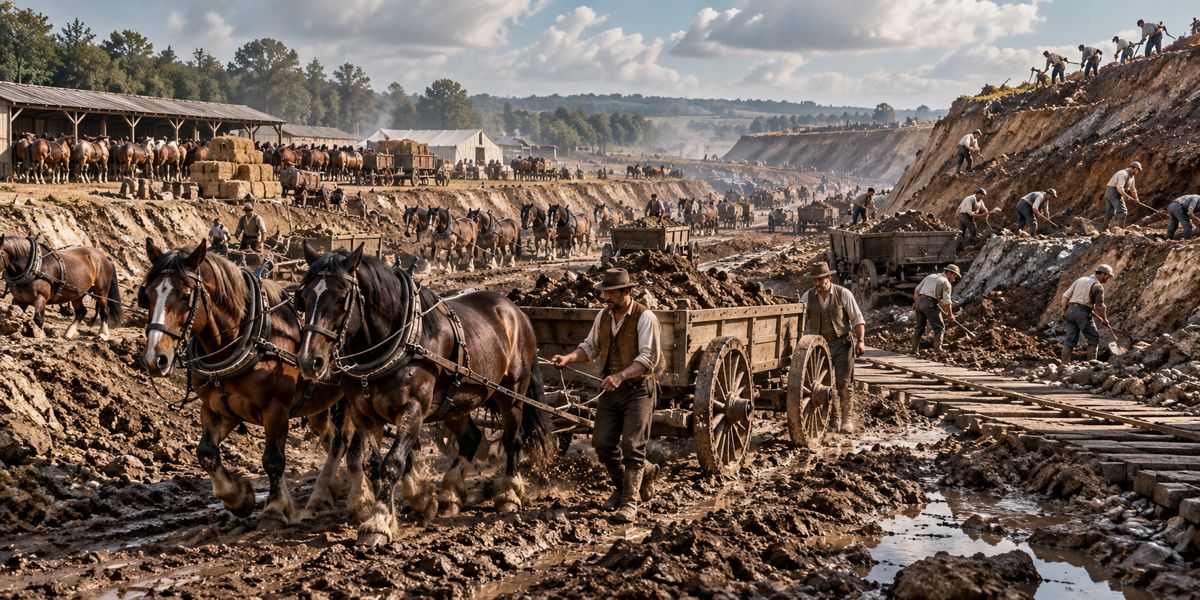
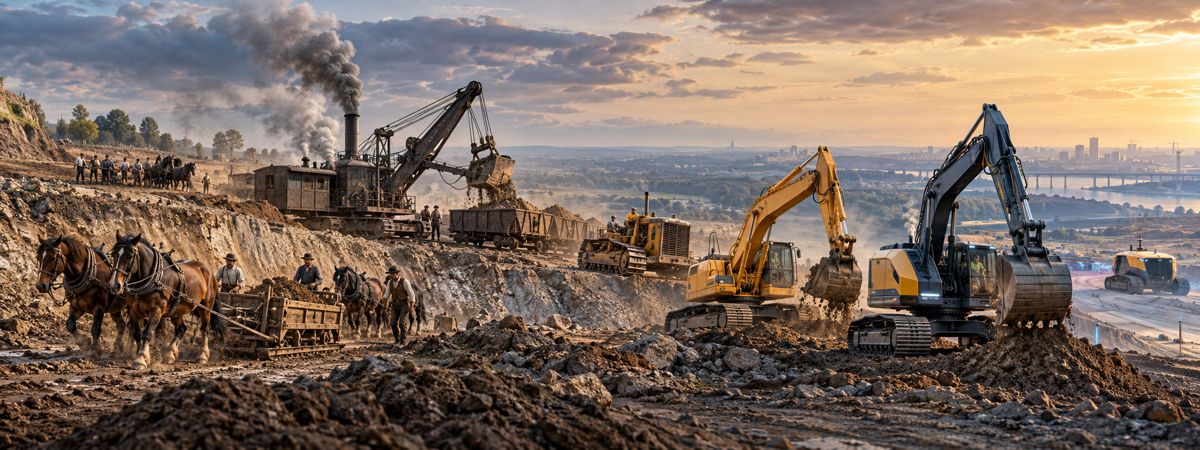
That was part of the power infrastructure behind nineteenth-century construction. Roads, canals, railway cuttings and embankments were built with human muscle supported by horses, oxen and other draught animals. Earth could be loosened by hand, loaded into carts and hauled away, but increasing production usually meant adding more labour and more animals, together with everything required to sustain them.
Mechanisation broke that relationship in stages. Each new source of power brought different machinery, logistics and skills around it, from the coal and water needed by steam equipment to the fuel bowsers serving diesel fleets and the electrical infrastructure now appearing alongside battery machines. The history of construction equipment is as much about supplying and controlling energy as it is about the engines themselves.
Briefing
- Before mechanisation, construction power depended heavily on human labour and draught animals, bringing substantial requirements for feed, water, accommodation and handling.
- Tracks, compact internal-combustion engines and later diesel power allowed powerful machines to work independently across construction sites rather than remaining tied to rails or stationary power sources.
- Hydraulic systems gave excavators, loaders and other machines compact and highly controllable working power, establishing an architecture that continues to dominate heavy construction equipment.
- Electronics, positioning and machine control have added an information layer that connects equipment with digital designs, diagnostics and fleet management.
- Battery-electric machinery introduces commercial questions around purchase price, charging capacity, utilisation, battery condition and residual value alongside its operational and emissions advantages.
Construction Before the Machine
Large infrastructure existed long before powered construction equipment. Roman roads, canals, fortifications and later railway earthworks demonstrate what organised labour could accomplish with relatively simple tools. The limitation was not an absence of engineering knowledge so much as the amount of physical work that could be applied economically to excavation, hauling, lifting and compaction.
Horses extended human capability considerably. They hauled wagons, operated some stationary machinery and provided traction for graders, rollers, scrapers and other implements as roadbuilding became more organised. The Library of Congress records the use of horse power alongside steam to operate machinery for moving, smoothing and compacting earth during the development of improved roads.
The logistical burden was considerable. The British Army’s 1895 allowance of 10 lb of oats, 12 lb of hay and 8 lb of straw per horse provides a contemporary benchmark for an animal under institutional management. One hundred horses at that allowance would require more than 1.3 tonnes of feed and bedding each day before water was considered.
People were required specifically to maintain this source of power. Historical records of military horse management describe routines dominated by stabling, exercise, grooming, watering, feeding and bedding. The horse could pull a scraper or wagon, but maintaining the animal was itself a labour-intensive operation.
The language of machinery still carries a reminder of this world. James Watt used horsepower to give prospective steam-engine customers an understandable measure of mechanical output, eventually settling on 33,000 foot-pounds of work per minute. One mechanical horsepower is approximately 0.746 kW. The horse survived as a unit long after it disappeared from the construction site, although contemporary European machinery specifications generally express engine and motor output in kilowatts.
Steam Excavation
Steam engines initially transformed industries in which the machine could remain stationary. Pumping mines and driving factory machinery suited equipment that was heavy, required substantial supporting infrastructure and did not need to travel independently across rough ground. Construction presented a harder problem because the source of power had to follow the work.
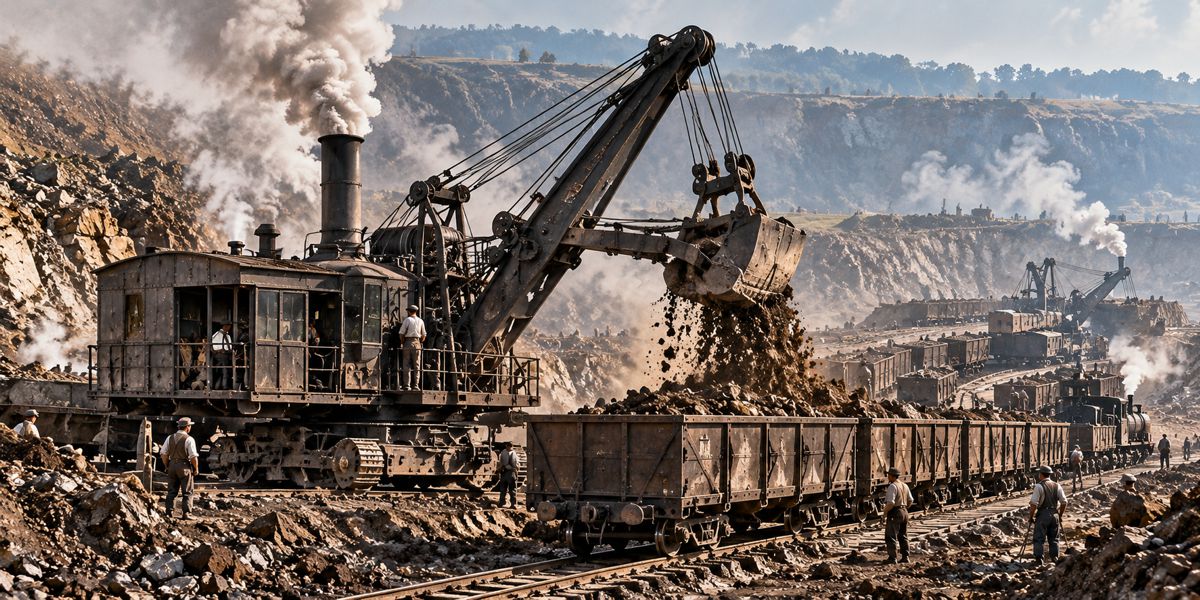
William Smith Otis, a civil engineer in Philadelphia, received US Patent 1,089 in February 1839 for what he described as a crane-excavator for excavating and removing earth. The patent specifically referred to railway and canal construction. Otis died later that year, but development continued and steam shovels became established in heavy excavation. The Smithsonian’s National Museum of American History notes that early machines travelled on temporary rails laid by workers as excavation progressed.
The arrangement appears cumbersome from the perspective of a modern excavator, but the production system was already recognisable. A powered machine excavated material and loaded it into transport units. Those units carried spoil away while the excavator continued digging. Output depended on balancing excavation and haulage rather than simply assembling more people with picks, shovels and carts.
The Panama Canal demonstrated that principle on an extraordinary scale. At Culebra Cut, holes were drilled and blasted through rock and hard clay before steam shovels loaded the loosened material into railway wagons. The railway operation included locomotives, spoil trains, Lidgerwood unloaders, spreaders and track-shifting equipment. As the face advanced and spoil destinations changed, the railway supporting the excavation had to move with it.
The machines were components of a production line extending across the excavation. In 1908 alone, more than 37 million cubic yards of spoil were taken from the Cut, according to the Panama Canal Authority. Geological instability repeatedly increased the total amount requiring excavation, with major slides adding millions of cubic yards.
Steam greatly increased the mechanical power available to contractors, but it exchanged one logistical system for another. Boilers required water and fuel. Steam had to be raised before work. Heavy machinery required substantial structures to carry the boiler, engine and operating equipment, while specialised crews were needed to maintain and run it. Construction had gained mechanical power without yet gaining the compact mobility that would define the next generation of equipment.
Engines, Tracks and Mobility
Internal combustion removed many of the constraints surrounding steam. Petrol, kerosene and diesel engines could be made considerably more compact for their output. They could start without raising steam, and liquid fuel was relatively straightforward to transport and store. An engine could be installed directly into the machine that needed its power.
The history of the crawler track contains numerous competing inventions and experiments, and Benjamin Holt did not originate the underlying idea of continuous tracks. His place in machinery history rests on the development of a commercially successful practical track-type tractor.
Holt’s problem was ground pressure. Heavy steam tractors used in California agriculture could sink into soft peat soil. In November 1904, the rear wheels were removed from Holt tractor No. 77 and replaced with a tracked arrangement that distributed its weight across a much larger contact area. Caterpillar’s archive describes earlier attempts at track-type machines but identifies Holt’s design as the first to achieve continuing commercial success.
The principle became fundamental to construction machinery. Greater engine power was of limited use off road if the machine could not transfer tractive effort into the ground without burying itself. Tracks allowed heavier tractors to work on surfaces unsuitable for conventional wheels and created the foundation for crawler tractors, bulldozers and tracked excavators.
Holt tested a gasoline-powered track-type tractor in 1906, only two years after the steam crawler experiment. Caterpillar began producing its first diesel engine in 1931 and introduced the Diesel Sixty track-type tractor that year. Ten of the first 25 Diesel Sixty tractors built during 1931 and 1932 went to Belgium for work on the King Albert Canal.
Other machine forms evolved in parallel. Purpose-built motor graders emerged from earlier combinations of tractors and grading frames. Scrapers mechanised the cutting, loading and transportation of soil. Pneumatic tyres enabled another family of faster construction equipment, including loaders, trucks and eventually articulated haulers.
The familiar categories of modern equipment emerged gradually from this experimentation. A crawler tractor fitted with a blade became more specialised for pushing. Excavators evolved away from rail-mounted steam shovels. Graders developed frames, steering geometry and mouldboards designed specifically for precision earth shaping. Wheeled machines exploited speed and mobility where ground conditions permitted.
Diesel proved particularly well suited to heavy equipment because construction required engines capable of sustained operation under changing loads, with fuel that could be transported easily to remote sites. A machine could carry enough energy for a working shift and be replenished quickly from a bowser or storage tank. The remaining engineering challenge was to transmit that power to a bucket, blade, boom, undercarriage or steering system in a form the operator could control.
Diesel and Hydraulic Power
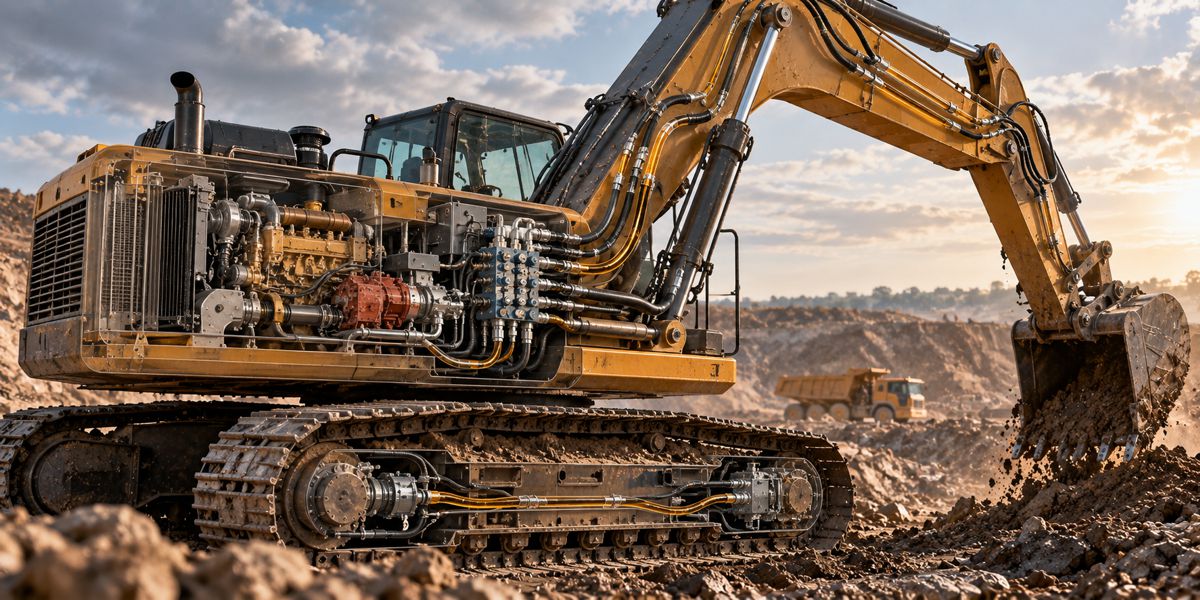
A hydraulic excavator converts mechanical energy from its engine into hydraulic energy through pumps. Pressurised fluid is directed by valves towards cylinders and hydraulic motors, where it produces linear or rotary movement. Substantial power can be transmitted through comparatively compact components without requiring a mechanical shaft or cable to follow the complete route between the engine and each working function.
For construction equipment, the combination of power density and controllability was exceptionally useful. A cylinder could produce enormous force while remaining compact enough to mount directly on a boom, arm or linkage. Valves could meter movement precisely, allowing the same machine to break into difficult material, lift heavy loads and perform fine grading.
Several manufacturers contributed to the emergence of the hydraulic excavator, and historical priority depends partly on the definition of a fully hydraulic machine. Demag’s B504 of 1954 is among the early reference points, while Poclain’s hydraulic excavators of the 1950s and its widely exported TY45, introduced in the early 1960s, helped establish the architecture commercially.
Across the 1950s and 1960s, pumps, valves, cylinders and hydraulic motors replaced many of the drums, cables, clutches and other mechanical systems used on earlier machines. An operator could command the boom, arm and bucket through hydraulic circuits, producing powerful excavation forces and fine movement from the same machine. Hydraulic slew and hydrostatic travel helped create the compact 360-degree excavator architecture that became familiar on construction sites around the world.
Hydraulic cylinders provided lift and crowd functions on wheel loaders. Dozer blades could be raised, lowered and tilted under hydraulic control. Articulated steering became practical on large wheeled machines. Backhoe loaders combined a loader and excavator around a single power unit, while auxiliary circuits eventually allowed excavators and loaders to power breakers, grapples, compactors, crushers, augers, tiltrotators and an expanding range of attachments. The machine had become a mobile source of controlled hydraulic power.
The durability of the diesel-hydraulic architecture owes much to its independence. A modern excavator can arrive on a remote site carrying its energy supply, engine, cooling system, hydraulic pumps, valves, actuators, undercarriage and working equipment as one unit. Refuelling can be completed quickly without any fixed energy connection.
Engine management, pump control, variable displacement systems and load sensing improved the relationship between the power being produced and the hydraulic work being demanded. Manufacturers learned to package sophisticated systems into machines expected to survive dust, shock, vibration, heat, cold and long working hours.
Electronic Control and Positioning
Electronic engine management allowed combustion to be controlled more precisely. Electro-hydraulic systems replaced direct mechanical connections with electrical signals. Sensors measured pressure, temperature, speed, position and load, while controllers coordinated systems that had previously operated largely independently.
Construction machinery acquired an information network alongside its mechanical and hydraulic systems. CAN bus and related vehicle networks reduced the need for individual wiring between every component and allowed electronic control units to exchange data. Joysticks could generate electronic commands rather than directly operating hydraulic valves, while software could alter machine response according to operating mode, attachment or load.
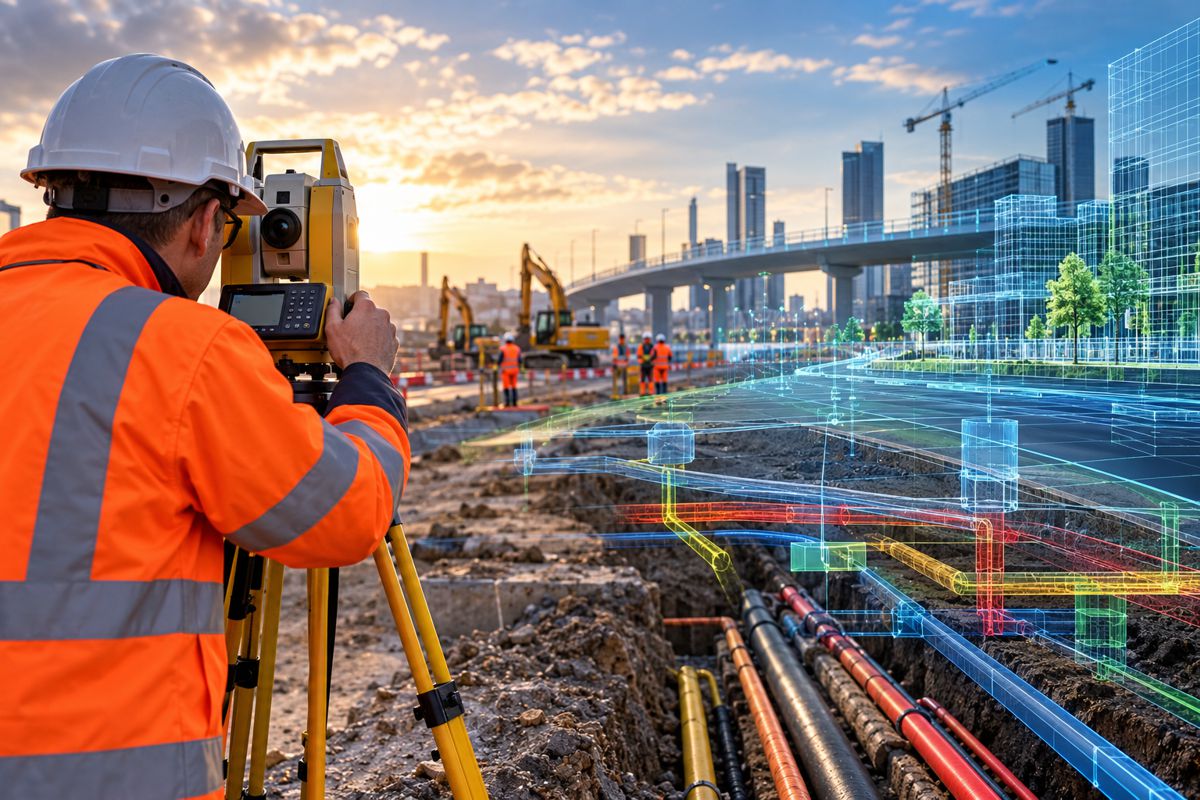
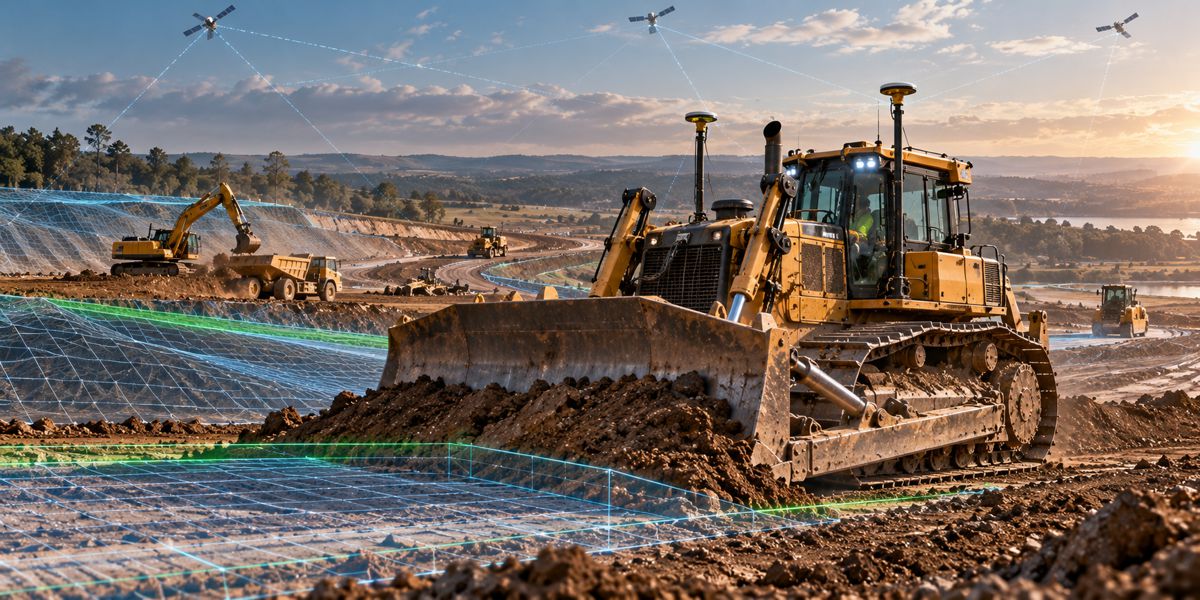
Positioning technology extended electronic control beyond the machine itself. Laser and sonic systems had already been used for elevation and steering applications before satellite positioning became sufficiently accurate for earthmoving. Trimble’s development of real-time kinematic GPS during the early 1990s opened the way to centimetre-level positioning, while Caterpillar and Trimble signed a memorandum of understanding in 1996 to develop GPS-based display and machine-control products. Caterpillar demonstrated a D11R dozer equipped with its Computer Aided Earthmoving System at MINExpo that year.
The machine could now relate its position to a digital representation of the project. Dozer blades could be controlled against design surfaces. Grader operators could work without relying exclusively on stakes and stringlines. Excavator systems could show bucket position relative to target grade, while later systems could limit digging movements to help prevent the bucket passing below a specified surface. Compaction equipment could record where it had travelled and aspects of the work performed there.
The progression from guidance towards control gave software greater influence over machine movement. An operator might initially receive information showing where the cutting edge was relative to the design. Later systems could automatically position a dozer blade or assist an excavator movement. The operator remained responsible for the work but no longer had to manually control every element of the machine’s response.
Telematics extended the same electronic architecture into maintenance and fleet management. Systems can report location, operating hours, fuel use, diagnostic information and utilisation remotely. Caterpillar reported more than 1.6 million connected and reporting assets during 2025. A machine working hundreds of kilometres from its fleet office can now report its condition while it works.
Electric Construction Equipment
Electric heavy machinery predates the current interest in battery-powered construction equipment by many decades. Mining provides some of the clearest examples because large machines often operate within controlled sites where substantial electrical infrastructure can be justified.
Demag, whose mining excavator business later became part of Komatsu, developed the H241 electric hydraulic mining excavator around the beginning of the 1980s. The machine replaced diesel power with a large electric motor supplied through a trailing cable connected to the mine’s electrical infrastructure. Contemporary and later sources differ on the motor rating of individual H241 configurations, but the underlying engineering problem was already familiar: electric motors could perform the excavation, while the machine still needed practical access to energy as it moved.
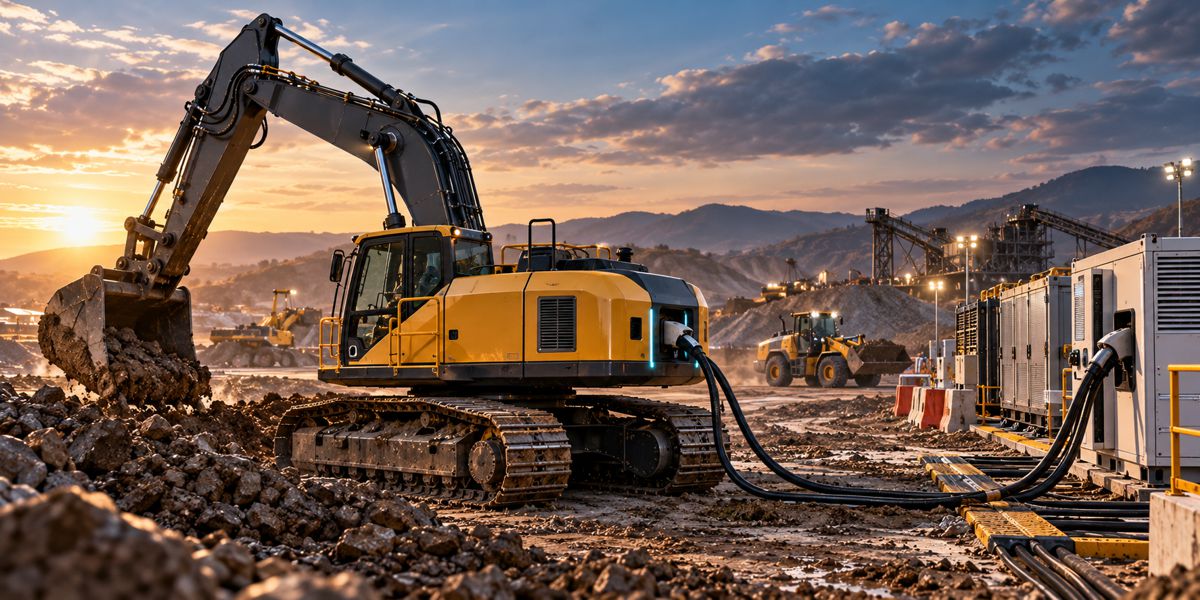
Battery development has expanded the range of applications where carrying that electricity onboard is viable. Volvo Construction Equipment’s latest ECR25 Electric compact excavator moved from a 20 kWh battery in the earlier generation to 40 kWh, doubling its indicative runtime to as much as eight hours depending on application. The current machine has an operating weight of around 2,670 kg and a 47 kW peak electric motor.
The scale changes quickly with larger equipment. Volvo’s EC230 Electric has a 450 kWh battery and an operating weight range of approximately 21.3 to 26.2 tonnes. The manufacturer quotes seven to eight hours of indicative runtime, with charging from 20 to 80 per cent taking around an hour using a 250 kW DC charger.
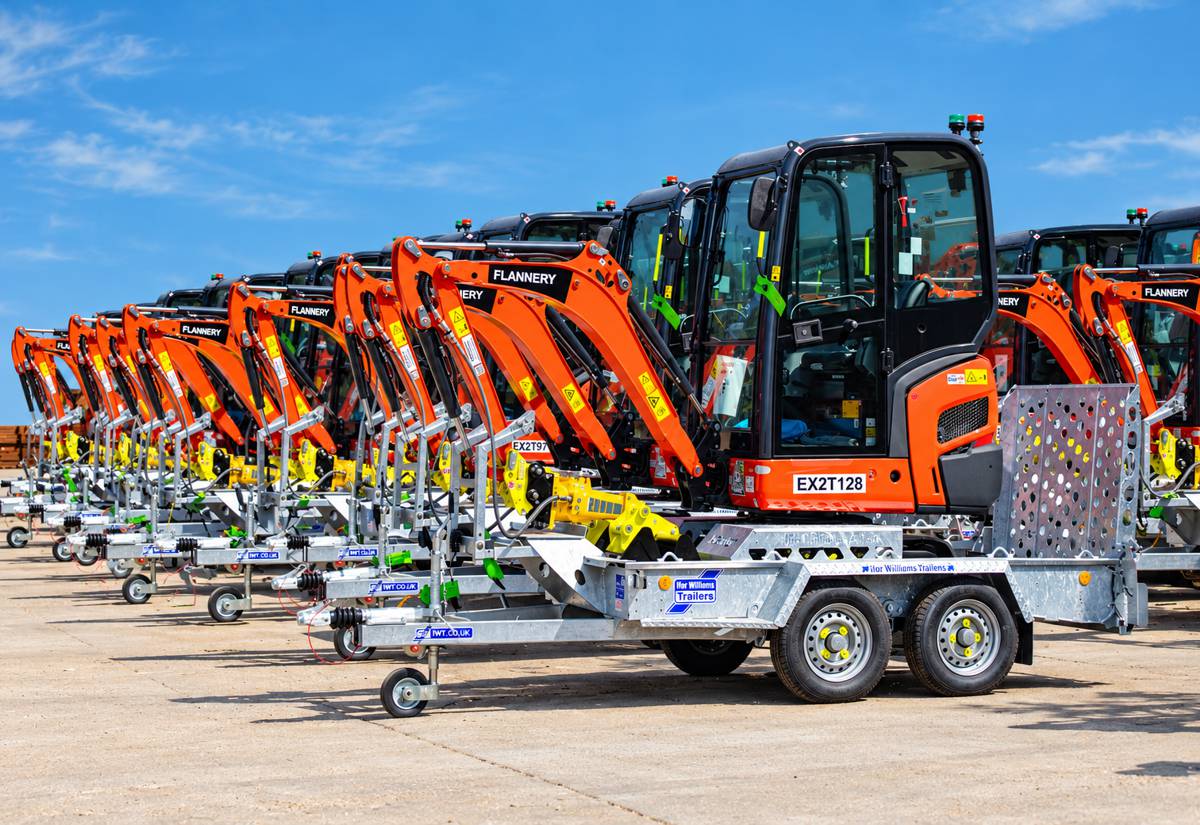
Those machines occupy very different energy environments. A compact excavator working on utilities, landscaping, demolition or an indoor project may return regularly to a depot or operate close to an established electrical supply. Its daily energy requirement is relatively modest, while reduced noise and the absence of local exhaust emissions can have immediate operational value.
A large excavator working long shifts on remote earthworks needs hundreds of kilowatt-hours of energy and a means of replenishing it without undermining utilisation. One high-power charger can be accommodated on a suitably equipped project. A fleet of large machines charging simultaneously becomes an electrical distribution requirement in its own right, particularly where the project is temporary and the equipment moves as the work advances.
Regulation and procurement are also changing the operating environment. European Stage V rules impose stringent pollutant-emission limits on non-road mobile machinery, although they do not require electrification. Since 1 January 2025, Oslo has required machinery on municipal construction sites to be emission-free, subject to exemptions where compliant equipment is not technically feasible or would impose disproportionate costs. For contractors bidding for this work, the availability of suitable machinery and charging infrastructure has become part of procurement and site planning.
Battery-electric equipment is not the only route available to fleets seeking to reduce emissions or dependence on conventional diesel. Hybrid systems, renewable liquid fuels such as HVO, tethered electricity and developing hydrogen technologies are being pursued for different applications, with their suitability determined by duty cycle, energy availability, equipment size and operating environment.
The commercial calculation extends beyond energy consumption. Electric machinery can carry a purchase-price premium, while charging interruptions can affect utilisation if the site energy strategy is poorly matched to the duty cycle. Temporary grid connections and high-power charging equipment can become site-establishment costs. Contractors buying early generations of battery machinery must also consider battery condition, technological development and residual values in a market with far less historical evidence than exists for diesel equipment.
Mining presents a different calculation. Large sites may operate for decades and already have substantial electrical distribution systems. Haul routes and machine movements can be predictable enough to support trolley systems, tethering or planned charging, allowing battery-electric, tethered electric, diesel-electric and hybrid machines to be applied according to the operation.
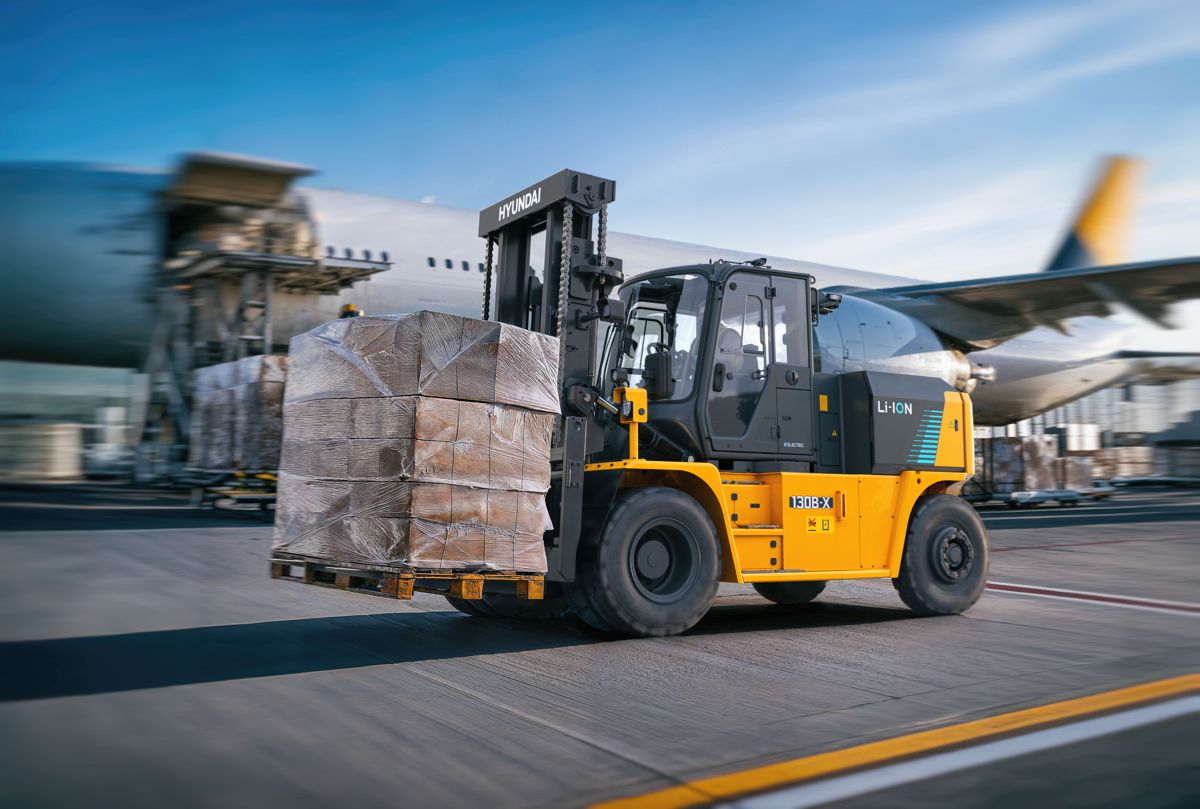
Electric drive offers engineering opportunities beyond eliminating local exhaust emissions. Electric motors provide immediate torque and precise control, while electrical auxiliaries can operate only when required. Mechanical driveline components can sometimes be reduced or eliminated, and energy recovery becomes possible in suitable applications.
Hydraulics need not disappear either. Electric mining excavators operating decades ago were hydraulic machines whose pumps happened to be driven electrically rather than by diesel engines. More fundamental changes become possible when machinery is designed around electric power from the outset.
Machine Architecture
Most current battery-electric construction machines remain recognisable derivatives of diesel equipment. This limits development risk, preserves established manufacturing processes and allows existing attachments, transport systems, operator practices and service arrangements to continue.
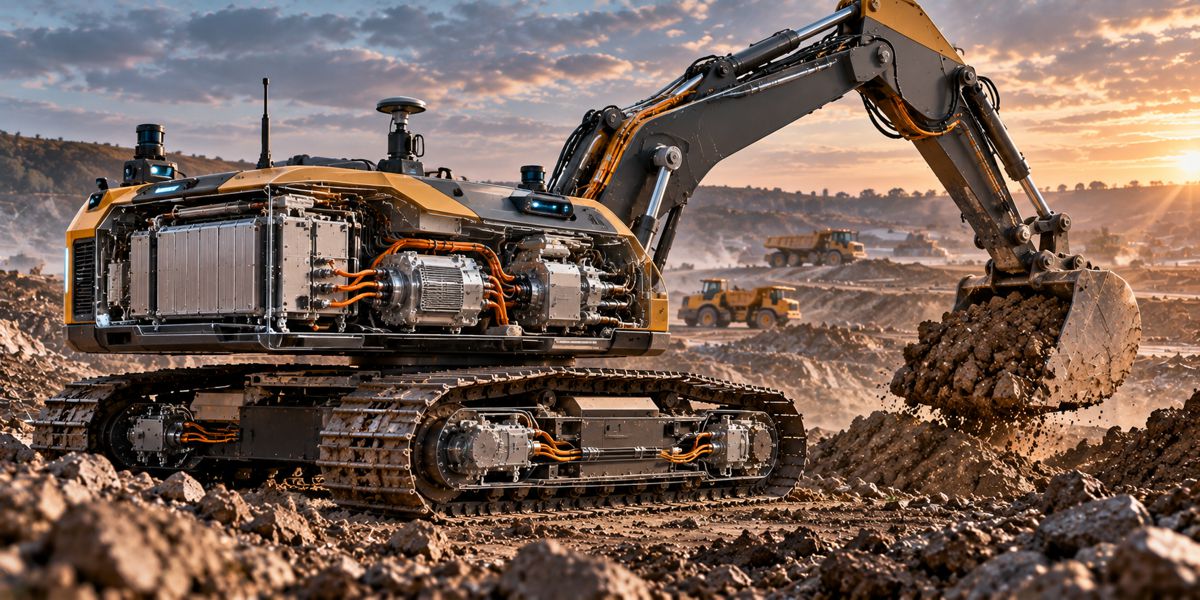
Electric power does not require all of those conventions. A diesel engine usually occupies a central position in the machine’s energy architecture, with its output distributed through transmissions, hydraulic pumps, shafts or other systems. Electric motors can be distributed around a machine. Separate motors can drive pumps, axles or individual propulsion systems, while electrically driven pumps can operate independently. Cooling requirements change when a combustion engine disappears, and batteries can be distributed through structures that previously accommodated fuel tanks, engines and counterweights.
Hydraulic systems remain attractive wherever high force density and rugged linear actuation are required, but their layout can change as well. Electrically driven pumps do not necessarily need to reproduce a conventional engine-driven arrangement. Functions can become more decentralised, and electromechanical actuators may become practical for some duties.
Concept machines have begun exploring the greater freedom this creates. Volvo CE’s LX03 research prototype was a five-tonne battery-electric autonomous loader developed partly from technology used in the L25 Electric. Without a conventional operator environment dictating the layout, the machine could be designed around autonomous operation rather than treating autonomy as an addition to a traditional cabbed loader. It remained a research project rather than a production machine, but showed how much of the familiar machinery layout becomes optional once both the combustion engine and onboard operator are removed from the design brief.
New power systems often enter service inside machinery whose basic architecture was developed for the technology they are replacing. Manufacturers have good reasons for proceeding this way, from established production lines and components to operator familiarity and residual values. As electric systems mature, battery location, distributed drive and electronic control give engineers greater freedom to reconsider layouts that evolved around the diesel engine.
Remote Operation and Autonomy
Removing the operator from the cab is not a new ambition. In 1968, Caterpillar began developing radio-controlled 977K track loaders for slag removal around steel furnaces, with two machines delivered in early 1969. Low-pressure hydraulics physically operated the control levers, while fail-safe provisions placed the transmission in neutral, held the bucket, applied the brakes and reduced the engine to low idle if the remote system malfunctioned.
The purpose was practical: a hazardous task could be performed without keeping the operator inside the machine. Modern remote operation uses very different technology but retains the same advantage in mining, demolition, unstable ground and other environments where distance can reduce human exposure.
Autonomy gives software control over more of the operation. Mining provides the clearest commercial evidence because haul routes are comparatively controlled and repetitive. Komatsu began trials of its Autonomous Haulage System at Codelco’s copper operations in Chile in 2005 and achieved commercial deployment in January 2008. Caterpillar followed with commercial autonomous haulage in 2013 after development work dating back to the 1980s.
The scale is now industrial rather than experimental. Caterpillar reported 827 autonomous haul trucks operating during 2025. In April 2026, Komatsu commissioned its 1,000th autonomous ultra-class haul truck, a 930E-5AT deployed at Nevada Gold Mines.
General construction is less controlled. A mine haul road can be mapped, managed and separated from many outside variables. Construction sites change constantly as excavation progresses, structures rise, temporary works move and different trades arrive. People, delivery vehicles, subcontractors and machinery may share the same space, while the work itself continually changes the terrain the autonomous system must navigate.
Task automation therefore matters alongside full autonomy. Automated grading, digging assistance, payload measurement, compaction control, collision warnings and repeatable machine movements can remove portions of the operator’s workload without removing the operator.
Electrification and autonomy may eventually reinforce each other. Electronic drive is inherently controllable by software, while an autonomous machine does not need a conventional cab, seating position or the same visibility arrangements required by a human operator. Removing both the engine and operator as fixed design constraints gives machinery designers freedoms that conventional equipment has never had.
The Changing Construction Workforce
Every machinery transition has changed the labour around it. Animal-powered construction needed people to handle, feed, groom and manage horses as well as those performing the construction work. Steam machinery created specialist roles around boilers, engines and mechanical maintenance. Internal combustion reduced some of those requirements while increasing demand for engine mechanics, fuel logistics and machine operators.
Diesel-hydraulic equipment concentrated extraordinary productive capacity into individual machines. One skilled excavator operator could repeatedly dig, swing and load material using forces far beyond human physical capability, while the machine remained mobile enough to follow the work around a site.
Electronics changed the required skills again. Fault finding came to involve sensors, wiring, control modules and diagnostic software alongside mechanical and hydraulic knowledge. Machine control brought digital designs and satellite positioning into earthmoving operations, while telematics connected workshop decisions with data arriving directly from machines.
Electrification adds high-voltage systems, battery diagnostics, charging equipment and electrical safety to that skills mix. Remote and autonomous machinery adds another layer around software, communications and system supervision. Fleet investment has consequences for workshops and training as well as operators and site production.
Construction knowledge remains essential. Automation still needs a correct design, a workable sequence and an understanding of material behaviour, site conditions and the task being performed. A machine capable of following an incorrect model precisely can simply produce the wrong result more efficiently.
Energy, Control and Software
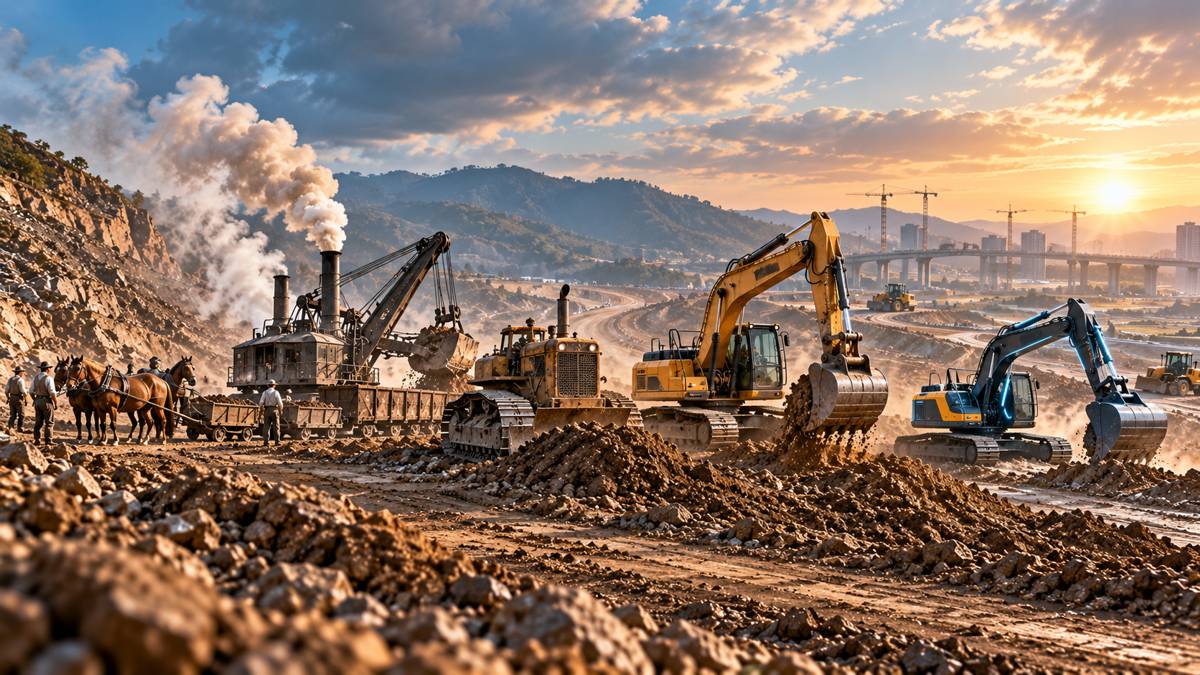
Construction machinery has never moved neatly from one technology to another. Steam machinery worked alongside horses. Internal combustion overlapped with steam. Cable excavators remained useful after hydraulics appeared, while mechanical controls survived well into the electronic era. The same overlap is likely to characterise the present transition.
Machinery procurement is becoming a broader decision than engine power, breakout force, bucket capacity and purchase price. Charging capacity can become part of site establishment. Machine-control compatibility and access to operational data can influence fleet integration. Electrical and software diagnostics change workshop requirements, while first-generation electric equipment introduces questions around utilisation, battery condition and residual value that established diesel fleets have had decades to resolve.
Diesel remains exceptionally difficult to replace where machines need high utilisation, rapid refuelling and independence from fixed infrastructure. Electric equipment already makes considerably more sense in other applications, particularly where charging can be planned and noise or local emissions carry an operational cost. Between them sit hybrid systems, renewable fuels, tethered machines and other approaches competing for particular duties.
Electricity and autonomy face the same practical test as every machinery technology before them. Their future in construction will be determined less by the novelty of batteries, motors or software than by what happens when the machine arrives on site and starts work.
Key Industry Questions
- Why did diesel become dominant in construction machinery? Diesel combines high energy density, rapid refuelling, durability and the ability to operate independently of fixed energy infrastructure. Those characteristics remain particularly valuable for heavy equipment working long shifts or at remote sites.
- Why were hydraulics so important to the development of modern machinery? Hydraulics allow large forces to be transmitted and controlled through relatively compact pumps, valves, cylinders and motors. This gave excavators, loaders and other equipment powerful but precise working movements without the mechanical complexity of many earlier cable and linkage systems.
- Who invented the hydraulic excavator? There is no universally accepted single inventor. Several manufacturers developed hydraulic excavators and hydraulic functions during the mid-twentieth century, and historical claims depend partly on how a fully hydraulic excavator is defined. Demag and Poclain are among the manufacturers associated with important early machines.
- Are electric excavators a new technology? No. Tethered electric hydraulic mining excavators were operating decades ago, and electrically powered mining machinery has a considerably longer history. Current development is centred particularly on battery storage, charging systems and making untethered electric equipment practical across a wider range of applications.
- Why is compact equipment easier to electrify? Smaller machines generally have lower daily energy requirements and are often used in urban, indoor or depot-based applications where charging infrastructure is easier to provide. Reduced noise and the absence of local exhaust emissions can also offer greater operational benefits in these environments.
- Can large construction machinery operate on batteries? Yes, although suitability depends heavily on duty cycle. Commercial excavators now carry batteries measured in hundreds of kilowatt-hours. Charging capacity, working hours, utilisation and access to electrical infrastructure become more significant as machine size and energy demand increase.
- Will electric machines still use hydraulics? Many will. Electrification changes the source of mechanical power but does not remove the advantages of hydraulics for high-force actuation. Electric motors can drive hydraulic pumps instead of diesel engines, while future designs may combine hydraulic and electromechanical systems.
- Is autonomous heavy machinery already in commercial use? Yes. Autonomous haul trucks have operated commercially in mining for well over a decade, with fleets now numbering in the hundreds for individual manufacturers. General construction presents a more complex operating environment, so automation is more commonly applied to individual tasks, machine control, operator assistance and remote operation.
- Could electrification change the shape of construction machinery? Potentially. Electric motors can be distributed more freely than a central combustion engine and mechanical drivetrain. Battery placement, electric pumps and distributed drive systems could allow designers to reconsider layouts developed around diesel engines.
- What should contractors consider when buying electric machinery? Machine utilisation, charging time, available electrical capacity, site duration, mobility between projects, purchase price, maintenance requirements, battery condition and likely residual value all need to be considered alongside energy and emissions performance.
Strategic Takeaways
- Construction machinery has evolved around the practical problems of supplying, transmitting and controlling power rather than through simple replacement of one engine technology by another.
- Diesel-hydraulic machinery remains difficult to displace because it combines portable energy with highly controllable working power in a self-contained machine.
- Electrification shifts part of the machinery decision into site infrastructure, with charging capacity and electrical distribution becoming operational considerations.
- Electric power creates opportunities to redesign machinery rather than simply replace a diesel engine with batteries and motors.
- Software, positioning, connectivity and autonomy are changing equipment procurement and maintenance alongside the transition in power systems.