






Trailers, the Hidden Workhorses of Construction
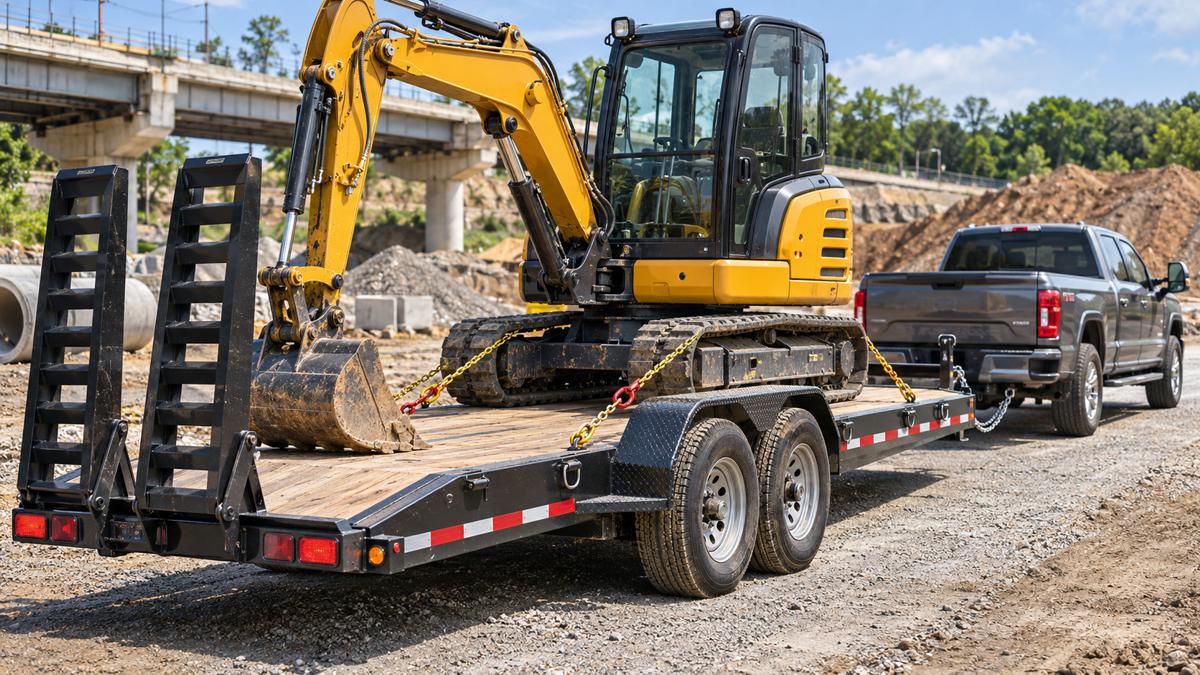
A compact excavator might spend eight hours digging trenches, but its profitability can depend on what happens before the first bucket touches the ground. If the machine cannot reach the jobsite on time, its capabilities become irrelevant.
Across the construction industry, equipment trailers perform an essential but frequently overlooked role. They connect machinery ownership with productive deployment, allowing contractors to move valuable assets between projects without relying on dedicated heavy-haulage operations for every journey.
From compact excavators and skid-steer loaders to rollers, compressors, generators and specialist attachments, an extraordinary range of equipment depends on reliable transport. Behind every successful movement is a combination of trailer engineering, towing capability, load management and careful logistics planning.
As construction fleets become increasingly diverse, the humble equipment trailer has evolved into a critical component of the industry’s wider transport infrastructure.
The Machinery Behind the Machinery
The modern construction industry relies heavily on equipment that can be transported without the complexity of specialist heavy-haulage operations. Compact excavators, small wheel loaders, trench rollers, access platforms and landscaping machinery are routinely moved between sites using trailers matched to the equipment and towing vehicle.
This flexibility is particularly important for contractors working across several smaller projects. Rather than maintaining dedicated machinery at every location, businesses can deploy equipment according to operational requirements, improving utilisation and reducing unnecessary capital expenditure.
Equipment trailers make this approach possible. Their relatively straightforward appearance disguises the engineering required to carry concentrated loads, withstand repeated loading cycles and remain stable under demanding road conditions.
Unlike conventional freight trailers, equipment transporters frequently accommodate machines with unusual weight distributions, high centres of gravity and limited ground clearance. These characteristics influence everything from chassis design and axle positioning to suspension systems and loading arrangements.
A trailer designed for general materials transport may be unsuitable for a tracked excavator, even when its nominal payload appears sufficient. Concentrated track loads, loading angles and the position of the machine’s centre of gravity all require consideration.
Engineering Trailers for Construction Applications
Equipment trailers come in several configurations, each developed to address particular transport requirements.
Flatbed trailers provide versatility for moving machinery, materials and attachments, while equipment-specific trailers often incorporate reinforced decks, integrated loading ramps and strategically positioned securing points.
Tilt-bed designs simplify loading by allowing the deck to incline towards the ground, reducing the need for separate ramps. Low-deck configurations help accommodate taller equipment while maintaining an appropriate transport height and centre of gravity.
Loading geometry can be just as important as payload capacity. A compact roller with limited ground clearance may require a shallower approach angle than a tracked excavator, while equipment with concentrated axle loads can impose significant stresses on individual sections of a trailer deck. These considerations influence ramp length, deck height, structural reinforcement and the positioning of securing points.
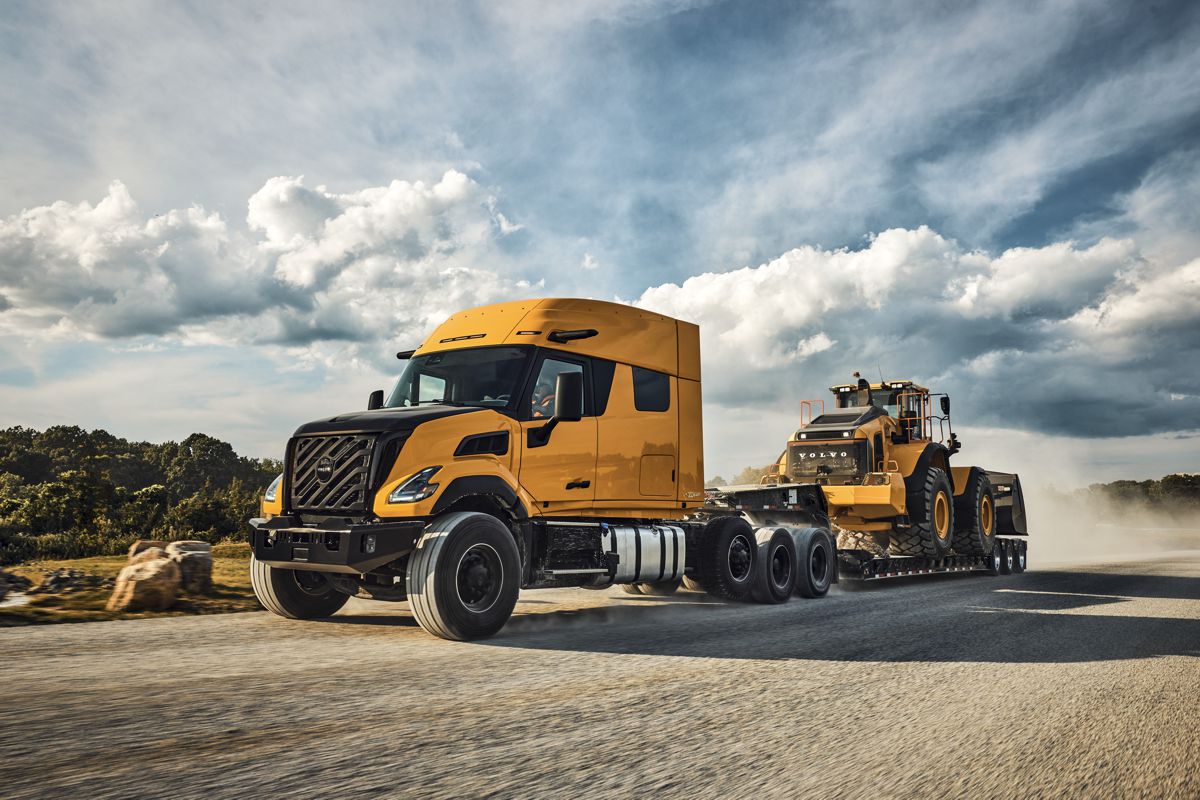
For heavier applications, gooseneck trailers and specialist low-loaders offer alternative arrangements for distributing weight and accommodating larger machinery. The appropriate configuration depends on the equipment being transported, the towing vehicle and the applicable operating regulations.
Trailer construction materials also influence performance. Steel remains widely used because of its strength, durability and suitability for demanding applications, while aluminium can reduce unladen weight and improve corrosion resistance in appropriate designs.
However, reducing trailer weight is not automatically beneficial if it compromises structural durability or the ability to accommodate concentrated machinery loads. Manufacturers must balance strength, weight, fatigue resistance and cost against the expected operating environment.
Understanding the difference between gross trailer weight ratings and usable payload is equally important. A trailer rated at 14,000 lb cannot necessarily carry 14,000 lb of machinery. Its own weight, together with any additional equipment or materials being transported, must be accounted for when calculating the available carrying capacity.
Axle configuration introduces further considerations. Tandem and multi-axle arrangements can distribute loads more effectively, but their suitability depends on axle ratings, tyre capacity, suspension characteristics and the trailer’s overall design.
For fleet operators, these engineering decisions translate directly into payload capability, maintenance requirements and long-term operating costs.
The Importance of Matching the Complete Towing System
Safe equipment transport depends on the compatibility of the towing vehicle, trailer, coupling arrangement and the load being carried.
A vehicle’s advertised towing capacity does not independently establish whether a particular combination is suitable. Operators must also consider gross combination weight, axle loading, hitch ratings, braking performance and the vertical load imposed at the coupling.
In North American towing applications, this vertical force is commonly described as tongue weight. An incorrectly distributed load can create instability, particularly when insufficient weight is transferred to the towing vehicle or when excessive weight overloads its rear axle or hitch assembly.
The connection between vehicle and trailer is therefore a critical engineering interface.
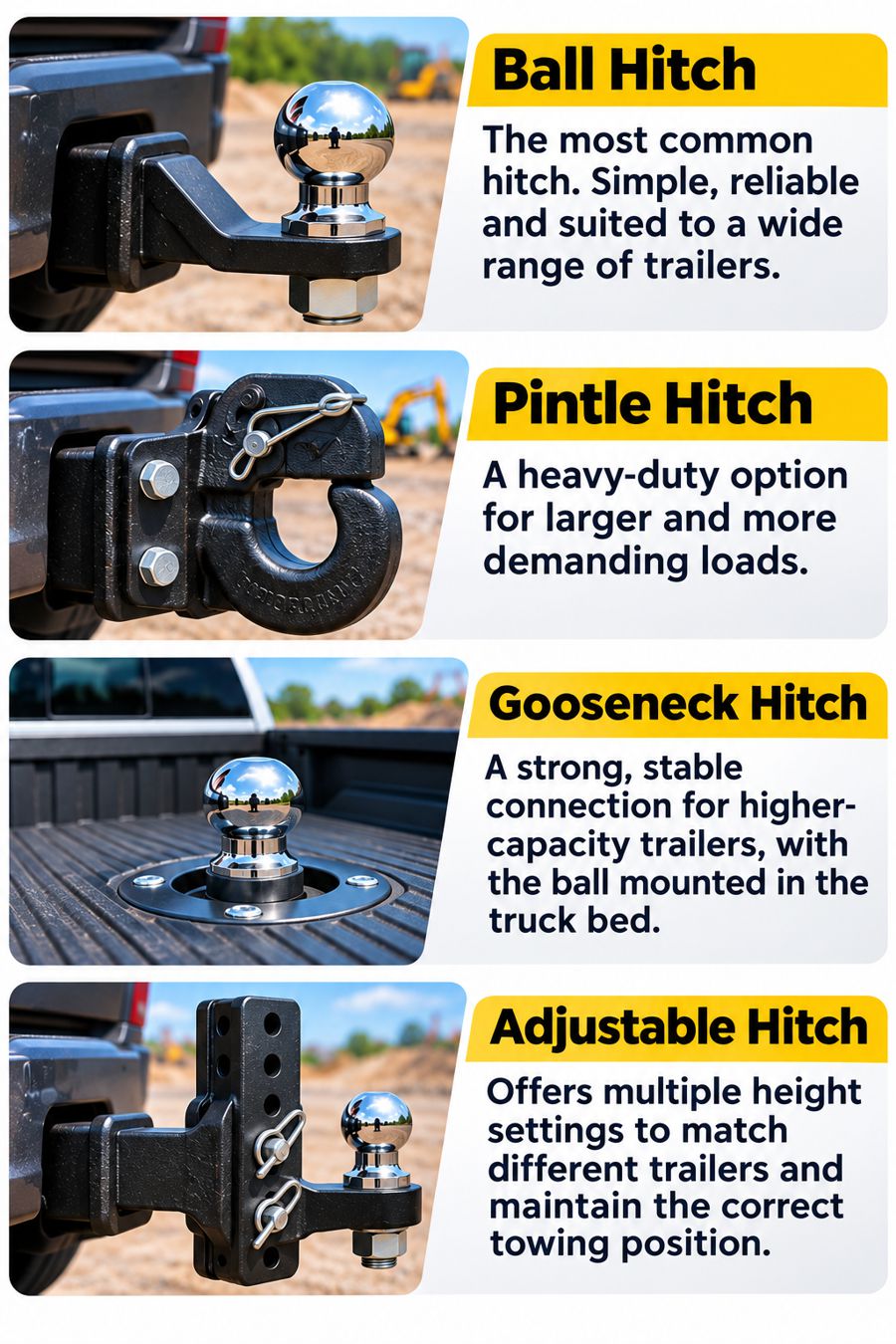
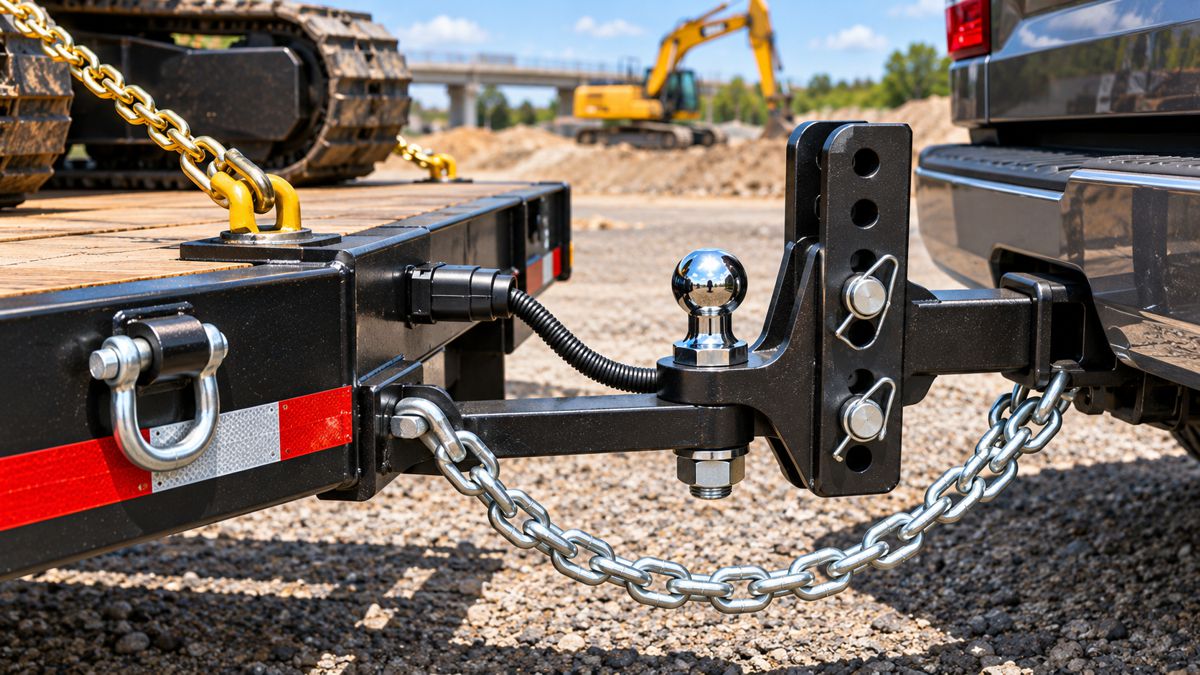
For contractors using multiple trailer configurations, correctly specified heavy duty trailer hitches can provide greater flexibility, particularly where adjustable mounting heights help maintain appropriate towing geometry across compatible combinations.
However, adjustability does not increase a vehicle’s authorised towing capacity. Every component must be compatible, correctly installed and operated within its individual rating, with the lowest-rated component limiting the combination.
For contractors managing mixed fleets, standardising suitable coupling arrangements and establishing clear towing procedures can reduce complications when equipment is reassigned between vehicles and sites.
Loading and Securing Equipment Safely
Loading construction machinery introduces risks that are quite different from those associated with transporting conventional freight.
An excavator may place substantial weight over a relatively small area, while an articulated loader presents additional considerations involving steering movement and the position of its attachments. Loading ramps must accommodate the equipment’s weight and geometry, and the trailer must remain stable throughout the process.
Once loaded, machinery must be positioned to achieve appropriate axle and coupling loads before being secured against movement.
In the United States, the Federal Motor Carrier Safety Administration establishes cargo securement requirements for commercial vehicles operating within its jurisdiction.
Under 49 CFR §393.130, applicable wheeled or tracked machinery weighing 10,000 lb (4,536 kg) or more must be restrained against forward, rearward, lateral and vertical movement using at least four tiedowns. Additional requirements address equipment preparation and the securing of accessories.
Lighter machinery may be secured under other applicable provisions, making it important to understand the relevant rules rather than assuming that every machine requires an identical arrangement.
The regulatory framework differs internationally. European and UK operators must follow their respective vehicle loading, weight and load-securing requirements, which may not correspond directly with North American standards. Contractors working across borders therefore need to establish which rules apply to each transport operation.
Beyond regulatory compliance, effective load restraint protects equipment, transport vehicles and other road users. Chains, straps, binders and anchoring points must be suitable for their intended loads, inspected regularly and used according to the relevant specifications.
A properly secured machine should remain stable during braking, cornering and normal road movements without relying on friction alone to prevent displacement.
Trailer Maintenance and the Cost of Neglect
Equipment trailers operate in environments that can accelerate wear and deterioration. Construction sites expose them to mud, dust, water, debris and uneven surfaces, while repeated loading and unloading place additional stresses on structural components.
Axles, wheel bearings, brakes, tyres, suspension systems and electrical connections all require routine attention. Loading ramps, hinges, locking mechanisms and securing points are equally important, particularly where damage may not be immediately obvious.
Corrosion can present a longer-term challenge, especially for trailers exposed to road salt, coastal environments or frequent wet conditions.
A neglected trailer can quickly become an expensive problem. A failed wheel bearing or damaged braking system may immobilise valuable machinery, interrupt a scheduled delivery and leave personnel waiting for equipment that should already be working.
The resulting disruption may cost considerably more than the repair itself.
For contractors operating multiple trailers, formal inspection schedules and maintenance records can help identify recurring faults, improve asset availability and support more informed replacement decisions.
The Economics of Equipment Mobility
Construction equipment is generally purchased to perform productive work, not to spend time travelling between sites or waiting for transport.
Consider a contractor operating several compact excavators across geographically dispersed projects. If the machines can be moved efficiently as work progresses, the business may achieve higher utilisation without increasing the number of machines it owns.
Conversely, insufficient transport capacity can create bottlenecks. Equipment may remain idle because an appropriate trailer or towing vehicle is unavailable, even when another project urgently requires it.
Trailer ownership also carries costs that extend beyond the initial purchase price. Insurance, maintenance, inspections, tyres, storage, licensing where applicable and the availability of qualified drivers all influence the overall economics.
Businesses must decide whether to maintain their own transport capability, use specialist haulage providers or combine both approaches.
For frequently relocated compact equipment, owning suitable trailers may provide scheduling flexibility and reduce dependence on external transport availability. Larger or less frequently moved machinery may be better suited to specialist operators with dedicated vehicles and equipment.
The equipment rental industry adds another dimension. Rental companies must coordinate the movement of machines between depots, customers and jobsites, often under demanding delivery schedules. Contractors hiring equipment face their own decisions about collection, delivery charges and whether their vehicles and trailers are suitable for transporting the machines involved.
A compact excavator may be available at a competitive daily rental rate, but the overall cost of using it can change significantly once transport arrangements are included.
For both rental companies and contractors, trailer availability and transport planning are therefore closely connected to equipment utilisation and profitability.
A Changing Role in Modern Construction Fleets
The development of compact construction machinery has created new opportunities for contractors to undertake specialised work with smaller, more adaptable fleets.
Electric compact equipment, increasingly sophisticated attachments and multifunctional machines are also changing the characteristics of the loads that contractors need to transport.
Although electric machinery eliminates local exhaust emissions during operation, battery systems can influence machine weight and its distribution. Transport planning must therefore account for the actual specifications of each machine rather than assuming that an electric model has the same loading characteristics as its diesel equivalent.
Meanwhile, fleet management technologies are making it easier to monitor equipment locations, schedule movements and coordinate resources between projects.
Trailers can form part of this connected operating environment through telematics, asset tracking and maintenance management systems. Knowing where a trailer is located, whether it is available and when it requires servicing can be valuable for contractors operating across multiple locations.
The growing sophistication of construction fleet management is also changing how transport assets are viewed. A contractor may have detailed information about machine operating hours, fuel consumption and maintenance requirements, yet relatively little visibility of the trailers needed to move those machines.
Bringing both into the same planning process offers a more complete picture of fleet availability and deployment.
Giving Equipment Trailers the Recognition They Deserve
Construction productivity is often discussed in terms of machine performance, automation, operator efficiency and digital technologies. Yet these improvements have limited value when equipment cannot reach the jobsite reliably.
Equipment trailers occupy an essential position between machinery ownership and productive deployment. Their design affects transport safety, their availability influences scheduling, and their maintenance contributes directly to fleet reliability.
For contractors, selecting and managing trailers with the same attention given to excavators, loaders and other revenue-generating assets can deliver meaningful operational benefits.
The construction industry’s most visible machines may do the digging, lifting and paving, but the trailers working behind the scenes help ensure those machines are in the right place when the work begins.