Heavy-Duty Tool Storage for Modern Equipment Maintenance Workshops
A fully equipped maintenance toolbox can weigh hundreds of kilograms before a technician has picked up a single spanner. In commercial vehicle depots, construction equipment workshops and industrial maintenance facilities, storing and moving that equipment presents practical challenges involving weight, access, stability and tool accountability.
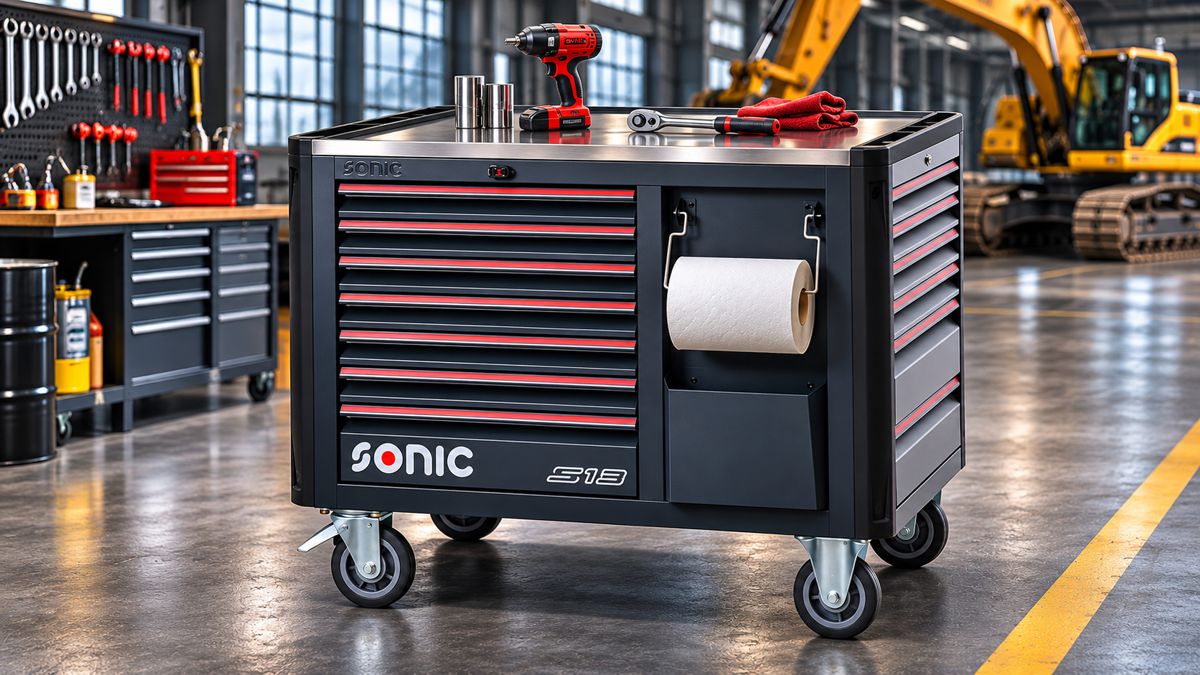
Sonic Tools USA has introduced the NEXT S13, a 13-drawer mobile workstation weighing approximately 212 kg empty and designed to accommodate substantial professional tool collections. Its reinforced construction, drawer interlocks and modular storage system provide an example of how workshop equipment is being engineered around the demands of modern maintenance operations.
Briefing
- Professional workshop storage combines mobility, equipment protection and organised access to specialist tools.
- Sonic Tools USA has introduced the NEXT S13, a 13-drawer mobile toolbox with a manufacturer-rated loading capacity of approximately 1,050 kg.
- Ten shallow drawers and three deep drawers accommodate different categories of hand tools, diagnostic instruments and heavier equipment.
- An anti-tilt mechanism restricts simultaneous drawer opening, reducing a common source of instability in mobile cabinets.
- Compatibility with the Sonic Foam System supports standardised tool layouts, inventory checks and visual tool accountability.
Heavy-Duty Mobile Toolboxes and Workshop Capacity
Professional maintenance operations involve substantial collections of equipment. A commercial vehicle technician might require socket sets, torque wrenches, electrical testing instruments and pneumatic tools during a single repair. Heavy machinery maintenance introduces additional requirements, including larger fasteners, hydraulic equipment and specialist diagnostic instruments.
Keeping these tools close to the work can reduce unnecessary movement between service bays and fixed storage areas. Mobile cabinets allow technicians to position their equipment alongside the machine or vehicle being serviced, although their usefulness depends on the capacity, dimensions and manoeuvrability of the cabinet itself.
The recently introduced Sonic NEXT S13 toolbox combines a reinforced steel chassis with 13 drawers and an integrated work surface. Measuring approximately 1,204 mm wide, 975 mm high and 763 mm deep, the cabinet has an unladen weight of around 212 kg.
Its one-piece steel construction is designed to provide structural rigidity under demanding workshop conditions. Four heavy-duty castors, comprising two fixed and two swivel units, allow the cabinet to be repositioned around maintenance areas.
According to Sonic Tools, the NEXT S13 has an overall rated loading capacity of 2,314 lb, equivalent to approximately 1,050 kg. Each castor is individually rated at around 770 lb, although the combined castor ratings should not be confused with the manufacturer’s overall permitted loading capacity.
Moulded plastic corner bumpers provide additional protection against incidental contact with vehicles, workshop equipment and surrounding infrastructure.
Moving a cabinet of this size requires appropriate floor conditions and sufficient clearance. Uneven surfaces, ramps and confined workshop spaces can present difficulties, particularly when the unit is heavily loaded.
Drawer Design and Equipment Accessibility
Drawer configuration determines how effectively a toolbox accommodates different categories of equipment. Shallow compartments generally suit sockets, spanners, measuring instruments and frequently accessed hand tools, while deeper drawers provide space for larger powered equipment and bulky accessories.
The NEXT S13 uses ten shallow drawers and three deep drawers. The shallow compartments have a manufacturer-rated capacity of approximately 60 kg each, while the deeper drawers incorporate double slides and are rated at approximately 120 kg.
Full-extension ball-bearing slides provide access to the complete drawer interior, including equipment stored towards the rear. This arrangement is particularly useful where drawers contain fitted tool trays or specialist instruments that need to remain in designated positions.
A fleet workshop specialising in commercial vehicle servicing may prioritise larger sockets, torque equipment and impact tools. Maintenance facilities handling electrical and electronic repairs may allocate more space to diagnostic instruments, precision tools and testing equipment.
The cabinet also incorporates supplementary side storage for frequently used items, allowing technicians to access selected equipment without opening the main drawer bank. The precise arrangement of these compartments should be confirmed against the selected product configuration.
Stability and Safety in Mobile Tool Storage
Mobile tool cabinets introduce stability considerations that are less pronounced with permanently installed workshop storage. Opening several heavily loaded drawers simultaneously can shift the centre of gravity forward, increasing the risk of tipping.
Mechanical drawer interlocks address this particular hazard by preventing multiple drawers from being extended at the same time.
The Sonic NEXT S13 incorporates an anti-tilt mechanism designed to permit only one drawer to open at a time. When a drawer is extended, the remaining drawers are restricted until it is closed.
Such systems provide an additional safeguard, although they do not eliminate the need for appropriate loading, correct castor use and sensible positioning on level workshop floors.
Individual drawer ratings also need to be considered alongside the overall cabinet capacity. A toolbox may have several compartments capable of carrying substantial loads, but their combined contents must remain within the manufacturer’s total loading limit.
Keeping heavier equipment in lower drawers can also help maintain a more favourable centre of gravity, particularly where a cabinet is moved regularly between maintenance locations.
Tool Accountability and Foam Storage Systems
Finding a missing tool can interrupt maintenance work, particularly when technicians share equipment or operate under formal inspection and quality assurance procedures.
Organised storage systems address part of this problem by assigning individual tools to designated positions. Shaped foam inlays and clearly identified compartments make it easier to recognise missing items before work is completed.
This approach is especially relevant in aviation maintenance, where foreign object debris presents an established operational concern. Similar principles apply in industrial workshops and vehicle maintenance facilities, where tools inadvertently left inside equipment can cause damage or create safety hazards.
Sonic Tools offers its Sonic Foam System (SFS), which uses dual-density foam inserts with dedicated spaces for individual tools. The contrasting layers make empty tool positions visually apparent, supporting routine inventory checks and tool accountability.
The NEXT S13 is compatible with Sonic’s modular foam storage arrangements, allowing technicians to configure drawers around different tool assortments and maintenance requirements.
The company also provides an online Sonic Drawer Configurator through which users can plan storage layouts and select compatible tool modules.
Foam systems can improve consistency in tool placement, but their effectiveness depends on technicians returning equipment to the correct positions. They support established tool-control procedures rather than replacing formal accountability requirements where these apply.
Integrated Work Surfaces and Secondary Storage
Professional mobile toolboxes increasingly incorporate features traditionally associated with fixed workbenches, allowing technicians to prepare tools and organise small components close to the equipment being serviced.
The NEXT S13 includes a reinforced stainless-steel worktop with integrated drip edges, side pockets for small hardware and holders for spray cans and paper rolls.
The manufacturer also describes a lockable rear compartment intended for personal belongings, specialist tools or other equipment requiring separate storage.
These features can be useful in workshops where technicians move between multiple service bays. Frequently used accessories remain accessible without requiring additional cabinets or temporary storage surfaces.
For maintenance operations involving oils, lubricants and hydraulic fluids, a cleanable work surface is a practical advantage. Appropriate spill management and chemical handling procedures remain necessary, and the integrated top should be used within its intended loading and operating limits.
Selecting Tool Storage for Fleet and Equipment Maintenance
Choosing a professional toolbox involves balancing storage capacity against the physical requirements of the workshop.
A larger cabinet can accommodate more equipment, but it occupies valuable floor space and may be less convenient to move through narrow service areas. Smaller units offer greater flexibility where technicians regularly work in confined spaces or move between vehicles.
Castor specifications, locking arrangements, drawer load ratings and the dimensions of a fully loaded cabinet all deserve consideration. Workshop floor conditions and access routes can be as important as the nominal storage capacity.
The arrangement of the drawers should also reflect the tools being stored. A technician with extensive hand-tool collections may benefit from numerous shallow compartments, while larger power tools and specialist maintenance equipment require deeper storage.
Purchase cost is another consideration. Premium mobile toolboxes represent a substantial workshop investment, particularly when fitted tool sets and modular storage systems are included. Buyers should assess the cabinet’s construction, warranty terms, compatibility with existing equipment and expected working life rather than comparing drawer counts alone.
For larger maintenance organisations, standardising tool storage across technicians or workshop bays may simplify equipment allocation and inventory procedures. Consistent layouts can make shared equipment easier to locate and help new technicians become familiar with workshop arrangements.
The NEXT S13 brings several of these considerations together in a single mobile unit, combining substantial loading capacity, full-extension drawers, mechanical anti-tilt protection and configurable tool storage.
For commercial vehicle operators, construction equipment maintenance facilities and industrial workshops, the practical objective remains straightforward: keeping the right equipment accessible, protected and accounted for without creating additional obstacles to the maintenance work itself.
Key Industry Questions
- What is the advantage of a mobile toolbox in a maintenance workshop? A mobile toolbox allows technicians to move organised tool collections between service bays or maintenance locations, reducing reliance on fixed storage cabinets.
- How many drawers does the Sonic NEXT S13 toolbox have? The NEXT S13 has 13 primary drawers, comprising ten shallow drawers and three deeper compartments for larger equipment.
- What is the loading capacity of the Sonic NEXT S13? Sonic Tools specifies a total loading capacity of 2,314 lb, approximately 1,050 kg. Individual drawer and castor ratings are subject to separate limits.
- Why are anti-tilt mechanisms used in professional toolboxes? Anti-tilt systems restrict simultaneous drawer opening, reducing the risk of excessive weight extending beyond the cabinet and contributing to instability.
- What are the benefits of full-extension toolbox drawers? Full-extension drawers provide access to equipment stored at the rear of a compartment without requiring other tools to be removed.
- How do foam tool organisers support workshop maintenance? Shaped foam inlays provide designated positions for individual tools, helping technicians identify missing equipment and maintain consistent storage arrangements.
- Can mobile toolboxes be used for heavy equipment maintenance? Yes. Suitable heavy-duty mobile toolboxes can support construction equipment and commercial vehicle maintenance, provided their dimensions, loading limits and mobility characteristics suit the workshop.
- What should fleet operators consider when selecting workshop tool storage? Key considerations include drawer capacity, overall loading limits, stability, castor design, floor conditions, available workspace and compatibility with existing tool collections.
Strategic Takeaways
- Workshop storage should be specified around actual maintenance tasks and equipment requirements rather than drawer count alone.
- Mobile cabinets can improve tool accessibility, but their weight, dimensions and movement requirements must suit the workshop environment.
- Anti-tilt mechanisms reduce a particular stability risk without replacing safe loading and handling procedures.
- Foam-based tool organisation supports accountability and inventory consistency, particularly where specialist tools are frequently used.
- Standardised storage layouts may simplify tool allocation and maintenance procedures across larger fleet and industrial workshops.