AI Drone Detection Research Targets Security Risks at Critical Infrastructure
Researchers at Rowan University in New Jersey are developing an artificial intelligence system capable of detecting and identifying drones through the radio signals exchanged with their operators. Working with commercial drone detection specialist AeroDefense, the university is collecting wireless data from different aircraft and operating environments to improve the technology’s ability to recognise drones around sensitive infrastructure.
The research, led by Dr Huaxia Wang, an assistant professor in Rowan’s Henry M. Rowan College of Engineering, addresses a security challenge for airports, power stations, correctional facilities, stadiums and major industrial installations. Small unmanned aircraft can operate at low altitude, manoeuvre around buildings and present difficult targets for conventional radar systems, particularly in environments with extensive physical obstructions.
Instead of relying on radar reflections, the Rowan team is developing algorithms to recognise the radio-frequency characteristics associated with different drone models. The intended system would detect and classify aircraft while estimating the positions of both the drone and its operator. The collaboration with AeroDefense provides a route towards commercial development, although quantitative performance results and a deployment timetable have yet to be announced.
Briefing
- Rowan University is developing AI-powered drone detection using radio-frequency signals and machine learning.
- The system aims to detect, classify and locate drones, with additional capabilities for estimating operator positions.
- Researchers are collecting signal recordings from different aircraft through regular flights on the university campus.
- Commercial partner AeroDefense is contributing to development and potential commercialisation, with testing extending to stadiums, urban environments and other locations.
- The university intends to share its research dataset, although detection accuracy, localisation performance and commercial availability remain unconfirmed.
Detecting Drones Through Radio Signals
Conventional aviation radar transmits electromagnetic energy and analyses signals reflected by objects in the surrounding airspace. Dedicated counter-drone radar can detect small unmanned aircraft, but performance depends on target size, operating altitude, sensor resolution and interference from the surrounding environment.
Buildings, trees, terrain and moving equipment complicate detection around industrial installations and urban infrastructure. A small quadcopter flying close to a structure can be considerably harder to distinguish from background clutter than an aircraft operating in open airspace.
Radio-frequency detection approaches the problem differently. Many remotely operated drones maintain wireless connections with ground controllers to receive flight instructions, transmit telemetry and deliver live video. These communications produce electromagnetic signals that appropriately configured receiving equipment can detect without transmitting radar pulses.
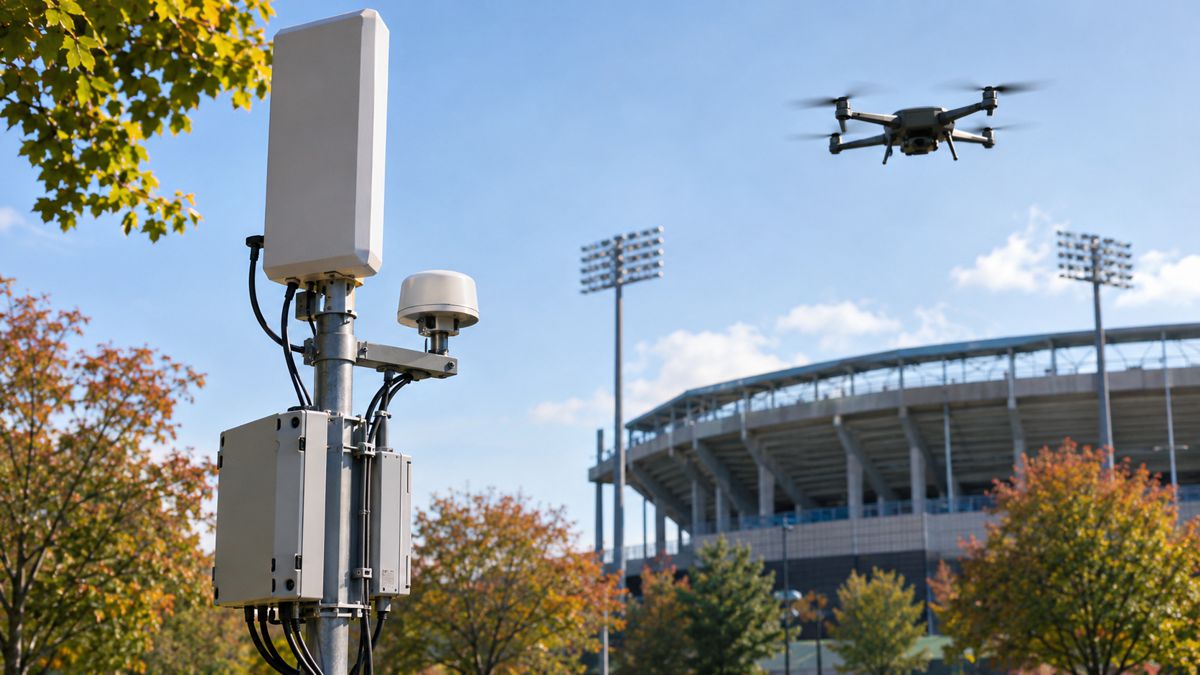
Wang’s researchers are developing a system that uses antennas to capture relevant signals and AI algorithms to recognise patterns associated with different aircraft. The intention is to distinguish between drone types and estimate their locations, building a more detailed picture of activity around a protected site.
Different wireless communication systems have characteristic transmission behaviour, frequency patterns and other signal properties. Machine learning algorithms can be trained to distinguish these characteristics, provided sufficient examples are available across different aircraft types and operating conditions.
Detecting a signal, identifying its likely source and determining the location of an aircraft are separate technical challenges. Location estimates may require multiple receivers, directional measurements or other positioning techniques, depending on the system architecture and available signals. The Rowan announcement does not specify the configuration needed to deliver its proposed localisation capability, nor does it provide detection accuracy or false-alarm figures.
Building a Drone Signal Dataset
A central part of the Rowan programme involves collecting radio-frequency recordings from different drones, allowing the researchers to establish the characteristic signatures needed to train their classification algorithms.
“Every week, we are going to fly different types of drones on campus in order to collect their corresponding data,” Wang explained.
The university also intends to make the resulting dataset available to other research teams, potentially allowing independent investigations and comparisons of different detection methods.
“We want to share the full dataset we have collected at the Rowan campus and let everyone utilize the data we have collected to boost this kind of drone defense research,” Wang said.
A system trained on a limited selection of aircraft in relatively quiet radio conditions may struggle when deployed in a busy commercial environment. Office buildings, telecommunications equipment, industrial machinery and other wireless devices create a complicated electromagnetic background, while physical structures can obstruct or reflect transmissions.
The position and orientation of a moving aircraft also influence how its signals are received. Reflections from nearby buildings can produce multiple signal paths, introducing errors when attempting to establish where a transmission originated.
Working alongside AeroDefense, the university team has gathered data across stadiums, urban locations, offices and university campuses. The researchers are examining conditions that vary with weather and local activity, including differences between the periods before, during and after events.
“We want to collect as much environmental data as we can to further enhance our model training because our model needs to see different scenarios like a rainy day, a sunny day, and also during the event, before the event and after the event,” Wang said. “We want our model to be aware of those environments and get sufficiently trained.”
The recordings should provide a more varied training foundation than laboratory measurements alone, although the university has not specified when the dataset will be released or how it will be organised for external researchers.
Commercial Development with AeroDefense
The university is working with Ziang Gao, who leads research and development at New Jersey-based AeroDefense. The company already supplies passive radio-frequency drone detection equipment and is collaborating with Rowan to advance the technology towards commercial use.
AeroDefense’s existing AirWarden range includes systems designed to monitor drone activity through Remote ID broadcasts and radio-spectrum sensing. Depending on the equipment and installation, these technologies can provide information about aircraft operating around a protected location without transmitting signals of their own.
The company’s commercial experience gives the university researchers access to practical deployment considerations, including sensor placement, wireless interference and the demands of operating continuously around sensitive facilities.
AeroDefense’s existing AirWarden technology received a designation under the US Department of Homeland Security’s SAFETY Act programme on 16 April 2024, with the approval listed through 30 April 2029. The programme provides specified liability protections for qualifying anti-terrorism technologies. The designation applies to the company’s identified AirWarden offering and does not constitute independent performance certification of the new Rowan research.
There is also a technical and legal distinction between detecting radio-frequency energy and interpreting the content of wireless communications. AeroDefense describes its spectrum-sensing approach as detecting relevant RF activity without decoding the communications between drones and their controllers, an approach intended to avoid restrictions associated with intercepting protected transmissions.
For the Rowan programme, the precise signal-processing methods used in any commercial implementation will therefore require careful consideration alongside the machine learning technology. Recognition methods developed during research must be suitable for the legal and operational conditions in which commercial equipment will operate.
The university has separately reported a $105,000 award from AeroDefense for a project titled RAPTOR 2.0: AI-Powered UAS Recognition and Threat Optimization Response. The funding appears in Rowan’s October 2026 account of recent research awards.
Neither organisation has announced whether the new classification algorithms will be incorporated into existing AirWarden equipment or developed as a separate product.
Remote Identification and Infrastructure Security
The regulatory environment creates an important distinction between drones that are broadcasting identification information and aircraft that cannot be identified through those messages.
Under the US Federal Aviation Administration’s Remote ID requirements, drones subject to registration generally must transmit identification and location information, with specified exceptions. Standard Remote ID aircraft broadcast details relating to the drone and its control station, while retrofit broadcast modules provide the aircraft’s position and take-off location.
Compatible receivers can obtain this information without analysing proprietary drone communications. However, equipment relying exclusively on Remote ID cannot provide the same identification capability when an aircraft is not broadcasting compliant information.
Spectrum-based detection offers another way to recognise certain aircraft through their radio activity. It also has limitations. Some drones can follow pre-programmed routes without maintaining continuous communications with a controller, while others use unfamiliar transmission systems or communicate intermittently. A passive RF system cannot recognise an aircraft through signals that are absent or outside its detection capabilities.
For infrastructure operators, several sensing technologies may therefore be needed to establish dependable coverage. Radar can detect suitable airborne objects without relying on their radio communications, while optical cameras and other sensors can assist with verification and tracking.
The operational requirements differ considerably between sites. At an airport, an unidentified drone approaching a runway can present an immediate aviation safety concern. At a power station or industrial facility, the priority may be monitoring unauthorised activity near sensitive equipment. Stadiums encounter concentrated periods of public activity, while correctional facilities face particular concerns about drones being used to transport prohibited items.
Large construction projects introduce another consideration. Surveying, inspection and progress monitoring drones are increasingly familiar around highways, bridges, earthworks and major industrial developments. A large infrastructure programme may involve several surveying subcontractors, inspection teams and neighbouring operators conducting legitimate flights.
A detection system at such a site would need to distinguish routine operations from aircraft requiring investigation. Recognising a drone signal does not establish whether the flight is authorised, nor does it reveal the operator’s intentions.
Automated alerts would need to be supported by site procedures, records of authorised drone activity and arrangements for responding to incidents. Equipment that can identify aircraft without repeatedly interrupting legitimate operations would be more practical than a system producing large numbers of unexplained warnings.
Detection must also be distinguished from intervention. As the FAA’s guidance on drone detection and mitigation explains, disrupting drone communications, disabling aircraft or attempting to take control of their flight involves separate technical capabilities and potentially restrictive legal requirements. The existence of a drone detection system does not itself authorise those actions.
From Research to Deployment
The next challenge for Rowan and AeroDefense is demonstrating that the classification methods remain reliable outside the conditions represented in their training data.
A system might identify familiar drone models during controlled flights yet encounter difficulties with modified equipment, unfamiliar communication protocols or signals distorted by surrounding structures. Maintaining accurate classifications as manufacturers introduce new aircraft would require continuing attention to the training data and software.
False alarms are another practical concern. Security personnel need to investigate genuine incidents without being overwhelmed by warnings caused by unrelated wireless activity, particularly at locations with extensive telecommunications infrastructure or frequent authorised drone operations.
The proposed release of Rowan’s signal recordings could allow other researchers to investigate these problems using a common dataset. Its value for comparative testing will depend partly on the information accompanying the recordings, including aircraft models, collection conditions and the methods used to label individual examples.
Commercial deployment will require evidence beyond successful classification during research trials. Detection range, recognition accuracy, location error, performance against unfamiliar aircraft and integration with existing security systems will all influence whether the technology is suitable for a particular installation.
For now, Wang’s team is continuing to collect drone signals across different operating environments. The next measure of progress will be how reliably those recordings can train a system to recognise aircraft it has not previously encountered.
Key Industry Questions
- How does AI-powered radio-frequency drone detection work? Antennas receive radio-frequency activity associated with drone operations. Algorithms analyse signal characteristics to detect and classify aircraft, with additional sensor measurements potentially supporting location estimates.
- Can radio-frequency detection identify drones without Remote ID? Potentially. Spectrum-based systems can recognise certain drone communications without relying on Remote ID broadcasts. Detection still depends on identifiable radio emissions and the capabilities of the equipment.
- Can the technology locate a drone operator? Some radio-frequency systems can estimate controller positions using suitable signal measurements and receiver configurations. The Rowan research aims to develop this capability, but published localisation accuracy figures have not been provided.
- Is radio-frequency detection better than radar? Neither approach is universally superior. RF sensing can identify relevant wireless activity, while radar can detect suitable airborne objects independently of their communications. Combining sensor technologies can improve coverage.
- Where could the Rowan technology be used? Potential applications include airports, power stations, correctional facilities, stadiums, industrial installations and major infrastructure construction sites. Actual suitability will depend on testing, installation conditions and security requirements.
- Can the technology detect autonomous drones? Only when relevant detectable transmissions are present. An autonomous aircraft operating without an active radio link may not be identified by a passive RF system, although other sensors could detect it.
- Does detecting an unauthorised drone permit security personnel to disable it? No. Detection and mitigation are separate activities. Interfering with drone communications or flight operations may require specific legal authority, particularly in the United States.
- When will the Rowan University drone detection system be commercially available? No commercial release date has been announced. The university and AeroDefense are continuing research and development, and detailed performance benchmarks have not been disclosed.
Strategic Takeaways
- RF classification can extend monitoring beyond Remote ID. Recognising characteristic transmissions may help identify certain drones that are not broadcasting compliant identification messages.
- Environmental data will influence detection reliability. Wireless interference, physical obstructions and unfamiliar aircraft remain significant challenges for permanent installations.
- Operator localisation requires separate validation. Recognising a drone signal does not automatically establish the position of the aircraft or its controller.
- Commercial integration offers a potential development route. AeroDefense’s existing detection equipment provides relevant deployment experience, although no integration of the Rowan algorithms has been announced.
- Operational performance will determine suitability. False-alarm rates, detection probability, location accuracy and compatibility with site security procedures will influence procurement decisions.