Volvo Trucks Brings Romanian Freight Compliance into the Cab
Volvo Trucks has introduced a regulatory compliance service that integrates Romania’s electronic freight monitoring requirements into its existing vehicle systems, allowing operators to manage transport identification codes and GPS reporting without additional in-cab hardware.
Developed with connected vehicle software specialist AiDEN Auto, the RO e-Trans application connects Romania’s national freight monitoring requirements with the truck’s factory-installed telematics equipment, in-cab display and Volvo Connect fleet management platform. Transport identification codes are synchronised with the vehicle, while location reporting uses its existing communications hardware.
Announced on 4 November 2026, the service initially targets Volvo Trucks customers in Romania and the Czech Republic, with wider European availability planned. It follows AiDEN’s earlier work integrating Poland’s SENT GEO regulatory monitoring requirements into connected vehicle systems.
Briefing
- Volvo Trucks and AiDEN Auto have launched RO e-Trans for Romanian electronic freight compliance.
- Unique transport identification codes are synchronised with compatible trucks’ in-cab displays.
- GPS reporting uses factory-installed telematics equipment without additional tracking hardware.
- Fleet managers can access compliance information through the Volvo Connect ecosystem.
- The initial rollout covers customers in Romania and the Czech Republic, with further European expansion planned.
Romania’s Electronic Freight Monitoring Requirements
Romania’s RO e-Transport system was established under Emergency Ordinance No. 41/2022 as part of measures to improve the monitoring of goods movements and combat tax evasion. It covers specified domestic shipments involving goods considered to present a high fiscal risk, together with international road freight movements falling within the legislation.
The system requires designated parties to declare transport information through the Romanian National Agency for Fiscal Administration (ANAF), generating a unique transport identification code known as a UIT. This connects the registered consignment with information used by the authorities to monitor its movement through Romania.
Separate responsibilities apply to road transport operators, including transmitting vehicle positioning data during regulated journeys and ensuring drivers have access to the appropriate UIT code. Romanian legislation permits positioning information to be transmitted using equipment already installed in the vehicle, rather than requiring a dedicated external tracking device.
For international hauliers, the administrative arrangements can be awkward. Consignment information may originate with an importer, exporter or another responsible commercial party, while the transport operator must ensure that the corresponding vehicle is correctly identified and its location reported during the journey.
The process becomes more complicated when a fleet handles consignments for different customers using different booking, enterprise resource planning and transport management systems. Even where the original declaration is completed correctly, the resulting identification code must reach the driver and be associated with the appropriate truck.
Integrating Compliance with the Vehicle
AiDEN’s RO e-Trans service addresses the connection between shipment declarations and the vehicle performing the transport.
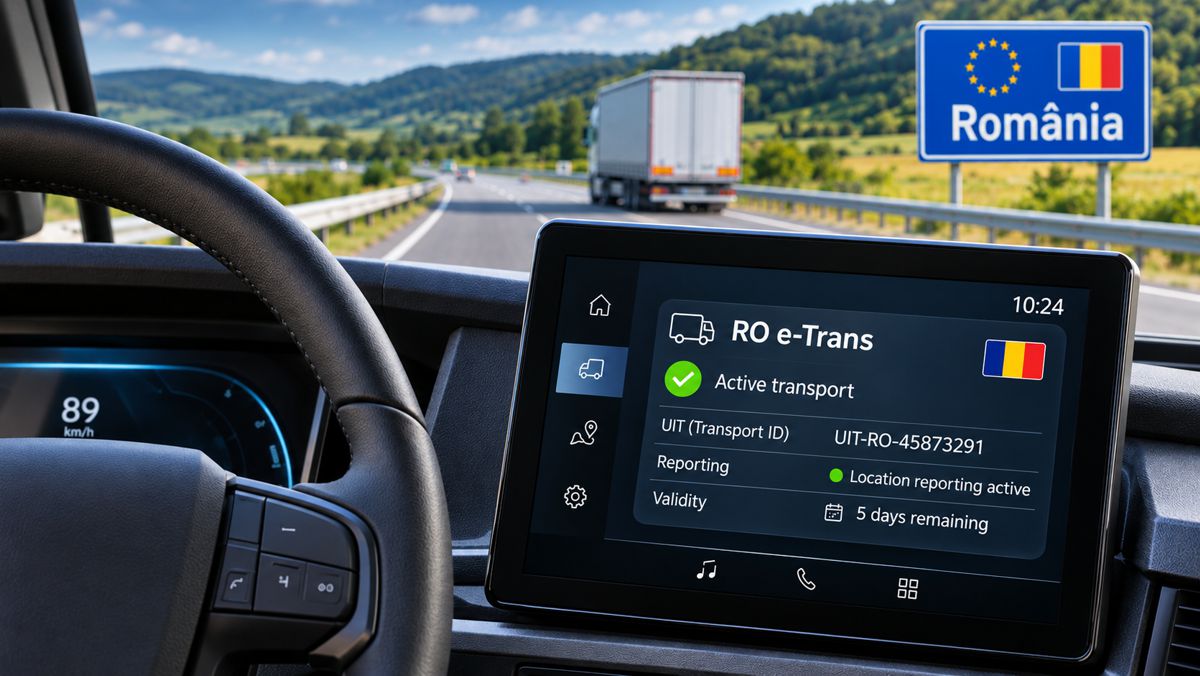
Fleet administrators can continue using their existing systems to submit the required information through ANAF. Once a UIT code has been generated, the application synchronises it with the compatible Volvo truck, allowing the driver to check active identification codes directly on the vehicle’s display without relying on printed documents or messages from a dispatcher.
The system also uses the truck’s factory-installed modem to manage the location reporting required by Romanian regulations. According to AiDEN, the arrangement eliminates the need for aftermarket GPS equipment, separate mobile applications or additional cabling.
The company’s RO e-Trans service information describes a software-based approach using existing vehicle telematics hardware, with activation supported through the Volvo Trucks dealer network.
The driver interface provides visibility of active UIT codes and reporting status, while fleet managers can access relevant information through Volvo Connect. A haulier carrying goods for several customers can therefore receive shipment identification information without requiring every consignor to use the same booking or declaration software.
The integration does not remove the underlying legal responsibilities. Romanian legislation distinguishes between the parties responsible for declaring a consignment and the road transport operator responsible for vehicle positioning and making the UIT code available to the driver.
Correct shipment information, appropriate vehicle assignments and compliance with identification code validity periods remain essential. Under Article 11 of the legislation, UIT codes are generally valid for five calendar days, with a 15-day period applying to intra-Community acquisitions and certain other specified transactions.
Automatic synchronisation can reduce the administrative handling of these codes, but it cannot establish whether every underlying declaration is accurate. Operators must still manage changes to transport arrangements, incorrect vehicle assignments and interruptions in connectivity. The companies have not published independently verified performance figures for reporting reliability or administrative time savings.
Extending the Volvo Connect Ecosystem
RO e-Trans is being offered through Volvo Trucks’ existing digital services environment, giving operators access through the Volvo Connect ecosystem.
Volvo Connect provides a central interface for connected fleet services, including vehicle information and operational management tools. Adding country-specific regulatory functions extends the platform into an area often handled through specialist compliance software or external telematics suppliers.
Niclas Gyllenram, CEO of AiDEN Auto, said: “With RO e-Trans, we’re building on what we accomplished with SENT GEO in Poland and showing just how quickly our platform can adapt to new regulatory requirements in different markets. Rather than asking drivers and fleet operators to manage yet another device or system, we’re bringing compliance directly into the tools they already use.”
The Romanian application follows AiDEN’s previous work with Poland’s SENT GEO system, providing another example of how a common connected vehicle software platform can accommodate different national reporting arrangements.
For Volvo Trucks, the partnership expands the services available through its connected vehicle environment without requiring the company to develop every regulatory application internally. AiDEN supplies the specialist software, while Volvo provides access to compatible onboard systems and its established fleet management platform.
Annelie Norhav, Services Partnership Manager at Volvo Trucks, said: “By making regulatory information accessible through the tools drivers and fleet managers already use, we can help simplify compliance and support efficient daily operations for our customers,”
AiDEN’s broader connected vehicle business covers applications for tolling, parking, fuelling, compliance and fleet services. Its software approach is built around Android Automotive, although the announcement does not specify the complete technical architecture of the Volvo implementation.
Rollout and Fleet Compatibility
RO e-Trans is available for compatible Volvo trucks equipped with the manufacturer’s latest-generation side display, covering appropriately configured models from 2021 onwards.
The initial rollout is directed towards customers in Romania and the Czech Republic, including operators conducting international freight movements involving Romania. Wider European availability is planned, although the companies have not announced a detailed expansion timetable.
Because the application uses existing vehicle hardware, compatible trucks do not require physical installation of additional GPS tracking devices. Operators will nevertheless need to confirm vehicle eligibility and arrange service activation through the appropriate channels.
AiDEN indicates that compatibility and onboarding can be coordinated through authorised Volvo Trucks dealers. Its published service information also refers to additional manufacturer integrations under development, although no further compatible brands have been confirmed in the announcement.
Neither company has disclosed subscription pricing, contractual arrangements or the number of vehicles expected to use the service during the initial rollout.
Connected Trucks and National Reporting Systems
European freight operators already work across a mixture of national electronic reporting arrangements, customs procedures and transport documentation requirements. These systems differ in their legal foundations, operating procedures and technical interfaces, making it difficult to establish a single compliance process across international fleets.
AiDEN’s deployments in Poland and Romania offer one approach to accommodating these differences within a common connected vehicle platform. Rather than requiring a separate hardware installation for each national regime, the software can be adapted to the relevant reporting requirements where suitable interfaces and vehicle integrations are available.
The approach depends on reliable electronic data exchange, access to national reporting systems and cooperation between software providers and vehicle manufacturers. Questions also remain about how regulatory location data is handled, particularly where information moves between the vehicle, the manufacturer’s services and government systems.
Mixed-fleet operations present another consideration. A transport company running trucks from several manufacturers may prefer a common compliance environment across its vehicles, while manufacturer-specific integration offers closer access to onboard equipment and can simplify installation and support.
RO e-Trans currently addresses a defined regulatory requirement in Romania. Its wider commercial potential will depend on how effectively comparable services can be extended to other national systems without introducing additional complexity for international operators.
For Volvo Trucks customers working in Romania, the immediate advantage is practical. A mandatory administrative and tracking function can now be managed through equipment already built into the vehicle, with the driver and fleet manager accessing the information through familiar systems.
Key Industry Questions
- What is RO e-Trans? RO e-Trans is a connected vehicle application developed by AiDEN Auto for compatible Volvo trucks. It helps operators manage Romanian electronic freight monitoring requirements through the vehicle’s existing digital systems.
- What is Romania’s RO e-Transport system? It is a government freight monitoring system administered by ANAF under Emergency Ordinance No. 41/2022. It covers specified domestic goods movements and regulated international road freight operations.
- What is a UIT code? A UIT is a unique transport identification code generated through Romania’s electronic reporting system. It identifies a declared freight movement and must be available to the driver where the regulations apply.
- Does RO e-Trans automatically submit freight declarations? No. The responsible commercial parties must still submit the required consignment information. RO e-Trans synchronises generated identification codes with compatible vehicles and supports the associated location reporting.
- Do Volvo trucks need additional GPS equipment? Compatible vehicles use their existing factory-installed telematics hardware and cellular modem, avoiding the need for separate GPS tracking devices.
- Which Volvo trucks support the application? The service is designed for Volvo trucks equipped with the latest-generation side display, generally covering compatible models from 2021 onwards. Individual vehicle eligibility should be confirmed through a Volvo dealer.
- Where is RO e-Trans available? The initial rollout covers Volvo Trucks customers in Romania and the Czech Republic. Further European expansion is planned, but no detailed timetable has been announced.
- Can mixed-manufacturer fleets use RO e-Trans? The announced integration supports compatible Volvo trucks. AiDEN says additional manufacturer integrations are under development, but availability for other truck brands has not been confirmed.
Strategic Takeaways
- Factory telematics can support national regulatory reporting. Compatible vehicles can transmit required positioning information without aftermarket tracking hardware.
- Automatic UIT synchronisation reduces manual handling. Drivers can access identification codes through the vehicle display rather than relying on separate messages or printed documents.
- National compliance requirements remain fragmented. Poland and Romania operate different monitoring systems, even where similar connected vehicle technology can support both.
- Manufacturer platforms are extending into regulatory services. Volvo Connect provides an established environment for country-specific compliance applications alongside conventional fleet management tools.
- Mixed-fleet compatibility remains unresolved. Operators using several truck brands must consider how manufacturer-specific applications fit with their existing compliance and transport management arrangements.