






Autonomous Robot Collects Deep-Sea Mineral Nodules at 4,000 Metres
An autonomous underwater robot has recovered polymetallic nodules from more than 4,000 metres below the Pacific Ocean, demonstrating a selective collection system that could offer an alternative to the large seabed mining machines and pumping infrastructure currently being developed for commercial mineral extraction.
Developed by American marine technology company Impossible Metals, the Eureka Collection System completed a scientific recovery operation in the Clarion-Clipperton Zone during September 2026, collecting approximately 450 grams of mineral-rich nodules. The robot located and retrieved individual nodules while hovering above the seabed, rather than travelling across it, and returned the recovered material to the surface. The operation was undertaken for biological research rather than mineral production.
Briefing
- Impossible Metals has demonstrated autonomous selective collection of polymetallic nodules at depths exceeding 4,000 metres.
- The Eureka robot recovered approximately 450 grams during a scientific expedition in September 2026.
- The system uses robotic manipulation, machine perception and variable buoyancy rather than seabed tracks and a continuous riser pipe.
- US patent 12,704,065, granted in August 2026, covers central elements of the collection architecture.
- A larger Eureka III system is scheduled for independent scientific assessment in 2027, with commercial productivity and environmental performance still to be established.
Rethinking How Minerals Are Collected
The Clarion-Clipperton Zone stretches across a vast area of the Pacific Ocean between Hawaii and Mexico. Its abyssal plains contain polymetallic nodules formed over millions of years as metals accumulate around small cores on the seabed. These irregular, often potato-sized formations contain manganese, nickel, cobalt and copper, making them a potential source of materials used in batteries, electrical equipment and industrial manufacturing.
Their distribution across the sediment surface creates a collection problem quite different from conventional terrestrial mining, where mineral deposits are excavated from rock formations or recovered through established processing operations. Most large-scale deep-sea collection concepts use tracked vehicles that travel across the seabed, gathering nodules through mechanical or hydraulic systems. The collected material is transported towards the surface through a long riser pipe, generally using pumped slurry and associated surface-handling equipment.
The approach has already progressed beyond laboratory experiments. In 2022, Nauru Ocean Resources and Allseas conducted a substantial trial in the Clarion-Clipperton Zone, recovering more than 3,000 tonnes of nodules using a tracked collector and riser system.
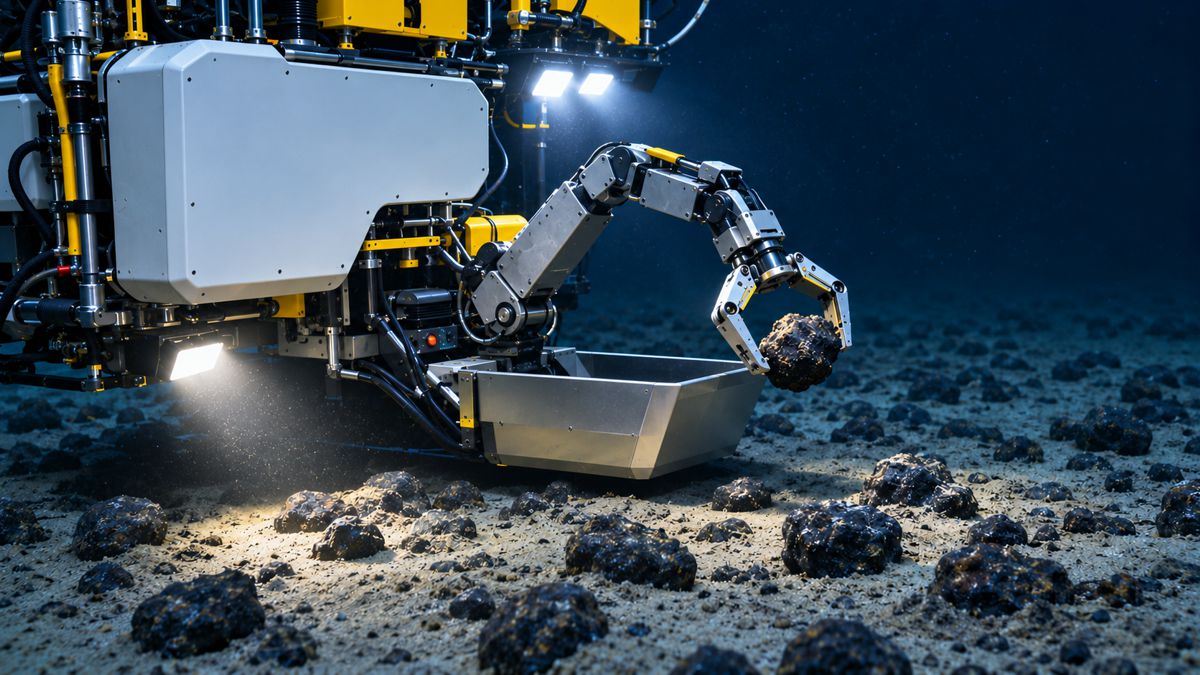
Impossible Metals has approached the collection process differently. Its Eureka platform operates as an autonomous underwater vehicle, remaining above the sediment while robotic arms retrieve selected nodules individually. A machine perception system identifies potential collection targets and distinguishes them from surrounding seabed features and visible organisms.
The arrangement removes the need for the collecting vehicle to drive across the ocean floor. It also changes how recovered material is transported, replacing the concept of continuously pumping mineral slurry through a pipeline with individual robotic collection and buoyancy-assisted ascent.
Engineering a Robot for the Abyss
Working more than four kilometres below the ocean surface places considerable demands on mechanical equipment. Hydrostatic pressure at that depth is approximately 400 bar, equivalent to around 400 times atmospheric pressure at sea level. Motors, actuators, electrical connections, seals, cameras and sensors must function reliably under conditions that are difficult to reproduce economically outside specialised testing facilities.
Eureka combines machine perception, robotic manipulation and autonomous vehicle control to operate in this environment. Its perception system identifies individual nodules, while robotic arms provide the physical means of collection. The system is designed to recognise nodules supporting visible fauna and leave those objects undisturbed, selecting other nodules for recovery.
The collection architecture is described in US patent 12,704,065, granted on 11 August 2026 to Impossible Metals, with company co-founders Oliver Gunasekara and Jason Gillham named as inventors.
The patent describes a hovering underwater vehicle carrying robotic arms, a payload hopper, a perception and control system, and variable-buoyancy equipment. It includes methods for identifying nodules associated with marine life, together with alternative gripping arrangements capable of handling irregular mineral formations. The patent covers several possible implementations, and its descriptions should not be taken as confirmation that every component was fitted to the vehicle used during the September expedition.
The buoyancy system addresses one of the more difficult engineering problems associated with deep-sea recovery. Moving mineral payloads vertically through several kilometres of water requires energy, lifting capacity and a means of accommodating changes in vehicle mass during collection.
By adjusting its buoyancy, the Eureka architecture is intended to use water displacement to support the load and assist ascent without a permanent mechanical connection to the surface. The method still requires energy to manage buoyancy and vehicle movement, but removes the continuous riser pipe and associated process-water handling infrastructure used in slurry-based collection systems.
The September demonstration established that the integrated vehicle could operate at the intended ocean depth, collect material and return it to the surface. It did not establish the payload capacity, collection rate or energy consumption of a production-scale machine, which will depend on the design and performance of subsequent versions.
Environmental Performance Under Examination
Environmental disturbance remains one of the principal obstacles facing commercial deep-sea mineral extraction. Abyssal ecosystems are poorly understood, and mineral nodules themselves provide hard surfaces on which organisms can attach in otherwise soft-sediment environments. Removing the nodules therefore removes part of the habitat, regardless of the equipment used to collect them.
Conventional tracked mining equipment introduces additional disturbance through direct seabed contact, sediment compression and the creation of suspended sediment plumes. Research published in Nature in March 2025 examined the effects of a seabed mining experiment conducted in 1979. Scientists found that physical disturbance remained visible 44 years later, with persistent changes in several biological communities despite evidence of recolonisation by some organisms.
A separate study examining a more recent industrial collector trial found that the density of sediment-dwelling animals fell by approximately 37% within collector tracks, while species richness declined by around 32%. These findings provide a useful scientific benchmark for evaluating alternative collection technologies, although differences in equipment, operating conditions and sampling methods must be considered when making comparisons.
Impossible Metals intends to reduce some of these impacts through its hovering architecture and selective collection methods. Avoiding direct vehicle contact with the seabed could eliminate track formation, while individual nodule selection may reduce unnecessary removal of habitat-bearing material.
Visible organisms, however, represent only part of the biological community. A nodule that appears unoccupied may still support microorganisms or other life that cannot be reliably identified by the vehicle’s perception equipment. Thrusters and robotic collection devices may also disturb sediment even when the main vehicle remains above the seabed.
The environmental performance of Eureka will depend on measurable operating characteristics, including sediment disturbance, collection selectivity, habitat retention and the cumulative effects of repeated deployments. A successful scientific recovery involving 450 grams of material cannot establish how those effects would develop across a commercial mining area.
Scientific Research and Independent Testing
The recovered nodules are being studied by Impossible Metals research partner Viridian Biometals, which is investigating biological methods of extracting metals from mineral formations. Its research includes the potential use of bacteria in mineral processing as an alternative to some conventional chemical extraction methods, with the programme examining approaches intended to reduce water and energy consumption while avoiding acid-based processing.
The September dive was undertaken to obtain material for studying bacterial populations associated with the nodules. Impossible Metals has committed to publishing the scientific data collected during the expedition, continuing an approach it says was followed after earlier Eureka II research operations on the Blake Plateau.
The next development stage will involve Eureka III, a larger version of the collection system. Impossible Metals plans to place the vehicle before an independent scientific team aboard the German research vessel RV SONNE in 2027, as part of environmental research associated with Germany’s Federal Institute for Geosciences and Natural Resources, known as BGR.
Independent monitoring could establish how the robot interacts with the seabed, whether selective collection performs consistently and how its environmental footprint compares with alternative collector designs. A larger vehicle will also have to demonstrate reliable operation over repeated collection cycles, rather than the limited recovery undertaken during the September expedition.
Building a Commercial Fleet
Impossible Metals intends to offer its technology through a robots-as-a-service model, supplying and operating collection systems for holders of deep-sea mineral resource rights.
The proposed commercial structure differs from the conventional model of developing a large integrated mining operation around a dedicated collection vessel, riser system and seabed vehicle. Instead, Impossible Metals envisages expanding production capacity by deploying additional autonomous robots, allowing capacity to increase incrementally rather than through a single large extraction system.
Steve Curnutte, Executive Chairman and Chief Executive Officer of Impossible Metals, described the commercial proposition following the September demonstration: “because it scales by adding robots one at a time rather than building substantial infrastructure all at once, it has a fundamentally different cost structure from anything built around a riser and a fleet of surface ships. What remains is scaling and manufacturing, not invention.”
The modular approach could provide greater deployment flexibility and allow individual machines to be maintained or replaced without necessarily interrupting an entire operation. It would also permit production capacity to be adjusted through fleet size, provided sufficient surface support and processing arrangements were available.
Every robot must still be manufactured, launched, recovered, serviced and supplied with energy, while its mineral payload must be transferred to a vessel and transported for processing. Removing the riser pipe eliminates one expensive component of conventional extraction infrastructure, but does not remove the need for substantial marine logistics.
Commercial viability will depend on the amount of material recovered during each operating cycle, the time required to collect a payload and return to service, equipment reliability and the number of robots needed to achieve an economically useful production rate.
Selective collection may also produce lower recovery rates than bulk harvesting, particularly where nodules are densely populated by organisms or seabed conditions make robotic handling difficult. The economics of that trade-off cannot be established until larger systems have been tested under representative operating conditions.
The company has attracted investors including In-Q-Tel, the strategic investor associated with the American intelligence and national security community, and members of the family of FedEx founder Fred Smith. Their involvement connects the development programme with wider interests in critical mineral supply chains, autonomous systems and advanced industrial robotics.
The Regulatory Position
The engineering demonstration comes as governments, regulators and prospective operators continue to debate the conditions under which commercial deep-sea mining should be permitted.
In international waters, mineral exploration and exploitation fall within the framework administered by the International Seabed Authority under the United Nations Convention on the Law of the Sea. Exploration contracts do not automatically confer the right to begin commercial extraction, and the Authority has been developing regulations governing mineral exploitation, including environmental assessment, monitoring and compliance requirements.
Meanwhile, the United States has pursued a separate domestic legal pathway for deep-seabed mineral activities, creating additional questions around international jurisdiction and commercial authorisation.
Impossible Metals has also been pursuing its own position within the international exploration framework. During the International Seabed Authority’s 2026 review of contractor activities, its Legal and Technical Commission considered changes to an exploration application submitted by Impossible Metals Bahrain W.L.L., deferring further consideration to a subsequent session.
The progression from research deployment to mineral production will depend on scientific evidence, commercial engineering and the applicable regulatory process developing alongside one another. A collection system capable of reducing particular forms of seabed disturbance may provide useful evidence for environmental assessment, but it does not remove the requirement for appropriate permissions or establish that its operating impacts are acceptable.
From Scientific Recovery to Industrial Production
The September expedition has demonstrated an integrated autonomous collection and recovery operation at a depth exceeding 4,000 metres. Its limited payload was appropriate for the biological research being undertaken, while the successful operation of the collection system provides a basis for developing larger machines.
The planned Eureka III trials will bring the technology into a more demanding phase of evaluation, combining independent environmental assessment with the practical challenge of scaling the collection process. Sustained operation, payload handling, recovery cycles and fleet logistics will determine whether selective robotic collection can progress from a scientific capability into productive industrial equipment.
The engineering concept has now been tested in the deep ocean. The next challenge is establishing how consistently it can work, how much material it can recover and what that operation will cost.
Key Industry Questions
- What did the Impossible Metals Eureka robot achieve? The robot autonomously recovered approximately 450 grams of polymetallic nodules from the Clarion-Clipperton Zone at a depth exceeding 4,000 metres during a September 2026 scientific expedition.
- How does Eureka differ from conventional deep-sea mining equipment? Eureka hovers above the seabed and uses robotic arms to select individual nodules. Conventional large-scale collector designs generally travel along the ocean floor and use a riser system to transport recovered material.
- What minerals are found in polymetallic nodules? They commonly contain manganese, nickel, cobalt and copper, although concentrations vary between deposits and locations.
- How does the buoyancy system work? The patented architecture uses adjustable buoyancy to manage the vehicle and its payload, assisting vertical movement through water displacement rather than relying on a continuous riser pipe.
- Does selective collection eliminate environmental damage? No. It may reduce vehicle contact and avoid collecting nodules with visible fauna, but nodule removal still affects habitat, while sediment disturbance and cumulative ecological consequences require independent assessment.
- Has Eureka demonstrated commercial mining capacity? No. The September operation was a scientific recovery exercise. Commercial throughput, operating costs, energy requirements and fleet reliability have not yet been established.
- What is planned for Eureka III? Impossible Metals plans independent scientific evaluation of the larger vehicle in 2027, involving the German research vessel RV SONNE and environmental research associated with BGR.
- Can commercial deep-sea mining begin without regulatory approval? No. Appropriate authorisation is required under the applicable jurisdiction, and international seabed exploitation remains subject to developing regulatory arrangements.
- What is the proposed business model? Impossible Metals intends to supply and operate autonomous collection systems for licensed resource holders through a robots-as-a-service arrangement.
Strategic Takeaways
- Modular extraction: Autonomous fleets could allow collection capacity to expand incrementally rather than through a single large integrated mining installation.
- Selective recovery: Machine perception and robotic manipulation introduce the possibility of choosing individual mineral targets while avoiding some habitat-bearing nodules.
- Infrastructure requirements: Removing the riser pipe simplifies one part of the extraction architecture but places greater importance on robot recovery, surface handling and fleet logistics.
- Environmental verification: Independent measurements of sediment disturbance and habitat effects will be essential before reduced-impact claims can be established at commercial scale.
- Industrial scalability: Payload capacity, collection speed, energy consumption and maintenance requirements will determine whether the demonstrated concept can become competitive mining equipment.