






Jacobs to Plan 25 Years of Expansion at India’s Solar-Powered Cochin Airport
Cochin International Airport in Kerala, India, is preparing for another quarter-century of development, appointing Jacobs to produce a master plan covering future passenger capacity, cargo operations, airfield infrastructure and ground transport connections.
The assignment comes as Cochin International Airport Limited (CIAL) advances an investment programme worth approximately US$426 million through March 2031. The airport handled 11.44 million passengers during the 2025–26 financial year, together with 72,178 tonnes of cargo and 73,134 aircraft movements. Its existing expansion projects must now be considered alongside longer-term requirements, including a possible second runway.
The master plan will establish a framework for future infrastructure investment, examining how additional capacity can be developed while maintaining airport operations and the renewable energy credentials that have distinguished Cochin since it became the world’s first fully solar-powered airport in 2015. The consultancy exercise is expected to take approximately ten months.
Briefing
- Jacobs has been appointed to prepare a 25-year development master plan for Cochin International Airport in Kerala, India.
- CIAL is planning approximately US$426 million in capital expenditure through March 2031, alongside longer-term infrastructure development.
- The study will examine a possible second runway, extension of the existing runway, terminal expansion and additional cargo capacity.
- The airport handled 11.44 million passengers and 72,178 tonnes of cargo during 2025–26.
- Cochin operates 50 MWp of installed solar generation capacity and is developing battery storage to support nighttime electricity requirements.
Planning for Future Passenger Growth
Cochin International Airport began commercial operations in 1999 and has developed into one of India’s principal international gateways. Located northeast of Kochi, it serves Kerala’s commercial centres, tourism destinations and substantial international travel market.
Passenger throughput has increased considerably over the airport’s operating life. According to CIAL’s published traffic statistics, annual passenger numbers stood at approximately 6.43 million in 2014–15, exceeded 10 million in 2017–18 and reached 11.44 million in 2025–26.
The latest figures also demonstrate why capacity planning cannot rely exclusively on passenger growth. Aircraft movements fell from 76,068 in 2024–25 to 73,134 in 2025–26, even as passenger numbers increased. Changes in aircraft size, passenger loads and flight schedules can alter the relationship between annual throughput and the infrastructure required to accommodate it.
Jacobs’ planning work will examine future demand across passenger and cargo operations, including different traffic scenarios and the aircraft types likely to use the airport. Terminal capacity, aircraft stands, baggage processing, immigration facilities and peak-hour operating requirements will all influence how future expansion is organised.
CIAL is already extending its international terminal and associated apron infrastructure. The terminal project involves approximately 600,000 sq ft of additional space, with completion targeted for 2029, while the adjoining apron expansion covers approximately 1.1 million sq ft. These projects provide immediate capacity improvements but must also fit within the airport’s longer-term development layout.
Runway Capacity and Airfield Infrastructure
A potential second runway forms one of the largest infrastructure options being evaluated under the master plan. According to reporting on the planning scope, the study will assess possible runway alignments, length, orientation, separation from the existing runway and associated taxiway connections.
The assessment will also consider the location of runway crossings, additional aircraft parking stands, air traffic control infrastructure and the land required to support future airside development. Any second runway would need to be integrated with the existing airfield while maintaining safe aircraft movements and practical connections to passenger and cargo facilities.
Jacobs will separately examine whether the existing Runway 09/27 could be extended by approximately 100–150 metres to accommodate Code E aircraft departing at maximum take-off weight without payload penalties. The option introduces a more immediate engineering consideration alongside the much larger potential investment in an additional runway.
Runway extensions can involve modifications to pavement structures, runway end safety areas, lighting, navigation equipment and surrounding ground conditions. The exact requirements at Cochin will depend on the feasibility assessment, available land and applicable aviation safety standards.
The airport’s location in Kerala also makes drainage and flood resilience important considerations for any substantial airfield development. Monsoon rainfall, surface water management and the protection of existing operational infrastructure will need to be addressed as potential layouts are examined.
Neither a second runway nor an extension of the existing runway has been confirmed for construction. The master plan will assess the technical, operational and commercial merits of these options before CIAL determines which projects should progress.
Expanding Cargo and Logistics Infrastructure
Cargo operations form another substantial part of Cochin’s development programme. CIAL handled 72,178 tonnes of freight in 2025–26, compared with 65,651 tonnes the previous year, increasing the demands placed on storage, handling equipment and connections between aircraft and road transport.
The airport is considering a new cargo village incorporating domestic and international freight facilities, perishable cargo handling and bonded warehousing. The proposal forms part of the wider 25-year planning exercise, with Jacobs expected to assess future cargo demand, infrastructure requirements and development options.
As outlined in The New Indian Express, the study will consider imports, exports, domestic freight, belly cargo carried aboard passenger aircraft and dedicated freighter operations. Different commodities place different demands on storage, inspection, handling and transport connections.
Perishable goods, for example, require temperature-controlled facilities and reliable electricity supplies, while bonded warehousing introduces customs and security requirements. Cargo terminal layouts must also accommodate freight vehicles, loading areas, equipment circulation and efficient connections with aircraft parking positions.
CIAL’s existing investment programme includes modifications to cargo facilities and related infrastructure. The master plan will examine how those developments can support longer-term freight growth without creating operational bottlenecks as additional buildings and handling areas are introduced.
Maintaining Cochin’s Solar Power Credentials
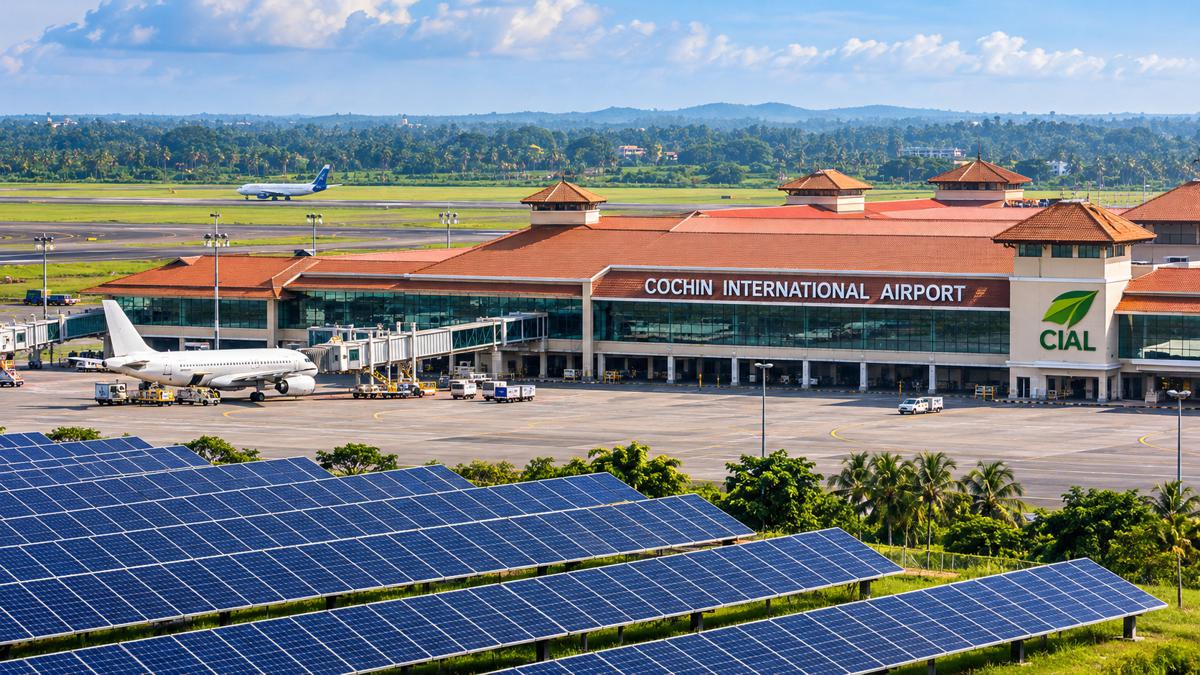
Cochin gained international recognition in 2015 when it became the world’s first airport to meet its operational electricity requirements through solar generation on an annual energy basis.
Its renewable electricity infrastructure has expanded considerably since then. According to CIAL’s 2024–25 infrastructure annual report, the airport company has eight solar power plants within the airport estate, providing a combined 38.5 MWp, together with an 11.5 MWp installation at Payyannur in Kannur district. Total installed photovoltaic capacity stands at 50 MWp.
The Payyannur development occupies approximately 35 acres of hilly terrain and uses solar panels arranged to follow the existing slopes. Rather than relying exclusively on conventional south-facing arrays, the installation accommodates several panel orientations to make effective use of the available land.
The distinction between renewable electricity generation and continuous electricity supply remains important. Solar facilities produce most of their power during daylight hours, while an international airport requires uninterrupted electricity for terminal operations, airfield lighting, communications, baggage handling and other essential systems.
CIAL has therefore been developing a battery energy storage system to support night-time electricity requirements. Its September 2025 annual general meeting statement confirmed that the project was underway, alongside a green hydrogen initiative developed in cooperation with Bharat Petroleum Corporation Limited.
Future airport expansion will add further electrical loads, particularly through additional terminal space, cooling equipment, cargo refrigeration and airfield infrastructure. Jacobs’ planning work will need to account for these requirements when considering utility networks, land use and the sequencing of future development.
The existing solar installations also create physical planning considerations. Land occupied by photovoltaic arrays, power distribution equipment and supporting infrastructure must be considered alongside future buildings, roads and airside facilities.
Environmental Planning and Regional Transport Connections
Jacobs’ appointment includes developing an environmental and social impact assessment framework to guide future airport development. The work will examine how expansion proposals can be assessed against operational requirements, environmental conditions and the interests of surrounding communities.
Airfield construction, terminal expansion and new access infrastructure can affect drainage, land use, road traffic and aircraft noise. Future development may also require additional land, making early assessment of property boundaries, access arrangements and environmental constraints an important part of the planning exercise.
Ground transport connectivity is another major consideration. The study will assess existing passenger access patterns and future requirements for private vehicles, taxis, buses, rail services and other public transport modes.
Potential improvements include new road connections, rail infrastructure, phased metro connectivity and possible inland-waterway links. The planning exercise will also examine whether alternative landside development areas could provide more efficient access to future passenger and commercial facilities.
These options will need to be coordinated with the surrounding transport network. Additional terminal capacity can increase demand for approach roads, parking, public transport and passenger drop-off facilities, while cargo development generates separate freight vehicle movements and associated infrastructure requirements.
The environmental and social framework will help CIAL evaluate alternative development layouts, although individual projects will remain subject to the applicable statutory approvals and project-level assessments.
Delivering the Long-Term Development Programme
Jacobs will lead the master planning assignment through its Indian operations, supported by aviation specialists in the United Kingdom. The company has worked on major international aviation projects, including Noida International Airport, Denver International Airport and Los Angeles International Airport.
Jacobs Executive Vice President Sinead Giblin said: “This master plan will prepare Cochin International Airport for future passenger and cargo demand while building on its leadership in sustainable airport operations.”
CIAL Airport Director Manu G described the appointment as an important stage in the airport’s development strategy, stating: “The development of a 25-year master plan is a significant milestone in shaping CIAL’s long-term vision and future growth.”
The new assignment comes as CIAL is also extending its activities into airport consultancy services. In a 2026 board announcement, the company outlined plans to offer expertise in airport master planning, runway development, cargo infrastructure, ground handling and commercial facilities to other airport operators across India.
For Cochin itself, the immediate task is to reconcile infrastructure already under construction with requirements that may emerge over the next two decades. The current investment programme includes terminal and apron improvements, cargo facilities, buildings and roads, while the master plan will assess larger development options and the land needed to accommodate them.
Runways, taxiways, terminals and major utility networks represent long-lived infrastructure assets. Their positions and connections can determine which expansion options remain practical many years after the original projects are completed.
The completed master plan will provide CIAL with a basis for prioritising investment, protecting land for future infrastructure and phasing construction around operational demand. It will also establish how the airport’s renewable energy infrastructure can be accommodated as passenger activity, freight operations and supporting facilities continue to develop.
Key Industry Questions
- What is Jacobs’ role at Cochin International Airport? Jacobs has been appointed to prepare a comprehensive 25-year airport master plan covering passenger and cargo demand, runways, terminals, associated infrastructure, land requirements and environmental considerations.
- How much is CIAL investing in airport infrastructure? CIAL is planning approximately US$426 million in capital expenditure through March 2031, covering terminal improvements, airside expansion, cargo facilities, buildings and roads.
- Is Cochin International Airport building a second runway? A possible second runway is being evaluated as part of the master plan. No final construction decision, alignment or timetable has been announced.
- Will the existing runway be extended? Jacobs will examine whether Runway 09/27 could be extended by approximately 100–150 metres to accommodate Code E aircraft departing at maximum take-off weight without payload penalties. The proposal remains subject to feasibility assessment.
- How many passengers use Cochin International Airport? The airport handled approximately 11.44 million passengers during the 2025–26 financial year, alongside 73,134 aircraft movements.
- What cargo infrastructure is being considered? The master plan includes proposals for a cargo village incorporating domestic and international freight handling, perishable goods facilities and bonded warehousing.
- How much solar capacity does Cochin International Airport operate? CIAL has 50 MWp of installed photovoltaic capacity, including 38.5 MWp at the airport and 11.5 MWp at Payyannur.
- Does the airport operate entirely on solar electricity at night? Its solar-powered status is based on renewable electricity generation meeting its energy needs over time. The airport remains connected to the electricity grid and has been developing battery storage to support nighttime requirements.
- Will the master plan consider public transport connections? Yes. The study includes road access, public transport, rail infrastructure, possible metro connections and other multimodal transport options.
- When will the airport master plan be completed? The consultancy exercise is expected to take approximately ten months from commencement, although publication and approval of the final development proposals may follow a separate timetable.
Strategic Takeaways
- Protecting land for future runway, taxiway and terminal development will be a central consideration as existing airport infrastructure expands.
- The potential extension of Runway 09/27 offers a separate capacity and aircraft performance question from the much larger proposal for a second runway.
- Cargo growth will require coordinated development of handling facilities, warehousing, temperature-controlled storage and road freight connections.
- Additional terminals and cargo infrastructure will increase electricity demand, requiring renewable generation, storage and distribution capacity to be considered together.
- CIAL’s existing investment programme and long-term expansion options will need to be sequenced so that near-term construction does not restrict later development.