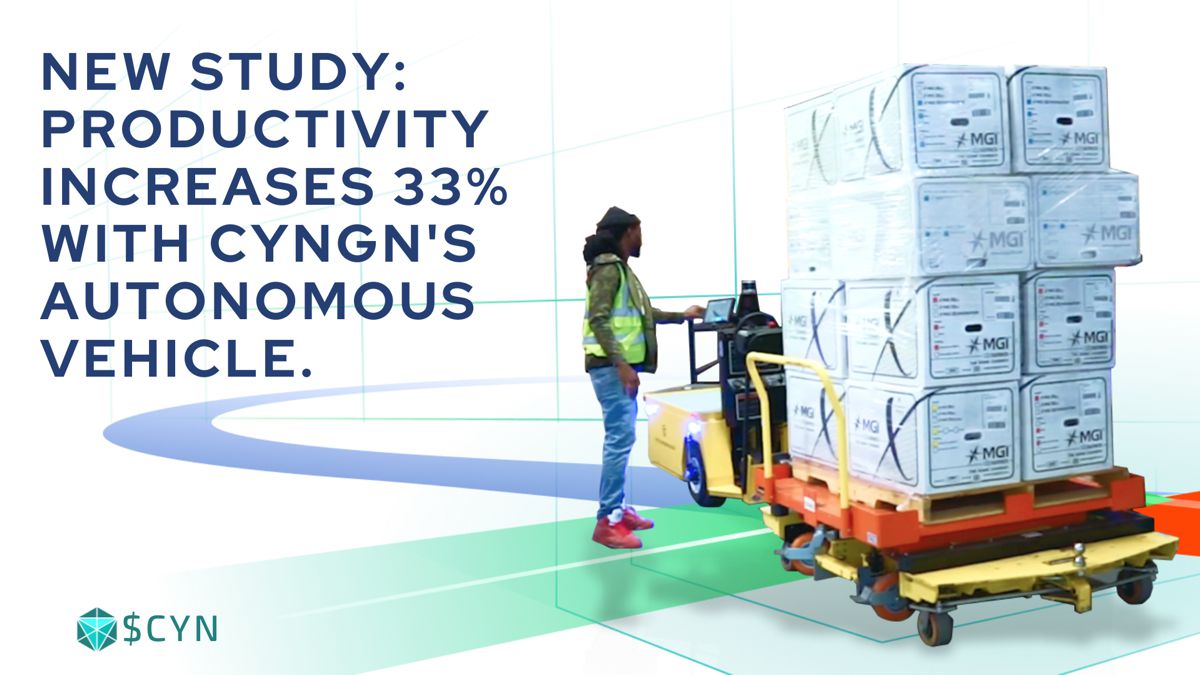
Cyngn Autonomous Industrial Vehicles increase productivity by 33 percent
Cyngn, a developer of innovative autonomous driving software solutions for industrial and commercial applications, today released a new case study quantifying the value that Cyngn’s autonomous vehicle technology brings to Global Logistics and Fulfilment, a leading West Coast distribution, fulfilment and third-party logistics services company.
This is Cyngn’s first study quantifying the return on investment an organization might expect by investing in AV technology.
According to Cyngn’s research, the deployment of an autonomous vehicle at GLF’s Las Vegas warehouse led to a dramatic increase in efficiency — almost immediately. The report found:
- a 64% reduction in human labour costs, when compared to using forklifts.
- a 33% increase in productivity when compared to using electric pallet jacks.
“The data speaks for itself,” says Cyngn CEO Lior Tal. “There are almost no other interventions an organization can implement to increase productivity at these levels. Depending on the organization’s throughput, we estimate that this technology could easily save a third-party logistics organization more than $100,000 per vehicle per year.”
In addition to the increased productivity, Cyngn’s autonomous Stockchaser delivered supplemental benefits. The vehicle provided GLF management with real-time data and reporting on operational analytics, created a safer working environment for GLF employees, and enabled further growth of GLF’s client base. Lastly, the Stockchaser served as tangible proof of GLF’s commitment to innovation, empowering them to continue surpassing their clients’ expectations.
“Working with Cyngn on an autonomous vehicle implementation really opened our eyes to endless possibilities and it’s part of what we’re trying to plan for in the future,” added Kenn Morris, Vice President of Global Logistics and Fulfilment. “I didn’t realize how quickly my team would become accustomed to the autonomous vehicle.”
As a result of the global e-commerce boom, the warehousing industry is experiencing rapid growth and even industry stalwarts are struggling to scale their operations to meet burgeoning demand. Consequently, traditional labour resources are drying up and becoming more expensive.
Global Logistics & Fulfilment is no stranger to these trends. For more than 25 years, the company has been a leading provider of distribution, fulfilment, and 3rd-party logistics services. With warehouses in San Diego and Las Vegas, it maintains over 300,000 square feet of cumulative space for storage, packing, and assembly. Like many others in the industry, GLF has a customer base that is constantly growing their warehouse footprint. Today, their facility has never been busier, yet the strain on their workforce and the risk of losing business to competitors has never been higher.
Facing rising labour costs, increasingly demanding customers, and an urgent need to scale their business, GLF sought an innovative solution to streamline their operations. Enter Cyngn and Columbia Vehicle Group’s new DriveMod-enabled Autonomous Stockchaser. After a brief integration period, the Autonomous Stockchaser supplemented GLF’s workforce to transport pallets around its Las Vegas facility. In only a four week pilot deployment period, the new Stockchaser was able to both significantly increase labor productivity and produce material cost savings.
Deploying Cyngn’s DriveMod Autonomous Vehicle technology at GLF involved a simple, yet robust set of steps:
- Conduct a site assessment. First, Cyngn interviewed GLF’s operations managers to obtain a thorough understanding of GLF’s process flows. Then, Cyngn’s field engineers surveyed GLF’s facility to document the operational design domain (“ODD”) including the lighting, lane widths, and types of obstacles the vehicle could encounter. From this, Cyngn was able to identify the transporting of pallets from an order fulfilment station to outbound shipping as the optimal use case for the deployment.
- Map the facility. In order for an AV to operate, it must know where it is within its environment. To accomplish this, Cyngn scanned the entirety of GLF’s facility to create a detailed virtual map.
- Bring-up the vehicle. Once the map was created, Cyngn worked with GLF management to define the vehicle’s missions, which included the routes the vehicle would take and the stops where pallets could be loaded and unloaded onto the vehicle.
- Train key personnel. Finally, before the vehicle was brought into full autonomous operation, Cyngn trained GLF employees on safe use of the vehicle. Then, it was seamlessly integrated into their daily workflow.
To read the complete report, click here.