Seoul’s Magok Living Lab Put Smart City Technology to the Test
Smart cities tend to be described through infrastructure: sensors, communications networks, digital twins, autonomous systems and the data platforms connecting them. Seoul’s Magok District had much of that foundation when the city tried something rather different in 2019. Instead of deciding what technology residents needed and deploying it from the top down, the city turned part of Magok into a place where people could help decide what problems were worth solving in the first place.
The resulting Magok Smart City Living Lab brought residents, workers, companies, experts and public bodies into the development process. Five projects were selected from 30 proposals, with each receiving approximately KRW 100 million in support and around six months in which to prove itself in the district. The technologies ranged from autonomous delivery robots and digital twins to environmental sensors and accessibility applications. Seoul Metropolitan Government described Magok at the time as a smart-city testbed in which residents and experts would participate as actual users rather than simply becoming recipients of completed systems.
A technically successful smart-city system can still fail because people do not use it, streets do not accommodate it, regulations prevent its deployment, operating departments cannot support it or the original problem was poorly understood. Magok put some of those uncertainties into the experiment itself.
Briefing
- Seoul launched the Magok Smart City Living Lab in 2019 as a real-world testbed involving citizens, companies, experts and public institutions.
- Five projects were selected from 30 proposals, with approximately KRW 100 million allocated to each project.
- Trials covered autonomous robot delivery, digital-twin fire detection, citizen-led odour mapping, accessibility technology and IoT-enabled electric scooter infrastructure.
- Citizens participated in identifying problems, testing services and feeding their experience back into development rather than only evaluating finished products.
- Seoul subsequently continued the Living Lab model, with ten projects tested across Magok during its first two years.
Building the Testbed
Magok offered unusual conditions for this kind of experimentation. Located in Gangseo-gu in south-western Seoul, the district was transformed from one of the capital’s last large undeveloped areas into M-Valley, combining industrial, commercial, residential and supporting uses. Around 1.12 million square metres were allocated to industrial and support facilities alongside approximately 590,000 square metres of residential land.
The intensity of that development brought familiar urban problems with it. Traffic congestion, odour complaints, pedestrian safety, mobility and access to amenities became part of everyday life in a district that was simultaneously being promoted as a smart-city environment. Seoul had begun establishing U-City infrastructure in Magok in 2015, providing the communications and technology base needed for more sophisticated urban services.
Connectivity could provide the technical platform, but it could not determine whether an autonomous delivery robot could negotiate a particular kerb, whether visually impaired residents could actually find a shop entrance or whether people experiencing an offensive smell perceived the problem in the same way as an environmental sensor. Those were questions that could only really be answered in the district itself.
Citizens Inside the Development Process
Conventional technology pilots often begin with a product and look for somewhere to demonstrate it. Magok attempted to start further upstream by bringing users into problem identification, design and testing.
Residents, workers and visitors could identify difficulties encountered in the district through workshops, online participation and field activities. Experts, public authorities and technology companies could then examine whether a technological response was feasible. Selected ideas moved into development and subsequently into trials under genuine urban conditions, bringing users into the process before systems had been completed.
That became particularly apparent in the accessibility project. Visually impaired participants walked through Magok and visited participating businesses while a smart ordering and navigation application was being developed. The proposed service incorporated voice guidance for shop locations and entrances, information about menus and biometric payment. Instead of accessibility being assessed after the application had been built, difficulties encountered while finding and entering real businesses became development inputs.
The same principle appeared in the district’s odour project. Residents and students carried measuring equipment around Magok, recording odours and contributing the results to an online map. The project combined these observations with measured data to investigate offensive odours. Environmental complaints contain a human component that fixed instrumentation alone can struggle to capture. Where a smell occurs, when residents notice it and how perception changes with local conditions can all be relevant to finding its source.
Digital Twins and Fire Detection
Another project applied the Living Lab approach to residential fire safety. Temperature sensors installed in homes at Magok M-Valley Apartment supplied information to a three-dimensional city model. Residents could access temperature information through computers or smartphones, while the project explored whether the combination of sensors and a digital representation of the residential environment could provide earlier recognition of abnormal conditions.
Residents were also involved in workshops around the system. Their suggestions extended beyond the original technical implementation, including potential links with fire departments, applications in schools and adaptations for vulnerable groups.
A fire-detection system that works technically still needs escalation procedures, emergency-service integration, maintenance responsibility and decisions about who acts on the information it produces. These questions begin to determine whether a prototype can eventually operate as a public service rather than remain a technology demonstration.
Autonomous Robots Meet Real Streets
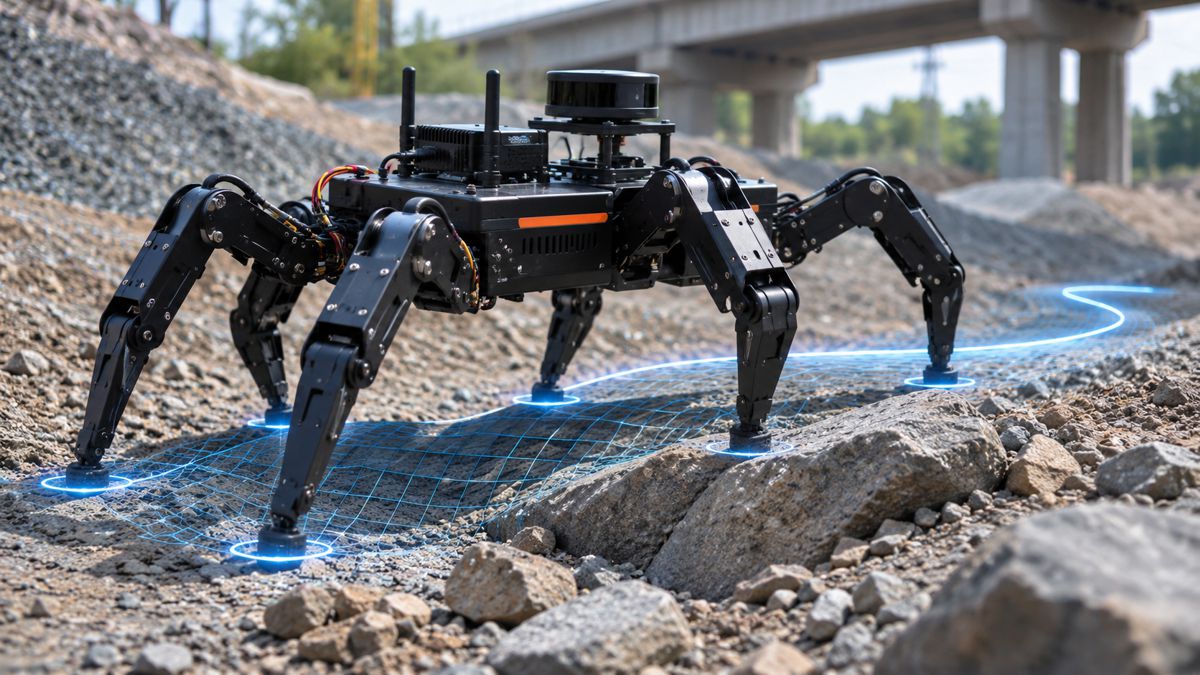
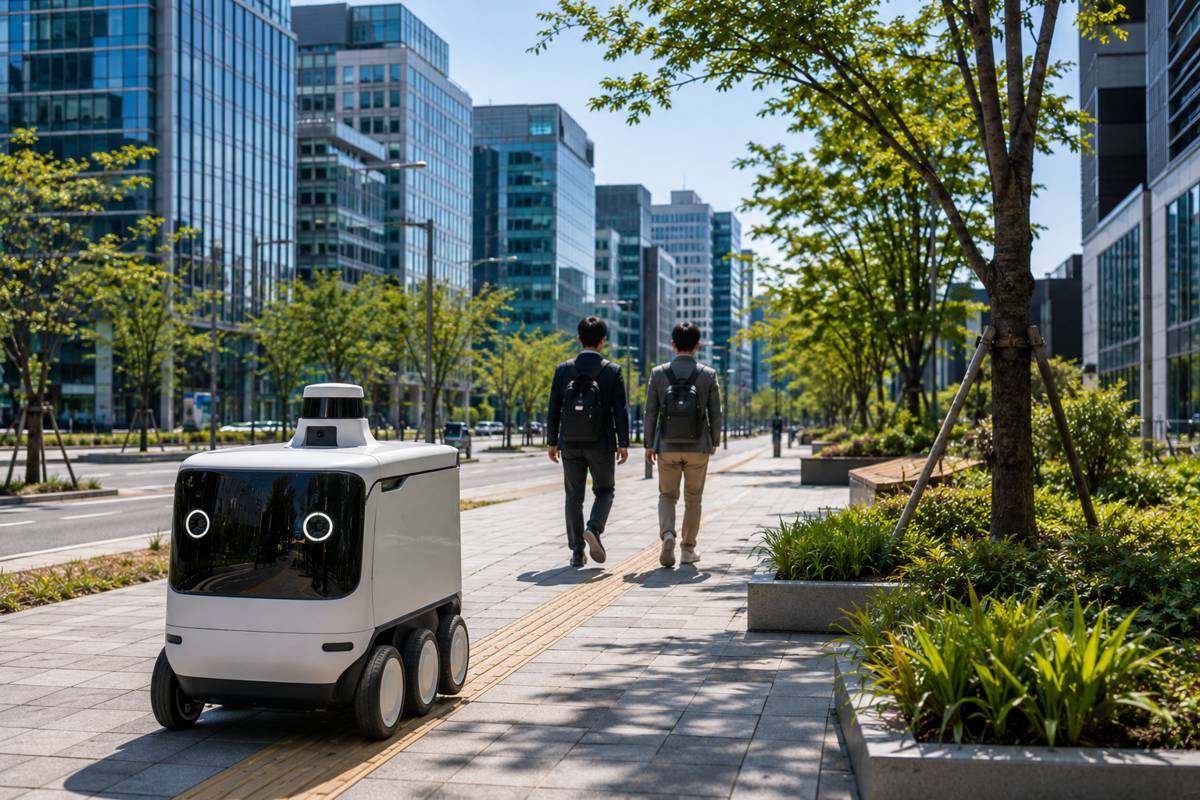
Magok also became an early proving ground for autonomous delivery. The 2019 project tested food delivery by autonomous robot within the district, examining a journey that sounds straightforward until the machine encounters an actual pavement. Slopes, kerbs, crossings, pedestrians and changing surfaces all become part of the operating environment.
The technology was subsequently developed further. Seoul reported in 2021 that ten projects had undergone technology demonstrations and service trials in Magok during the first two years of the Living Lab programme, including autonomous robot food delivery. Robotics company ROBOTIS demonstrated autonomous lunchtime deliveries to workers in the district.
Urban autonomy presents a rather different engineering problem from automation inside a warehouse or factory. Controlled industrial environments can be mapped, segregated and modified around machines. Pavements cannot be managed so conveniently. An autonomous delivery robot has to coexist with people, street furniture, access ramps, crossings, construction activity and infrastructure that was never designed with robots in mind.
Magok has continued to provide an environment for robotics experimentation. In 2023 Seoul opened the Seoul Future Lab in the district, incorporating autonomous delivery robots among the technologies available for public experience and education.
When a Pilot Does Not Work
Perhaps the most instructive Magok experiment was one that encountered difficulties before the intended infrastructure could be installed.
The Living Lab explored dedicated charging stations for IoT-enabled electric scooters. Sensors were intended to gather information about riding conditions and travel routes, while charging and parking infrastructure would support short-distance mobility. Permitting and cost barriers complicated the proposed station installations, and alternative locations, including cafés and convenience stores, consequently had to be considered.
Infrastructure technologies rarely fail solely because the technology itself is inadequate. Land ownership, permits, utility connections, maintenance, insurance, procurement, operating budgets and responsibility for public space can determine whether an apparently workable system survives outside a demonstration. Finding those constraints while a project is still small is considerably cheaper than discovering them after committing to citywide deployment.
The scooter experiment also shows why a Living Lab cannot be judged purely by the number of prototypes subsequently scaled. A trial that identifies a regulatory or operating barrier has produced useful information, even if no permanent installation remains behind.
From Demonstration to Urban Service
Magok’s early programme generated more than 20 service ideas and put five IoT-related projects into field trials. The project record also reports 15 resident workshops, participation rising from 30% to 90%, application usage reaching 70% and satisfaction with the odour-monitoring work reaching 85%.
The programme nevertheless encountered limitations. Consensus between different participants took longer than expected. Some systems remained incomplete, data governance was insufficient and several projects struggled to move beyond prototype scale.
A pilot can have a defined team, temporary funding and a six-month timetable. A permanent urban service needs an owner. Someone must maintain the hardware, pay recurring costs, govern the data, procure replacements, manage suppliers and remain responsible when the original project team has moved on.
Magok’s experience pointed towards involving the departments responsible for long-term operation and budgeting much earlier, while establishing clear arrangements for collecting, managing and sharing data before trials begin. Dedicated facilitation was also identified as important where citizens, companies, government departments and other institutions need to work together over extended periods. A system has to fit administrative structures as well as technical architecture.
A Different Measure of Smart-City Progress
Seoul did not abandon conventional smart-city infrastructure while experimenting with Magok’s participatory model. Citywide infrastructure provides scale, connectivity and continuous information; Living Labs provide somewhere to discover whether a proposed service survives contact with the people, regulations and physical environments it is intended to serve.
Magok’s robots, digital twins, sensors and applications were only part of the experiment. The district was also testing the process by which technology moves from an idea to something a city can actually operate. Cities have become increasingly capable of deploying connected technology, but deciding which technologies deserve to be deployed, and finding out whether they work outside a controlled demonstration, remains considerably harder.
Magok put that uncertainty on the street and invited the people using the street to participate.
Key Industry Questions
- What is a smart-city Living Lab? A Living Lab is a real-world development environment in which citizens, technology companies, experts and public bodies participate in identifying problems, developing possible solutions and testing them under actual operating conditions.
- When did the Magok Smart City Living Lab begin? Seoul launched the programme in 2019, using Magok District as a smart-city testbed. Five projects were selected from 30 proposals during the first programme.
- What technologies were tested in Magok? The initial projects included autonomous delivery robots, IoT environmental monitoring, digital-twin fire detection, accessibility and navigation applications, and IoT-enabled electric scooter infrastructure.
- How were residents involved? Residents and other users participated through workshops, field trials and technology testing. In several projects they contributed directly to development by identifying practical problems and providing feedback during trials.
- Why is Magok suitable for smart-city testing? Magok combines residential, industrial, commercial and supporting facilities within a rapidly developed district that already had substantial connected infrastructure. This provides both a technical platform and a complex real-world urban environment for trials.
- Did every Magok project succeed? No. Some projects remained at prototype stage, while the proposed electric scooter charging infrastructure encountered permitting and cost barriers. The programme also identified difficulties involving stakeholder coordination, data governance and long-term scalability.
- What role did autonomous robots play? Autonomous robots were tested for food delivery in Magok, requiring them to operate through genuine urban conditions including slopes, kerbs and crossings. Seoul later reported autonomous delivery among the technologies demonstrated during the programme’s first two years.
- Can Living Labs help infrastructure procurement? Potentially. Real-world trials can reveal operating, regulatory, maintenance and user requirements before authorities commit to larger deployments, providing evidence that can inform specifications and procurement decisions.
- What happens after a successful smart-city pilot? Scaling requires more than technical performance. Permanent services need budgets, operating responsibility, data-governance arrangements, maintenance and integration with existing municipal systems.
Strategic Takeaways
- Real-world testing can expose infrastructure, regulatory and operating constraints that controlled technology demonstrations miss.
- Citizen participation is most useful when incorporated during problem definition and development rather than added as consultation after a system has been designed.
- Autonomous urban systems have to accommodate existing streets and pedestrian infrastructure rather than assuming the environment will be adapted around them.
- A pilot that identifies why a technology cannot yet be deployed can provide as much practical value as one that proceeds directly to scale.
- Long-term ownership, budgets and data governance need to be considered during pilot design if successful prototypes are expected to become permanent municipal services.