John Deere Advances Orchard Autonomy with Ouster Rev8 Lidar
Autonomous machinery has a relatively easy job when the world around it is open, predictable and accurately mapped. An orchard offers almost the opposite.
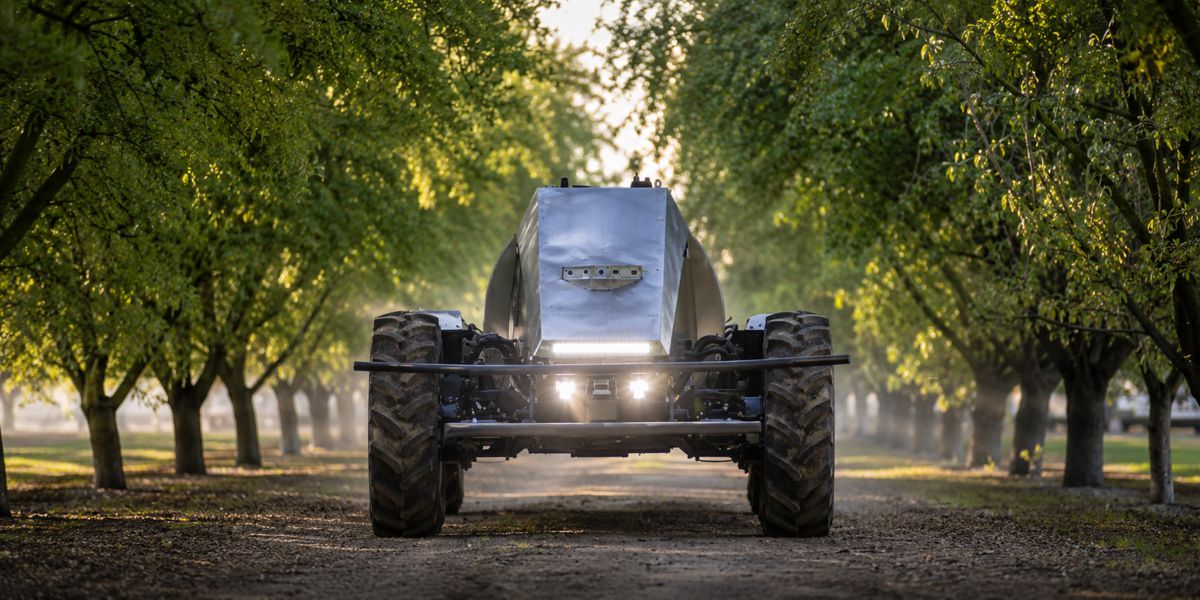
Rows of trees create repetitive geometry and obstruct satellite signals. Branches, foliage and ground contours change through the season. Dust and agricultural spray interfere with visibility, while the machine still has to distinguish where it can travel and what it needs to avoid. John Deere subsidiary GUSS Automation is now preparing to add Ouster’s latest Rev8 OS0 digital lidar to the next generation of its autonomous orchard machinery, adding perception capability for precisely this kind of environment.
The planned integration brings Ouster’s new native colour lidar architecture into an established commercial autonomous platform rather than an experimental vehicle. GUSS machines already work across permanent crops including orchards and vineyards, with one operator able to supervise multiple autonomous sprayers from a laptop.
Adding Rev8 therefore becomes less a demonstration of autonomous agriculture than an attempt to make an existing autonomous operation more capable in the difficult conditions where agricultural machinery actually has to work.
Briefing
- GUSS Automation plans to integrate Ouster Rev8 OS0 digital lidar into its next generation of autonomous orchard machines.
- GUSS is wholly owned by John Deere and specialises in autonomous machinery for high-value permanent crops.
- Rev8 combines 3D depth information and native colour data within the lidar sensor.
- The OS0’s wide field of view can support mapping of tree trunks, crop rows and changing ground contours.
- One operator can supervise up to eight GUSS autonomous machines from a laptop.
Perception Beneath the Canopy
Agricultural autonomy has a localisation problem that is quite different from autonomous road vehicles.
GNSS and high-precision correction systems work well when a machine has a clear view of the sky. Permanent crops complicate that relationship. Dense tree canopies can obstruct satellite reception, while the machine is travelling through narrow corridors surrounded by vegetation rather than across a relatively open field.
John Deere already acknowledges the problem in its conventional precision agriculture equipment, offering an Orchard Mode intended to help receivers maintain connectivity beneath heavy canopy. GUSS approaches the problem with a combination of positioning, lidar, vehicle sensors and software, allowing its machines to navigate orchard and vineyard environments without an onboard driver.
The proposed Rev8 OS0 installation adds richer environmental sensing to that architecture. Its dense 3D point cloud can provide geometric information about tree trunks, crop rows, obstacles and the terrain immediately surrounding the machine. Its ultra-wide field of view is particularly suited to the relatively short-range, enclosed surroundings encountered between orchard rows.
“At GUSS, we are focused on developing autonomous solutions that help growers address the unique challenges of high-value crop production,” said Jason Brantley, Vice President, Production Systems, Small Ag & Turf at John Deere. “Integrating advanced sensing technologies into our machines helps support reliable operation in complex orchard environments and provides growers with tools designed to improve productivity and operational flexibility.”
There is also a distinction between using lidar to demonstrate autonomous navigation and engineering a sensor package that can survive repeated agricultural duty cycles. Orchard machinery operates around dust, water, chemical spray, vibration, heat and vegetation, often for long working periods when spraying windows are tight. GUSS needs sensors that remain useful when the orchard is considerably less accommodating than a controlled development environment.
Native Colour Lidar
Ouster launched its Rev8 family in May 2026 around its new L4 and L4 Max silicon architecture. The family includes redesigned OS0, OS1 and OSDome sensors together with the longer-range 256-channel OS1 Max.
The more unusual development is native colour. Conventional lidar produces three-dimensional depth information, while colour data has typically come from a separate camera and been combined with lidar measurements elsewhere in the perception system.
Rev8 incorporates Fujifilm colour science at silicon level so that colour and 3D depth information are associated within the sensor rather than subsequently matched through software. Ouster specifies 48-bit colour depth and a 116 dB dynamic range, with the architecture designed to maintain useful visual information across differing lighting conditions.
For orchard machinery, that creates possibilities beyond producing more visually informative point clouds. Agricultural environments contain objects whose geometry can be similar while their visual characteristics differ considerably. Vegetation, trunks, fruit, posts, wires, machinery and people may occupy the same working space. Combining colour information with precise depth potentially gives perception software a richer dataset from which to classify what the machine is seeing.
How GUSS will ultimately exploit that additional information has not yet been detailed. The announced integration concerns additional sensing capability rather than a disclosed set of new autonomous functions, so it would be premature to attribute specific machine behaviours to the colour data.
The underlying sensor architecture also removes some of the calibration burden associated with combining independent cameras and lidar. Ouster says the colour and depth measurements are spatially and temporally aligned within the sensor, reducing the need to reconcile two separately mounted sensing systems.
Deployment in Agricultural Machinery
Rev8 has been moving into robotics and autonomous vehicle development since its May introduction, including support across NVIDIA’s Jetson robotics platform and qualification for the NVIDIA DRIVE Hyperion autonomous vehicle development platform. GUSS takes the technology into specialised agricultural machinery and a markedly different operating environment.
The company developed what it describes as the world’s first autonomous orchard sprayer and became part of John Deere as Deere expanded its autonomy strategy beyond broadacre farming. GUSS now anchors Deere’s autonomy offering for high-value crops, where the economics and physical environment differ markedly from large-scale grain production.
Spraying is particularly suited to supervised autonomy because several machines can perform repetitive passes while one person oversees the fleet. John Deere says one employee can operate up to eight GUSS machines simultaneously from a laptop. The operator moves from physically driving one sprayer to supervising several autonomous machines, retaining oversight while the vehicles undertake the repetitive movement through the rows.
The same perception architecture is not inherently limited to spraying. Orchards and vineyards contain numerous repetitive machine operations, although each brings different tooling, safety requirements and interactions with the crop. Better localisation and environmental perception provide some of the underlying capabilities needed before those applications can be automated reliably.
Agricultural Autonomy Gets More Specialised
Much of the early development of autonomous agricultural machinery naturally concentrated on environments where machines had room to operate. High-value permanent crops demand a different engineering approach. The machines are smaller, the surroundings are closer and the operating environment is less forgiving. An orchard sprayer may spend much of its working life only metres from tree trunks and vegetation, moving beneath a canopy that can interfere with the positioning technologies on which modern precision agriculture has become increasingly dependent.
GUSS also shows how Deere’s autonomy strategy is becoming application-specific. Rather than expecting one autonomous machine architecture to fit every agricultural task, specialist platforms can be developed around particular crops and operations while drawing on a broader ecosystem of positioning, perception, control and fleet-management technologies. Rev8 does not make the GUSS machines autonomous by itself, and the companies have not yet disclosed exactly what new functions the next generation will gain. Its role is to provide the existing autonomy system with more information about its immediate surroundings.
“John Deere’s decision to integrate Ouster’s Rev8 digital lidar technology represents an important milestone for the future of American agriculture,” said Ouster CEO Angus Pacala. “As GUSS leverages Ouster’s digital lidar in its autonomous fleet, we are empowering growers to achieve new levels of precision and efficiency. This announcement is about more than technology. It is about scaling reliable solutions that make agricultural operations more resilient and sustainable.”
The commercial test will come when those sensors have spent season after season moving through real orchards. Dust, spray, vegetation and changing light are difficult conditions for any perception system, and reliability there will ultimately matter more to growers than the specifications of the sensor itself.
Key Industry Questions
- What is GUSS Automation? GUSS Automation is a California-based developer of autonomous machinery for orchards and vineyards. It is wholly owned by John Deere and its machines are sold and supported through the John Deere dealer network.
- What does GUSS stand for? GUSS originally refers to Global Unmanned Spray System, developed around autonomous orchard spraying.
- How many GUSS machines can one operator supervise? John Deere states that one employee can operate up to eight machines simultaneously using a laptop.
- Why is lidar useful in orchards? Lidar creates a three-dimensional representation of the machine’s surroundings and can support localisation, navigation and obstacle detection where tree canopies and dense vegetation make reliance on satellite positioning more difficult.
- What is native colour lidar? Ouster’s Rev8 architecture associates colour information with 3D lidar measurements at sensor level rather than relying solely on subsequent software fusion between separate lidar and camera systems.
- Which Ouster sensor is planned for GUSS? GUSS plans to use the Rev8 OS0 native colour digital lidar sensor powered by Ouster’s L4 silicon.
- Will Rev8 replace GPS on GUSS machines? The announcement does not state that GPS will be replaced. The lidar provides additional local perception that can complement positioning and the other sensors used by the autonomous system.
- Does the integration create new autonomous functions? Neither company has yet detailed specific new functions resulting from Rev8. The announcement concerns the planned integration of additional perception capabilities into the next generation of GUSS autonomous machines.
Strategic Takeaways
- Permanent crops are pushing agricultural autonomy into environments where local perception becomes increasingly important alongside satellite positioning.
- GUSS provides Ouster with a production-oriented agricultural application rather than a standalone lidar demonstration.
- Native colour potentially gives machine-perception systems richer information without requiring all colour and depth data to be reconciled from separate sensors.
- Deere’s high-value crop strategy illustrates the increasingly application-specific nature of agricultural autonomy.
- Supervised fleets, with one person responsible for several autonomous machines, offer a practical model for deploying agricultural autonomy while retaining human oversight.