The 80,000 Year Engineering Project to Alpha Centauri
Launch before the end of 2029. Spend less than $15 million. Carry at least one kilogram. Get within one per cent of the distance to Alpha Centauri in no more than 80,000 years.
Those are the four constraints behind the Fermi Explorer Mission, a newly established US non-profit proposing something considerably more exotic than the machinery it intends to use: launching a spacecraft towards another star system using technology available today.
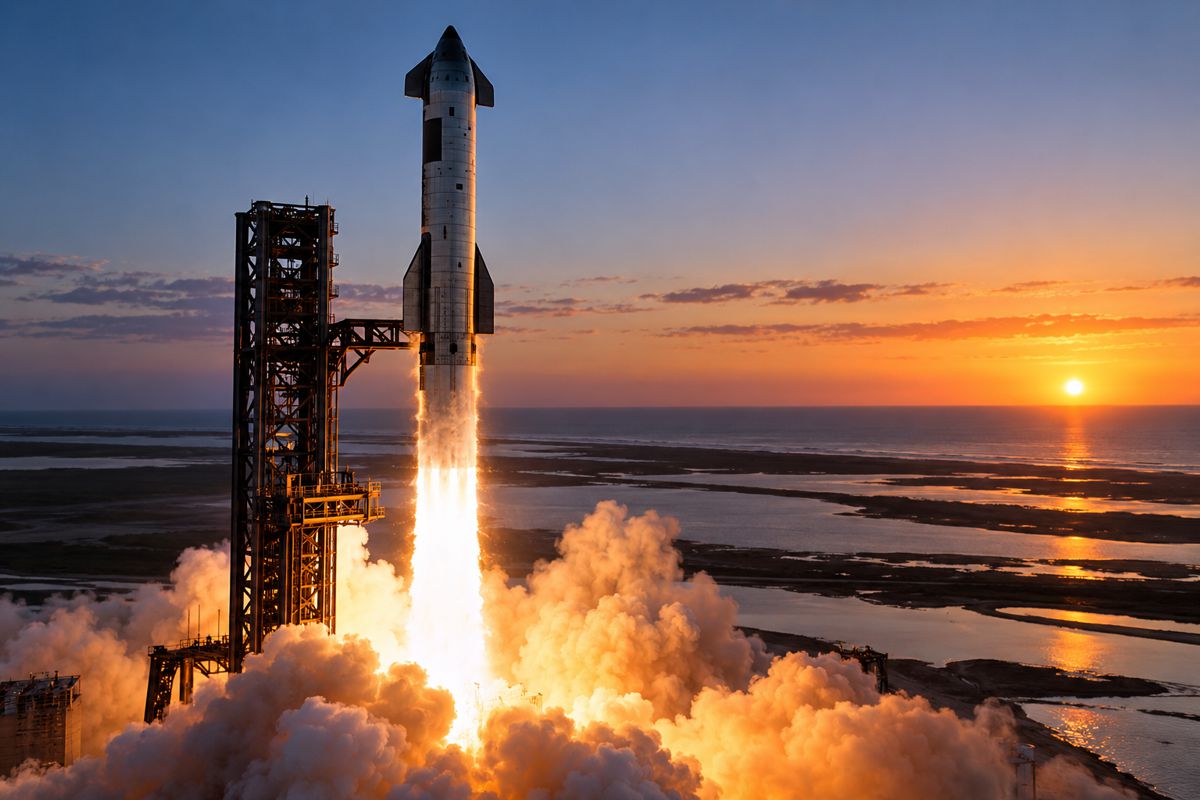
There is no proposed fusion drive, antimatter engine or experimental laser propulsion system. Fermi Explorer’s current feasibility concept envisages a small spacecraft using flight-proven electric propulsion, xenon propellant, solar arrays and a rideshare launch. It would spend more than a decade manoeuvring around the Sun before leaving the Solar System at about 23.6 km/s and beginning a journey measured in tens of thousands of years. It is an interstellar mission designed around accepting how slow existing spacecraft really are.
Fermi Explorer co-founder and president Philip Johnston captures the unusual logic of the project neatly: “We hope to be both the first to leave and the last to arrive at Alpha Centauri. None of us will be here when this journey ends, and that is the point.”
The expectation that a later spacecraft will overtake it is built into the idea. Fermi Explorer is not attempting to solve fast interstellar travel. Its proponents want to establish whether a spacecraft can actually be procured, built and launched towards another star within the economics and engineering capabilities of the present space industry.
Briefing
- Fermi Explorer wants to launch a spacecraft towards Alpha Centauri before the end of 2029 for less than $15 million.
- The mission specification requires at least a 1 kg payload measuring 10 x 10 x 10 cm.
- The current feasibility concept uses solar-electric propulsion and repeated manoeuvres close to the Sun rather than an experimental interstellar propulsion system.
- The spacecraft would spend around 12 years manoeuvring before leaving the Solar System around 2043 at approximately 23.6 km/s.
- Its planned closest approach is about 2,600 AU from the Alpha Centauri barycentre after roughly 77,500 years.
Building the Minimum Viable Interstellar Mission
Alpha Centauri is currently about 4.4 light-years away. At velocities achievable with existing spacecraft propulsion, the journey is measured in tens of thousands of years. Fermi Explorer removes the human lifetime from the specification and replaces it with four deliberately sparse requirements: approach to within one per cent of the present distance to Alpha Centauri within 80,000 years, carry at least a 1 kg payload, launch before the end of 2029, and keep the total cost of design, manufacture, launch and operation below $15 million.
Beyond those requirements, much of the engineering remains open to the satellite industry. The non-profit plans to invite major satellite manufacturers to tender for the spacecraft, allowing bidders to propose the power system, propulsion, communications architecture and detailed mission profile provided the basic specification is met.
Fermi Explorer says it already has a proposal from an unnamed US satellite bus manufacturer with more than 50 successful missions that falls within the $15 million ceiling, although no contractor has yet been selected. Its preferred engineering approach is to minimise research and development and use flight-proven hardware wherever possible, shifting the problem towards combining available propulsion, power, spacecraft mass and orbital mechanics within an unusually severe cost constraint.
Twelve Years Around the Sun
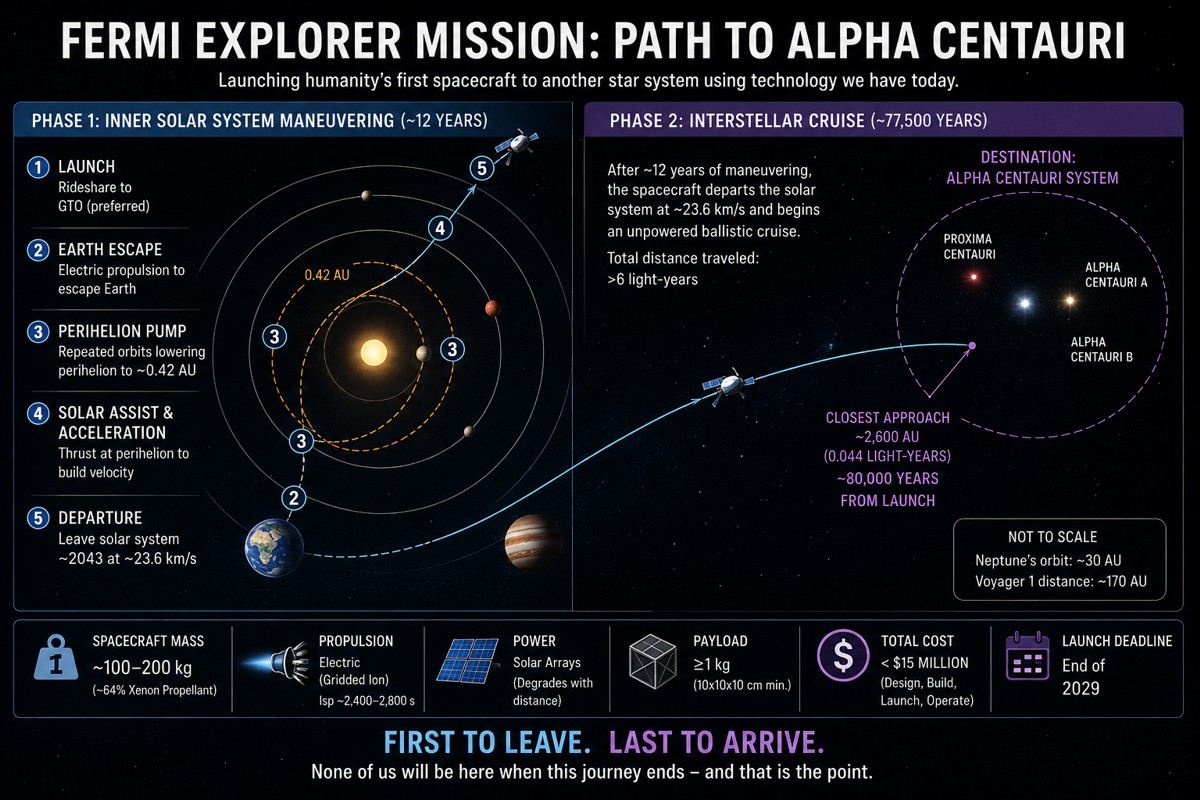
Simply attaching an electric thruster to a small satellite and pointing it towards Alpha Centauri will not produce the required departure velocity. Fermi Explorer’s current mission profile instead keeps the spacecraft within the Solar System for more than a decade, beginning with a preferred rideshare launch into Geostationary Transfer Orbit before electric propulsion is used to escape Earth and establish a heliocentric orbit.
The spacecraft would then use retrograde thrust to progressively lower its perihelion, eventually passing approximately 0.42 astronomical units from the Sun. Prograde acceleration would be concentrated around those close solar approaches, where the arrays receive greater solar flux and the trajectory study seeks to exploit the Oberth effect.
Fermi Explorer calls the technique a perihelion pump. Under the current analysis, the complete heliocentric manoeuvring phase would last about 12 years, although the electric thrusters would operate for only around 1.3 years cumulatively. The resulting trajectory is intended to send the spacecraft out of the Solar System around 2043 at approximately 23.64 km/s. Propulsion would then effectively end, leaving the vehicle on an unpowered ballistic coast lasting roughly 77,500 years.
A Spacecraft Made Mostly of Propellant
Keeping the vehicle small is central to the economics. Fermi Explorer’s preliminary analysis envisages a GTO-launched spacecraft with a wet mass of roughly 100 to 110 kg, about 64 per cent of it xenon propellant. The propulsion concept assumes demonstrated gridded-ion thrusters rather than a new propulsion technology developed specifically for the mission.
Communications are deliberately being traded against spacecraft mass. Fermi Explorer does not expect the vehicle to carry the large antenna required for conventional communications over extreme distances and accepts that connectivity could be lost relatively early. That would not necessarily end the powered mission: the current concept calls for highly automated operations capable of managing the long manoeuvring phase without continuous communication with Earth, while the spacecraft would eventually lose useful solar power after leaving the Solar System.
The autonomy requirement is therefore substantial. The machine may have to continue executing a trajectory developed over years of repeated solar orbits after meaningful communications with its operators have ceased. Once the final departure manoeuvres are complete, Fermi Explorer becomes an unusual kind of machine, an engineered object with a destination but effectively no operator.
Where Alpha Centauri Will Be
An 80,000-year trajectory introduces another problem because Alpha Centauri will not be where it is today. Fermi Explorer’s headline objective of getting “99% of the way” to Alpha Centauri is based on approaching to within 0.044 light-years of the system’s barycentre, equivalent to one per cent of its present distance of roughly 4.4 light-years. The current optimised trajectory produces a closest approach of approximately 2,600 astronomical units.
That is not a close fly-by of Alpha Centauri’s stars or planets. Neptune, for comparison, orbits the Sun at an average distance of about 30 AU. The mission’s definition of success is therefore interstellar passage into the wider region surrounding the Alpha Centauri system rather than arrival at one of its stars.
The spacecraft would also not be pointed at Alpha Centauri’s present location. The project intends to target the system’s future position, accounting for its movement relative to the Solar System over tens of thousands of years. Fermi Explorer calculates that the spacecraft would have travelled more than six light-years from the Sun by the time it made its closest approach. There is no proposed braking manoeuvre, orbital insertion or planetary encounter; the spacecraft would simply continue into interstellar space.
Engineering Beyond the Design Life
The 80,000-year journey creates a distinction between the lifetime of the spacecraft as an operating machine and its survival as a physical object. Fermi Explorer is not proposing to keep its solar arrays, computers, communications equipment and electric propulsion operating until arrival. Once the manoeuvring phase is complete, the essential requirement is that the spacecraft remain sufficiently intact and on its intended trajectory.
The payload presents a more unusual engineering problem. The organisation plans a three-month solicitation for scientific and artistic payload proposals, with a copy of the Voyager Golden Record and messages from children around the world also planned for the mission. Scientists proposing instruments are being told that, for most sensors, they should not expect data to return for approximately 80,000 years.
How such information could eventually be recovered remains speculative. One possibility discussed by the project is that a future human spacecraft could intercept Fermi Explorer rather than relying on the original probe to reactivate and transmit across interstellar distances. The spacecraft could therefore become as much an artefact as an operating scientific instrument.
Conventional engineering concepts such as service life and maintainability become difficult to apply to an object intended to coast through interstellar space for tens of thousands of years. Materials degradation, radiation exposure, micrometeoroid impacts and the survival of stored information extend far beyond normal spacecraft qualification periods.
Fermi Explorer has not yet selected a final spacecraft capable of answering those questions. The manufacturer has not been chosen, the payload remains open and the project still has to move from feasibility work through procurement, funding, detailed engineering and launch. The organisation itself suggests supporters should assume roughly a 50 per cent probability of mission success, an estimate that represents its own judgement rather than an independently established reliability assessment.
AI and the Trajectory
One unusual element of the feasibility work is the involvement of Physical Super Intelligence, a Cambridge, Massachusetts-based AI company founded by physicist Alex Wissner-Gross. Fermi Explorer says its board members had already worked on mission planning with input from Astro Digital and AstroForge before PSI developed the final perihelion pump concept.
The organisation says PSI used generative AI in producing the trajectory and believes it may be the first AI-generated novel trajectory intended to be flown on a real space mission. Independent reporting describes PSI producing an 81-page technical feasibility assessment after being given the mission parameters, with the resulting profile keeping the spacecraft around the Sun for more than a decade before interstellar departure.
The proposed trajectory has not flown, and the spacecraft manufacturer will remain free to suggest alternatives during procurement. Claims about the novelty or independence of the AI contribution also remain those of the organisations involved rather than an independently demonstrated engineering milestone.
The underlying optimisation problem is substantial regardless of how the final trajectory was produced. Vehicle mass, launch orbit, xenon capacity, solar-array output, thrust, perihelion distance, inclination change, journey time and payload all interact within a total mission budget capped at $15 million. The manufacturer ultimately selected will have to turn that optimisation into hardware.
First to Leave, Last to Arrive
Fermi Explorer expects its spacecraft to be overtaken. If propulsion advances sufficiently over the coming centuries or millennia, another spacecraft could leave Earth long after Fermi Explorer and reach the Alpha Centauri system long before it.
That possibility is already incorporated into the project’s thinking. The immediate engineering target is much closer to home: select a spacecraft, secure funding and launch capacity, complete more than a decade of autonomous manoeuvring and leave the Solar System on the required trajectory.
There are substantial hurdles between the current feasibility work and that departure. Fermi Explorer still needs a manufacturer, final spacecraft design, payload selection, funding and a flight programme capable of meeting an unusually tight budget and schedule. The project is attempting to discover what happens when interstellar flight is treated as a procurement and systems-engineering problem rather than waiting for a propulsion revolution.
If it succeeds, the spacecraft leaving the Solar System around 2043 may be hopelessly obsolete long before it reaches another star. For this particular mission, that would be a sign that things had gone rather well.
Key Industry Questions
- What is the Fermi Explorer Mission? Fermi Explorer is a US non-profit proposing to launch a small spacecraft towards Alpha Centauri before the end of 2029 using predominantly existing space technology. Its four principal constraints cover destination, payload, schedule and a maximum mission cost of $15 million.
- How close would Fermi Explorer actually come to Alpha Centauri? The current trajectory targets a closest approach of approximately 2,600 AU from the Alpha Centauri barycentre, equivalent to about 0.044 light-years. It is therefore not proposing a close fly-by of one of the system’s stars or planets.
- Why will the journey take nearly 80,000 years? The concept deliberately avoids requiring radically faster propulsion. Its proposed solar-electric system would accelerate the spacecraft during an initial 12-year manoeuvring phase before it begins an unpowered interstellar coast at approximately 23.6 km/s.
- How much will Fermi Explorer cost? The organisation has set a maximum of $15 million for spacecraft design, manufacture, launch and operation. Fermi Explorer says it has already received one proposal from an unnamed US satellite manufacturer within that ceiling, but no final contract has been announced.
- What is the perihelion pump manoeuvre? The current concept uses electric propulsion to lower the spacecraft’s closest approach to the Sun to approximately 0.42 AU before concentrating acceleration around repeated perihelion passages. Greater solar flux is available to the arrays there, while the trajectory analysis also seeks to exploit the Oberth effect.
- How large would the spacecraft be? The final design has not been selected. Fermi Explorer anticipates that the mission could be accomplished with a spacecraft of roughly 100 to 200 kg, while its current GTO-based feasibility concept indicates a wet mass around 100 to 110 kg.
- Can the spacecraft operate after communications with Earth are lost? That is part of the current concept. Fermi Explorer expects connectivity to be lost relatively early and proposes highly automated operations during the long powered phase. The exact autonomy and navigation architecture will depend on the final spacecraft design.
- Will Fermi Explorer remain powered for 80,000 years? No. The current concept anticipates an active manoeuvring phase of roughly 12 years followed by an unpowered ballistic coast. The spacecraft is expected eventually to lose useful solar power after leaving the Solar System.
- Could another spacecraft overtake it? Yes, and Fermi Explorer expects that to happen. A future spacecraft using substantially faster propulsion could launch much later and still reach the Alpha Centauri region first.
Strategic Takeaways
- Fermi Explorer reduces the immediate propulsion challenge by accepting an extreme journey time rather than making a technological breakthrough a prerequisite for launch.
- The $15 million ceiling turns spacecraft mass, launch orbit, propellant, power and trajectory into tightly connected procurement decisions.
- Almost all active engineering occurs during the opening years of a mission whose physical journey could continue for nearly 80 millennia.
- Losing communications before the powered phase is complete places unusual emphasis on spacecraft autonomy and long-duration reliability.
- The open manufacturer tender means the final spacecraft and trajectory could differ substantially from the current feasibility concept.