Closing the Loop on Titanium Recycling in Industrial Electrolysis
In heavy industry, the spotlight is shifting. It is no longer enough to optimise production. Increasingly, the real gains lie in how materials are sourced, reused and reintegrated into industrial systems. A new collaboration between Asahi Kasei, Nippon Steel and Nippon Steel Trading signals a deeper structural change within one of the chemical sector’s most established processes.
The initiative focuses on recovering and recycling high-purity titanium scrap generated during the manufacture of electrolysis cells. At first glance, it might appear a niche technical exercise. In reality, it touches on some of the most pressing challenges facing global infrastructure and industrial supply chains today, including resource efficiency, emissions reduction and supply security.
Titanium is not just another industrial material. Its unique resistance to corrosion, particularly in aggressive chemical environments, makes it indispensable in chlor-alkali electrolysis. Yet producing it is energy intensive, and waste streams have traditionally been difficult to reintegrate at scale. That tension between necessity and sustainability is precisely what this initiative seeks to address.
Titanium in Electrolysis Infrastructure
Electrolysis sits at the heart of modern chemical production. By applying an electric current to brine, operators produce chlorine, hydrogen and caustic soda. These outputs underpin everything from water treatment and construction materials to pharmaceuticals and advanced manufacturing.
Within this process, the anode environment is particularly hostile. Chlorine gas is highly corrosive, and few materials can withstand prolonged exposure. This is where pure titanium becomes essential. Its stability ensures operational longevity and process reliability, both of which are critical for large-scale industrial plants.
However, that performance comes at a cost. High-purity titanium requires stringent refining processes, and even minor contamination can compromise its properties. As a result, scrap generated during manufacturing has often been underutilised, despite its inherent value. Reintroducing it into the production cycle without degrading quality has long been a technical hurdle.
Turning Scrap into Strategic Resource
The collaboration between Asahi Kasei, Nippon Steel and Nippon Steel Trading tackles this challenge head on by establishing a closed-loop recycling system for pure titanium. The concept is straightforward, but the execution is anything but simple.
Scrap generated at Asahi Kasei’s electrolysis cell manufacturing site in Nobeoka is carefully controlled from the outset. Using digital traceability systems, the company ensures that the material remains uncontaminated throughout the production process. This level of oversight is critical, given the sensitivity of titanium to impurities.
Once collected, the material is transferred to Nippon Steel Trading, where it undergoes pre-treatment and sorting. This stage prepares the scrap for remelting, ensuring it meets the exacting standards required for reuse. A portion of the processed material is then returned to Nippon Steel, where it is reintroduced into the production cycle using advanced remelting technologies.
This is not recycling in the conventional sense. It is a tightly controlled industrial loop, designed to preserve material integrity while reducing reliance on virgin resources.
The Technology Behind High-Purity Remelting
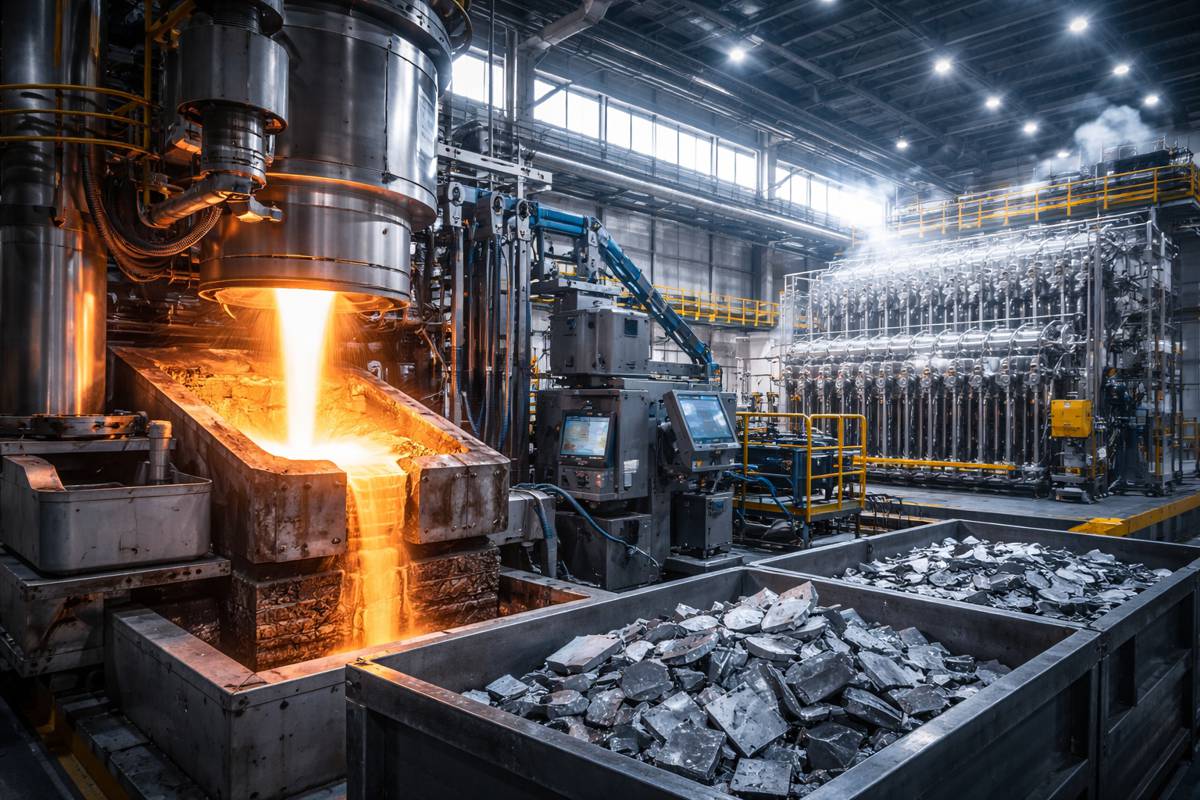
One of the key enablers of this initiative lies in Nippon Steel’s electron beam melting technology. Unlike conventional melting methods, electron beam furnaces operate under high vacuum conditions, allowing for precise control over impurities and material composition.
This is particularly important for titanium. Even trace levels of oxygen, nitrogen or other elements can alter its mechanical and chemical properties. By using electron beam melting, manufacturers can effectively remove unwanted contaminants and produce material that meets the stringent requirements of electrolysis applications.
The integration of this technology with Asahi Kasei’s production and traceability systems creates a seamless loop. Scrap is not just recycled, it is upgraded and requalified for high-performance use. In an industry where quality cannot be compromised, that distinction matters.
Circularity Gains Ground in Heavy Industry
The broader significance of this initiative lies in its alignment with global trends towards circular economy models. Across construction, infrastructure and industrial manufacturing, companies are under increasing pressure to reduce waste and improve resource efficiency.
According to the International Energy Agency, materials production accounts for a substantial share of global industrial emissions. Metals such as steel, aluminium and titanium are particularly energy intensive, making them prime targets for decarbonisation efforts. Recycling offers one of the most immediate pathways to reducing this footprint.
In this context, closed-loop systems are emerging as a critical strategy. By keeping materials within controlled industrial cycles, companies can minimise waste, reduce emissions and enhance supply chain resilience. The titanium recycling initiative fits squarely within this framework, demonstrating how even highly specialised materials can be integrated into circular models.
Strengthening Supply Chains Through Collaboration
Another notable aspect of the project is the level of coordination between the three partners. Each brings a distinct capability to the table, from material production and processing to logistics and trading.
Asahi Kasei’s expertise in electrolysis systems ensures that scrap is generated and handled in a controlled environment. Nippon Steel contributes advanced metallurgical capabilities, particularly in high-purity remelting. Meanwhile, Nippon Steel Trading plays a crucial role in managing the flow of materials between the two, ensuring efficiency and consistency.
This kind of collaboration is becoming increasingly important in modern industrial ecosystems. No single company can optimise the entire value chain in isolation. Instead, success depends on integrating capabilities across multiple organisations, each contributing its own expertise.
Yoshifumi Kado, Senior General Manager of Asahi Kasei’s Ion Exchange Membrane & Electrolysis System Division, highlighted this shared vision: “The establishment of a system to circulate precious resources represents each company’s shared sustainability perspective and ongoing partnership. This is another valuable initiative contributing to enhanced sustainability across the entire chlor-alkali industry.”
Scaling Recycling Across Industrial Metals
While the current focus is on titanium, the implications extend further. Asahi Kasei has already indicated plans to expand its recycling efforts to other materials used in electrolysis cells, including precious metals.
This builds on earlier initiatives aimed at recovering and reusing critical resources. By linking multiple recycling streams into a unified system, the company is effectively creating a broader circular materials platform within its operations.
For the wider industry, this raises an important question. If high-value, high-purity materials like titanium can be successfully recycled at scale, what does that mean for other metals? The potential for replication across sectors is significant, particularly in areas such as construction equipment, energy infrastructure and advanced manufacturing.
Economic and Environmental Payoffs
From a commercial perspective, the benefits of such initiatives are becoming increasingly clear. Reducing dependence on virgin raw materials can help mitigate price volatility and supply disruptions, both of which have become more pronounced in recent years.
At the same time, regulatory pressures are mounting. Governments and investors are placing greater emphasis on environmental performance, with carbon reduction targets and reporting requirements becoming more stringent. Companies that can demonstrate tangible progress in resource efficiency are likely to gain a competitive edge.
Environmental gains are equally compelling. Recycling titanium consumes significantly less energy than producing it from raw ore, leading to lower emissions. When scaled across industrial operations, these savings can be substantial.
Ken Terai, Executive Counselor and Head of the Titanium Unit at Nippon Steel, underscored the technical collaboration behind the project: “This initiative was realized by combining Nippon Steel’s development of industrial-grade pure titanium remelting technology in its electron beam melting furnace with Asahi Kasei’s long-established management system for titanium scrap within its manufacturing process.”
Towards a More Resilient Industrial Future
What emerges from this initiative is a glimpse of how industrial systems are evolving. The focus is shifting from linear production models towards integrated, circular frameworks that maximise the value of materials at every stage of their lifecycle.
This is not a quick fix. Implementing such systems requires investment, coordination and a willingness to rethink established practices. Yet the direction of travel is clear. As resource constraints tighten and sustainability expectations rise, circularity will become a defining feature of industrial strategy.
Manabu Akimoto, Executive Officer of Nippon Steel Trading, framed the broader ambition: “This collaboration marks a significant step towards realizing a decarbonized and circular society by undertaking the recovery, processing, and supply of pure titanium scrap. Moving forward, we will continue to leverage our accumulated experience and track record in distribution and trading to ensure the smooth operation of this initiative and maximize its added value.”
For construction, infrastructure and industrial stakeholders, the message is straightforward. Materials are no longer just inputs. They are assets to be managed, optimised and, increasingly, recycled within closed systems.
As the industry grapples with the twin challenges of decarbonisation and resource scarcity, initiatives like this offer a practical blueprint. Not revolutionary, perhaps, but quietly transformative all the same.