Danish Pension Funds Plug into Africa’s Electric Motorcycle Surge
Denmark’s pension savers have just bought a stake in the daily commute of millions of African riders. Impact Fund Denmark has committed DKK 258 million, roughly USD 40 million, to Spiro, one of the continent’s largest electric-mobility operators, and the cash is earmarked for more electric motorcycles and the battery swap stations that keep them moving.
The money flows mainly into Kenya, Rwanda and Uganda, with several other markets in line behind them. It was channelled through the fund’s commercial vehicle, SDG Fund II, with backing from the Danish pension funds Pensam, P+, PFA, PKA and PBU.
On its own, USD 40 million won’t reorder a continent. What makes the cheque worth a second look is who’s writing it and how it’s been structured. Pension capital tends to move slowly and hates surprises, so when retirement savings from northern Europe start underwriting motorcycle taxis in Nairobi, that’s a signal the asset class has crossed from pilot-project curiosity into something institutions are willing to model on a spreadsheet.
The deal also carries a European Union guarantee, which changes the risk calculus considerably for everyone at the table.
Briefing
- Impact Fund Denmark has invested DKK 258 million (USD 40 million) in Spiro through its commercial SDG Fund II, backed by pension funds Pensam, P+, PFA, PKA and PBU.
- The capital funds further rollout of electric motorcycles and battery swap stations, concentrated in Kenya, Rwanda and Uganda but reaching wider across Africa.
- A guarantee from the European Union, issued under the European Fund for Sustainable Development Plus framework, sits behind the investment and lowers the downside for Danish savers.
- Spiro’s fleet has grown from 8,000 motorcycles and 150 swap stations to more than 75,000 motorcycles and 1,600 stations in three years.
- Africa’s roughly 30 million motorcycle taxis, around 99% of them still running on petrol, make two-wheel electrification one of the single biggest decarbonisation opportunities anywhere on the planet.
Danish savers underwrite an African mobility bet
The structure here matters as much as the sum. Impact Fund Denmark routed the investment through SDG Fund II, its commercial fund, rather than a concessional or aid-style vehicle, which tells you the institution expects a market-rate return rather than a feel-good write-off. Mobilising private money alongside public guarantees is the whole point of the model, and pulling five of Denmark’s pension funds into the same African ticket is no small piece of plumbing. The aim, blunt as it sounds, is to make a climate outcome pay its own way.
That ambition gets a useful crutch from Brussels. The investment is covered by an EU guarantee issued under the European Fund for Sustainable Development Plus framework, the bloc’s main instrument for de-risking private capital headed into emerging markets. By absorbing part of the potential loss, the guarantee nudges cautious institutional money off the sidelines and into projects it would otherwise file under “too risky.” For a sector that’s long complained capital is the bottleneck, not demand, that backstop is arguably more valuable than the headline figure.
Lars Bo Bertram, chief executive of Impact Fund Denmark, set out the thinking behind the cheque: “The investment in Spiro offers the prospect of solid returns for the Danish pension funds and, at the same time, a large climate impact. We mobilise both private and public capital and help push the green transition forward in Africa. Every motorcycle that switches from gasoline to electricity makes a difference to the climate, and at the same time it becomes cheaper to drive, so drivers earn more. Africa is one of the world’s most interesting growth markets for e-mobility, and this is exactly the type of investment our SDG Fund II is built for.”
A swap network that’s really an energy grid
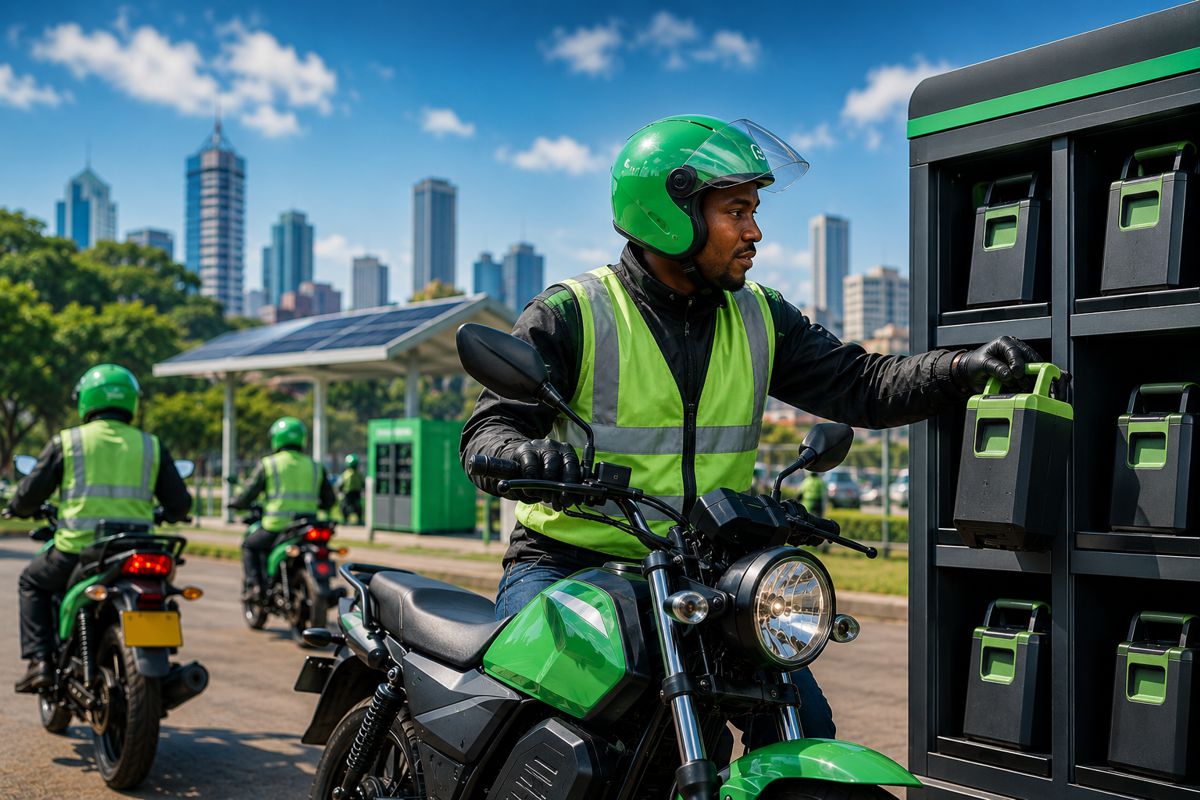
Strip away the branding and Spiro is building infrastructure, not just selling bikes. Riders buy or lease a motorcycle fitted with a removable battery, and when the charge runs low they pull into a local station and swap the dead pack for a fresh one in a couple of minutes. No waiting around at a charger, no need for a home power point that many drivers simply don’t have. Founded in 2022 and assembling its motorcycles at a factory in Nairobi, the company has scaled its physical footprint at a pace that would make most infrastructure developers wince, from 150 swap stations to more than 1,600 in three years.
Battery swapping isn’t a uniquely African idea, but Africa may turn out to be its proving ground. Gogoro built the template across Asia, Swobbee has pushed it in Europe and Vammo’s running with it in South America, yet none of those markets has the sheer commercial two-wheeler density that East and West Africa offer.
Each swap station functions as a node in a distributed energy network, storing and dispensing power on demand, which is closer to grid infrastructure than to a petrol forecourt. Development financiers have noticed, treating the build-out as an industrialisation play as much as a climate one. Spiro is already planning further factories across the continent, which would deepen local manufacturing and the jobs that come with assembly, maintenance and station operation.
Oil imports and the Hormuz squeeze
There’s a hard-nosed energy-security argument running underneath the green one, and it’s the part policymakers tend to grasp fastest. Africa imports more than 70% of its refined fuel, leaving household and transport budgets hostage to events thousands of miles away. The disruption to shipping through the Strait of Hormuz that began on 28 February 2026 has repeatedly sent crude back above USD 100 a barrel, and every spike feeds straight through to pump prices and, from there, to the cost of a boda boda ride. Electrifying the fleet pulls a sizeable chunk of demand off that volatile import bill.
Geography then does Spiro a favour, at least in Kenya. Around 90% of the country’s electricity comes from renewable sources, led by geothermal and hydropower, so a motorcycle plugged into that grid is effectively running on domestic green power rather than imported diesel. Every kilometre ridden swaps a barrel-linked cost for a locally generated one, which strengthens both the climate case and the balance-of-payments case at once. For governments weighing fuel subsidies against scarce foreign exchange, that’s a combination with real political appeal.
Thirty million motorcycles and the economics of switching
The scale of the prize is easy to underestimate from a European desk. Somewhere north of 30 million motorcycles operate as taxis across Africa, known as boda bodas in the east and okadas in the west, and they’re the backbone of how people and parcels actually get around. Close to 99% of them still burn petrol. That single statistic is why analysts keep calling two-wheel electrification one of the largest standalone decarbonisation levers on Earth, bigger in addressable terms than swapping out a lot of the passenger cars in wealthier markets.
For the rider, the sums are what close the deal, not the climate footnote. Spiro reckons electricity can cut running costs by as much as 50% against a petrol bike, and because the fuel is domestic power rather than imported crude, drivers are far less exposed when oil prices lurch. Real-world reports back the direction of travel: some riders elsewhere on the continent have seen daily profits climb meaningfully after switching, and a 2022 FIA Foundation study found that while electric motorcycles cost more upfront, their operating costs run well below petrol equivalents. Lease and pay-as-you-go arrangements help paper over that higher sticker price, which has historically been the thing keeping drivers on combustion engines.
The carbon ledger and cleaner city air
The emissions story is meaningful even at today’s fleet size. Spiro estimated in 2025 that its motorcycles had already saved more than 446,000 tonnes of CO2, and that figure climbs with every bike added and every swap completed. Multiply the model across tens of millions of taxis and the abatement potential starts to register at a national-accounts level rather than a corporate-brochure one.
There’s a public-health dividend that rarely makes the financial summaries but lands hard in dense African cities. Petrol motorcycles throw out particulate pollution at street level, exactly where pedestrians, traders and commuters breathe it in. Cutting that locally improves air quality in a way grid-scale clean energy projects can’t, since the benefit shows up on the same corner where the bike used to splutter. For municipal authorities wrestling with congestion and respiratory illness, that’s a tangible win sitting alongside the carbon maths.
The road ahead for Africa’s electric two-wheelers
Spiro isn’t operating in a vacuum, and the competitive field is filling up fast. Roam and Ampersand are chasing the same riders, Uganda’s Zembo pioneered solar-powered swap stations years ago, and a clutch of newer names like Stima and TankVolt are circling the market. That crowd is a sign of confidence rather than trouble, but it does mean the firms with the deepest capital pools and the densest station networks are likely to set the pace. Patient money of the sort Danish pensions are now supplying could prove decisive in that race.
Plenty could still trip the rollout up. Rural West Africa remains largely cut off from swap and charging infrastructure, so petrol bikes keep their grip wherever fuel stations outnumber power points. Upfront costs still bite despite the financing tricks, and the maintenance ecosystem for electric motorcycles is only half-built. None of that dents the underlying logic, though.
With more factories on the drawing board, fresh markets in its sights and institutional backers now in the tent, Spiro has turned a neat idea about removable batteries into one of the more closely watched infrastructure stories on the continent, and the people writing the cheques clearly expect the next three years to look a lot like the last three.