A Fleet Without Downtime: The Method That Turns Repairs into a Managed Process
Diesel engine specialist Sabi Kuanyshbayev on the methodology that moves fleet maintenance from “fix it when it breaks” to a managed system
A fuel injector on a diesel engine can be replaced again and again, and paid for as new every time, without getting one step closer to the actual cause of the failure. That is exactly how one 24-vehicle fleet operated: the fuel system failed over and over, the service shop dutifully issued an invoice for a new set of injectors, and the breakdowns just as dutifully came back. The real culprit turned out to be contaminated fuel. The injectors were the victim, not the cause, but they were what the fleet kept paying for.
In the summer of 2024, the industry admitted the same thing to itself on a larger scale. In its June roundup, the trade publication Fleetio placed the risk fleets take by cutting corners on maintenance among its top themes: a calculator for the odds of unplanned downtime, metrics for the return on money invested in equipment, all against a backdrop of record-high vehicle costs.
The conclusion was old but stubborn: unplanned downtime and emergency repairs are not a minor line item but the main source of losses.
Sabi Kuanyshbayev has spent more than a decade working in that gap between symptom and cause. Over years of practice, he built his own methodology, a fleet reliability management system of eleven modules, in which diagnostics, preventive maintenance, control of service invoices, and training of people are linked into a single loop. We sat down to talk about why “fix it when it breaks” is still treated as normal, and how to break out of it.
The industry keeps coming back to the cost of downtime. You built an entire system around it. Why a system rather than just a set of good tips?
Because tips aren’t inherited. Look: in any fleet there are people who do something well. One can almost hear a bad injector, another knows how to argue with a shop and not overpay, a third keeps meticulous parts records. All of that is valuable, and all of it walks out the door when the person quits. The knowledge lives in someone’s head, not in the fleet. I wanted to pull it out into the open: into procedures, checklists, metrics, into something you can hand to a new hire in a week instead of five years.
At some point the scattered tricks came together into a closed loop where one thing pulls the next, and it stopped being just the craft of a good mechanic. Craft doesn’t scale. A system does.

What problem are you really fighting?
I call it the reactive maintenance trap. The default logic is simple: drive it until it stops; when it breaks, haul it to the shop and pay the invoice. It sounds thrifty. In reality it’s the most expensive way to run equipment. Unplanned downtime tears up schedules. An emergency repair is always more expensive than a planned one, it’s done in a hurry, under pressure, often replacing extra parts “just in case.”
And most importantly, if the cause wasn’t found, the failure comes back. Like with those injectors: replace the hardware, leave the cause, and you pay a second time, then a third. Big companies cover this with expensive systems and dedicated departments. A small fleet has neither. That gap is exactly what the methodology is built for.
So what is the fundamental difference from ordinary repair practice?
One word – integration. An ordinary mechanic fixes a fault. An ordinary fleet manager keeps the schedule and the budget. Those two worlds don’t talk to each other. My methodology sits them at the same table: diagnostics feed directly into the financial decision, the choice of contractor, the warranty claim, the parts stock, the timing of the next service. Separately, all of this exists in many organizations.
The trick is to close them into a single loop, where diagnostic data decides what to repair; repair data decides what to buy and which vehicles to watch closely; and recurring failures rewrite the maintenance schedule themselves. A repair stops being an isolated incident and becomes a managed process.
A sceptic will say you’re describing reliability-centred maintenance, which has been around for decades. What is new here?
Completely honestly: I didn’t invent preventive maintenance and I don’t pretend I did. These are long-known things. But they’re locked inside expensive corporate systems that require departments, budgets, and software licenses. The owner of five trucks, a mobile diagnostician, an independent mechanic, they have no access to that; for them it’s like talk of space travel.
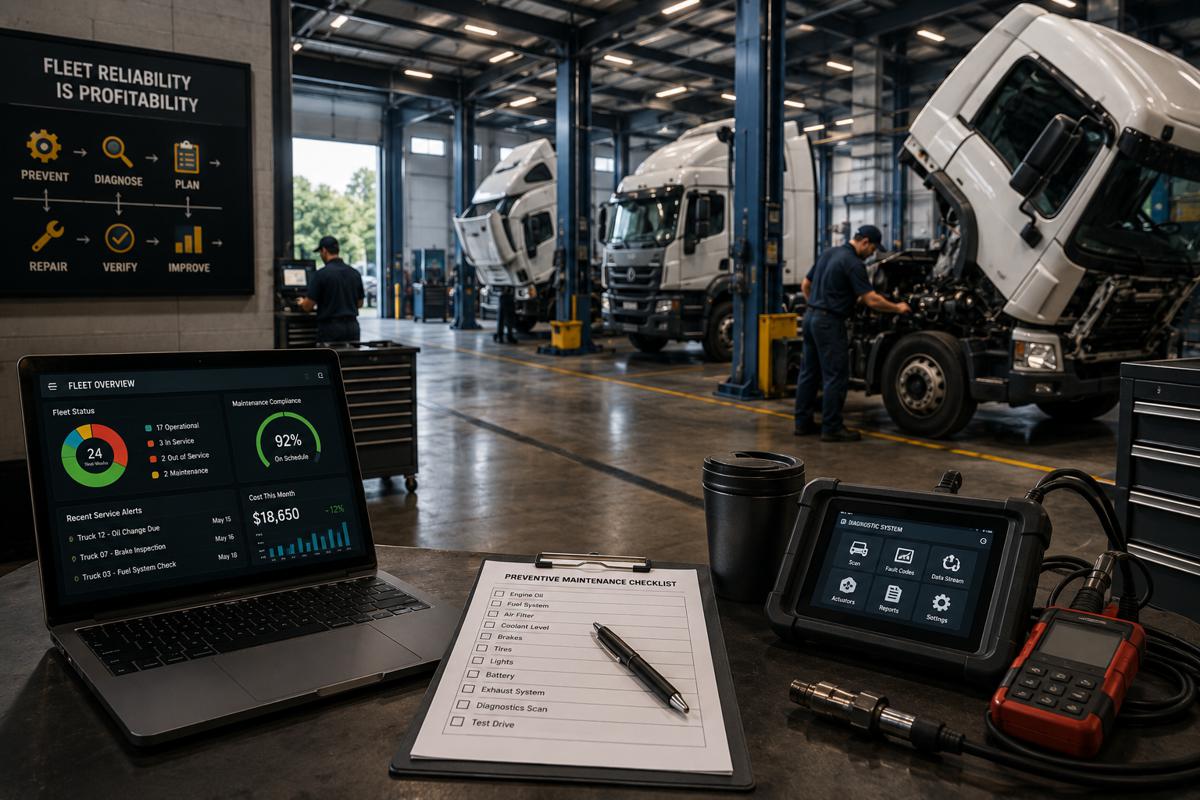
My contribution isn’t the principle, it’s the packaging: gathering it all into a set of procedures and rules that works without expensive infrastructure, on a diagnostic scanner and ordinary spreadsheets, and that you can hand to another person. And I hard-wired into that same loop two things that usually live apart: the discipline of Common Rail diagnostics and a line-by-line review of repair invoices.
The value isn’t in a single brick, but in the fact that the whole wall stands, and that someone other than me can build it.
Let’s talk architecture. What is the system built from?
It’s a single loop of eleven modules. It all starts with a technical passport for each vehicle, its honest profile: failure history, costs, operating conditions. Without that foundation there’s no point going further. Then vehicles are ranked by risk, and that immediately tells you where to put attention and money.
On top of that comes multi-level prevention, from a daily driver walkaround to seasonal prep. If a fault does occur, it goes through a strict diagnostic sequence, and for Common Rail, a separate protocol. No invoice is paid until it’s reconciled line by line with the diagnosis.
Service shops, for me, are accountable suppliers, not infallible authorities. Parts are planned ahead, people are trained, recurring failures are opened up to the root. And it all closes onto the metrics. The beauty is that every breakdown that happens against the plan becomes data that fixes the plan. The system repairs itself.

One module is devoted to Common Rail. Why so much attention on it?
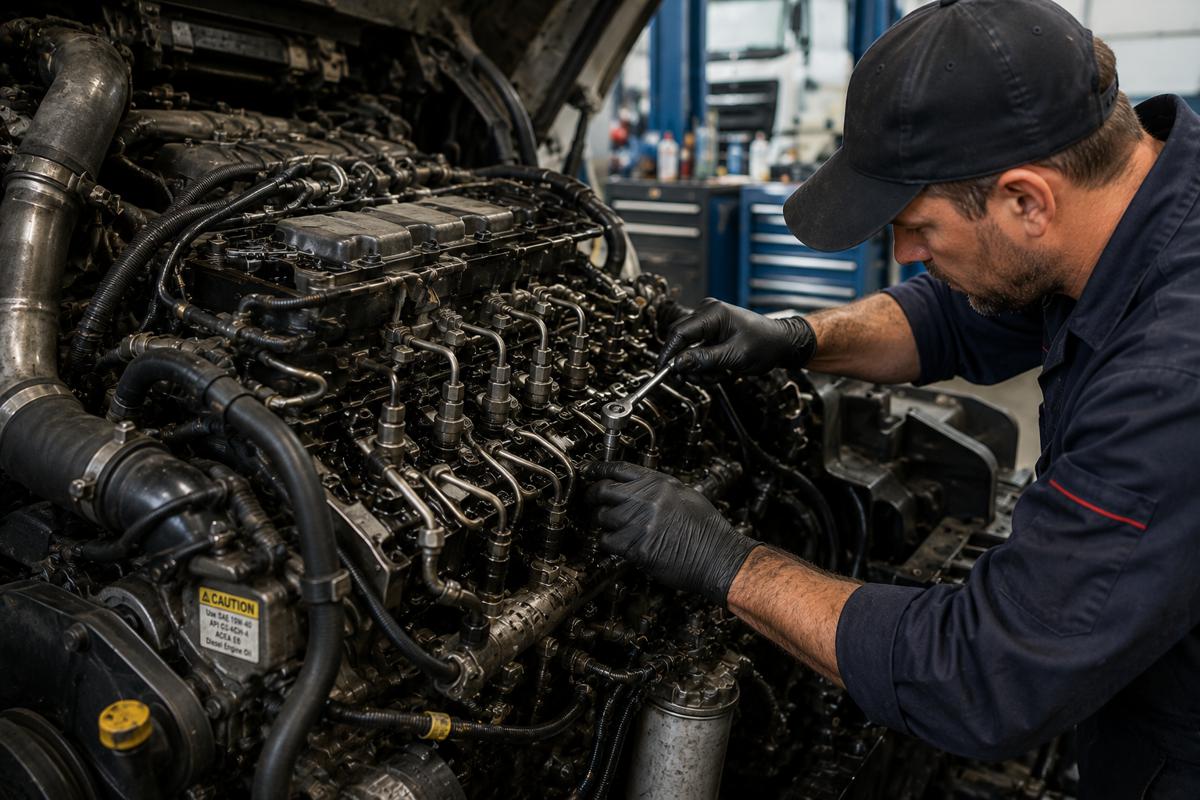
Because it’s the zone of the most expensive mistakes. A modern diesel is electronics: high pressure, electronic injectors, sensors, control units. To understand it you need a scanner and a head that reads live data and keeps the link between mechanics and electrics in mind.
Many mechanics were simply never taught this, and out comes a wrong diagnosis with the most expensive part replaced. Injectors and high-pressure pumps are the champions of mistaken replacement. My protocol is built on simple but ironclad rules: fuel first, because dirty or water-laden fuel is killer number one; data before parts; separate low pressure from high; check the electrics before the hydraulics.
Dirty fuel kills an injector quietly and gradually, and the injector gets the blame. Discipline at exactly this point saves the most.
You suggest reading a repair invoice as a technical document. What does that mean in practice?
That behind every dollar spent there has to be a technical justification. An invoice isn’t a receipt you sign without looking; it’s a document that has to match the diagnosis. We agree the scope of work in advance, no open-ended “find it and fix it” orders. Every line, parts and labour alike, is checked against the documented cause, and a part that isn’t in the diagnosis had better come with a written explanation of where it came from.
Honestly, a line no one can justify gets under my skin: behind it there’s almost always either someone’s carelessness or a charge for thin air. We catch the standard schemes, a full set of injectors where the data pointed to a single cylinder; an unrelated part “swapped while we were at it” under cover of an emergency job. We check whether the failure is under warranty, and whether we’re treating the cause rather than the symptom.
Not a single payment without a checklist, and what you get in the end is a verifiable record of what you managed not to spend.
Your manual cites benchmarks: around 20% on downtime and 15% on repair costs. Are those confirmed results or a nice model?
They’re target benchmarks, not an average I guarantee to anyone. They come from where the money actually hides: the emergency premium, repeat repairs of the same fault, unjustified invoice lines, missed warranty. Close those four channels and the order of savings comes out about like that.
But the honest answer: the result depends on the starting point a fleet comes in with. Where prevention is already in place, the effect is more modest; where they live in permanent firefighting, it’s bigger. That’s why the metrics are built in: downtime hours, repair cost per kilometre, the share of emergency work, the share of repeats, warranty recoveries. You can’t announce a number from a podium, you have to show it on a specific fleet.
Show me
That same 24-vehicle fleet we started with. The fuel system kept falling apart, and the shop kept proposing new injectors. We pulled the repair history, ran Common Rail diagnostics, and the picture flipped: the root was in dirty fuel, not the injectors.
The fleet was paying for expensive hardware and never touching the cause, so the failures came back like a boomerang. We did three things: fuel-quality control, new filter-change intervals, and a mandatory justification for every replacement, we don’t touch an injector until diagnostics prove that’s the problem.
In six months repeat visits fell from 14 to 5, unplanned downtime by roughly 20%, repair costs by roughly 15%. And that’s not a promise, it’s a recorded before-and-after difference: the cause was found by data, not by the shop’s guess.

How much of this lives beyond one particular fleet?
The system was written from the start to be reproducible, not luck, but a set of procedures and decisions. It isn’t tied to a brand, to one piece of software, or to one shop. To start, you need a scanner, standard tools, record-keeping discipline, and spreadsheets, on a computer or on paper. Expensive software makes life better but isn’t required. It scales down beautifully: the logic is the same for five vehicles or a hundred, only the volume of records changes.
You can run it as an in-house fleet function, as mobile diagnostics, as a standalone invoice-and-warranty review service, or as a shop’s standard for working with corporate clients. And even if all the repairs are outsourced, the owner of the equipment still holds the diagnostics, the scope of work, the invoices, and the warranties in hand.
You give a lot of attention to training. Why is it part of the method rather than something separate?
Because the whole system runs on data, and data is brought in by people. The driver is the fleet’s early sensor: he’s the first to hear a new noise, catch a vibration, notice smoke. But usually, he has no one and no way to report it, so he stays quiet until he’s stranded mid-route. I teach drivers to report to a format: what, when, under what conditions, constantly or intermittently, instead of “the truck’s acting weird.”
I teach mechanics the discipline of sequence, the scanner, the basics of Common Rail and, the part few people love, documentation. The idea is that the system doesn’t rest on one irreplaceable genius: the driver catches the symptom, the mechanic writes up the diagnosis, the manager sees the trend across the whole fleet, procurement has the part ready in advance, the shop gets a finished file instead of a complaint. Everyone in their place, but in one chain.
How do you see the future of the methodology?
What matters to me is that it stays a tool for those who usually have no solution, small and mid-size fleets, mobile diagnosticians, one-person operations. The most promising path is to spread it as a training standard.
The shortage of capable diesel mechanics isn’t going anywhere, and the sharper it gets, the more valuable clear written rules become: one experienced specialist can keep a far larger volume of work under control, while a newcomer works inside an understandable, verifiable system instead of by guesswork. In essence,
I want to turn scattered shop-floor experience into a practice that can be handed from one person to the next, there, where today the choice is between an expensive corporate system and nothing at all. Between those two extremes is where most fleets live. That’s who I want to give a third option.