€79.3m Financing Backs New Generation of European Aggregate Carriers
Germany’s KfW IPEX-Bank is providing €79.3 million to finance two 44,000-tonne self-unloading bulk carriers destined for one of Northern Europe’s most established construction-material supply chains.
The vessels will be owned by a joint venture between Hartmann Schiffsbeteiligungen and Canada’s CSL Group and operated under long-term charter by Mibau Stema Shipping. They are scheduled to enter service progressively from September 2028, carrying aggregates into markets across Northern and Western Europe. Mibau Stema’s three quarries produce around 17 million tonnes of crushed rock annually, supported by more than 40 terminals around the North and Baltic Seas.
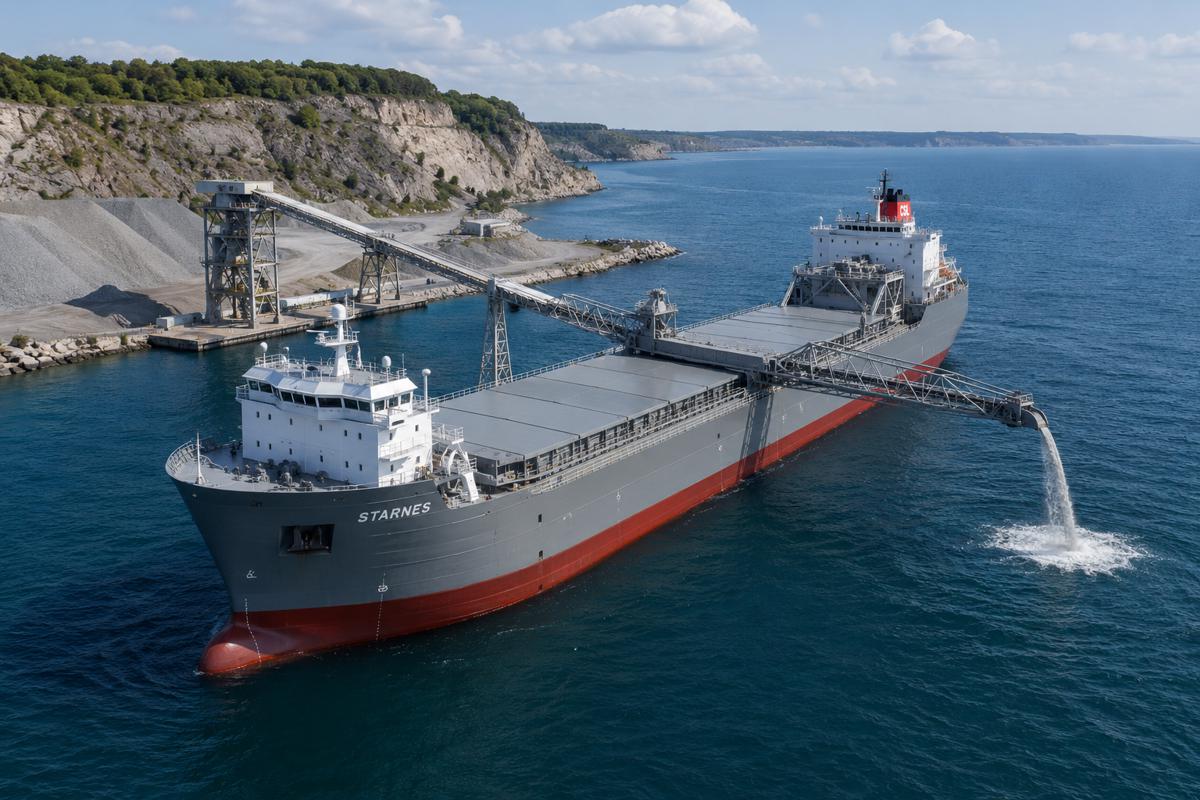
The ships are specialised pieces of maritime infrastructure. Unlike conventional bulk carriers dependent upon large shoreside unloading installations, their self-discharging systems allow construction aggregates to be moved directly through the vessel’s own material-handling equipment, extending the range of terminals that can be served efficiently and reducing dependence on port-side handling plant.
The new ships also represent another step in a partnership that has already produced the Starnes and Fjordnes, two 40,700 DWT self-unloaders now operating in Europe.
Briefing
- KfW IPEX-Bank is providing €79.3 million to finance two new self-unloading bulk carriers.
- Each vessel will have a maximum cargo capacity of approximately 44,000 tonnes.
- Hartmann Schiffsbeteiligungen and CSL will own the ships through their joint venture, with Mibau Stema Shipping operating them under long-term charter.
- The vessels will use dual-fuel propulsion capable of running on B100 biofuel and subsequently green methanol.
- Delivery is expected from September 2028, adding capacity to Mibau Stema’s Northern and Western European aggregates network.
Building on Starnes and Fjordnes
Hartmann and CSL’s relationship in European aggregate shipping stretches back to 2018, when they formed a 50:50 venture to build self-unloading vessels for Mibau Stema. The first resulting ship, Starnes, was delivered from China’s Chengxi Shipyard in August 2020, followed by Fjordnes in June 2021.
Those ships provide the engineering starting point for the latest order. Starnes has approximately 40,000 tonnes deadweight capacity and can discharge material at up to 5,500 tonnes per hour through a 90.5-metre boom. Its material-handling system accommodates free-flowing cargo with bulk densities between 1.2 and 3.5 tonnes/m³ and lump sizes up to 300 mm.
The new generation increases cargo capacity by around 3,500 tonnes compared with Starnes and Fjordnes, taking each ship to approximately 44,000 tonnes. Beam increases from 29 metres to 32 metres, while the self-discharging system retains a capacity of 5,500 tonnes per hour with a modified boom arrangement. Mibau Stema estimates that each vessel will be capable of transporting approximately 2.5 million tonnes annually.
That combination of ship capacity and unloading rate is particularly suited to high-volume aggregate logistics. Rock is relatively low in value per tonne compared with many internationally traded cargoes, making transport efficiency a substantial component of its delivered cost. A vessel designed around a regular quarry-to-terminal operation can therefore be optimised differently from a general-purpose bulk carrier seeking flexibility between unrelated trades.
Moving Millions of Tonnes of Stone
The scale of the underlying material flow puts the vessel investment into perspective.
Mibau Stema operates three quarries and extracts approximately 17 million tonnes of crushed rock annually. Its network supplies construction and major infrastructure markets through more than 40 terminals around the North and Baltic Seas. The two new vessels will add considerable capacity to that system from 2028.
Self-unloading vessels are particularly useful within this model because the ship becomes part of the materials-handling system rather than merely its maritime transport component. Increasing vessel capacity while retaining a 5,500-tonne-per-hour discharge capability strengthens that system without fundamentally changing it. The new ships are an evolution of machinery and operating practices already being used commercially rather than an experimental departure from the existing fleet.
Fuel Flexibility
The propulsion specification adds another dimension to the investment.
KfW describes the ships as having dual-fuel engines capable of operating on conventional fuels while being prepared for biofuels and green methanol. Mibau Stema provides greater detail, saying the engines will be capable of operating on B100 biofuel from their introduction into service and switching to green methanol as availability develops.
Rather than basing the investment entirely on the future availability of a particular low-carbon marine fuel, the vessels are intended to have an immediately usable alternative alongside a pathway towards methanol.
“The financing enables the transition towards more efficient maritime transport for the building materials logistics sector,” said Aida Welker, Member of the Management Board of KfW IPEX-Bank. “This ensures that new technologies, such as dual-fuel propulsion systems, are deployed where they deliver the greatest added value: in day-to-day operations.”
Hull design has also been revised, with Mibau Stema identifying optimised underwater lines intended to reduce fuel consumption. KfW says the vessels will achieve Energy Efficiency Design Index performance 3.5% better than the applicable reference line. EEDI, mandatory for new ships under MARPOL Annex VI, sets minimum energy-efficiency requirements according to vessel type and size.
Financing Fleet Renewal
For construction-material suppliers, shipping is part of the production and distribution system. Quarry output only becomes commercially useful when large volumes can be delivered reliably to consuming markets, and Northern Europe’s geography makes coastal and short-sea shipping particularly well suited to that task.
The long-term charter arrangement provides an important part of the commercial structure. Hartmann and CSL provide the shipowning platform, while Mibau Stema secures vessels designed around its aggregate flows and terminal network. KfW supplies long-term financing against an asset with an established operating model and identifiable employment.
The result is less a speculative bet on future shipping technology than the renewal and expansion of an existing logistics chain.
When the two ships enter service from 2028, their most conspicuous features may be the dual-fuel engines and methanol capability. Their everyday work will be considerably less exotic: loading enormous quantities of crushed stone, moving them between quarries and markets and unloading them quickly enough to keep one of Europe’s largest aggregate distribution networks moving.
Key Industry Questions
- Who is financing the new Mibau Stema vessels? KfW IPEX-Bank is providing €79.3 million towards construction of the two ships.
- Who will own the vessels? They will be owned through the joint venture between Hartmann Schiffsbeteiligungen and CSL Group.
- Who will operate them? Mibau Stema Shipping will employ the vessels under a long-term charter arrangement.
- How much material will each ship carry? Maximum cargo capacity will be approximately 44,000 tonnes, around 3,500 tonnes more than the preceding Starnes and Fjordnes design.
- How quickly can the vessels unload? Mibau Stema specifies a self-discharging capacity of 5,500 tonnes per hour.
- What fuels will they use? The dual-fuel engines are intended to operate on B100 biofuel from entry into service while providing the ability to move to green methanol as supply becomes available. Conventional fuel capability is also retained.
- Where will the vessels operate? They are intended principally to support Mibau Stema’s construction-aggregate supply network across Northern and Western Europe.
- When will the ships enter service? Mibau Stema expects deliveries to begin in September 2028, with both ships entering service within approximately three months.
- Why use self-unloading ships for aggregates? Their integrated conveying and discharge equipment reduces dependence on shoreside unloading infrastructure and allows high-volume bulk material to be handled rapidly at suitable terminals.
Strategic Takeaways
- The €79.3 million financing supports expansion of an established quarry-to-terminal logistics operation rather than an unproven shipping concept.
- Increasing capacity from roughly 40,700 to 44,000 tonnes gives Mibau Stema more material moved per voyage while retaining rapid self-discharge.
- Fuel flexibility reduces dependence on a single decarbonisation pathway while future marine-fuel availability remains uncertain.
- Long-term chartering aligns the vessel design closely with predictable construction-material flows rather than the general bulk shipping market.
- Self-unloading technology remains central to the economics because port handling capability can be as consequential as vessel capacity when moving millions of tonnes of relatively low-value bulk material.