Ritchie Bros. Takes Heavy Equipment Bidding Fully Mobile
Buying a used excavator, truck or wheel loader at auction no longer necessarily requires a buyer to stop what they are doing, open a laptop and settle in front of a browser.
Ritchie Bros. has redesigned its mobile application to bring the complete bidding process inside the app, including live auctions, bidding from equipment listings, watchlists, saved searches and real-time auction tracking. The development is relatively straightforward technically, but early testing suggests removing friction between finding a machine and acting on it can materially change buyer behaviour.
Pre-launch users moved from equipment searches to watchlists at more than twice the rate recorded on the company’s web platform. Ritchie Bros. also reported that watch-listed items went on to receive a bid within 14 days, although it has not disclosed the underlying conversion figures.
The smartphone is becoming another complete transaction point for used machinery.
Briefing
- Ritchie Bros. has introduced native bidding within its redesigned iOS and Android application.
- Buyers can bid directly from search results and equipment listings without being redirected to a web browser.
- Pre-launch testers converted from searches to watchlists at more than twice the rate recorded on the web platform.
- Live auction tracking, inspection reports, photographs, saved searches and bid management have been consolidated within the app.
- The application supports more than 10 languages for Ritchie Bros.’ international buyer base.
From Browsing to Bidding
Mobile access to equipment marketplaces is hardly new. The Ritchie Bros. redesign brings much more of the transaction into the application itself.
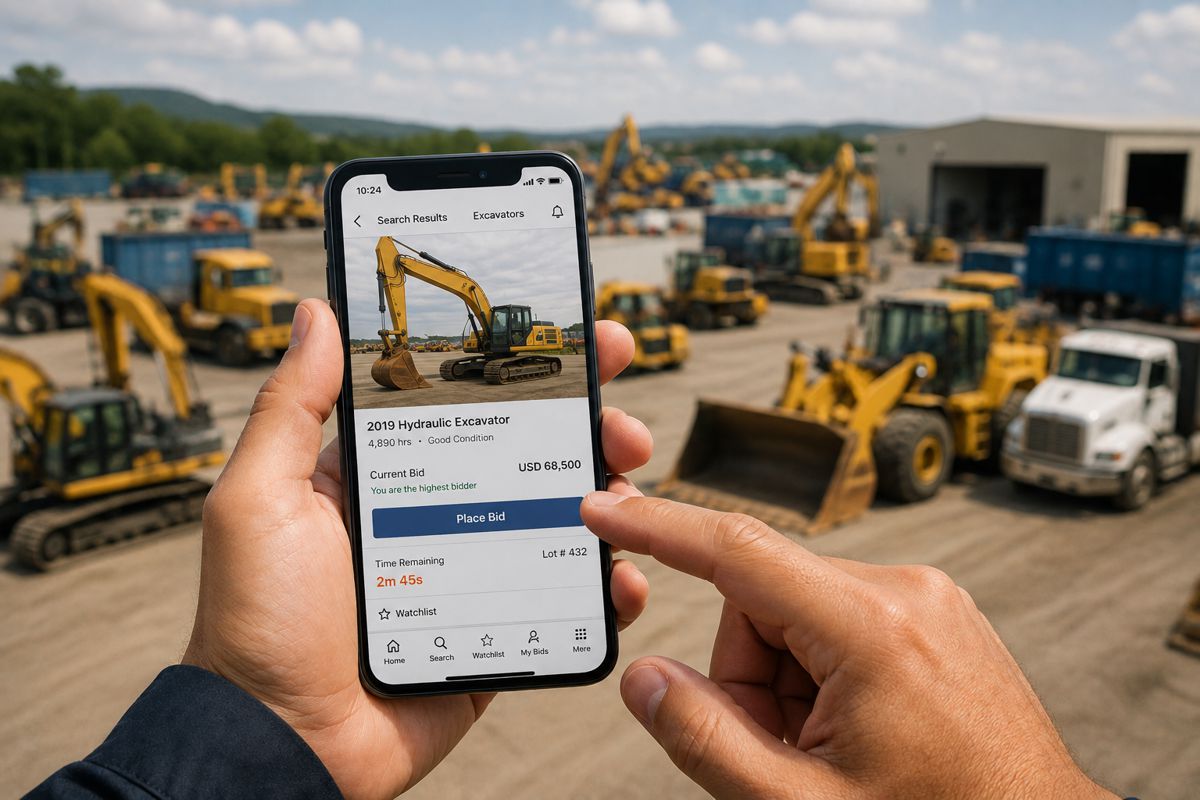
Native bidding allows buyers to place bids directly from search results and individual equipment listings and immediately see whether they are leading or have been outbid. Live auctions can be followed as lots close, with one-tap bidding from the application. The redesigned My RB area brings bids, watched equipment and saved searches together, while newly listed machinery matching those searches can be surfaced to the buyer.
Inspection information has also been incorporated more closely into the mobile process. Listings contain redesigned inspection reports alongside the full photographic record, reducing the need to move between different parts of the marketplace while assessing a machine. Search suggestions and revised browsing are intended to shorten the journey to suitable inventory.
Ritchie Bros. says its marketplace receives more than 120 million visits annually. Even relatively small changes in the way buyers move between searching, watching and bidding therefore operate across a substantial volume of marketplace traffic.
Equipment Buying Away From the Desk
The practical environment for construction equipment purchasing is quite different from conventional consumer e-commerce. Fleet owners, contractors, plant managers and equipment dealers are frequently away from desks, and auction timings do not necessarily coincide with a convenient moment in the working day.
A machine discovered in the morning might need to be compared with several alternatives, discussed internally, checked against a purchasing limit and monitored as an auction progresses. An additional browser login or a requirement to return to a computer can interrupt that process.
*”Our buyers operate in fast-paced, high-stakes environments where split-second decisions dictate business success,” said Shiv Dutt, Executive Vice President and Head of RB Marketplaces at Ritchie Bros. “Targeted investments like this modernize our technology to improve the customer experience and represent a significant step forward in enhancing access to our inventory. By engineering a native bidding ecosystem and integrating real-time auction trackers, we are giving our global buyer base the ability to view, compare, bid and buy from anywhere, without friction.”*
The pre-launch results offer some evidence for that argument. Moving from search to watchlist is a relatively small action, but once an asset has been saved the buyer can continue monitoring it rather than having to find it again. Ritchie Bros.’ testing found that the rate at which users made that transition was more than double the equivalent rate on the web platform.
The company has not disclosed the size of the test group or provided detailed conversion figures, so the result should not be treated as evidence that mobile users are universally twice as likely to bid. It does suggest that interface friction has a measurable effect on how potential buyers progress through equipment inventory.
A Marketplace Already Operating Across Borders
The redesigned application sits inside a much larger digital marketplace rather than replacing the physical auction environment that established the Ritchie Bros. business.
Parent company RB Global operates auction sites in 13 countries alongside its digital platform and serves customers in more than 170 countries. That geographical reach makes remote participation a routine part of the equipment marketplace rather than an adjunct to the physical auction.
The scale of transactions illustrates the environment in which the mobile development is being introduced. RB Global reported gross transaction value of $4.3 billion in the fourth quarter of 2025, up 4% year on year, with growth led partly by commercial construction and transportation. Full-year revenue reached $4.59 billion.
Ritchie Bros.’ February 2026 Orlando event generated more than US$265 million in gross transaction value from over 14,500 equipment items, trucks and vehicles. More than 19,500 participants from over 80 countries took part, using a mixture of onsite bidding, online participation and timed auctions.
A crawler excavator sitting in Florida can consequently be assessed by a buyer thousands of miles away, while inspection information, photographs and other transaction services increasingly sit around the sale digitally. A mobile application capable of completing the bidding process fits naturally into that structure.
Mobile Information and Equipment Due Diligence
Convenience alone is not sufficient when expensive machinery is being purchased remotely. The quality of information presented alongside the asset is at least as important as the bidding mechanism.
Ritchie Bros. has incorporated its revamped inspection reports and complete photo libraries into the redesigned listings. Buyers considering machinery remotely can move from discovery through inspection material and into bidding without leaving the application.
That becomes increasingly relevant as marketplaces stretch geographically. Cross-border purchasing can give buyers access to a wider choice of equipment, but distance makes physical inspection more difficult and increases dependence on consistent asset information.
Digital equipment trading has consequently moved well beyond putting classified advertisements onto a screen. Search, condition information, bidding and transaction management are increasingly connected, particularly when the buyer and machine may be in different countries.
Competing for the Buyer’s Attention
Used-equipment marketplaces compete for inventory, but they also compete for buyer attention. A large selection of machines has limited value if potential purchasers do not see relevant assets quickly enough or fail to return when an auction approaches.
Saved searches, watchlists and automatic surfacing of matching inventory help maintain that connection. Live status information can then bring the buyer back as a sale develops.
The pre-launch watchlist figures are interesting in this context. Better engagement does not require a marketplace to create additional demand for machinery. It can come from making existing demand easier to express.
A more active bidding pool can improve price discovery for sellers while giving buyers easier access to inventory without organising the working day around a desktop auction interface. Both strengthen the marketplace itself.
That commercial logic is particularly relevant to RB Global. The company describes itself as an omnichannel marketplace rather than simply an auctioneer, with physical auction sites, online marketplaces and transaction services operating alongside one another. Its 2026 financial outlook anticipates gross transaction value growth of between 5% and 8%.
The redesigned Ritchie Bros. application addresses one of the most basic requirements of any marketplace: reducing the distance between finding something worth buying and being able to buy it.
Mobile Auctions Without a Separate Mobile Experience
The updated application is available for iOS and Android, with existing users being prompted to install the latest version. It supports more than 10 languages, reflecting a buyer base that routinely crosses national boundaries.
Buyers have been looking at machinery on smartphones for years. A native application that allows them to search inventory, examine photographs and inspection information, establish bidding limits, monitor watchlists, follow live auctions and place bids without returning to a browser removes much of the remaining distinction between mobile browsing and mobile participation.
For a construction contractor standing on a jobsite or a dealer walking a machinery yard, that may be precisely where the next equipment purchase now happens.
Key Industry Questions
- What has changed in the Ritchie Bros. mobile app? The redesigned application now includes native bidding, live auction tracking, improved search, revised equipment listings, inspection reports, photo libraries, watchlists and saved-search management within the app.
- Can buyers bid without opening a web browser? Yes. Native bidding allows bids to be placed directly from search results and equipment listings without a browser redirect.
- Can the application be used for live Ritchie Bros. auctions? Yes. Buyers can monitor closing lots in real time and place bids from the application.
- What did Ritchie Bros. find during pre-launch testing? Test users moved from searches to watchlists at more than twice the rate recorded on the web platform. Ritchie Bros. also reported that watch-listed equipment subsequently received a bid within 14 days.
- Does that mean mobile users are twice as likely to buy equipment? No. The disclosed result concerns conversion from search to watchlist, not completed purchases, and Ritchie Bros. has not published the underlying sample size or detailed conversion rates.
- Why are inspection reports important in mobile equipment auctions? Remote buyers need sufficient information to assess an asset without necessarily inspecting it physically. Photographs and structured inspection information can therefore become an important part of purchasing due diligence.
- Is Ritchie Bros. now an online-only auction business? No. Ritchie Bros. combines digital participation with physical auction sites and live events. Its February 2026 Orlando auction, for example, included onsite, online and timed-auction participation.
- How international is the Ritchie Bros. marketplace? Parent company RB Global says its digital platform and auction network serve customers in more than 170 countries. The Ritchie Bros. application itself supports more than 10 languages.
Strategic Takeaways
- Mobile bidding reduces a practical barrier for contractors, fleet managers and dealers who spend much of their working time away from a desk.
- Ritchie Bros.’ early watchlist data suggests seemingly minor changes to transaction design can alter buyer engagement measurably.
- Inspection reports and photography become increasingly important as used-equipment transactions extend across greater geographical distances.
- The development continues the movement of equipment marketplaces from digital listings towards integrated transaction platforms.
- For marketplace operators, improving buyer engagement can be as commercially valuable as adding more inventory.