Toshiba Cuts the Power Budget for Industrial Digital Isolation
Industrial controllers rarely fail for want of headline-grabbing computing power. More often, their designers are wrestling with quieter problems: electrical noise, different voltage domains, heat, board space and the cumulative power consumed by hundreds of small components.
Toshiba Electronic Devices & Storage Corporation has added four dual-channel digital isolators aimed directly at that part of the design problem. The new DCL32xx00 Series operates at a typical 0.2mA per channel at 1Mbps while supporting data rates of up to 25Mbps, with a minimum isolation voltage rating of 3000Vrms. Volume shipments began on 1 October 2026.
The components are intended for industrial automation equipment including programmable logic controllers (PLCs), I/O interfaces, sensors, actuators, motor controls, inverters and switching power supplies. Their specifications are modest by the standards of high-speed communications devices, deliberately so. Toshiba is addressing industrial signals where extreme bandwidth is unnecessary, but isolation, low consumption and dependable operation across demanding temperature and voltage ranges are valuable.
Briefing
- Toshiba has begun volume shipments of four dual-channel DCL32xx00 digital isolators.
- Typical current consumption is 0.2mA per channel at 1Mbps under Toshiba’s specified test conditions.
- Maximum data transmission speed is 25Mbps.
- Minimum isolation voltage is rated at 3000Vrms, with operation from -40°C to 125°C.
- Two channel configurations cover two-forward and one-forward/one-reverse signal arrangements.
Isolation Inside Industrial Controls
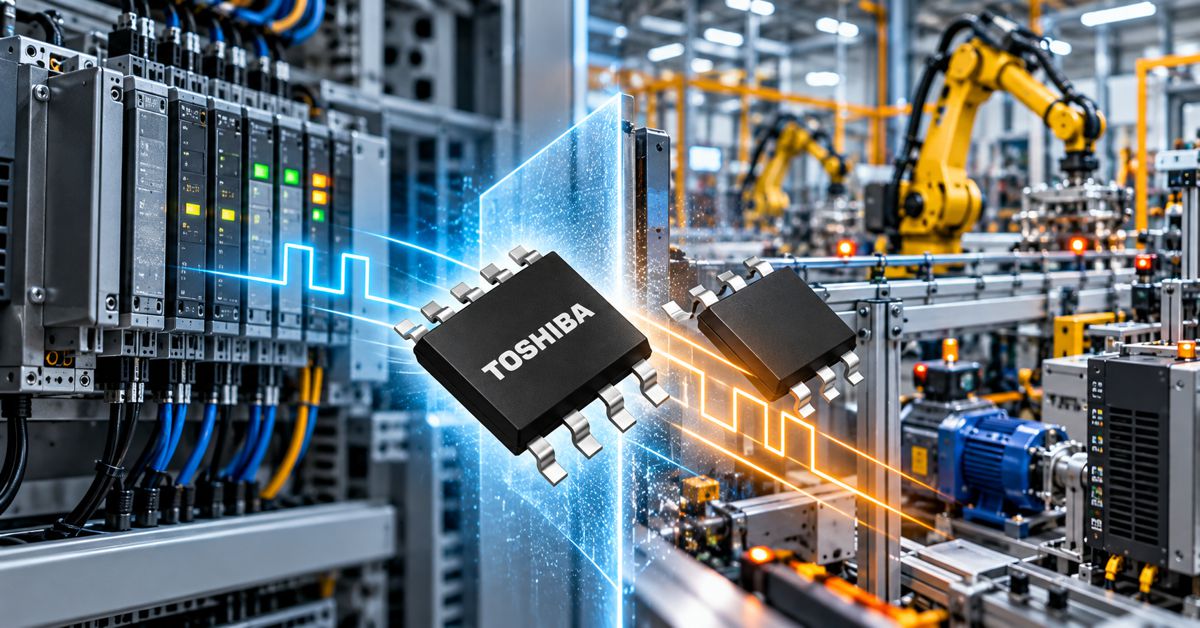
In a PLC, motor drive or remote I/O system, control signals routinely have to cross between circuits operating at different electrical potentials. Isolation lets those signals pass without creating a direct conductive path, helping protect sensitive logic from ground differences, unwanted currents and disturbances elsewhere in the system.
The requirement becomes particularly apparent where relatively delicate logic electronics coexist with switching circuits, motors and other electrically noisy loads. Galvanic isolation is consequently commonplace in industrial control architectures, from PLC inputs and field devices to motor drives and factory control systems.
Toshiba’s new devices transmit signals across the isolation barrier using magnetic coupling. According to the company, modulation and demodulation circuitry are combined with insulating layers within the package, with the encoded signal transferred by a magnetic field. The DCL32xx00 devices use a new circuit design in this transmission section to reduce operating current.
That 0.2mA figure requires some context. It is a typical per-channel value calculated at a 1Mbps data rate, with both supplies at 3.3V, a 15pF load and an ambient temperature of 25°C. At the maximum 25Mbps data rate, Toshiba’s published figures show supply currents measured in milliamps rather than hundreds of microamps. The specification therefore describes a particularly low-power operating point rather than consumption under every possible operating condition.
Designing Around the Signal
The four devices provide two basic channel arrangements. DCL320C00 and DCL320D00 have two forward channels, while DCL321C00 and DCL321D00 provide one forward and one reverse channel.
Toshiba positions the two-forward arrangement for unidirectional digital signal transmission and the forward/reverse configuration for applications requiring signals to travel in both directions. Designers can therefore match the isolator to the communication architecture rather than consuming board space with unused channels.
Toshiba cites I2C as an example for the two-forward devices, although conventional I2C uses bidirectional data lines and can require additional circuitry or specialised isolation arrangements. Texas Instruments notes that the inherently unidirectional channels used by conventional digital isolators create particular challenges when isolating bidirectional I2C communications.
Channel direction and the surrounding interface circuitry therefore matter at least as much as the headline data rate.
Industrial Operating Range
All four components use Toshiba’s SOIC8-N package, measuring a typical 4.9 × 6.0 × 1.75mm. Supply voltage extends from 2.25V to 5.5V and the specified operating temperature range runs from -40°C to 125°C. Toshiba gives a maximum propagation delay of 52ns and minimum common-mode transient immunity of 30kV/μs under its specified measurement conditions.
The use of the familiar SOIC8 format is practical for equipment designers balancing density against isolation requirements, manufacturability and established PCB layouts. A conventional package can be accommodated without forcing manufacturers towards unusually specialised assembly processes.
Power Across the Control Cabinet
A fraction of a milliamp sounds inconsequential beside the motors, pumps and actuators controlled by industrial automation systems. At component level, however, the arithmetic is different.
A PLC, distributed control system or drive can contain numerous isolated signal paths, while high-density I/O systems multiply those channels further. Power consumed by each isolation device contributes to the electronics’ total thermal and electrical budget, particularly as manufacturers place greater functionality into smaller enclosures.
The broader digital-isolator market reflects that design pressure. Semiconductor manufacturers offer devices spanning very different combinations of bandwidth, channel count, isolation performance and current consumption, allowing engineers to optimise the component around the actual signal rather than automatically selecting the fastest available device. Texas Instruments, for example, lists products ranging from ultra-low-power isolators operating in the microamp-per-channel range to devices supporting data rates of 200Mbps.
Toshiba is taking a similarly segmented approach. The DCL32xx00 family sits alongside its four-channel DCL34xx0B devices and higher-speed DCL52xx00 and DCL54xx01A industrial isolators. With the four new parts, the company’s low-power standard industrial isolator range now comprises ten products.
That gives engineers another choice between channel density, communication speed and power consumption rather than treating digital isolation as a single component category.
From Optics to Magnetic Coupling
Optocouplers remain common in industrial electronics, but magnetic and capacitive digital isolators have widened the options available to designers. The technologies differ in speed, power consumption, electromagnetic behaviour, ageing and package requirements, making the application more important than any simple hierarchy between them.
Toshiba continues to offer photocouplers alongside its magnetic-coupling devices rather than presenting one technology as a universal replacement for the other. Its expanding digital-isolator portfolio gives equipment designers greater scope to select the isolation method and component specification around the electrical architecture.
Every connected sensor, motor controller, inverter and PLC ultimately depends on signals travelling reliably between different parts of the electrical system. Much of the engineering that makes this possible remains buried inside components that receive little attention once the equipment is installed.
The DCL32xx00 Series occupies a deliberately unglamorous part of that electronics stack: two channels, 25Mbps maximum throughput, an established eight-pin package and very low current consumption when the application does not require the device to run at full speed. In industrial controls built from hundreds or thousands of similarly modest components, that is precisely where careful engineering tends to happen.
Key Industry Questions
- What does a digital isolator do? It transfers a digital signal between electrically separated circuits, allowing information to cross an isolation barrier without a direct conductive connection.
- Why is isolation used in PLCs and industrial machinery? Industrial systems can contain different voltage domains, ground potential differences and substantial electrical noise. Isolation helps prevent unwanted currents and disturbances from propagating into sensitive control electronics.
- How much current do Toshiba’s new isolators consume? Toshiba specifies typical consumption of 0.2mA per channel at 1Mbps under defined test conditions. Consumption increases at higher transmission rates.
- Why does digital isolator power consumption increase with data rate? Faster signal switching requires the isolation circuitry to operate more frequently. Actual consumption therefore depends on factors including transmission speed, supply voltage, load and operating conditions.
- What is the maximum communication speed? The DCL32xx00 Series supports data transmission up to 25Mbps.
- What isolation voltage is specified? Toshiba specifies a minimum isolation voltage of 3000Vrms.
- Where could the devices be used? Applications identified by Toshiba include PLCs, industrial I/O interfaces, sensors, actuators, motor controls, inverters and switching power supplies.
- What is the difference between the DCL320 and DCL321 configurations? DCL320 devices provide two forward channels. DCL321 devices provide one forward and one reverse channel.
Strategic Takeaways
- Low-speed and medium-speed industrial signals can justify optimising isolation around power consumption rather than maximum bandwidth.
- Channel direction is an important selection criterion where isolated interfaces carry signals in both directions.
- High-density PLC and I/O designs turn small per-channel power reductions into a more meaningful system-level consideration.
- Toshiba is building a tiered industrial isolation portfolio rather than relying on a single speed or channel configuration.
- Magnetic, capacitive and optical isolation address different combinations of electrical performance, power consumption, packaging and system requirements.