Steering Wheel Lets Drivers Negotiate with Automated Driving Systems
A steering wheel that physically changes shape beneath the driver’s hands could offer a different way of managing one of the awkward problems in partially automated driving: what happens when the human and the computer disagree.
Researchers at the University of Michigan and the Toyota Research Institute have tested a haptic steering interface that allows an automated driving system to communicate its intended direction through two expanding sections of the wheel. The driver can respond by squeezing the same sections, giving the machine a physical signal that they disagree with its proposed action.
In a simulator study involving 30 participants and 39 intersection turns, that two-way exchange produced smoother and more accurate driving when the intentions of the driver and automation conflicted. Participants also fought the automated steering less, used less braking and reported lower effort, frustration and physical demand.
The research moves the steering wheel beyond its conventional role as a control and source of warnings. Instead, it becomes a communications channel through which human and machine can establish what each intends to do before either commits to the manoeuvre.
Briefing
- University of Michigan and Toyota Research Institute researchers tested a shape-changing steering wheel for two-way communication between drivers and automation.
- Thirty participants completed a continuous simulated driving task involving 39 intersection turns.
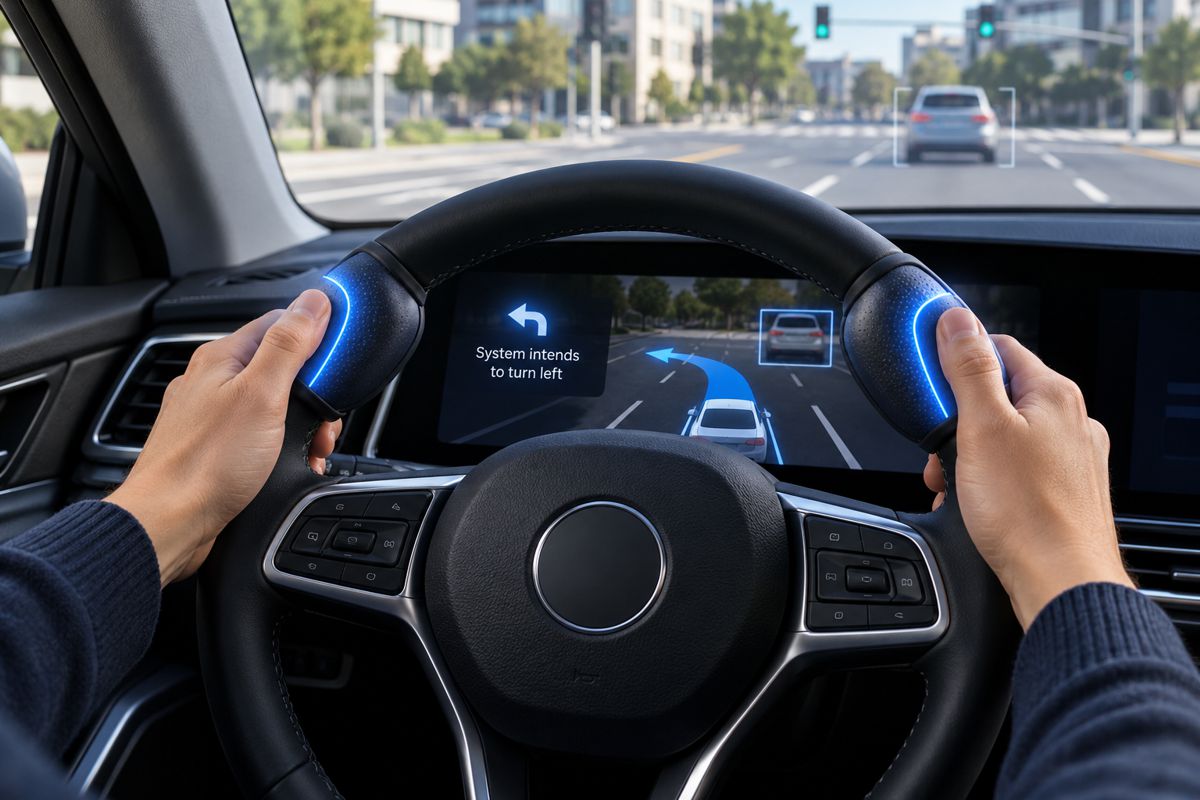
- Sections of the wheel at approximately 10 o’clock and 2 o’clock expanded to indicate the automated system’s intended direction.
- Drivers could squeeze the haptic sections to communicate disagreement with the automation before the manoeuvre.
- Two-way communication improved driving performance during conflicting intentions and produced stronger trust recovery after automation faults.
Communication Through the Steering Wheel
Most vehicle interfaces are good at telling drivers that something has happened. Warning tones, dashboard messages, illuminated symbols, steering-wheel vibration and resistance can all attract attention or encourage a particular response. Communication in the opposite direction is less developed.
The Michigan system attempts to create that return channel without asking the driver to look away from the road or operate another control.
“To improve driver communication with automation, we added two haptic zones onto a steering wheel at 10 o’clock and 2 o’clock that can expand or contract to express the intention of the automated system,” said Hannah Báez, a robotics Ph.D. student and first author of the study in Human Factors.
“Drivers could agree or disagree with the automated system by squeezing the haptic zones, which allowed them to negotiate with the system before a given action to resolve any conflict.”
In the experiment, participants approached intersections where the direction selected by the driver could agree or conflict with the direction planned by the automation. The appropriate section of the steering wheel inflated to indicate where the system intended to turn. A driver who disagreed could squeeze the corresponding haptic section and initiate a change in the planned action.
Obstacles added another layer. When an obstruction appeared in the driver’s intended path, the wheel could pulse on that side, communicating information through the hands rather than adding another visual warning to the instrument panel. The driver could therefore signal disagreement before having to overpower the automated steering.
University of Michigan researchers have explored haptic shared control for several years, including simulator work on lane keeping, obstacle avoidance and the allocation of control between human drivers and automation. The latest system extends that work towards communication about a future action rather than simply responding once steering inputs are already in conflict.
Driving Without Fighting the Automation
Shared steering creates an unusual control problem because two agents can attempt to influence the same mechanism. If the automated system applies steering torque while the driver wants to move in another direction, the resulting resistance may tell the driver that the machine disagrees, but it does little to establish why or what either party intends to do next.
The research compared three communication arrangements: no explicit haptic communication, one-way communication from the automation to the driver, and two-way communication in which the driver could respond. The largest benefits appeared when driver and automation had conflicting plans.
“We found that drivers drove better when negotiating with the automated system through haptic feedback,” said Brent Gillespie, U-M professor of robotics and senior author of the study. “Drivers displayed smoother, more accurate driving paths, fought less with automation and used less braking with more confidence in their manoeuvres.”
Participants using the negotiation interface also reported lower workload, including reductions in effort, frustration and physical demand.
The experiment was conducted in a driving simulator rather than a production vehicle, and its 30 participants represent a relatively small experimental population. The findings establish evidence for the interface concept rather than its performance across the much broader range of drivers, vehicles, road conditions and unexpected events encountered in everyday driving.
The control problem is nevertheless relevant to current driver-assistance technology. Under the SAE J3016 classification, Level 2 systems can provide both steering and speed support while continual supervision and intervention remain with the human driver. Human and automated control inputs can therefore coexist, including situations where they do not initially agree.
Trust After Automation Errors
The researchers deliberately introduced faults during a later part of the experiment, including missed obstacles and false warnings. This allowed them to examine how drivers responded after discovering that the automated system could be wrong.
Participants using two-way haptic communication showed significantly better overall trust recovery following the period containing automation faults than those receiving one-way or no haptic communication.
Greater trust, however, is not necessarily better. Trust in automation is useful when it corresponds reasonably well with what the system can actually do. Excessive trust can create another human-factors problem, particularly where the driver retains responsibility for supervision.
That concern appeared in the experiment. The researchers reported that some participants became overly trusting following successful negotiations, identifying an area requiring further study.
The steering wheel could therefore face two opposing design requirements. It must make collaboration intuitive enough that drivers can work with the automation without unnecessary conflict, while avoiding an interaction that makes the machine appear more capable or dependable than it really is.
A Shape-Changing Control
The physical design behind the experiment is covered by US patent US12227190B2, titled Grip-force sensing and shape-changing steering wheel. The University of Michigan patent has a priority date of 26 May 2020, was filed in May 2021 and was granted in February 2025.
Its architecture combines grip-force sensing with sections capable of physically expanding and contracting, allowing the steering wheel to provide two-way non-visual communication. Changes in grip can communicate the driver’s intention, while physical changes in the wheel return information from the automated system.
The approach takes advantage of a control the driver is already touching. It avoids adding another screen, button or audible alert and leaves the visual channel available for the road environment.
There are substantial steps between a laboratory prototype and an automotive production component. A commercial system would need to operate reliably across different hand positions, grip strengths and driving styles while distinguishing deliberate responses from ordinary changes in grip. Packaging, durability, steering-wheel safety systems and integration with vehicle control software would also have to be addressed.
The research team is seeking commercial partners for the patented technology.
Human and Machine as a Driving Team
Much of the development of automated driving has concentrated on improving what the vehicle can perceive and decide. Cameras, radar, lidar, positioning systems and increasingly sophisticated software determine where the vehicle is and what it should do next. Vehicles in which a human remains part of the control loop introduce another decision-maker whose intentions also have to be understood.
The haptic interface treats that relationship as a shared control problem rather than a sequence of handovers. The driver can feel what the automation intends to do before the action develops, while the automation receives an explicit physical response when the driver disagrees. Neither needs to begin by overpowering the other through the steering mechanism.
It is a relatively modest change in hardware compared with the sensor and computing systems surrounding modern automated driving, but the experiment suggests there may be useful information still available in the oldest human-machine interface in the vehicle: the driver’s hands on the steering wheel.
Key Industry Questions
- How does the haptic steering wheel communicate with the driver? Two shape-changing areas positioned around 10 o’clock and 2 o’clock can expand or contract. In the experiment, inflation on one side communicated the automated system’s intended turning direction.
- How does the driver respond to the automated system? The driver can squeeze a haptic section of the wheel to communicate disagreement with the automation’s proposed action.
- Was the technology tested in a road vehicle? No. The published research used a driving simulator with 30 participants completing a continuous task involving 39 intersection turns.
- Did two-way communication improve driving performance? The study found significantly improved performance under two-way communication when the driver’s intended turn differed from that of the automation.
- How did the interface affect trust? Drivers using two-way communication showed better overall trust recovery after a period in which automation faults were introduced. The researchers also observed instances of excessive trust after successful negotiations.
- Could the system be relevant to Level 2 driver assistance? Potentially. Level 2 systems can support both steering and speed while requiring continual driver supervision, creating circumstances in which human and automated control inputs need to coexist.
- Is the steering-wheel technology patented? Yes. US12227190B2 covers a grip-force sensing and shape-changing steering wheel intended to provide two-way communication between a driver and vehicle automation.
- Is the technology commercially available? Not currently. The research team is seeking partners to bring the technology to market.
Strategic Takeaways
- Two-way haptic communication allows disagreement to be expressed before it becomes a physical steering conflict between driver and automation.
- Separating communication from steering torque gives the vehicle another channel for conveying intent without increasing visual or audible alerts.
- Improved trust recovery following automation errors could be valuable, but excessive trust remains a design risk rather than a desirable outcome.
- The simulator results establish a promising human-machine interface concept, but broader validation would be required before drawing conclusions about real-world driving performance.
- The work places greater emphasis on coordination between human and automation while drivers remain responsible for supervising partially automated vehicles.