From the Caspian to the Tian Shan: 10 Infrastructure Projects to Watch Across Central Asia
Deep beneath the mountains of Kyrgyzstan, excavation is under way on 29 railway tunnels.
Eight extend for more than five kilometres. Three will exceed 12 kilometres. Together, the tunnels will account for more than 100 km of the Kyrgyz section of the China-Kyrgyzstan-Uzbekistan Railway, a connection intended to create a new route between China’s railway network and Central Asia.
The engineering challenge is dictated by geography. Between the Chinese frontier at Torugart and Uzbekistan lie mountain ranges, deep valleys and elevations that leave little room for conventional railway alignment. Fifty bridges will complement the tunnels, while temporary construction infrastructure already includes more than 190 km of access roads and extensive power infrastructure.
At Makmal, another obstacle appears. China’s railways use the international standard gauge of 1,435 mm. Much of the former Soviet railway system uses 1,520 mm. Cargo crossing the new route will therefore encounter not only mountains and borders, but two railway systems built to different standards.
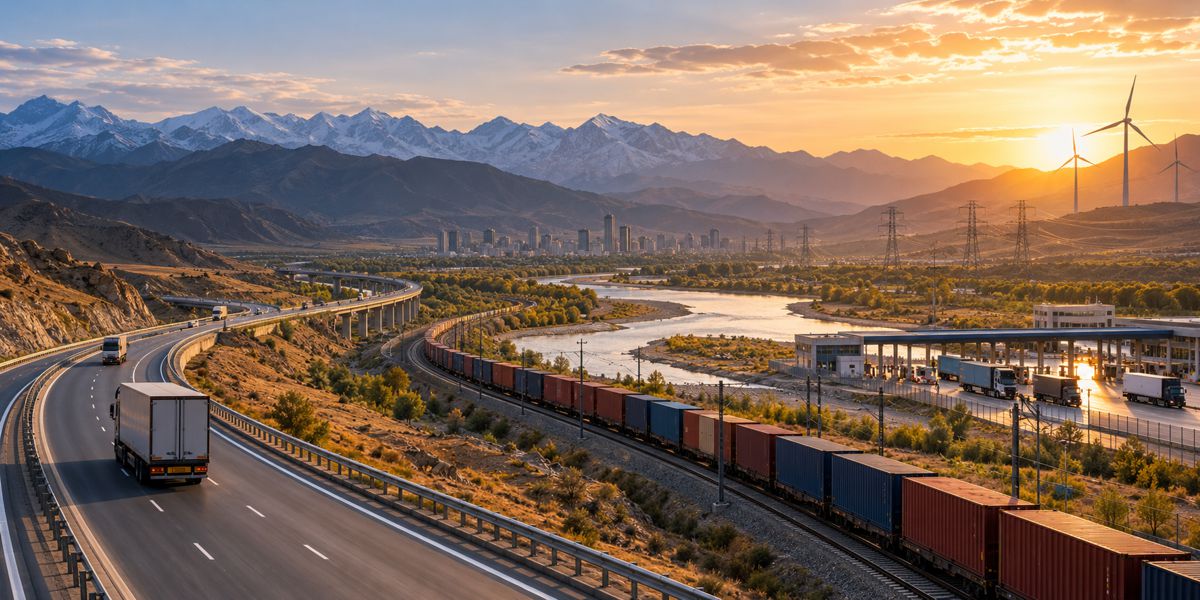
Kazakhstan, Kyrgyzstan, Tajikistan, Turkmenistan and Uzbekistan occupy an enormous landlocked region between China, Russia, the Caucasus, the Middle East and South Asia. Mountains divide some of its largest cities. Deserts separate others. Freight travelling between Asia and Europe must negotiate borders, different railway systems and, on the Trans-Caspian route, a sea without direct access to the world’s oceans.
Across the region, tunnels, railways, highways, ports, power infrastructure and airports are changing how those physical constraints shape trade and movement.
Briefing
- Construction of the China-Kyrgyzstan-Uzbekistan Railway has moved into large-scale tunnelling, with excavation under way across 29 tunnels in Kyrgyzstan.
- Tajikistan’s Rogun Hydropower Project is advancing with further international financing for civil works and generating equipment, while its future reservoir requires another major transport project around it.
- Kazakhstan is expanding rail capacity between China, Uzbekistan and the Caspian while developing Aktau and Kuryk as Trans-Caspian logistics gateways.
- Uzbekistan has begun construction of the 282 km Tashkent-Samarkand motorway as traffic growth places increasing pressure on existing transport corridors.
- Projects from Almaty’s LRT to Turkmenistan’s Caspian highway show investment spreading beyond the international freight corridors that usually dominate discussion of Central Asian infrastructure.
1. China–Kyrgyzstan–Uzbekistan Railway
Few infrastructure projects illustrate Central Asia’s physical geography as clearly as the railway now being driven through Kyrgyzstan.
The China-Kyrgyzstan-Uzbekistan Railway has been discussed for decades. Construction is now transforming that proposal into tunnels, bridges, earthworks and access roads.
The complete route extends for more than 530 km, including approximately 304 km across Kyrgyzstan. It will enter the country from China through the Torugart Pass before crossing mountainous terrain towards Jalal-Abad and the Uzbek border.
The Kyrgyz section requires 29 tunnels and 50 bridges. Underground excavation is under way across all 29 tunnel sites, with eight tunnels longer than 5 km and three exceeding 12 km. More than 100 km of the railway through Kyrgyzstan will therefore run underground.
Building those structures first requires another network to support them. Construction teams have developed more than 190 km of temporary roads and extensive electricity infrastructure to reach tunnel portals, bridge sites and compounds in terrain where access is itself an engineering problem.
The railway must also reconcile two different technical systems.
From the Chinese border at Torugart towards Makmal, the railway is planned around the 1,435 mm standard gauge used in China and much of the world. Beyond Makmal towards Jalal-Abad and Uzbekistan, the route interfaces with the 1,520 mm gauge inherited from the Soviet railway network.
Facilities around Makmal will manage the transition between the two.
For Kyrgyzstan, the project changes the country’s position within the regional railway system. Rather than sitting beside the major east-west freight routes, it gains a direct railway connection between China and Uzbekistan.
The mountains remain. The difference is that trains will eventually pass through them.
2. Rogun Hydropower Project, Tajikistan
The Vakhsh River descends through steep mountainous terrain before joining the Amu Darya system. At Rogun, that elevation is being converted into one of Central Asia’s largest pieces of energy infrastructure.
The Rogun Hydropower Project is being developed around a 3,780 MW generating complex with six turbines and an enormous dam across the Vakhsh. Two generating units are already producing electricity while construction of the wider scheme continues.
Once fully operational, the World Bank expects the plant to produce approximately 14,400 GWh of electricity annually, equivalent to around 60% of Tajikistan’s present electricity generation.
Construction encompasses the dam and reservoir system, underground and hydraulic structures, power-generation equipment and associated infrastructure required to turn the Vakhsh’s elevation into controllable generating capacity.
In June 2026, the World Bank approved a further $300 million towards the programme, taking its financing to $650 million. The funding supports civil works, electromechanical equipment and the institutional and environmental requirements surrounding the development.
Tajikistan has historically faced winter electricity shortages, while hydropower provides opportunities for electricity exports during periods of high generation. Additional Rogun output is expected to support domestic supply while increasing the potential for electricity trade with neighbouring Kazakhstan and Uzbekistan.
The project is also changing the physical landscape around it. As the reservoir develops, roads, settlements and other infrastructure have to adapt to future water levels.
One of those consequences is already under construction farther east.
3. Obigarm-Nurobod Road, Tajikistan
Part of Tajikistan’s existing M41 highway lies in territory that will eventually be affected by the Rogun reservoir.
Rather than wait for the road to disappear beneath rising water, Tajikistan has been constructing a replacement through the mountains.
The Obigarm-Nurobod corridor extends for approximately 72 km and includes tunnels, bridges, retaining structures and extensive mountain roadworks. Three tunnels account for roughly 6 km of the alignment, while the project also includes a major bridge approximately 700 m long and another 13 bridges.
The alternative is not a minor diversion. Loss of the existing connection without the replacement route could force traffic onto detours approaching 500 km, severely affecting communities and transport between central and eastern Tajikistan.
Construction has been divided between internationally financed packages, with substantial portions now approaching completion.
Road engineers have had to design around future reservoir levels, unstable mountain terrain, river crossings and the limited alignment choices available through the valleys. The replacement must be available before rising water removes sections of the existing connection.
The result is a highway being built not because the old road has worn out, but because the landscape around it is being deliberately transformed.
4. Tashkent-Samarkand Highway, Uzbekistan
Uzbekistan’s infrastructure challenge is increasingly being driven by growth.
Traffic on the country’s main corridors has risen alongside industrial production, trade and urban expansion. Government assessments indicate that around 30% of international transit roads are operating at capacity, with another quarter carrying traffic above their original design capacity.
Construction of a new Tashkent-Samarkand motorway began in July 2026.
The planned road will extend for approximately 282 km between Uzbekistan’s capital and Samarkand, creating a new high-capacity alternative to the existing corridor. It is being designed with three lanes in each direction, cement-concrete pavement and a design speed of up to 150 km/h.
Plans include 12 interchanges, 91 bridges and 16 overpasses.
A purpose-built motorway will allow long-distance traffic to move independently of many of the towns, junctions and local movements that constrain existing highways.
Tashkent and Samarkand are two of Uzbekistan’s most important economic and population centres. The route between them also forms part of the country’s connections towards Bukhara and the western regions.
The project creates a separate high-capacity motorway spine through a corridor where existing infrastructure is already carrying traffic beyond its intended capacity.
5. Almaty LRT, Kazakhstan
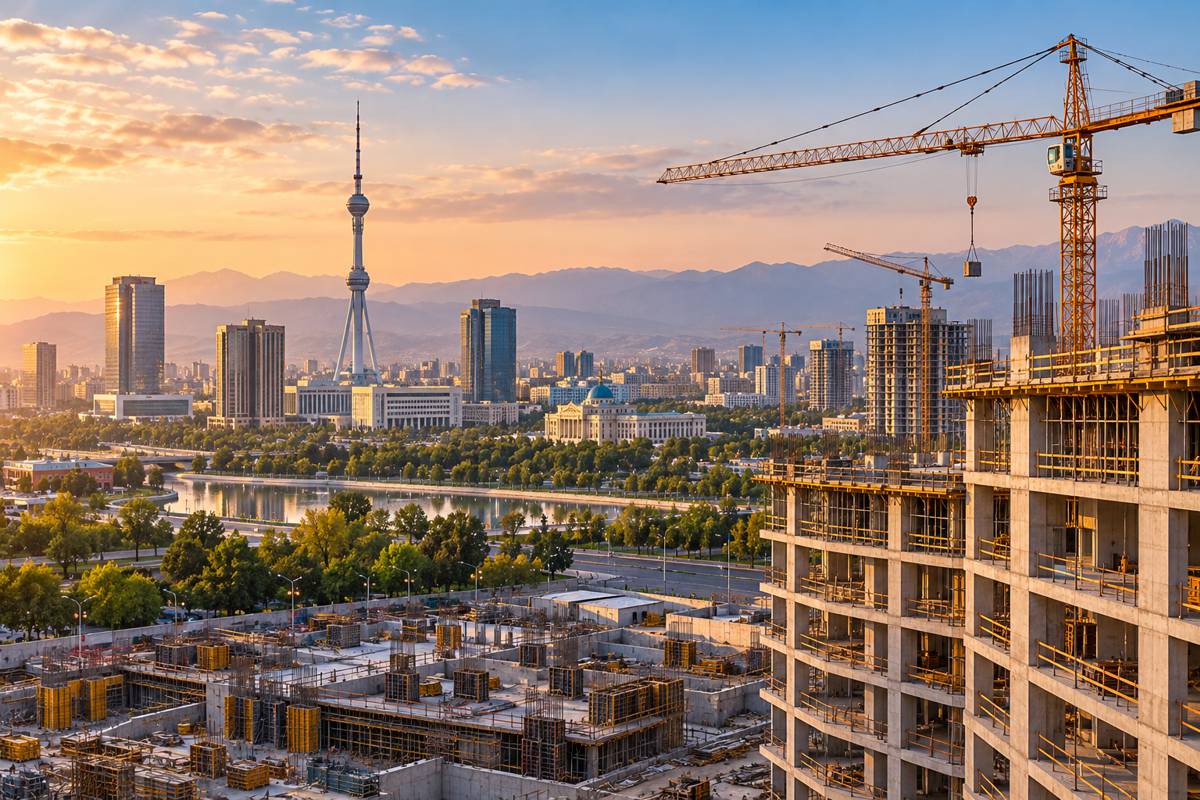
In Almaty, construction is moving ahead on a new light-rail system through Kazakhstan’s largest city.
The project has had a long and difficult history, including delays, redesigns and procurement problems. In 2026, the work has become unmistakably physical.
Rail installation is under way along sections of Baurzhan Momyshuly Street. One 4.4 km section alone requires 14,784 concrete sleepers and 1,408 rail lengths, while utility relocation and civil construction continue elsewhere along the route.
Work is also advancing along Tole Bi Street as the alignment is prepared through the existing urban fabric.
Building the railway through established streets requires water, electricity, communications and other utilities to be moved before permanent track infrastructure can take their place. Junctions and road layouts must be rebuilt around the alignment while stops, traction power, signalling and maintenance infrastructure are integrated into the wider transport network.
All of this has to happen while traffic and businesses continue operating around the construction sites.
Passenger operations are currently planned for the end of 2027.
After years in which Almaty’s LRT was better known for its difficulties than its engineering, sleepers, rails and civil works are now establishing the route through the city.
6. Aktau and Kuryk Port Expansion, Kazakhstan
Railways crossing Kazakhstan eventually encounter an obstacle that cannot be tunnelled through or bridged economically.
The Caspian Sea breaks the overland route between Central Asia and the Caucasus.
At Aktau and Kuryk, Kazakhstan is expanding the infrastructure needed to turn that break into an intermodal connection.
The first phase of Aktau’s international container hub entered service in March 2026. Once fully developed, the facility is intended to provide annual capacity of approximately 240,000 TEU.
Port modernisation extends beyond the container terminal. Kazakhstan is carrying out dredging and berth improvements while developing additional handling and logistics capacity around Aktau and Kuryk.
These investments sit at the centre of the Trans-Caspian International Transport Route, commonly known as the Middle Corridor.
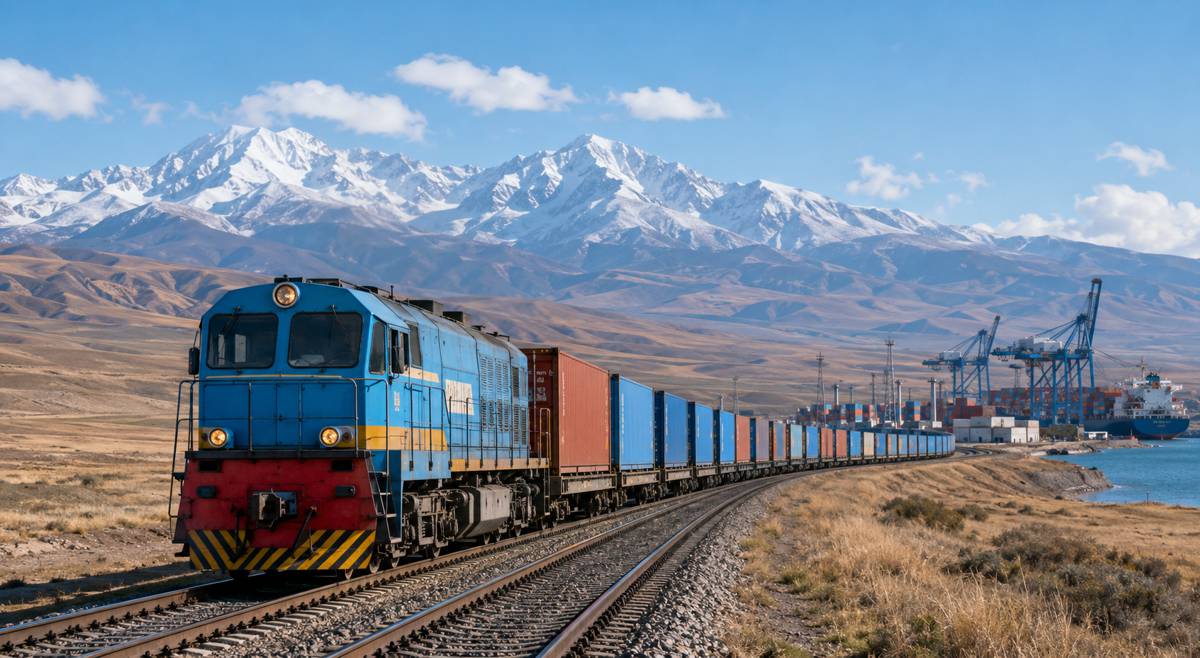
Freight arriving from China and Central Asia by rail cannot simply continue westwards on the same train. Containers and other cargo have to be transferred through port terminals, loaded onto vessels, carried across the Caspian and returned to railway infrastructure in Azerbaijan before continuing towards Georgia, Türkiye and Europe.
Every transfer adds time, cost and operational complexity. Port capacity, berths, vessels, rail yards and customs facilities therefore become as important as the railway lines approaching them.
World Bank modelling suggests coordinated improvements across the Trans-Caspian corridor could more than triple trade volumes and halve journey times by 2040.
Whether that potential is realised will depend partly on infrastructure being built at places such as Aktau and Kuryk, where a continental railway corridor temporarily becomes a maritime one.
7. Altynkol-Zhetygen Railway Modernisation, Kazakhstan
On the opposite side of Kazakhstan, the same transport system meets China.
Altynkol lies near Khorgos, one of the principal railway gateways between the two countries. It is another point where the 1,435 mm standard-gauge railway system meets Kazakhstan’s 1,520 mm network.
Freight moving west from China therefore encounters a technical break before beginning its journey across Kazakhstan.
The Altynkol-Zhetygen railway is being modernised to increase its capacity to approximately 25 million tonnes annually, with completion planned during 2026.
The work forms part of a broader programme to increase the ability of Kazakhstan’s railways to absorb growing transit and domestic freight volumes.
Kazakhstan occupies the central land bridge between China’s western border and the Caspian. Capacity added at Aktau ultimately depends on trains reaching the sea efficiently, just as additional capacity at Altynkol cannot simply move a bottleneck farther west.
Expanded border terminals, higher-capacity railway sections, logistics hubs and enlarged Caspian ports increasingly have to function as parts of the same system.
There is no single piece of infrastructure capable of carrying the corridor by itself.
8. Darbaza-Maktaaral Railway, Kazakhstan
Kazakhstan is also adding railway capacity towards Uzbekistan.
The new Darbaza-Maktaaral railway is designed to connect the Maktaaral district more directly with Kazakhstan’s national network while providing additional capacity on the country’s southern transport routes.
The line is expected to handle around 20 million tonnes of freight annually once complete, with construction continuing through 2026.
Its importance is more regional than transcontinental.
Railways across Central Asia were developed within a Soviet transport system that did not have to accommodate today’s independent national borders. Modern trade between Kazakhstan and Uzbekistan now places different demands on those inherited routes.
Additional capacity around Maktaaral strengthens Kazakhstan’s connections with its densely populated south while supporting growing cross-border trade with Uzbekistan.
Not every new railway in Central Asia is intended to carry freight between China and Europe. Some are rebuilding connections between the region’s own economies.
9. Turkmenbashy-Garabogaz-Kazakhstan Highway, Turkmenistan
Along the eastern shore of the Caspian, Turkmenistan is extending its high-standard road network towards Kazakhstan.
Construction is continuing on the Turkmenbashy-Garabogaz-Kazakhstan highway, creating a modern road connection north from the Caspian port city towards the international border.
The route crosses an unusual and demanding landscape.
Much of western Turkmenistan is sparsely populated desert. Garabogaz lies beside the enormous Garabogazköl lagoon, while settlements, services and alternative routes are limited across much of the corridor.
Road construction in such conditions requires more than pavement. Reliable access, drainage, structures, roadside facilities and long-term maintenance have to function across considerable distances in an arid environment.
At its northern end, the route connects towards Kazakhstan and the transport systems running along the eastern Caspian. To the south, Turkmenbashy provides access to one of Central Asia’s principal Caspian ports.
The highway adds another north-south connection to the network developing around the eastern side of the sea.
10. New Tashkent International Airport, Uzbekistan
Central Asia’s growing connectivity is not entirely terrestrial.
Tashkent is developing a new international airport intended to overcome the capacity constraints of the existing facility serving Uzbekistan’s capital.
A public-private partnership agreement was signed in June 2026, with the new complex planned across approximately 1,310 hectares and development scheduled through the remainder of the decade.
The initial phase is expected to involve investment of around $3 billion and provide capacity for approximately 20 million passengers annually. Longer-term development envisages capacity rising towards 46 million passengers.
The scale reflects changes already taking place in Uzbekistan. International travel has expanded, the economy is attracting greater investment and Tashkent increasingly acts as a regional business and aviation centre.
A new airport also requires considerably more than a passenger terminal. Airfield infrastructure, utilities, surface access, baggage and cargo systems, maintenance facilities and the supporting transport network have to be developed as parts of the same complex.
For a country without direct access to the sea, aviation provides something roads and railways cannot: direct connections that are largely indifferent to the borders and terrain below.
Building Through Geography
Central Asia has always occupied an important position on maps. That position has not automatically translated into efficient transport.
A landlocked region can sit between some of the world’s largest economies and still struggle to move goods between them. Mountain passes may shorten a route geographically while making construction difficult. Railways can meet at a border and still require cargo to change systems because their gauges differ. A corridor can cross thousands of kilometres of land only to stop at the edge of the Caspian.
The projects now under construction address those constraints physically.
Kyrgyzstan is tunnelling through mountains. Kazakhstan is adding capacity between the Chinese frontier and Caspian ports. Tajikistan is constructing a hydropower project large enough to alter the landscape around it, while Uzbekistan’s growth is driving investment in motorway and aviation capacity.
The barriers have not disappeared. The Tian Shan and Pamir mountains remain formidable engineering obstacles. The Caspian still requires cargo to transfer between railway and ship, and international corridors still depend on several countries maintaining compatible infrastructure, border systems and operating rules.
But geography is not an entirely fixed economic condition.
A mountain range means something different when a railway passes beneath it. A landlocked country becomes less isolated when several functioning corridors connect it with neighbouring markets. A sea that interrupts a railway can become part of the route when ports and shipping capacity are built around the transfer.
Across Central Asia, infrastructure is beginning to turn geography from a constraint into an asset.

Key Industry Questions
- What is the China-Kyrgyzstan-Uzbekistan Railway? The railway is a new connection between western China, Kyrgyzstan and Uzbekistan. More than 300 km will cross Kyrgyzstan, where the alignment requires 29 tunnels and 50 bridges through mountainous terrain.
- Why does the China-Kyrgyzstan-Uzbekistan Railway require a gauge change? China uses the 1,435 mm international standard gauge, while Uzbekistan and much of Central Asia use the 1,520 mm railway gauge inherited from the Soviet network. Infrastructure around Makmal will manage the transition between the systems.
- How large is the Rogun Hydropower Project? Rogun is being developed as a 3,780 MW hydropower complex. Once completed, it is expected to generate around 14,400 GWh annually, equivalent to roughly 60% of Tajikistan’s present electricity generation.
- Why is Tajikistan building the Obigarm-Nurobod road? Part of the existing M41 highway will be affected by the future Rogun reservoir. The approximately 72 km replacement route uses tunnels and bridges to maintain connectivity through the mountainous region.
- What is the Tashkent-Samarkand motorway? Uzbekistan began construction of the approximately 282 km motorway in July 2026. It is planned with three lanes in each direction and includes 12 interchanges, 91 bridges and 16 overpasses.
- Why are Aktau and Kuryk important to the Middle Corridor? The Kazakh ports provide the maritime connection across the Caspian Sea. Freight arriving by rail must transfer to ships before continuing through Azerbaijan towards the Caucasus, Türkiye and Europe.
- What is Kazakhstan doing at Altynkol? The Altynkol-Zhetygen railway is being modernised to increase annual capacity to approximately 25 million tonnes. Altynkol is one of Kazakhstan’s principal railway gateways with China.
- What is Almaty LRT? Almaty is constructing a new urban light-rail system through the city, with track installation, utility relocation and associated civil works advancing during 2026. Passenger operations are currently planned for the end of 2027.
- What is being built between Turkmenistan and Kazakhstan? Turkmenistan is constructing a highway from Turkmenbashy through Garabogaz towards the Kazakhstan border, improving road connectivity along the eastern side of the Caspian.
- Why is Central Asia investing in transport infrastructure? Economic growth, increasing regional trade and attempts to diversify international transport routes are placing greater demands on infrastructure originally built around different economic and political geography. Investment is increasing domestic capacity while creating additional connections between China, the Caspian, neighbouring Central Asian economies and markets farther west.
Strategic Takeaways
- Central Asia’s infrastructure cycle is increasingly focused on overcoming physical constraints created by mountains, deserts, long distances and landlocked geography.
- The China-Kyrgyzstan-Uzbekistan Railway represents one of the region’s most consequential new transport links, with more than 100 km of tunnelling required through Kyrgyzstan.
- Kazakhstan’s railway and Caspian port investments demonstrate that international corridors depend on coordinated capacity across borders, railways, terminals, ports and shipping rather than individual megaprojects.
- Uzbekistan’s motorway and aviation investment reflects a shift from basic connectivity towards the capacity requirements of a rapidly expanding economy.
- Energy, urban transit and replacement infrastructure show that Central Asia’s construction cycle extends well beyond the geopolitical narrative surrounding east-west freight corridors.