






Samsara Launches 360-Degree AI Camera for Construction Machinery
Samsara has introduced a single-mount, 360-degree AI camera for operated equipment, extending its connected fleet technology to excavators, forklifts and airport ground support vehicles. Announced on 12 November 2026, the new system combines panoramic video recording, operator behaviour detection and equipment monitoring within the same platform used to manage commercial road fleets.
The launch addresses a familiar problem in construction and industrial operations. Machines routinely work alongside pedestrians, structures and other equipment, yet determining what happened during an incident can depend on incomplete witness accounts, limited camera coverage or footage from separate security systems. Samsara’s approach places the recording equipment on the machine itself, capturing the operator and surrounding activity while connecting recorded events to a wider safety and maintenance management system.
Surround-view cameras and proximity detection systems are already established in the off-highway equipment market. Samsara’s contribution is a compact dual-fisheye camera that captures a panoramic scene from one mounting position, supported by AI analysis and remotely accessible incident footage. The combination is intended to bring the safety management capabilities developed for road fleets into environments where machinery operates under considerably different conditions.
Briefing
- Samsara launched its 360 Camera for Equipment and Samsara for Equipment platform on 12 November 2026.
- Two fisheye lenses provide panoramic recording from a single camera installation.
- AI functions detect mobile phone use, seat and lap belt use, camera obstruction and harsh impacts.
- Equipment monitoring incorporates engine hours, idling, utilisation and maintenance management.
- Alaska Airlines is using the technology across airport ground support equipment.
A Different Approach to Equipment Camera Coverage
Surround-view systems have been available for construction and commercial machinery for years, typically using several cameras mounted around a vehicle to create a composite image. This arrangement can provide operators with useful visibility around the chassis, counterweight and working area, although installation involves routing cables, positioning cameras and calibrating the resulting images.
Brigade Electronics, for example, supplies its Backeye 360 system for commercial vehicles and mobile plant. Four ultra-wide-angle cameras are positioned around the vehicle, with their images processed into a simulated overhead view that can be displayed on an in-cab monitor. The company’s Backeye 360 AI also incorporates human form recognition, demonstrating that intelligent camera monitoring and pedestrian detection are already available in the off-highway equipment market.
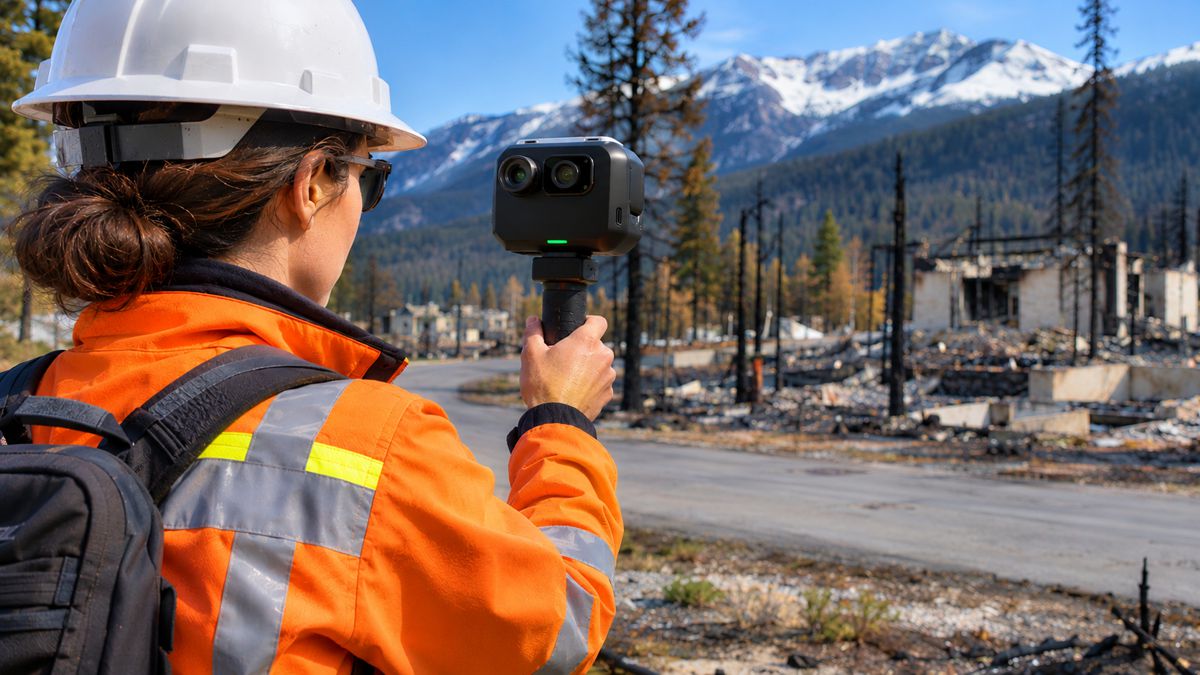
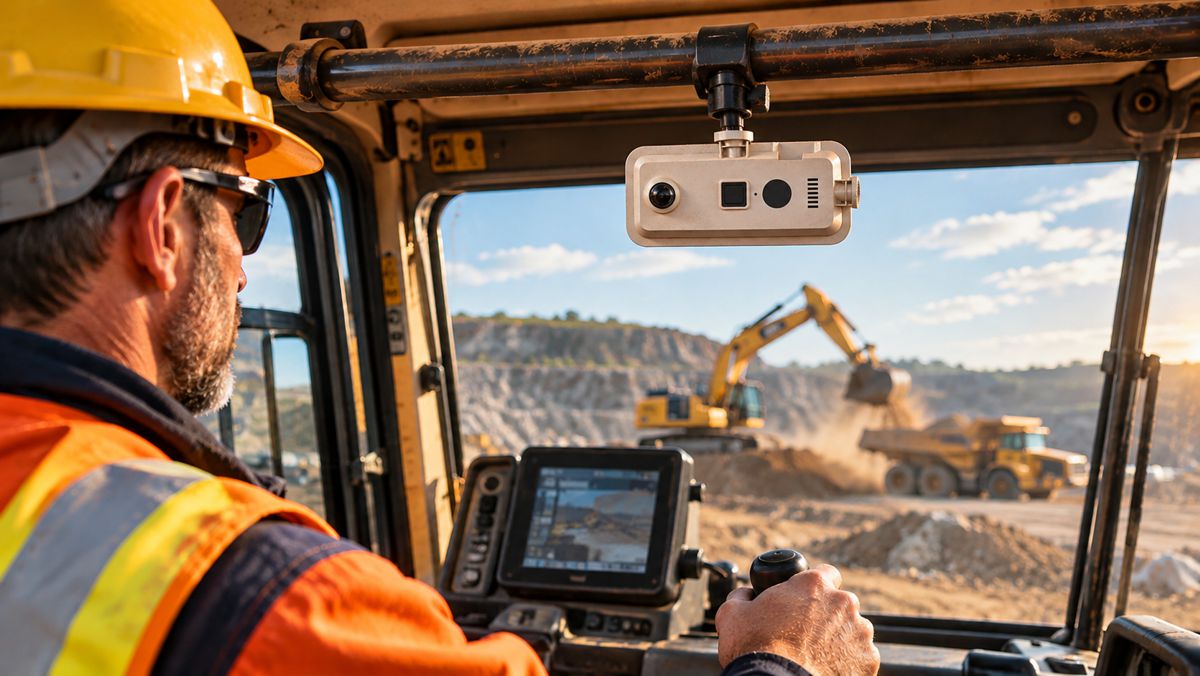
Samsara’s new system takes a different approach, using two opposing fisheye lenses within a single housing to record the operator, controls and surrounding environment. Safety managers can examine recorded footage interactively, panning around the scene and zooming into particular areas to reconstruct the circumstances of an incident without switching between separate camera feeds.
The camera is designed for demanding operating conditions, with infrared capability for low-light recording and a stated temperature range of -40°C to 75°C. It connects through a Samsara Vehicle Gateway, which provides power and mobile connectivity, while local video storage allows footage to be retained when an immediate upload is unavailable. The compact arrangement should simplify some aspects of installation, particularly where operators are retrofitting equipment that was not originally supplied with camera monitoring.
The Practical Limits of Panoramic Vision
Capturing a complete angular panorama is different from providing an unobstructed view of every hazard around a machine. An excavator boom, raised loader bucket, protective structure or large load can obscure a camera’s line of sight, particularly when the unit is mounted close to the operator.
A machine working in a quarry also presents different visibility challenges from a forklift moving through a warehouse. Fisheye lenses distort the apparent shape and distance of objects towards the edges of the image, while mud, dust and physical damage can further affect the footage. These limitations are familiar to manufacturers of conventional surround-view equipment, where camera positioning and calibration remain essential to obtaining useful coverage.
There is a further distinction between recording an incident and actively preventing a collision. Samsara’s new camera is principally presented as an operator monitoring, coaching and incident investigation system. Its published detection functions concern behaviour and events such as mobile phone use, seat belt use and impacts, rather than comprehensive automatic pedestrian detection around a moving machine.
For construction equipment, panoramic recording can help establish what an operator was doing and what was happening nearby when an incident occurred. It remains a complementary technology to established safety measures such as pedestrian segregation, operator training, effective visibility arrangements and appropriately selected proximity warning systems.
AI Monitoring Moves Beyond Road Vehicles
Samsara has developed much of its camera technology around commercial road transport, where forward-facing and driver-facing systems are used to investigate collisions, identify risky behaviour and support driver coaching. Extending similar capabilities to construction machinery introduces complications because equipment operators perform tasks that differ substantially from driving a lorry.
An excavator operator may repeatedly turn to observe the bucket, look behind the cab or concentrate on a banksman’s signals. Forklift operators change direction and body position throughout the working day, particularly when loading pallets, reversing through confined spaces or checking the position of a raised load. An AI system trained primarily on road driving behaviour would need to account for these movements to avoid generating unnecessary warnings.
Samsara says its equipment-specific models can identify mobile phone use, camera obstruction, seat and lap belt use, and harsh impacts. When an impact is detected, associated footage can be directed to the Samsara Safety Inbox, allowing managers to review the circumstances and arrange follow-up coaching. The value of these detections will depend on their accuracy and whether supervisors can distinguish unsafe behaviour from the normal physical demands of operating machinery.
David Gal, Samsara’s Vice President of Product and Engineering, described the conditions behind the development: “The frontline workers operating forklifts, excavators, and ground equipment do some of the riskiest work in physical operations,” he said. “These machines have open cabs, no windshield, no roof, and hazards on every side. We built a camera tough enough to work in those conditions and see all the way around the operator, so customers can protect frontline workers on the warehouse floor, the job site, and the ramp the same way they do on the road.”
The ability to associate recorded events with particular machines, operators and locations could make recurring problems easier to identify. However, video evidence still requires interpretation within the context of the task being performed, especially where operators are required to move their heads and bodies continually to maintain a safe view of the working area.
Equipment Utilisation and Maintenance in One Platform
The camera forms part of the wider Samsara for Equipment offering, which combines safety monitoring with operational data from connected machinery. Fleet managers can review engine hours, idling, utilisation and maintenance requirements alongside incident records, bringing information that might otherwise sit in several separate systems into one management environment.
This has practical appeal for contractors operating mixed fleets. A business running excavators, wheel loaders, site dumpers and commercial road vehicles may already rely on several manufacturer telematics portals, a separate workshop maintenance system and another platform for vehicle safety. Bringing selected functions together could reduce administrative duplication, although the depth of information available will depend on machine compatibility and the data provided through each connection.
Maintenance scheduling is a particularly useful application because off-highway machinery can accumulate substantial operating hours without travelling significant distances. Servicing according to engine hours rather than fixed calendar intervals can better reflect actual usage, while fault information may support automated work orders where the necessary machine data and maintenance integrations are available.
Utilisation records can also help establish whether equipment is being deployed efficiently. A contractor with several wheel loaders at different sites might find substantial differences in operating hours, while a warehouse operator could use peak utilisation data to assess whether its forklift fleet is appropriately sized. Combining these records with safety information provides a more complete operational history of each machine, without requiring supervisors to move between unrelated management platforms.
Airport Ground Support Equipment
One of the launch’s more substantial operational references comes from Alaska Airlines, which is using Samsara’s 360 Camera across its ground support equipment.
Airport ramps present unusually concentrated risks because baggage tractors, pushback vehicles, belt loaders and service equipment operate close to aircraft and ground personnel. Even relatively minor contact with an aircraft can lead to inspections, repairs and disruption to flight schedules, making reliable incident evidence particularly valuable.
Ground handling also involves repetitive vehicle movements within tightly controlled working areas. Video recordings can help supervisors examine how equipment approached an aircraft, where pedestrians were positioned and whether the operator followed the relevant procedure. The ability to retrieve footage quickly is particularly useful when an incident must be investigated before equipment or an aircraft can return to service.
Mehdi Jnah, Director of Ground Support Equipment at Alaska Airlines, said the system was extending the airline’s existing camera coverage to additional equipment categories: “With the 360 Camera, we extend safety to every type of ground service equipment on the ramp. Baggage tractors, tugs, pushbacks — each with its own unique demands and operating procedures.”
The airline reports faster access to recorded evidence for incident investigation, although the launch announcement does not establish a quantified reduction in aircraft damage, workplace accidents or insurance costs attributable to the camera. Such results would provide a useful measure of its performance beyond the operational benefits described by the customer.
Workplace Safety and Incident Evidence
The forklift safety figures cited in Samsara’s announcement come from historical US Occupational Safety and Health Administration estimates. The figures of approximately 85 fatalities and 34,900 serious injuries annually can be traced to OSHA’s 1995 proposed powered industrial truck training rule, rather than a current assessment of annual workplace accidents.
More recent National Safety Council figures recorded 84 work-related deaths involving forklifts, order pickers or powered platform trucks in the United States during 2024. The Council also identified 25,110 cases involving days away from work, job restriction or transfer across 2023 and 2024. Changes in reporting definitions and methodologies prevent direct comparison with the older OSHA estimates, but the figures demonstrate that powered industrial trucks remain a significant workplace hazard.
Video systems can contribute to investigations by preserving a record that might otherwise be unavailable, particularly where witness accounts differ or the circumstances are difficult to reconstruct. Their effectiveness as preventive tools depends on whether recorded incidents lead to changes in training, working procedures or equipment arrangements, rather than simply providing evidence after an accident.
Continuous recording also raises questions about workforce privacy and the handling of personal data. Employers will need clear policies governing access to footage, retention periods and the circumstances in which recordings may be used for safety management, performance assessment or disciplinary proceedings. Applicable data protection and employment requirements will vary between jurisdictions, particularly for organisations operating across several countries.
Installation, Connectivity and Fleet Adoption
For equipment owners considering the system, installation practicality will be an immediate consideration. A single camera housing removes the need to position several separate lenses around a machine, but suitable mounting remains essential, particularly where booms, protective structures or attachments can obstruct the field of view.
Compatibility with the Samsara Vehicle Gateway, power requirements and mobile network coverage will also influence deployment. Remote construction sites, quarries and underground operations may have unreliable connectivity, making local recording and subsequent video retrieval important parts of the operating arrangement. Companies will need to establish how footage is retained, uploaded and accessed under the conditions encountered at their own sites.
The commercial assessment extends beyond the camera itself. Hardware, installation, connectivity, software subscriptions, integration and ongoing support all contribute to ownership costs. Samsara has announced availability of the camera and equipment platform, but the launch does not provide a comparative total cost of ownership assessment against existing multi-camera systems or specialist off-highway safety equipment.
Managing Mixed Equipment Fleets
Samsara is entering a market where surround-view cameras, proximity detection and AI-assisted machine monitoring are already commercially available. Its offering combines panoramic recording and operator behaviour analysis with incident management and equipment telematics, giving businesses that already use its road fleet technology a possible route to extending the same management environment across their construction and industrial equipment.
The practical test will come from deploying the system across machinery with very different configurations and working patterns. Camera placement that performs well on a forklift may be unsuitable for an excavator, while the connectivity, recording and coaching requirements of an airport ramp will differ from those of a remote quarry. Whether a common platform can accommodate those differences without compromising the usefulness of its data will determine how widely the approach can be adopted.
Key Industry Questions
- What is the Samsara 360 Camera for Equipment? It is a single-mount panoramic camera using two fisheye lenses to record equipment operators and their surroundings, with AI-based safety detection and remotely accessible footage through Samsara’s connected operations platform.
- Which machines can use the camera? Samsara identifies forklifts, excavators and airport ground support vehicles among its applications. Individual machine compatibility and installation requirements should be confirmed before deployment.
- How does it differ from conventional 360-degree camera systems? Conventional surround-view systems commonly combine several cameras positioned around a machine. Samsara uses two fisheye lenses in one housing, with recorded footage connected to operator monitoring and equipment management workflows.
- Does the Samsara camera detect pedestrians? The published features of this particular camera concentrate on operator behaviour, restraint use, camera obstruction and impacts. Comprehensive automatic pedestrian collision warning is not established as a capability of the product.
- Can the camera record when mobile coverage is unavailable? The system includes local video storage, with uploading and remote access handled through the connected Vehicle Gateway. Practical retrieval and retention arrangements depend on the recording configuration and available connectivity.
- Can video evidence assist accident investigations? Timestamped footage can help reconstruct events, identify contributing factors and support insurance or regulatory investigations, provided the relevant activity was captured at sufficient quality.
- Does Samsara for Equipment support preventive maintenance? The platform incorporates operating data, including engine hours and fault information, to support maintenance scheduling and workflows where compatible machine data and integrations are available.
- Is the Samsara 360 Camera commercially available? Samsara announced availability on 12 November 2026. Pricing, regional support, subscriptions and equipment compatibility should be confirmed directly with the company.
Strategic Takeaways
- Simpler retrofitting: A single camera housing could reduce installation complexity, although mounting position and machine geometry still determine effective coverage.
- Better incident reconstruction: Panoramic recording linked to operational data can provide additional evidence for investigations and operator coaching.
- Equipment-specific detection: AI monitoring must account for the physical movements and working practices of off-highway machinery operators.
- Consolidated fleet information: Combining safety, utilisation and maintenance records could reduce dependence on multiple equipment management platforms.
- Performance verification: Fleet owners should assess false-alert rates, actual camera coverage, connectivity, data retention and total ownership costs before wider deployment.