NETGEAR Takes On Cisco and Extreme With AI Network Management for SMEs
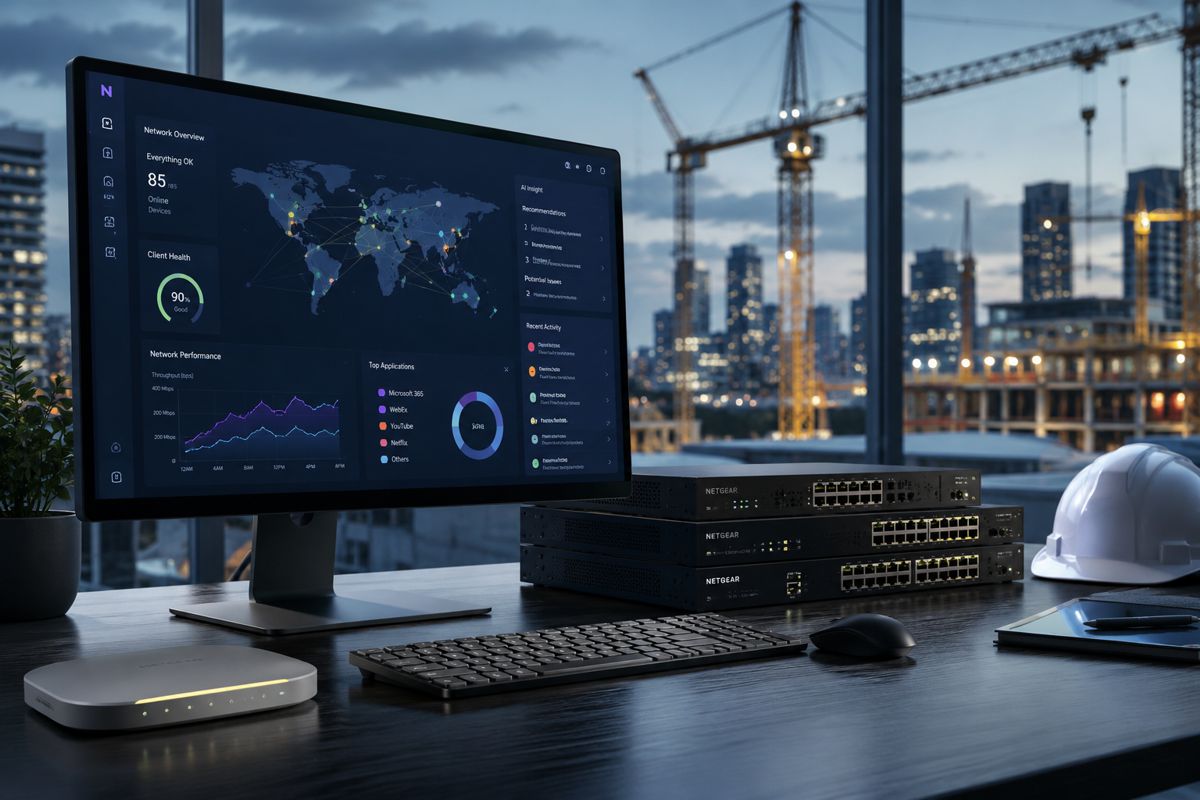
NETGEAR has released Insight 10.0, the latest generation of its cloud network management platform, and framed it as the starting point for what the company calls AIOps and, eventually, AI-defined networking for small and medium-sized enterprises.
The headline is artificial intelligence, but the story that matters to investors and channel partners sits underneath it. A company still widely known for consumer routers and business switches is trying to convert hardware customers into recurring software subscribers, and it is doing so by chasing a mid-market that the large enterprise vendors have never served well. The launch is best read as a commercial repositioning dressed in the language of intelligent operations.
The logic is straightforward once the market context is clear. Cisco, HPE Aruba Networking, Juniper Networks and Extreme Networks have spent years embedding telemetry, machine learning and automation into their management platforms, building AIOps tooling that assumes a dedicated network operations team to consume it. That model works for large organisations and leaves a substantial gap beneath it, populated by businesses with fewer than 500 staff, distributed sites, franchise operators and the managed service providers that keep them running.
These customers face the same complexity as larger firms, driven by cloud adoption, connected devices, hybrid working and now AI workloads, without the headcount to manage it. NETGEAR is positioning Insight 10.0 as the platform that brings enterprise-grade intelligence into that space without the enterprise-grade operational burden.
Briefing
- Insight 10.0 is available now to existing users and is built on four stated pillars: AI-powered operations, unified network intelligence, simplicity at scale and a secure cloud-native foundation.
- The release adds AI-assisted workflows, contextual insights and proactive recommendations, alongside a redesigned interface, faster onboarding and streamlined subscription management under a single comprehensive tier.
- The strategic target is the mid-market gap left by enterprise AIOps vendors, aimed squarely at SMEs and the MSPs that serve multi-site and multi-customer estates.
- The launch advances NETGEAR’s pivot from hardware toward recurring software and services revenue, following its 2025 acquisition of SASE specialist Exium.
- Much of the AI capability is described as a foundation for future functionality rather than shipped product, making execution over the next release cycle the key variable to watch.
The Commercial Case Behind The Software Pivot
The most significant part of this announcement is not technical, it is financial. NETGEAR, listed on the Nasdaq under NTGR and headquartered in San Jose, reported first-quarter 2026 net revenue of 158.8 million US dollars, down two per cent year on year, though gross margins improved markedly, with GAAP gross margin rising to 40.5 per cent from 34.8 per cent a year earlier.
A hardware business under revenue pressure but expanding margins has a clear incentive to build higher-margin, recurring software income, and cloud network management delivered on subscription is precisely that kind of revenue. Insight is the vehicle, and moving customers from one-off box purchases to ongoing platform relationships is the commercial objective that the AI messaging supports rather than replaces.
That ambition also explains the deliberate simplification of the commercial model. NETGEAR has consolidated Insight into a single comprehensive subscription tier and streamlined how subscriptions are managed across sites and customer environments. For a lean IT team or an MSP juggling dozens of client estates, licensing friction is a real operational cost, and reducing it lowers the barrier to committing to the platform at scale. The redesigned interface, faster onboarding and flexible access controls all serve the same end, which is to make Insight sticky enough that customers standardise on it and keep paying. Recurring revenue is only valuable if it recurs, and ease of operation is what determines whether it does.
Pramod Badjate, President and General Manager of NETGEAR Enterprise, who joined the company from senior roles at Arista, Ruckus and Cisco, set out the thesis in blunt terms. “The future of networking is about giving organizations the intelligence to operate increasingly complex environments with confidence,” he said. “As AI transforms every business, networks must become more adaptive, more automated, and easier to operate. Insight 10.0 is the foundation for our vision of AIOps and AI-defined networking for the millions of small and medium-sized organizations that have historically been underserved by enterprise networking solutions. We’re bringing enterprise-class intelligence to businesses without enterprise-sized IT teams.”
The reference to millions of underserved organisations is the total addressable market NETGEAR is claiming, and the whole enterprise strategy rests on capturing a meaningful share of it.
The MSP Channel Is The Real Route To Market
For a vendor targeting businesses without dedicated network teams, managed service providers are not a secondary audience but the primary distribution channel. MSPs aggregate demand from hundreds of small customers, and a platform that lets them onboard, monitor and troubleshoot many client environments from one interface directly improves their delivery economics.
Insight 10.0 leans into this with multi-tenant management, simplified navigation and subscription handling designed for portfolios rather than single organisations. The commercial appeal for NETGEAR is leverage, since winning one MSP can mean winning its entire book of downstream customers, and the platform is clearly engineered to make that switch attractive.
This is also where the competitive contest is sharpest. Extreme Networks has been courting the same MSP-friendly, multi-tenant territory, and Cisco’s Meraki franchise has long defined what simple cloud-managed networking looks like for smaller sites. NETGEAR’s wager is that it can undercut the complexity and cost of those incumbents while offering the reliability and support that smaller firms still expect. The customer testimony accompanying the launch speaks directly to that integrator economics case.
Kenny Red, CTO at CTI, framed the release in terms of billable time rather than features, noting “We’ve had NETGEAR switches deployed across our own locations for years, and we’ve been part of the Insight development process since beta. So when we recommend Insight 10.0 to customers, we’re recommending something CTI actually runs on. The 10.0 release reflects the feedback we gave — the interface is sharper, onboarding is faster, and the platform handles the two things that cost integrators the most time: post-deployment troubleshooting and manual network configuration. That’s a meaningful change, and it shows up in how we deliver.”
When an integrator points to troubleshooting and configuration time as the metric, it signals that the platform’s value is being measured in labour saved, which is the currency MSP margins are built on.
What Insight 10.0 Actually Delivers, And What It Promises
The platform rests on four pillars, and it is worth separating what ships today from what is described as groundwork. AI-powered operations embed intelligence into the management experience through contextual insights, proactive recommendations and AI-assisted workflows intended to move teams from reactive troubleshooting toward earlier detection of problems.
Unified visibility consolidates network performance, device health, connectivity and user experience into a single view, on the reasoning that operational data only becomes useful once it is turned into a clear signal an administrator can act on. Simplicity at scale addresses the multi-site and multi-customer sprawl that generates administrative drag, while the secure cloud-native foundation provides the centralised, controllerless architecture that the platform’s datasheet describes, covering access points, switches, routers, security and mobile hotspots.
A degree of caution is warranted about how much of the intelligence is live rather than aspirational. NETGEAR repeatedly describes Insight 10.0 as the first step and the foundation for a broader AIOps and AI-defined networking vision, language that positions predictive, intent-driven operation as a direction of travel rather than a delivered capability.
The concrete improvements customers can point to at launch are the redesigned interface, quicker onboarding, streamlined subscriptions and better visibility, which are meaningful operational gains but sit some distance from autonomous, self-optimising networks. That gap between vision and shipped product is not unusual for a platform release, yet it is the variable that will determine whether the AIOps framing proves durable or merely marketing. The next two or three releases will show whether the foundation carries real weight.
Security Convergence And The Single-Pane Strategy
Insight 10.0 does not stand alone, and its longer-term value is tied to NETGEAR’s broader effort to fold security into the same platform. In 2025 the company acquired Exium, a Secure Access Service Edge specialist built with MSPs in mind, and committed to integrating its capabilities into Insight through 2027, beginning with the PR60x router series and extending across Wi-Fi 6 and Wi-Fi 7 access points, AV-over-IP products and 5G mobile hotspots.
The intent is a single interface where administrators configure VLANs, segmentation, firewall rules and zero-trust policies together, eliminating the mismatches that arise when networking and security are managed in separate tools. For SMEs, that convergence is arguably more valuable than the AI headline, because misconfiguration between disjointed systems is a persistent source of both operational cost and security exposure.
The market backdrop reinforces why NETGEAR is pursuing this. Gartner has projected the SASE market to grow at a 29 per cent compound annual rate toward more than 25 billion US dollars by 2027, and reporting on the Exium integration has cited Verizon breach data indicating that smaller enterprises absorbed several times as many security incidents as large enterprises in 2025.
A platform that pairs cloud-managed networking with integrated security, sold through the MSP channel under a simplified subscription, addresses a genuine and expanding need. Insight 10.0 is the management layer through which that combined proposition will be delivered, which is why the release matters beyond its immediate feature set. The AIOps story and the security convergence story are two halves of the same commercial bet on becoming the default operating platform for mid-market networks.
The Policy Backdrop That Sharpens The Strategy
There is a regulatory dimension that gives the software pivot additional urgency. In March 2026 the US Federal Communications Commission announced a ban on foreign-made, consumer-grade routers on national security grounds, citing supply-chain vulnerabilities and referencing state-linked cyber campaigns.
NETGEAR, which manufactures in Taiwan, Vietnam and Indonesia, became the first company to secure a conditional exemption in April 2026 after the Department of Defense determined that certain of its products did not pose unacceptable risk, with that approval running to October 2027. The reprieve removed an immediate threat to part of its hardware business, but it also underlined how exposed a hardware-dependent revenue base can be to policy shifts largely outside a company’s control.
Against that backdrop, building recurring, cloud-delivered software and services revenue is not only a margin play, it is a resilience play. Platform and subscription income is insulated from the tariff, import and supply-chain risks that increasingly shadow the physical networking market, and it deepens customer relationships in ways that a one-off hardware sale does not.
Insight 10.0 therefore fits a strategy that reads as much defensive as opportunistic, reducing reliance on a hardware model facing both competitive and regulatory headwinds. For investors weighing NETGEAR’s enterprise ambitions, the platform’s traction with MSPs and its conversion of hardware customers into subscribers are the metrics that will indicate whether the pivot is working.
Where NETGEAR Goes From Here
The measure of Insight 10.0 will not be the AI vocabulary in its launch materials but the execution over the releases that follow. NETGEAR has identified a real and underserved segment, has a credible channel strategy built around MSPs, and has begun assembling a combined networking and security proposition that could differentiate it from both the enterprise incumbents above it and the commodity vendors below.
The immediate gains in onboarding, visibility and operational simplicity are tangible, and the customer evidence suggests they translate into saved time for the integrators who ultimately sell the platform on. Those are the foundations of a defensible mid-market position, provided the company keeps delivering against them.
The open question is whether the promised intelligence materialises at the pace the messaging implies. Moving from proactive recommendations to genuinely predictive, intent-driven operation is a substantial engineering undertaking, and the enterprise vendors NETGEAR is implicitly challenging have years of head start in the underlying machine learning and telemetry.
If Insight evolves into a platform that meaningfully reduces the operational load on small teams while integrating security convincingly, NETGEAR will have converted a hardware franchise into a durable recurring-revenue business. If the AI remains largely framing around incremental interface improvements, the pivot will stall against better-resourced competition.
The next twelve to eighteen months of releases, and the subscription numbers that accompany them, will settle which of those outcomes prevails.