Smart Vibration Isolation Could Give Precision Machinery the Ability to Adapt
A research team at Pusan National University has built a vibration isolator that senses a change in load and re-tunes itself within seconds, and it arrives at a moment when the commercial value of that capability has rarely been higher. The world’s chipmakers are pouring record sums into new fabrication plants, the tolerances on those plants are tightening toward the picometre, and the hardest vibrations to suppress are exactly the low-frequency ones that conventional isolation handles worst. Into that gap steps a device its designers describe as a smart cushion, one that addresses the two problems that have kept a promising class of isolators out of production environments for years.
The work matters less as a laboratory curiosity than as a signal of where competitive advantage in precision isolation is heading. Quasi-zero stiffness isolators have long offered a theoretical answer to low-frequency vibration, yet their sensitivity to payload and their tendency toward unstable behaviour have confined them largely to the bench. By using ordinary electric actuators and a two-part control scheme to solve both faults at once, the Pusan team has pointed at a lower-cost, software-defined route into a market currently dominated by expensive piezoelectric hardware.
For infrastructure owners, equipment builders and investors watching the semiconductor build-out, the interesting question is not how the mechanism works but who captures the value as isolation becomes adaptive.
Briefing
- A team led by Professor Seunghun Baek at Pusan National University’s School of Mechanical Engineering has developed a controllable quasi-zero stiffness (QZS) isolator that uses motor actuation to compensate for payload changes and eliminate the residual resonant peak, published in Mechanical Systems and Signal Processing on 1 August 2026.
- The design solves the two failings that have kept passive QZS isolators off the production floor: performance collapse when the payload changes, and a leftover resonance that can drive large oscillations and even chaotic motion.
- The commercial backdrop is a record semiconductor investment cycle, with SEMI forecasting worldwide 300mm fab equipment spending of $133 billion in 2026, up 18 per cent, rising to $151 billion in 2027.
- Advanced lithography and metrology tools demand stability in the 1 to 10 Hz band and vibration budgets measured in picometres, the precise low-frequency regime where conventional isolators struggle and QZS designs excel.
- The active vibration isolation market remains fragmented and reliant on piezoelectric and voice-coil actuators; a self-retuning motor-and-spring approach hints at where cost and differentiation could shift.
Why Chip Investment Turns a Laboratory Problem Into a Commercial One
The reason this research reads as commercially significant rather than merely clever lies in the scale of spending now committed to advanced manufacturing. According to SEMI, worldwide 300mm fab equipment spending is set to climb 18 per cent to $133 billion in 2026 and a further 14 per cent to $151 billion in 2027, the first time the figure will pass $150 billion.
Ajit Manocha, the association’s chief executive, framed the shift bluntly, noting that “AI is resetting the scale of semiconductor manufacturing investment.” That capital is not evenly distributed. It concentrates in leading-edge logic and memory, the two segments where feature sizes are smallest and stability requirements most punishing.
South Korea, where the Pusan research originates, sits at the centre of that expansion through its memory sector. Samsung alone has signalled spending of more than 110 trillion won, roughly $74 billion, in 2026 to hold its position in AI-related memory. Every one of those fabs depends on holding lithography and inspection tools steady to a degree that would have seemed absurd a generation ago.
When a single facility can cost tens of billions and its yield hinges on nanometre-scale patterning, the economic weight attached to vibration control climbs with it. A component that was once a line item in a laboratory budget becomes a factor in the return on a national industrial strategy.
Why Passive Isolation Runs Out of Road on the Fab Floor
The engineering problem the Pusan team set out to solve is old and stubborn. Conventional isolators place springs and dampers between a sensitive load and its surroundings, but they carry an inherent trade-off. Suppressing low-frequency vibration calls for a very soft spring, yet a soft spring cannot reliably hold a heavy static load.
Quasi-zero stiffness designs escape that bind by pairing a positive stiffness element that carries the weight with a negative stiffness element that cancels most of the dynamic stiffness, giving high static support and very low dynamic response at once. On paper this is close to an ideal answer for the ultra-low-frequency vibration that dominates building floors, traffic and mechanical services.
In practice, two faults have kept passive QZS isolators from earning a place in production environments. Their performance is tuned to one specific payload, so any change in weight can degrade or destroy the isolation entirely. They also leave a residual resonant peak untouched, which can produce large-amplitude oscillations and, under certain conditions, tip the system into chaotic motion.
For a fab tool that must sit within a tightly specified vibration envelope, either fault is disqualifying. The industry has generally answered the low-frequency challenge instead with active systems built around piezoelectric or voice-coil actuators, effective but costly, which is precisely the incumbency the Pusan approach sets out to undercut.
A Rhombus, Two Springs and a Pair of Motors
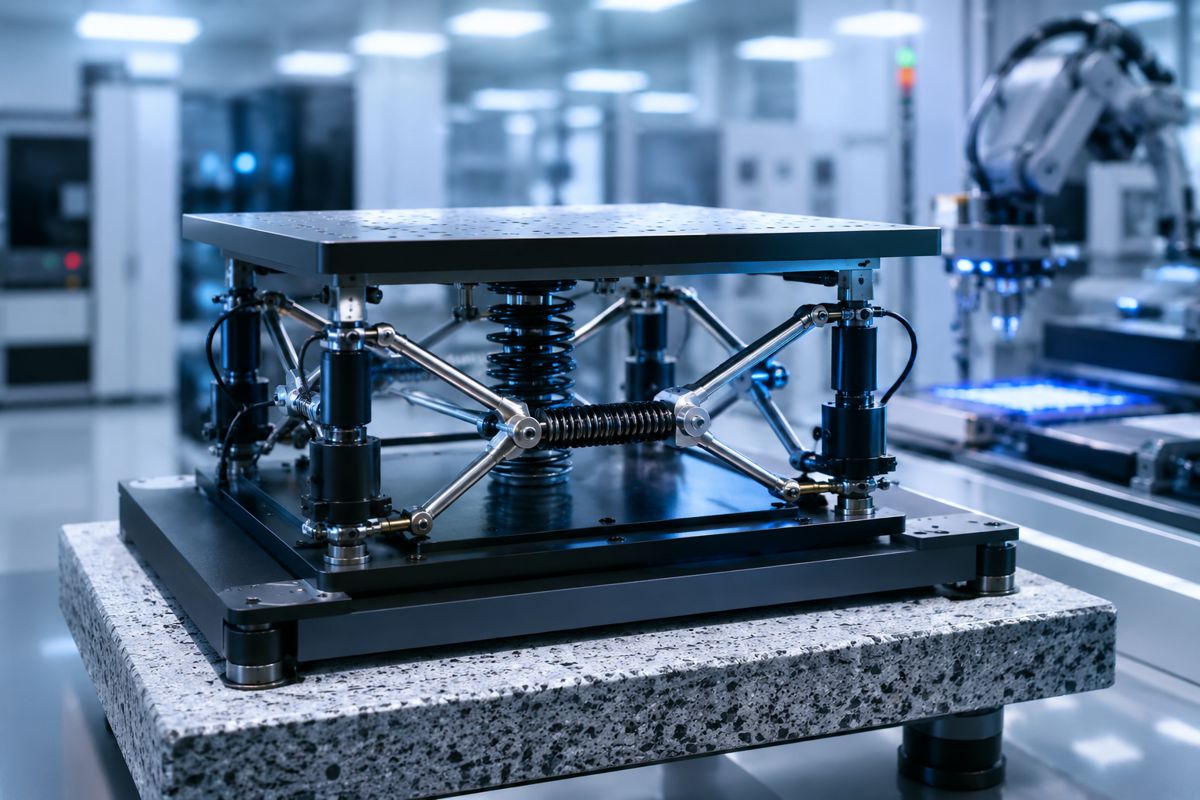
The device at the heart of the study is a rhombus-shaped mechanism of four identical links, two fixed vertical springs and a single horizontal spring. In its passive form it behaves like any other QZS isolator, highly sensitive to how much weight sits on top. The team’s intervention was to place electric actuators at the joints where the horizontal spring connects, then use those actuators to change the spring’s pretension and therefore its effective initial length. That length becomes the control variable, the single dial through which the whole system can be adjusted on the fly.
What gives the design its reach is a hybrid control strategy built from two cooperating laws. The first handles payload. By altering the effective length of the horizontal spring, it shifts the equilibrium point so the zero-stiffness condition holds even as the load changes, curing the payload sensitivity that hobbles passive designs. The second law puts the same actuators to work in real time, reading the system’s current state and generating a counteracting force that pins the payload at equilibrium and cancels the residual resonance outright.
Professor Baek summarised the logic in terms an engineer would recognise, observing that “Our hybrid control strategy effectively addresses the static payload-matching problem and the dynamic resonance problem as two coupled aspects of a single control challenge.” Treating the static and dynamic faults as one problem rather than two is the conceptual move that makes the single actuator set do double duty.
What the Prototype Actually Demonstrated
A working prototype backed the theory with measured results, and the numbers matter for judging how far the idea has travelled. The payload-compensation law kept the isolator’s low-frequency performance intact across loads from 1.01 kg to 1.21 kg, a range over which a passive system would have lost its isolation. The resonance-elimination law removed the residual ultra-low-frequency peak completely under a 1.11 kg payload. Professor Baek set out the mechanism the isolator uses to modulate its behaviour plainly, describing a “controllable QZS isolator that utilizes motor actuation to address both payload variations and vibrations associated with the residual resonant peak.”
The scale of those figures should temper as well as encourage. A payload band of roughly 200 grams around a one-kilogram load is a laboratory demonstration, not a fab-floor specification, and the prototype addresses a single axis rather than the six degrees of freedom a real tool experiences. What the experiment establishes is the principle: that inexpensive motor actuation, driven by the right control architecture, can make a QZS isolator adapt to changing weight and suppress its own worst resonance. Scaling that from a bench rig carrying a kilogram to a platform carrying a lithography stage is a substantial engineering programme, but it is a programme of development rather than a search for a new idea.
Where the Commercial Value Is Concentrating
The market this could disturb is larger and more specialised than the mechanism suggests. Advanced lithography and metrology tools require stability in the 1 to 10 Hz band with vibration budgets that industry criteria now push into the picometre range. Fabs are specified against the VC-A to VC-E scale, and the most demanding tools at the leading edge sit at VC-E or beyond, where a passive concrete floor cannot deliver the required quiet on its own. That is the low-frequency territory where conventional isolators fade and where QZS designs are theoretically strongest, which is why the research community keeps returning to them despite their practical faults.
Commercially, active isolation today leans on piezoelectric and voice-coil actuators supplied by a concentrated set of specialists. Technical Manufacturing Corporation, now part of AMETEK, has made its STACIS active piezoelectric platform something close to a reference standard among lithography tool builders, while Newport, part of MKS Instruments, and firms such as Kinetic Systems, Herzan, Integrated Dynamics Engineering and Minus K Technology occupy the rest of a fragmented field.
Market-research estimates put the top five suppliers at only around a third to two-fifths of the global total, a structure that leaves room for a differentiated entrant. A motor-and-spring isolator that re-tunes itself in software points at two competitive levers at once, lower actuator cost and adaptability that fixed-payload hardware lacks, and it is worth noting that Korea already hosts precision-isolation names such as Daeil Systems and Park Systems close to the memory fabs driving demand.
Beyond the Cleanroom: Robotics, Aerospace and the Self-Tuning Machine
The applications the Pusan team names stretch well past the fab. An isolator that senses a change in weight and adjusts itself has obvious value wherever the load is not fixed, and that describes a great deal of modern automation.
Professor Baek pointed directly at that breadth, suggesting the smart cushion “could inspire isolators that automatically sense a change in weight and re-tune themselves in seconds. This will be crucial for fields like chip manufacturing where precision is paramount, and even for robots carrying fragile goods.” A robot arm whose payload varies from cycle to cycle, an aerospace instrument exposed to shifting mass distributions, or an automotive sensor package all present the same moving target that defeats a statically tuned passive isolator.
That framing places the research within a broader shift toward mechanical systems that adapt rather than merely resist. The dominant active-isolation platforms already correct dynamically, but they generally do so around a fixed operating point, assuming the load stays put. The distinctive claim here is adaptation of the static equilibrium itself, so the isolator remains optimally tuned as conditions change rather than only damping around a preset condition.
For equipment builders, that is the difference between a component specified for one job and a subsystem that can be reused across a family of machines with different loads, which changes the procurement calculation as much as the engineering one.
From Prototype to Production
For the industry professionals watching this space, the sensible reading is directional rather than immediate. Nothing about a kilogram-scale, single-axis prototype is ready to sit under a lithography stage, and the incumbents hold deep advantages in qualification, reliability data and customer trust that a university demonstration cannot touch.
What the work does is validate a design path that lowers the cost of entry and adds a capability, self-retuning to payload, that the installed base does not offer. In a market expanding on the back of record fab investment, a credible lower-cost and more adaptable approach is exactly the kind of development that reshapes supplier positions over a decade rather than a quarter.
The strategic takeaway for infrastructure owners, tool builders and investors is to treat vibration isolation as an active technology frontier rather than a settled commodity. As nodes shrink toward 2nm and below and stability budgets tighten further, the premium on low-frequency isolation will rise, and the suppliers who combine adaptability with cost discipline stand to benefit most.
The Pusan research does not settle who those suppliers will be, but it marks the direction of travel clearly enough. Isolation is moving from passive hardware toward adaptive, software-defined systems, and the value is following the intelligence rather than the springs.
Key Industry Questions
- What is a quasi-zero stiffness isolator and why does it suit low-frequency vibration? A quasi-zero stiffness isolator pairs a positive stiffness element that supports the static load with a negative stiffness element that cancels most of the dynamic stiffness. The result is high static support combined with very low dynamic response, which allows it to suppress vibration at frequencies where a conventional soft-spring isolator would be unable to hold the load. That low-frequency band, roughly 1 to 10 Hz, is where building floors, traffic and mechanical services transmit the most disruptive energy into sensitive equipment. It is also the regime where linear isolators perform worst, which is why QZS designs have attracted sustained research interest despite their practical limitations around payload and stability.
- Why have passive QZS isolators struggled to reach production environments? Two faults have held them back. Their performance is tuned to one specific payload, so any change in the weight they carry can degrade or eliminate the isolation. They also leave a residual resonant peak in place, which can drive large-amplitude oscillations and, in some conditions, chaotic motion that is unacceptable in precision settings. For a semiconductor tool that must remain within a tightly defined vibration envelope, either failure mode is disqualifying. The Pusan design targets both faults directly by using electric actuators and a two-part control scheme, which is what distinguishes it from the passive QZS work that preceded it.
- How significant is the semiconductor investment cycle to this technology? It is central to the commercial case. SEMI forecasts worldwide 300mm fab equipment spending of $133 billion in 2026, an 18 per cent rise, climbing to $151 billion in 2027. Much of that capital funds leading-edge logic and memory, where feature sizes are smallest and stability requirements most severe. South Korea’s memory sector, including Samsung’s planned spending of more than 110 trillion won in 2026, sits squarely in that expansion. Because each advanced fab depends on holding lithography and inspection tools stable to picometre levels, the economic value attached to vibration control rises directly with the scale of fab investment.
- How does this approach differ from existing active isolation systems? Established active platforms, such as piezoelectric and voice-coil systems from suppliers like TMC and Newport, correct vibration dynamically but generally do so around a fixed operating point that assumes the load stays constant. The Pusan design instead adjusts the static equilibrium itself, shifting the isolator’s zero-stiffness condition as the payload changes, then uses the same actuators to cancel residual resonance. Using ordinary electric motors rather than piezoelectric stacks also points toward lower hardware cost. The combination of self-retuning to payload and cheaper actuation is the differentiator, though it must still be proven at production scale and against the reliability records incumbents have built over years.
- What are the realistic limits of the current prototype? The demonstration is a laboratory rig operating on a single axis, compensating payloads across a narrow band from 1.01 kg to 1.21 kg and eliminating residual resonance under a 1.11 kg load. Real fab tools weigh far more, move in six degrees of freedom, and must meet qualified vibration criteria over long service lives. Bridging that gap involves substantial engineering, including scaling the mechanism, proving reliability and integrating control across multiple axes. The value of the work lies in validating the principle that inexpensive motor actuation with the right control architecture can make a QZS isolator adaptive, not in delivering a deployment-ready product.
- Which industries beyond semiconductors could benefit? Any application where the load varies stands to gain, because payload variation is precisely what defeats a statically tuned passive isolator. Robotics is an obvious candidate, particularly arms that handle different or fragile payloads from cycle to cycle. Aerospace instruments exposed to changing mass distributions, automotive sensor and camera modules, and sensitive scientific equipment such as microscopes and metrology stages all present the same challenge. The broader appeal is a component that can be reused across machines with different loads rather than tuned for a single job, which changes both the engineering and the procurement case for equipment builders.
- What does the competitive landscape look like for vibration isolation suppliers? It is specialised and fragmented. Technical Manufacturing Corporation, now within AMETEK, has made its STACIS active piezoelectric platform a reference point for lithography tool builders, with Newport, Kinetic Systems, Herzan, Integrated Dynamics Engineering and Minus K Technology among the other established names. Market-research estimates place the top five suppliers at only around a third to two-fifths of the global market, a structure that leaves space for differentiated entrants. Korea hosts precision-isolation firms including Daeil Systems and Park Systems close to its memory fabs. A lower-cost, self-retuning approach could, over time, shift supplier positions, though qualification and trust remain formidable barriers.
- What should industry leaders take from this research now? The practical message is directional. A university prototype will not displace qualified incumbents in the near term, but it validates a design path that lowers the cost of entry and adds adaptability the installed base lacks. Leaders in construction, precision manufacturing and equipment supply should treat vibration isolation as an active technology frontier rather than a settled commodity. As advanced nodes tighten stability budgets further, the premium on low-frequency isolation will grow, and suppliers combining adaptability with cost discipline are best placed to capture it. The sensible posture is to track adaptive isolation development closely and factor it into longer-term procurement and investment thinking.
Strategic Takeaways
- Vibration isolation is shifting from passive hardware toward adaptive, software-defined systems, and the commercial value is following the control intelligence rather than the springs and dampers themselves.
- The record semiconductor investment cycle, with fab equipment spending set to exceed $150 billion in 2027, is raising the economic weight attached to low-frequency isolation and turning a laboratory problem into a procurement priority.
- Solving payload sensitivity and residual resonance with inexpensive motor actuation rather than piezoelectric hardware points to a potential cost and differentiation opening in a market currently led by a concentrated set of specialist suppliers.
- The isolation market’s fragmented structure, with the top five suppliers holding only around a third to two-fifths of global share, leaves room for adaptive entrants, though qualification, reliability data and customer trust remain decisive barriers to entry.
- Self-retuning isolation has applications well beyond the fab, particularly in robotics and aerospace, where variable payloads defeat statically tuned passive designs and reusable adaptive subsystems could reshape equipment procurement.