When Industrial AI Can Send a Robot to Investigate
A vibration sensor on an industrial pump detects something unusual. Conventionally, that creates an alert, a work order or perhaps a message on an engineer’s dashboard. Someone then has to decide whether the warning deserves investigation, find the equipment and gather enough information to determine what is happening.
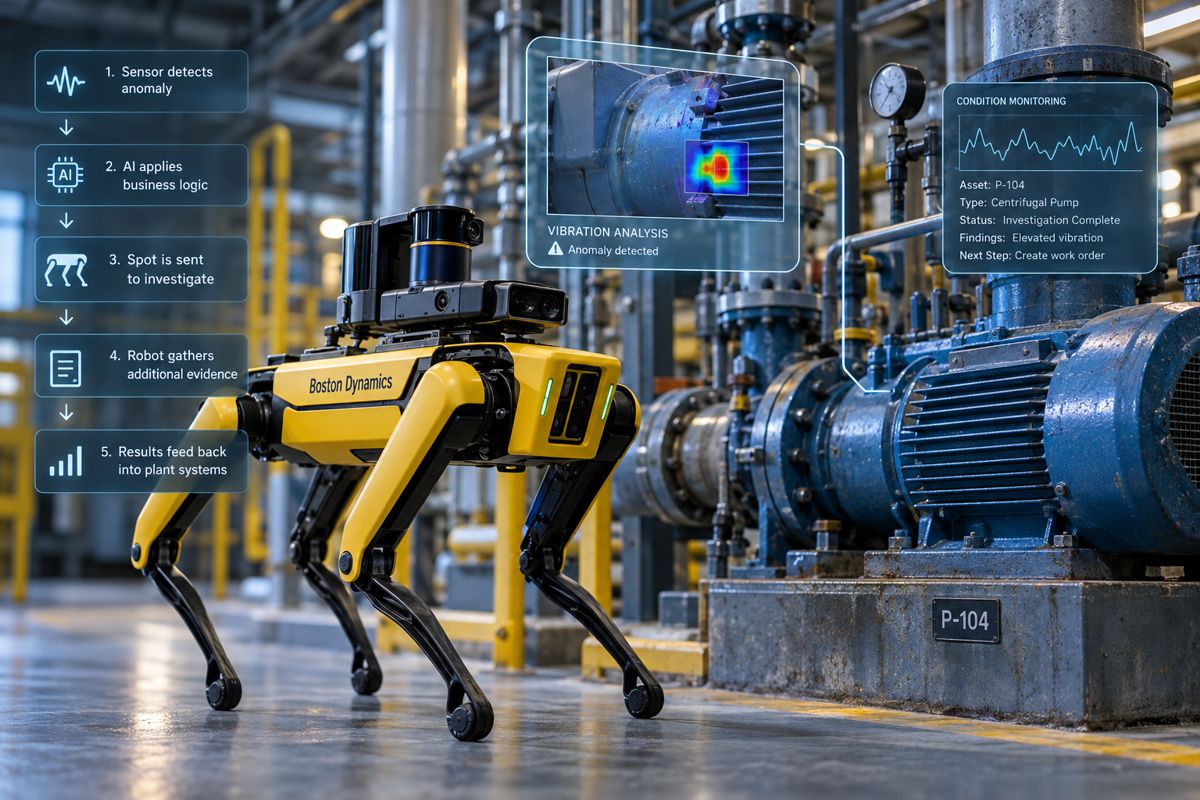
Boston Dynamics is working towards a different sequence. The sensor raises the alarm, software applies the relevant business logic and Spot is sent to investigate. The robot reaches the equipment, gathers additional information from the physical environment and feeds the results back into the plant’s digital systems.
AI systems are increasingly capable of analysing information held in enterprise software, cameras, sensors and maintenance platforms. What they have generally lacked is an independent means of going into the physical world to collect information that was not already available.
Spot 5.2 and the accompanying changes to Boston Dynamics’ Orbit software begin connecting those two environments. Rather than treating the quadruped robot as an isolated autonomous inspection machine, Boston Dynamics is positioning it as a mobile sensing platform that can increasingly become part of the wider information architecture of a factory, power station, processing plant or other industrial facility.
Briefing
- Spot 5.2 expands Boston Dynamics’ industrial inspection capabilities and the integration between Spot, Orbit and external plant systems.
- Orbit is moving towards an asset-centric architecture that can align robot inspection data with equipment represented in CMMS, MES and EAM systems.
- External inputs including PLC sensors and security cameras can be incorporated into workflows alongside information collected by Spot.
- New inspection capabilities include video analysis, gas sensing, visual vibration analysis and partial-discharge detection.
- Boston Dynamics says the architecture lays the foundation for an MCP layer through which AI agents could deploy Spot according to defined business logic.
From Inspection Routes to Industrial Assets
Spot has already been capable of navigating industrial facilities and performing repeatable inspection missions. Boston Dynamics’ GraphNav and Missions systems provide the underlying autonomous navigation and task architecture, while the Spot API allows external applications to control the robot and retrieve sensor information. The more consequential changes in 5.2 are happening around the robot.
Orbit, Boston Dynamics’ fleet management and data platform, collects and organises information generated during Spot missions and teleoperation sessions. Version 5.2 introduces a new stable, service-oriented v1 REST API intended for new integrations, alongside changes designed to organise operational information around industrial assets rather than individual inspections.
That distinction is practical. A maintenance engineer is unlikely to think primarily in terms of “inspection 2847”. The engineer is interested in Pump P-104, Transformer T2 or a particular conveyor motor and wants to know what has happened to that asset over time.
Asset hierarchies can now be imported into Orbit with metadata such as location, equipment type, criticality, manufacturer and model, then associated with inspections. A plant manager could examine anomalies across every pump in a facility, narrow the view to pumps within a particular production area or look at the history of an individual machine. Engineers responsible for specific equipment categories could receive alerts relevant to those assets rather than having to sift through the entire inspection output.
It moves robotic inspection closer to the existing structure of industrial maintenance.
Connecting the Fixed and Mobile Sensor Networks
Orbit does not have to work exclusively with information collected by Spot. Boston Dynamics says the new architecture provides API flexibility for connections with external sources including programmable logic controller sensors and security cameras. Orbit already provides APIs and webhooks that allow information collected by robots to interact with other applications, including workflows that can create an Enterprise Asset Management work order when a robot identifies an anomaly.
Connecting information in the opposite direction opens another possibility. A fixed sensor might detect abnormal behaviour and trigger a Spot mission to collect additional evidence. The robot does not necessarily need to inspect every machine repeatedly according to a fixed timetable; it can potentially be directed towards equipment because another system has already found something worth investigating.
For reliability work, Boston Dynamics gives the example of dispatching Spot when a fixed sensor generates an alert, or arranging an inspection only while particular equipment is operating. In security applications, information from CCTV or another third-party sensor could similarly provide the trigger for a robot to investigate an area.
The fixed sensor provides persistence while the robot provides mobility. That combination could be useful across large industrial sites where fixed monitoring identifies equipment requiring attention and a mobile platform carries specialised sensing equipment to the asset.
Giving AI a Physical Route into the Plant
Boston Dynamics describes these integrations as laying the foundation for a Model Context Protocol, or MCP, layer through which AI agents could deploy Spot when defined business logic is present.
Spot already provides extensive programmatic control, autonomous navigation and mission capabilities, while Orbit 5.2 introduces a stable v1 API for new integrations. Boston Dynamics is describing the MCP layer as something for which the new architecture provides a foundation, rather than presenting unrestricted AI-agent control of robots as a finished industrial capability.
Large language models and AI agents are increasingly being connected to maintenance databases, ERP platforms and other enterprise systems. Those systems can reason over records, maintenance histories, work orders and sensor data, but their understanding of a physical facility is constrained by the information available to them. A mobile robot potentially allows the software to request new evidence.
An AI system examining the condition of a motor may eventually recognise that the existing information is insufficient and request another inspection. Instead of waiting for a person to take a photograph, measure a gauge or listen to a bearing, it could dispatch a robot equipped with the appropriate sensors. Industrial AI moves from analysing observations towards deciding which observations need to be made.
Expanding What Spot Can Observe
That approach becomes more useful as the robot’s sensing capabilities broaden. Visual inspections using Boston Dynamics’ AIVI-Learning system are now powered by Google Gemini and are intended for specialised industrial tasks involving equipment including gauges and sight glasses, as well as operational conditions such as pallets and 5S boards.
Spot 5.2 also introduces video inspection through AIVI-Learning. Static photographs work well for many visual checks, but some mechanical problems reveal themselves through movement. Boston Dynamics cites dripping water around pumps and motors, slipping conveyor lines and changing indicator lights as examples where video can provide information that a still image may miss.
Site Scans extend the approach beyond predetermined assets. AIVI-Learning can analyse Site View 360-degree imagery for transient conditions within a facility, including spills or people entering restricted areas, with operators able to configure the zones and periods in which scans operate.
Three additional predictive-maintenance capabilities broaden the available sensing further. Integration with MFE’s Spot Connected Gas Detection Solution allows Spot to monitor more than 20 gas types and stream atmospheric readings into Orbit during missions. Visual vibration analysis using Spot CAM can reveal and amplify small movements that are difficult for the human eye to perceive, while the Sorama L642 acoustic imaging system provides partial-discharge monitoring of high-voltage equipment including cables, bushings and transformers for indications of insulation deterioration.
Spot consequently becomes a carrier for several different sensing modalities rather than a machine tied to a single form of inspection.
Combining Evidence Around the Asset
Industrial maintenance already produces enormous quantities of information. A vibration sensor may know that a machine has changed behaviour. A maintenance database knows when its bearings were replaced. A camera can see whether a warning light is illuminated. An acoustic sensor may detect an abnormal sound. A robot can travel to the machine and collect several of those observations without sending a technician into the area.
Organising that evidence around the asset gives the different sources a common reference. This is where Orbit’s asset-centric architecture may prove as consequential as the more visible additions to Spot itself. Industrial operators ultimately need robotic observations associated with the equipment, maintenance processes and decisions that already run the facility.
The new Orbit v1 API reinforces that direction. Boston Dynamics’ developer documentation describes it as a stable interface recommended for new integrations, with services organised by domain rather than the flatter structure of the earlier experimental API. It is infrastructure for software developers connecting the robotic system to other applications as well as an interface for operating the robot.
Autonomy Still Has Boundaries
Connecting AI agents, enterprise systems and mobile robots creates questions that do not arise when Spot simply follows a scheduled inspection route. Industrial facilities contain moving machinery, hazardous areas, electrical equipment, workers and operational procedures, so robot deployment remains constrained by permissions, safety systems, operating rules and the physical capabilities of the machine.
Spot’s existing architecture contains several of those controls. Boston Dynamics’ 5.2 release notes, for example, introduce separate reporting for software command failures and safety restrictions where the safety system is limiting robot capabilities, including situations involving people nearby.
Data governance is another consideration. AIVI-Learning uses shared inspection data to improve Boston Dynamics’ models, something operators of sensitive industrial sites may need to consider alongside cybersecurity, network architecture and their own policies governing operational information. These are part of the operating environment in which greater autonomy has to function.
Robots as Part of the Information Architecture
For years, one of the most visible questions surrounding industrial robots such as Spot has been what jobs they can perform instead of people. Inspection provided an obvious answer because robots can repeatedly enter areas that are inconvenient, remote or potentially hazardous while carrying cameras and specialised sensors.
The question is increasingly how those robots fit into the intelligence systems surrounding the facility. A Spot robot walking a predetermined inspection route is an autonomous machine. One that can be dispatched because another sensor detected an anomaly, collect the information required to investigate it and return that evidence to the enterprise systems managing the asset occupies a broader role within the plant’s information architecture.
That architecture is still developing. Boston Dynamics describes the proposed MCP layer as something the 5.2 integrations are preparing for, rather than a completely autonomous industrial agent already operating without human oversight.
Industrial AI has spent much of its development learning to reason over the information companies already possess. The next stage may involve giving those systems a controlled way to go and find out what they do not yet know.
Key Industry Questions
- What is Boston Dynamics Orbit? Orbit is Boston Dynamics’ software platform for site awareness, Spot fleet management and centralisation of information collected during robotic missions and teleoperation.
- What changes with Orbit 5.2? The release introduces an asset-centric approach to organising inspection information and a stable v1 REST API intended for new software integrations, alongside greater connectivity with external industrial systems.
- Can an external sensor trigger a Spot inspection? Boston Dynamics describes workflows in which information from fixed sensors or third-party systems can be used to initiate additional robotic data collection according to business logic. The company says the architecture also lays the foundation for future MCP-based agentic workflows.
- Is Spot controlled autonomously by AI agents in version 5.2? Boston Dynamics does not present unrestricted AI-agent control as a completed 5.2 capability. It describes the new integration architecture as laying the foundation for an MCP layer capable of enabling such workflows.
- What new inspection capabilities are included? The release includes video inspection through AIVI-Learning, Site Scans for transient risks, gas sensing, visual vibration analysis and partial-discharge detection.
- Why is asset-centric data useful? It associates robotic inspection information with the pumps, motors, transformers and other equipment being maintained, making it easier to combine robot observations with maintenance and enterprise systems.
- What is visual vibration analysis? It uses imaging to reveal and amplify small movements that may be difficult for the human eye to detect, providing another way of assessing machinery condition.
- How can Spot detect electrical insulation problems? A Sorama L642 payload can be used for partial-discharge monitoring of high-voltage equipment including cables, bushings and transformers, looking for early indications of insulation problems.
Strategic Takeaways
- Mobile robots are moving from standalone inspection tools towards integrated components of industrial information systems.
- Asset-centric data makes robotic inspection easier to connect with existing maintenance and enterprise workflows.
- Combining fixed sensors with mobile sensing allows additional evidence to be gathered when equipment requires investigation.
- Broader sensing capabilities increase the range of industrial conditions that a single mobile platform can examine.
- AI-directed robotic workflows will depend on integration, permissions, safety and data governance alongside improvements in robot autonomy.