Boeing Uses Frontier Supercomputer to Advance Aircraft Aerodynamics
Boeing researchers have reduced complex aerodynamic calculations that would ordinarily take months to just days by using the Frontier supercomputer at Oak Ridge National Laboratory in Tennessee. The work has enabled the company to investigate turbulent airflow around aircraft wings at much greater resolution, including conditions during take-off and landing that remain difficult to reproduce accurately with conventional simulation methods.
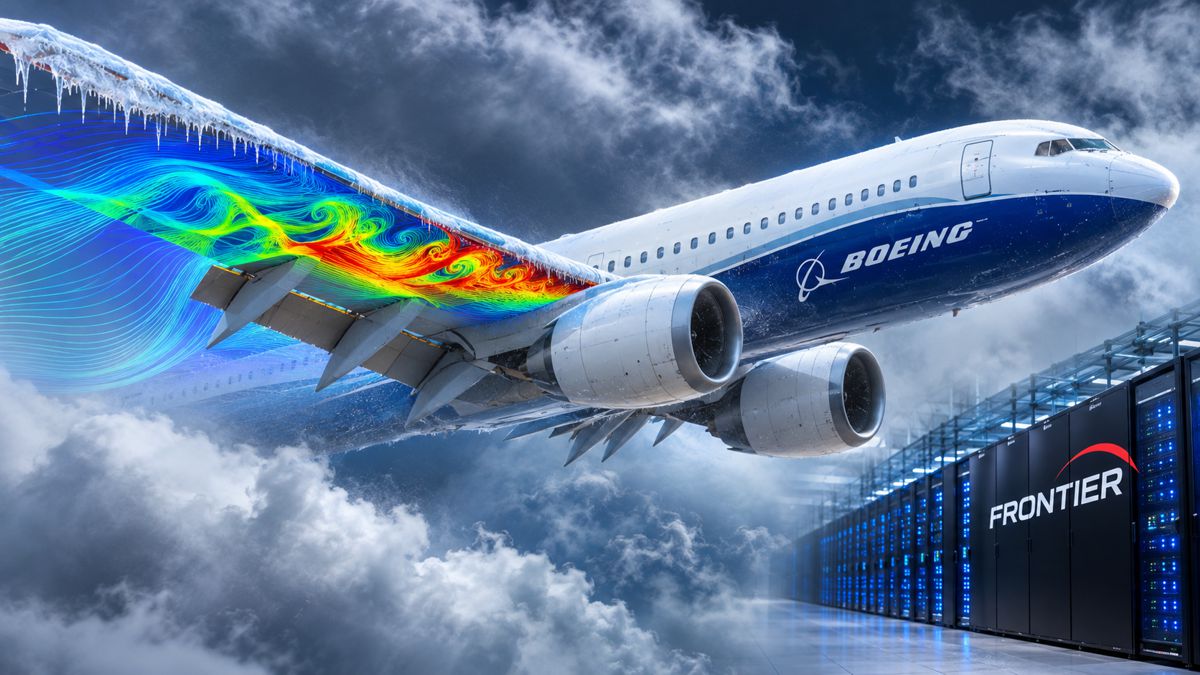
Working with specialists at the US Department of Energy’s Oak Ridge Leadership Computing Facility, the Boeing team examined how turbulence develops around high-lift wing configurations and how ice accumulation affects aerodynamic performance. The researchers reported predicting lift coefficients to within 1% of reference values for the configurations studied, while gaining a clearer understanding of airflow behaviour that had previously proved difficult to explain through wind tunnel experiments.
The research forms part of Boeing’s continuing efforts to improve aerodynamic efficiency, reduce the costs of aircraft development and investigate complex operating conditions before designs reach physical testing. It also demonstrates how advanced computational fluid dynamics (CFD) can increasingly support engineering work that once depended on extensive experimental programmes.
Briefing
- Boeing used the Frontier exascale supercomputer to investigate turbulent airflow, aircraft icing and high-lift aerodynamics.
- Researchers reported lift coefficient predictions within 1% of reference values for the configurations studied.
- Complex simulations were completed in days rather than the months potentially required on conventional industrial computing systems.
- The research examined airflow transitions, wing surface heating and the aerodynamic effects of different ice formations.
- Frontier was the world’s first exascale supercomputer and ranks third globally in the November 2026 TOP500 rankings.
Understanding Turbulence at the Wing Surface
Aircraft designers have spent decades refining wing geometry to reduce aerodynamic drag while maintaining the lift required across different operating conditions. Much of the remaining difficulty lies in the boundary layer, the thin region of airflow immediately adjacent to the aircraft surface, where friction and changing pressure conditions influence how air moves around the wing.
Within this region, airflow can remain relatively smooth and ordered, known as laminar flow, or develop irregular turbulent structures that mix momentum and energy. The transition between these conditions affects drag and can influence aerodynamic performance as the aircraft changes speed or angle of attack. Around leading edges, movable high-lift devices and areas where airflow separates from the surface, these interactions become particularly difficult to predict.
Adam Clark, an aerodynamics engineer at Boeing, explained the attraction of maintaining laminar flow: “We want to fly in the laminar regime as long as possible because that’s the most fuel-efficient way of flying, where airflow is smooth and steady.”
According to Boeing’s research, reducing aerodynamic drag by 1% during cruise conditions can lower fuel consumption by approximately 0.75% over a flight. Although that relationship is an engineering estimate rather than a saving demonstrated by the Frontier programme, it provides an indication of the potential commercial value of incremental aerodynamic improvements.
Turbulence complicates such calculations because it involves interacting structures across a wide range of spatial and temporal scales. Capturing enough of those structures to understand their behaviour requires increasingly detailed computational models, particularly when engineers need to investigate localised flow conditions around complex wing geometry.
Moving Beyond Conventional CFD
Computational fluid dynamics has become an established part of aircraft development alongside wind tunnel experiments and flight testing. Engineers construct digital representations of aircraft components and divide the surrounding airflow into computational cells, forming a mesh that may contain hundreds of millions of individual elements. Mathematical calculations then determine properties such as pressure, velocity and temperature throughout the model, allowing researchers to investigate flow behaviour that may be difficult to measure directly during physical experiments.
The accuracy and computational cost of these simulations depend heavily on how turbulence is represented. Many industrial applications rely on Reynolds-averaged Navier-Stokes (RANS) methods, which model the average effects of turbulent motion. These approaches remain practical for full-aircraft calculations, although they cannot resolve all the rapidly changing structures found in complex, unsteady flows.
Higher-fidelity techniques such as large eddy simulation (LES) explicitly resolve larger turbulent structures while modelling smaller-scale behaviour. Wall-modelled LES reduces the computational demands associated with the boundary layer, making it more practical for complex engineering configurations. Direct numerical simulation (DNS) goes further by resolving the full range of turbulent scales without a separate turbulence model, but the computing resources required generally make it impractical for complete aircraft simulations.
Boeing’s research used high-fidelity computational approaches to investigate airflow behaviour that simpler engineering models cannot always reproduce adequately. The additional computing capacity was particularly valuable because aircraft performance cannot be established from a single operating condition. Engineers need to examine how airflow develops as speed, altitude, angle of attack and wing configuration change.
Clark described the challenge of conducting such work using conventional industrial resources: “If we were to run a full-scale wall-modeled simulation on our in-house system, it could take several months just to get a single solution.”
The need for multiple calculations becomes especially demanding when researchers are investigating the accuracy of the turbulence models themselves. Comparing results across different operating conditions helps engineers identify where predictions remain reliable and where further experimental evidence or model development may be required.
High-Lift Aerodynamics and Aircraft Icing
The Boeing team concentrated particularly on high-lift configurations used during take-off and landing, when aircraft operate at lower speeds and depend on devices such as flaps and slats to generate additional lift. These movable surfaces introduce complicated interactions between the main wing and the surrounding airflow, especially as the angle of attack increases and turbulent structures begin to influence separation and reattachment.
Using Frontier, researchers examined these conditions in greater detail and investigated aerodynamic behaviour that had previously produced unexplained wind tunnel results. The simulations provided information about how airflow develops around the wing’s leading edge and progresses through unstable conditions towards fully developed turbulence.
The work also addressed aircraft icing, where changes to the wing’s physical shape and surface texture can alter the boundary layer and affect aerodynamic performance. Ice accumulation may encourage premature flow separation and change the lift and drag characteristics of the wing, with the response depending on the geometry, location and roughness of the formation.
Boeing simulated flight through cold clouds to examine how different ice shapes, sizes and textures influence airflow. These calculations allow researchers to isolate specific aerodynamic effects and compare conditions that can be expensive or difficult to reproduce consistently during physical testing.
Clark emphasised that the work was intended to improve the understanding of already certified aircraft operating conditions: “All of our airplanes are certified to operate safely in those conditions, and with Frontier, we were able to simulate flight through cold, icy clouds to understand how different ice shapes, sizes, and textures affect performance.”
The team also investigated the influence of wing surface temperature, providing additional information relevant to evaluating anti-icing systems. Heating changes the thermal conditions experienced by the boundary layer, and its effect on airflow can be more complicated than conventional engineering assumptions suggest.
Investigating the Effects of Wing Heating
Related research by Boeing engineers Konrad Goc and Jeffrey Crouch, published in the Journal of Fluid Mechanics in September 2026, examined how elevated surface temperatures affect airflow around the leading edge of a swept wing.
Using wall-resolved large eddy simulations, the researchers investigated the relationship between surface heating, flow instability and the transition from laminar to turbulent conditions. Earlier stability analyses had established that heating can destabilise the flow, but the more detailed numerical work revealed a complicated relationship between the initial instability and the subsequent development of turbulence.
The study also examined relaminarisation, the process through which turbulent airflow returns towards a laminar state under suitable conditions. Its findings provide additional insight into the fluid mechanics relevant to heated aircraft surfaces, although the published investigation addresses a specific aerodynamic problem rather than validating Boeing’s complete icing and high-lift simulation programme.
For engineers developing leading-edge heating and anti-icing systems, the relationship between temperature and airflow introduces another consideration alongside the thermal performance of the equipment itself. A system may meet its heating requirements while still influencing the aerodynamic conditions close to the wing surface.
Exascale Computing and Engineering Development
Frontier became the world’s first supercomputer to demonstrate sustained exascale performance, using a combination of AMD processors and graphics processing accelerators to undertake exceptionally large parallel calculations. Installed at Oak Ridge National Laboratory, the system has a theoretical peak performance of approximately 2.06 exaflops, equivalent to more than two quintillion floating-point operations per second.
In the November 2026 TOP500 rankings, Frontier placed third globally with a measured High Performance Linpack performance of 1.353 exaflops, behind China’s LineShine and the US El Capitan systems. The theoretical peak and measured benchmark figures represent different assessments of computing performance.
Boeing gained access through the Department of Energy’s INCITE programme, which allocates high-performance computing resources to selected industrial, academic and government research projects. Working with specialists at Oak Ridge Leadership Computing Facility, the company optimised its calculations to exploit Frontier’s parallel processing capabilities and increase the resolution of its simulations.
The computational improvement allowed the Boeing team to investigate conditions that would otherwise have required exceptionally long calculation periods. Goc explained: “Not only did Frontier allow us to run simulations that we couldn’t do before, but we were also able to get results in a matter of days, which would have taken months using a typical industrial-scale computing system.”
The researchers also reported predicting the coefficient of lift to within 1% of reference values for the configurations examined. The figure describes the performance of particular simulations rather than an accuracy guarantee across every aircraft geometry or flight condition, but it provides a useful measure of the progress being made with high-fidelity aerodynamic modelling.
Reducing calculation times gives engineering teams more opportunities to compare designs and operating conditions within the same development programme. Researchers can investigate an unexpected wind tunnel result, modify a computational model and examine alternative configurations without committing immediately to another physical experiment.
Access to exascale computing remains specialised, however, and the resources available through a national laboratory are substantially greater than those typically maintained by an individual manufacturer. Adapting the techniques and knowledge developed on machines such as Frontier to more accessible computing environments will be an important consideration for their wider industrial use.
The Continuing Role of Physical Testing
Despite the advances in numerical modelling, wind tunnel experiments and flight testing remain essential to aircraft development. Physical measurements provide evidence against which computational methods can be assessed, while flight testing establishes performance under actual operating conditions. Accurate simulations can improve the efficiency of these programmes, but their reliability still depends on appropriate validation.
Boeing reports that advances in computational modelling over the past two to three decades have already changed how engineers evaluate alternative wing designs. Where a development programme might once have required more than 20 wind tunnel experiments to compare different configurations, numerical screening can now reduce the number of physical variations requiring investigation. The comparison reflects Boeing’s wider experience of CFD development rather than a reduction attributable specifically to the Frontier research.
Detailed numerical models can also help explain experimental results that remain difficult to interpret from measurements alone. Wind tunnels provide information about aerodynamic forces and local flow conditions, but capturing every rapidly changing turbulent structure across a complex wing configuration is not always practical.
By combining physical evidence with higher-resolution calculations, engineers can investigate particular flow mechanisms and refine subsequent experiments. The Frontier programme extends that capability into operating conditions where conventional simulations have struggled to provide sufficient detail, allowing researchers to examine difficult aerodynamic behaviour before committing resources to additional testing or prototype modifications.
Applications Across Industrial Engineering
The computational methods developed for advanced aerospace research also have relevance across engineering disciplines where turbulence and fluid behaviour influence design decisions. Wind loading on bridges and tall buildings, aerodynamic drag around road vehicles, ventilation through tunnels and airflow around industrial equipment all involve complex interactions between geometry, surface conditions and moving fluids.
Bridge engineers, for example, may investigate how turbulent wind interacts with structural components, particularly where aerodynamic forces can influence vibration and stability. Vehicle manufacturers use CFD to examine drag, cooling airflow and the effects of changes in body geometry, while tunnel ventilation studies must account for confined airflow, obstructions and, in some cases, the movement of heat and smoke.
High-fidelity numerical modelling is already used in research across these fields, although the required computational methods and validation procedures differ considerably. Boeing’s reported accuracy and simulation speed cannot be transferred directly to civil engineering applications, where operating conditions, physical scales and the numerical models required may be substantially different.
There are also practical economic limits. A highly detailed turbulence simulation may provide valuable insight during the development of an aircraft wing or a major bridge, but the same level of computational investment may be difficult to justify for routine engineering work. The appropriate level of modelling depends on the complexity of the problem, the consequences of prediction errors and the availability of reliable experimental data.
For Boeing, the immediate achievement is a more detailed understanding of aircraft airflow under demanding conditions, supported by calculations that can now be completed within a practical engineering timeframe. The ability to investigate previously unexplained wind tunnel behaviour, examine the effects of icing and evaluate turbulent flow at greater resolution gives its researchers another means of refining aircraft designs before they reach the next stage of physical testing.
Key Industry Questions
- What is the Frontier supercomputer? Frontier is an exascale computing system at Oak Ridge National Laboratory in Tennessee, USA. It combines CPUs and GPUs to undertake scientific calculations requiring substantially more processing power than most conventional industrial computing systems provide.
- How accurate were Boeing’s aerodynamic simulations? Boeing reported lift coefficient predictions within 1% of reference values for the configurations studied. This does not establish equivalent accuracy across every aircraft design or operating condition.
- What is the difference between CFD and wind tunnel testing? CFD uses numerical calculations to predict fluid behaviour, while wind tunnels physically reproduce airflow around a model. The methods complement one another, with experimental measurements helping validate computational predictions.
- Why is aircraft turbulence difficult to simulate? Turbulence involves interacting flow structures across many length and time scales. Resolving those structures accurately requires detailed computational meshes, appropriate numerical methods and substantial computing resources.
- How does ice affect aircraft aerodynamics? Ice changes the geometry and surface roughness of aircraft components, potentially disrupting airflow and affecting lift, drag and flow separation. The effects depend on the ice formation and operating conditions.
- What is direct numerical simulation? Direct numerical simulation resolves the full range of turbulent motion without using a turbulence model. Its computational requirements make it impractical for routine full-aircraft calculations, although it remains valuable for detailed fluid mechanics research.
- Can the Frontier research improve aircraft fuel efficiency? The research may help engineers develop more efficient aerodynamic designs by improving turbulence predictions. However, Boeing has not established a specific aircraft fuel saving resulting directly from the Frontier simulations.
- Could similar techniques benefit civil engineering? Yes. High-fidelity CFD can support research into wind loading, bridge aerodynamics, road vehicle performance and tunnel ventilation. Practical adoption depends on computational cost, suitable modelling methods and application-specific validation.
Strategic Takeaways
- High-fidelity simulation is becoming more practical for industrial research. Exascale computing allows engineers to investigate aerodynamic problems that would otherwise require exceptionally long calculation periods.
- Simulation accuracy remains dependent on the problem being studied. Boeing’s reported lift prediction results must be understood within the configurations and validation conditions used.
- Computational modelling can improve experimental programmes. Detailed flow calculations help explain difficult physical measurements and guide the selection of subsequent tests.
- Computing resources influence development capacity. Access to national laboratory systems allows manufacturers to investigate more demanding engineering problems without maintaining comparable computing infrastructure internally.
- Wider industrial adoption will depend on economics and validation. Aerospace research offers useful methods for other engineering disciplines, but each application requires suitable models, reliable evidence and a practical level of computational investment.