






Electrifying the Mountain: The Infrastructure Behind Electric Snow Groomers
Preparing a ski resort for the following morning involves hours of energy-intensive work after the last visitors have left the slopes. Tracked snow groomers reshape and compact the snow, snowmaking systems replenish heavily used runs, and maintenance crews prepare lifts, access roads and facilities. Introducing battery-electric heavy machinery into this environment presents a rather different engineering challenge from installing electric vehicle chargers in a hotel car park.
Charging infrastructure specialist ChargePoint and German snow groomer manufacturer Kässbohrer Geländefahrzeug AG announced a strategic partnership on 24 November 2026 to support the electrification of ski resorts across Europe and North America. The agreement gives Kässbohrer customers access to charging hardware, energy management software and associated services covering snow groomers, maintenance vehicles and visitor parking. With Kässbohrer accounting for more than half of annual worldwide snow groomer sales, according to the company, the partnership provides access to an established international market for specialised heavy machinery.
Briefing
- ChargePoint and Kässbohrer have established a strategic partnership covering European and North American ski resorts.
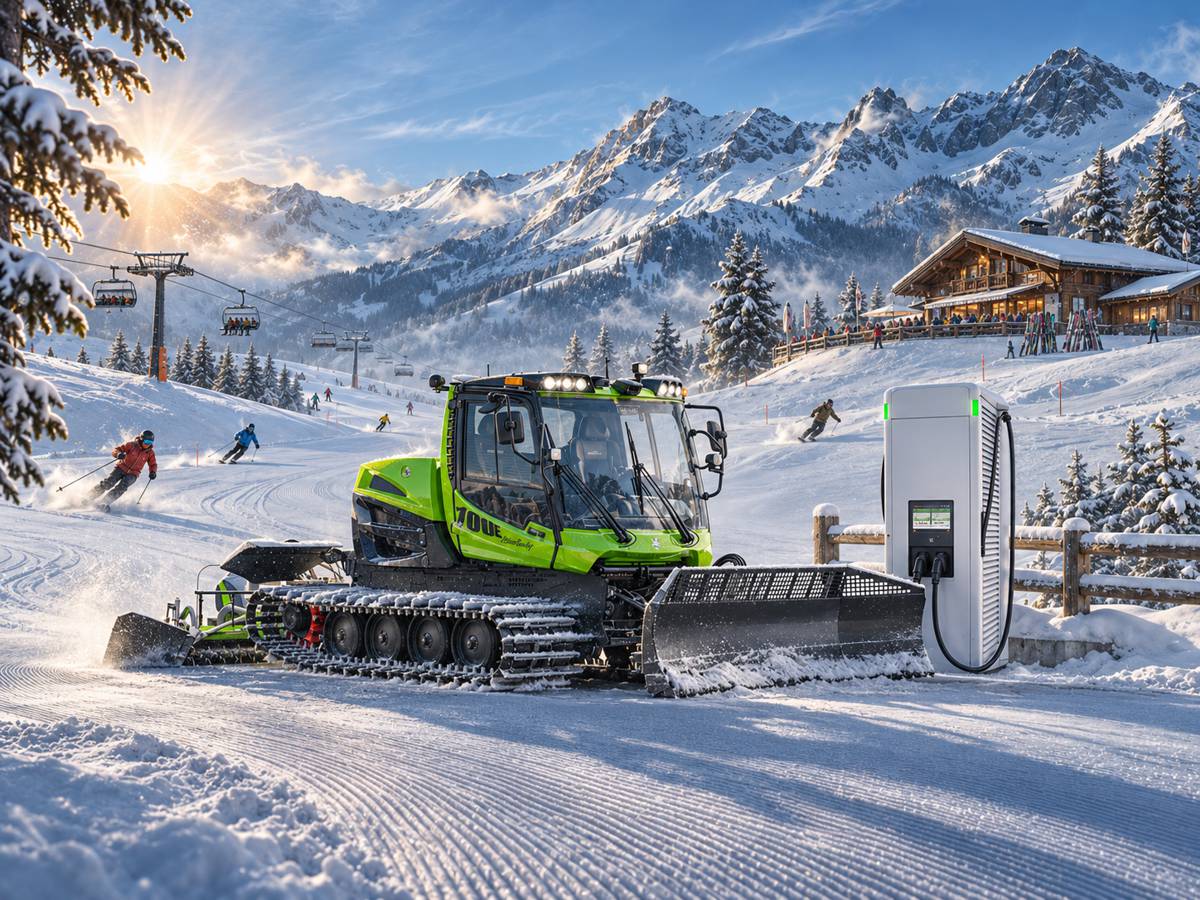
- The fully electric PistenBully 100 E incorporates a 196 kWh battery and supports DC charging at up to 150 kW.
- Charging infrastructure must accommodate the competing electrical demands of snowmaking, ski lifts and resort facilities.
- Sweden’s Hammarbybacken ski resort has already combined electric snow grooming with stationary battery storage and renewable electricity procurement.
- Competing manufacturer Prinoth unveiled its larger, fully electric Leitwolf E-Motion in 2026.
Engineering an Electric Snow Groomer
Kässbohrer has been developing battery-electric snow grooming technology for several years, presenting an early version of its PistenBully 100 E at the INTERALPIN exhibition in 2019. The subsequent development of the machine has brought improvements in battery storage and charging capabilities, providing a platform for commercial operations.
The current PistenBully 100 E incorporates a battery with a gross capacity of 196 kWh, providing up to three hours of grooming under the manufacturer’s stated operating conditions. Its European specifications indicate a fast charging time of approximately 90 minutes at 150 kW, although Kässbohrer’s North American specifications indicate a minimum charging time of two hours at the same power rating. Operators will need to establish realistic charging durations for their particular equipment and working conditions.
Electric motors drive the machine and its snow tiller directly, replacing elements of the conventional hydrostatic drivetrain. Energy consumption nevertheless extends considerably beyond moving a heavy tracked vehicle across the mountain. The front blade redistributes snow, while the rear-mounted tiller processes and prepares the surface, with gradients, snow density and grooming intensity all influencing power requirements.
John Saffrett, EVP and Managing Director, Europe at ChargePoint, described the operating environment: “Electrification is reaching heavy-duty vehicles that operate under some of the toughest conditions anywhere.” The relatively compact PistenBully 100 E is well suited to cross-country trails, indoor ski facilities and selected alpine grooming operations, where routes and operating schedules can be matched to available battery capacity.
Charging Infrastructure in Mountain Environments
Four snow groomers charging simultaneously at 150 kW would require a combined charging capacity of 600 kW, before accounting for conversion losses or electricity consumed elsewhere across the resort. Depending on the existing electrical network, accommodating such demand could require dedicated distribution infrastructure, transformer upgrades or an increased grid connection capacity.
Mountain geography complicates the installation of charging infrastructure. Maintenance facilities may be distributed across several elevations, with some located considerable distances from the main resort buildings. Returning machinery to a central charging station consumes both energy and productive operating time, particularly where the journey involves steep terrain.
Charging stations must also contend with freezing temperatures, snow accumulation and moisture. Workshop layouts need to accommodate tracked machinery with large grooming attachments, while charging cables and connectors require protection against ice, physical damage and the movement of other equipment.
Tim Estelmann, Product Manager at Kässbohrer, explained the company’s approach: “Only when vehicle and charging solution work together does a powerful machine become a system that operators can rely on day after day and night after night.” The partnership brings these elements into the same procurement process, although the design and installation of electrical infrastructure will remain specific to each resort.
Managing Electricity Across the Resort
Cableways, chairlifts, pumping stations, snowmaking equipment, workshops and accommodation already place substantial demands on mountain electricity networks. Snowmaking can be particularly energy-intensive during periods of suitable weather, which frequently coincide with overnight grooming operations.
Introducing high-power machinery charging during these periods could increase peak electrical demand or exceed the capacity of existing distribution equipment. Managed charging offers a means of allocating available power between vehicles according to operational priorities, while charging schedules could be coordinated with snowmaking and other major electricity consumers.
Swedish mountain tourism operator SkiStar has already explored this approach through its Fossil-Free Ski Resort Project at Hammarbybacken in Stockholm. The project incorporates a Prinoth Husky E-Motion electric snow groomer, a stationary battery energy storage system to support charging, and an electricity supply contract based on renewable generation.
Stationary storage can help accommodate short periods of high charging demand without requiring an equivalent increase in instantaneous grid capacity. Its commercial viability, however, depends on electricity tariffs, available connection capacity, battery costs and the frequency with which the stored energy is used.
Combining machinery charging with infrastructure for maintenance vans, utility vehicles, shuttle buses and visitor cars could improve utilisation throughout the year. These vehicles have different operating schedules and charging requirements, allowing some electrical capacity to be shared without every vehicle requiring simultaneous access.
Matching Machinery to the Grooming Schedule
Electric snow groomers could influence the organisation of overnight maintenance operations, particularly at resorts accustomed to running diesel machinery continuously for extended shifts. Equipment allocation may increasingly take account of route length, terrain, snow conditions and proximity to charging facilities, alongside conventional considerations such as grooming width and productivity.
Smaller electric machines could undertake shorter routes, beginner slopes and cross-country trails close to established infrastructure. More demanding operations on remote or steep terrain may continue to favour conventional diesel or hybrid equipment, particularly where returning to a charging station would compromise the overnight maintenance schedule.
Indoor ski centres offer a particularly attractive application because electric machinery eliminates exhaust emissions at the point of operation. Enclosed facilities also benefit from reduced drivetrain noise, although tracks, tillers and other working equipment continue to generate sound.
Before committing to larger fleet investments, operators would benefit from monitoring energy consumption across representative grooming routes throughout the winter. Measurements taken during difficult snow conditions and periods of intensive preparation are likely to prove more useful than operating duration figures obtained under ideal circumstances.
Competition Extends to Larger Snow Groomers
The development of electric snow grooming machinery is progressing beyond compact equipment. Prinoth’s Husky E-Motion already serves applications ranging from Nordic trails and indoor ski areas to alpine slopes, providing an established commercial platform for battery-electric grooming.
At Mountain Planet in April 2026, Prinoth unveiled its larger Leitwolf E-Motion, developed in collaboration with French mountain tourism operator Compagnie des Alpes. Three machines were scheduled to enter operation at the group’s resorts by the end of 2026, extending battery-electric technology into more demanding alpine grooming applications.
In September 2026, Scania Industrial Batteries announced a partnership with Prinoth covering battery systems for both the Husky and Leitwolf E-Motion. The agreement brings battery technology developed for heavy-duty transport and industrial applications into a specialist machinery sector with particularly demanding operating conditions.
As manufacturers expand their electric equipment ranges, resort operators will have greater flexibility to match machinery to different types of grooming work. Charging networks will need sufficient capacity and adaptability to accommodate larger vehicles as well as successive generations of battery technology.
Fleet Economics and Seasonal Utilisation
Electric snow groomers offer opportunities to reduce diesel consumption and expenditure on conventional engine servicing, but their financial performance will depend on machinery purchase prices, electricity tariffs, battery longevity and the capital cost of supporting infrastructure.
Seasonal operation introduces complications that are less pronounced in construction, quarrying and other industries where equipment may operate throughout the year. Dedicated snow grooming chargers could remain underutilised for several months, while batteries require appropriate storage and maintenance during extended periods of inactivity. Battery calendar ageing continues even when machinery is out of service, making off-season management an important part of equipment ownership.
Resorts operating mountain biking facilities, summer tourism activities and year-round accommodation may be better positioned to spread infrastructure costs across multiple operations. Charging facilities installed as part of a wider electrification programme could continue serving utility vehicles, maintenance equipment and visitors outside the winter season.
The environmental assessment also extends beyond eliminating exhaust emissions on the slopes. Electricity generation, battery manufacturing and equipment longevity all contribute to lifecycle emissions, with resorts supplied by low-carbon electricity potentially achieving greater overall reductions.
Neither ChargePoint nor Kässbohrer has disclosed contract values, named resort installations or projected operating savings under the new partnership. These details will become increasingly relevant as the industry moves from individual machinery deployments towards larger fleet investments.
Building the Infrastructure for Electric Mountains
Ski resorts have long invested in substantial engineering infrastructure, from cableways and pumping stations to electrical distribution networks and maintenance facilities. Incorporating electric machinery into these systems will require coordinated investment, with equipment procurement increasingly influenced by the availability and location of electrical power.
The partnership between ChargePoint and Kässbohrer offers a route towards integrating machinery and charging infrastructure from the outset. Its longer-term value could lie in establishing electrical networks capable of supporting successive equipment generations, rather than installations designed around a single machine purchased for a particular winter season.
As battery capacity improves and manufacturers extend electrification into larger machinery classes, resort operators will gain more options for organising maintenance operations. The machines may be changing, but the requirement to have the mountain prepared before the first lift opens remains exactly the same.
Key Industry Questions
- How long can an electric snow groomer operate? The PistenBully 100 E offers up to three hours of grooming under stated operating conditions. Actual duration depends on terrain, temperature, snow density and the demands placed on its working attachments.
- How quickly can an electric snow groomer recharge? European specifications for the PistenBully 100 E indicate approximately 90 minutes at 150 kW, while North American specifications indicate a minimum of two hours. Charging performance should be confirmed for the equipment and installation concerned.
- How much electrical capacity does a fleet of snow groomers require? Four machines charging simultaneously at 150 kW would require 600 kW of combined charging capacity. Additional electrical demand and conversion losses must be included when sizing distribution infrastructure.
- Can electric snow groomers charge while snowmaking systems are operating? Yes, provided sufficient electrical capacity is available. Managed charging and stationary battery storage can help coordinate demand between snowmaking and vehicle charging.
- Are larger electric snow groomers becoming available? Yes. Prinoth unveiled its fully electric Leitwolf E-Motion in 2026, extending battery-electric grooming into larger machinery classes, with initial resort deployments scheduled for the end of the year.
- Are electric snow groomers suitable for indoor ski centres? Electric machinery is particularly suitable for enclosed facilities because it produces no exhaust emissions during operation. Reduced drivetrain noise offers an additional operational benefit.
- How should snow groomer batteries be managed during the summer? Operators should follow manufacturer recommendations concerning storage temperature, battery state of charge, inspections and maintenance. Battery ageing continues during extended periods of inactivity.
- Can renewable electricity support mountain machinery electrification? Renewable electricity can be supplied through the grid or suitable on-site generation. Stationary energy storage may help accommodate peak charging demand and coordinate electricity availability with machinery operations.
Strategic Takeaways
- Machinery procurement and electrical infrastructure planning should form part of the same investment programme.
- Actual grooming duty cycles provide the basis for selecting appropriate battery capacities and charging arrangements.
- Managed charging and stationary storage could help resorts electrify machinery without unnecessarily expanding grid connections.
- Competition is extending electric snow grooming technology into larger and more demanding equipment classes.
- Year-round utilisation and appropriate seasonal battery management will influence the lifetime economics of electric mountain machinery.