Verified Failure Data is Becoming the New Currency of Recycled Plastics
A geosynthetics market worth around USD 18 billion in 2026 is being reshaped by two forces pulling in opposite directions. Regulation is forcing recycled polymer into more products on a fixed timetable, while the tools to prove that recycled polymer actually survives in service have barely moved in a generation.
A new fracture-testing platform out of Georgia Tech’s Daedalus Lab, detailed in Science Advances, sits directly on that fault line. It offers engineers a faster, cheaper and more realistic way to see how a material fails, and in doing so it points to where commercial value in recycled materials is quietly relocating: away from the recycled-content claim on the datasheet, and towards verifiable evidence of how a component performs across its full working life.
That distinction carries real money in construction and infrastructure. Recycled polyethylene terephthalate now appears in nonwoven geotextiles, drainage layers, landfill geotextiles and reinforcement fabrics, applications designed to sit in the ground for decades and to protect groundwater, slopes and highway foundations. When one of those components fails early, the cost is not confined to the fabric itself. It reaches into excavation, remediation, liability and reputational exposure, and it can erase the environmental case that justified specifying recycled material in the first place.
The Georgia Tech work, led by assistant professor Christos Athanasiou and postdoctoral researcher Danqi Sun, matters because it attacks the single weakest point in the recycled-materials story, which is the gap between what a material is labelled and what it will actually do.
Briefing
- Georgia Tech researchers have published an in-situ, high-throughput fracture-testing platform in Science Advances that cuts testing time by more than 60% and studies materials under realistic service conditions rather than idealised laboratory ones.
- The platform tests many specimens in parallel, exposes them to real chemical environments such as alkaline solutions, and uses photoelastic imaging to reveal stress fields and crack initiation earlier than conventional methods allow.
- Testing recycled PET against virgin PET, the team found recycled PET showed lower resistance to environmental stress in alkaline conditions above pH 9, conditions typical of landfill liner and geotextile applications.
- The finding lands as the EU Packaging and Packaging Waste Regulation prepares to mandate 10% to 35% recycled content across plastic packaging from 2030, intensifying demand for recycled polymer without a matching increase in verified performance data.
- The technology is available for licensing through Georgia Tech’s Office of Technology Licensing, positioning cheap, fast, evidence-based material qualification as a commercial service rather than a purely academic exercise.
The Verification Gap Regulation Has Opened
The commercial backdrop to this research is a policy environment that has decided the direction of travel and is now legislating the pace. Under the EU Packaging and Packaging Waste Regulation, all plastic packaging placed on the European market must contain a minimum share of post-consumer recycled content from January 2030, ranging from 10% to 35% depending on category, with contact-sensitive PET set at 30% and rising towards 50% by 2040. The Single-Use Plastics Directive already requires recycled content in beverage bottles.
These measures were designed to create stable, mandatory demand for recycled polymer and to correct a market failure in which virgin plastic was simply cheaper. They have succeeded in that aim, and recyclers across Europe have committed billions of euros to expanding high-quality recyclate supply.
What regulation has not created is a corresponding ability to confirm that recycled polymer performs as required once it leaves the packaging stream and enters a structural or environmental application. Recycled content is now something a manufacturer must demonstrate through documentation, yet documentation of origin says nothing about mechanical behaviour under load, temperature or chemical attack.
The result is a widening verification gap. Specifiers face growing pressure, and in many cases a legal obligation, to design recycled material into products, while the fracture and durability data needed to do that responsibly remains slow and expensive to generate. This is precisely the space the Daedalus Lab platform is built to occupy, and it explains why a piece of experimental mechanics equipment has direct relevance to procurement teams who may never read a materials-science journal.
What The Platform Actually Changes
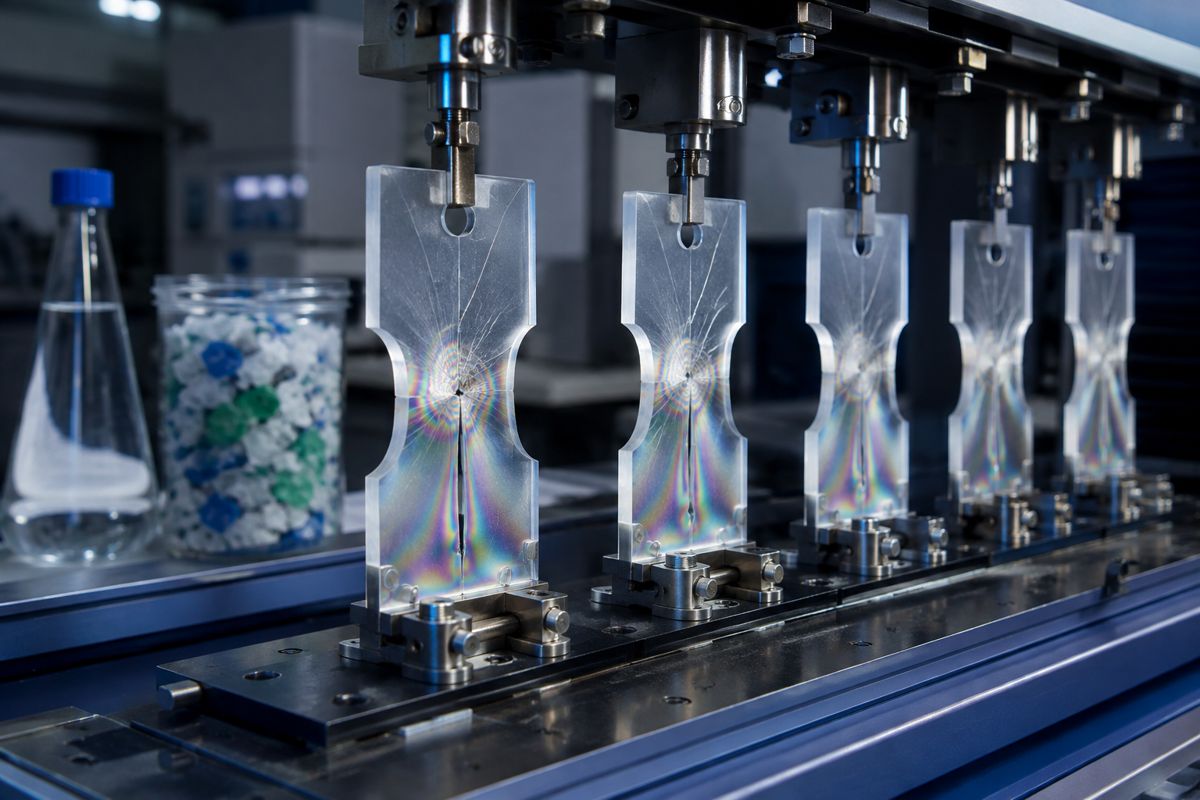
Conventional fracture testing has changed little in principle for decades. A single specimen is loaded to failure under carefully controlled laboratory conditions, one test at a time, in an environment that bears little resemblance to a landfill cell or a drainage trench. Sun’s platform breaks with that model in three commercially meaningful ways. It tests multiple specimens in parallel, cutting experimental time by more than 60% according to the published work.
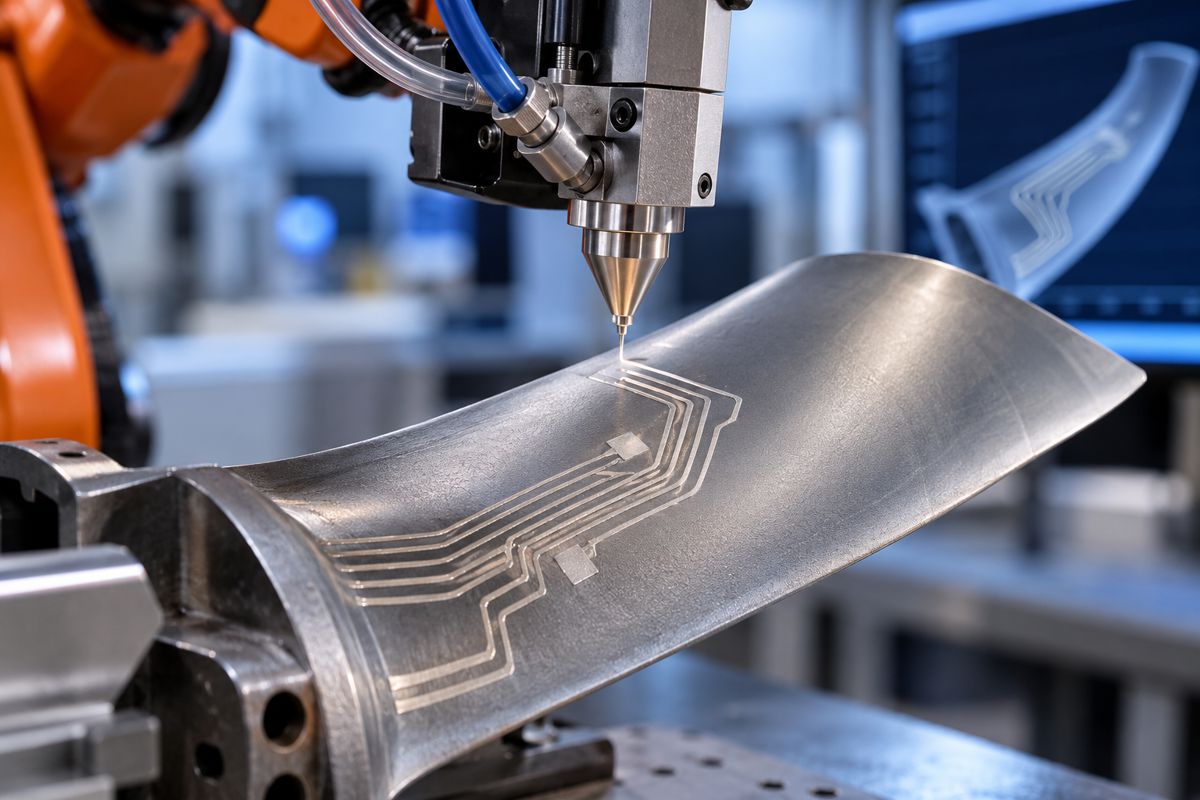
It exposes those specimens to realistic environments, in this case alkaline solutions that mirror the chemistry around landfill liner membranes and geotextiles. It adds photoelasticity, an optical technique that renders the stress fields forming at the tip of a developing crack visible, allowing failure to be observed earlier and understood more fully.
The significance is not that any one of these capabilities is unprecedented, but that combining them turns fracture testing from a bottleneck into something closer to a screening tool. Cost and throughput are the reasons recycled materials so often lose out at the specification stage. Where reliable failure data is slow and costly to obtain, engineers reasonably default to virgin material because its behaviour is already characterised and trusted. Compress the time and cost of generating that data, and the calculus shifts.
As Sun puts it, “Our goal was to make fracture testing not only faster but also more informative. By combining high-throughput testing, realistic environments, and full-field stress imaging, we can better understand how materials fail under conditions closer to real-world applications.” For an industry under regulatory pressure to adopt recycled inputs, a faster route to trustworthy data is worth more than another sustainability label.
Where The Risk Concentrates In Geosynthetics
The recycled PET finding deserves careful reading because it is specific rather than sweeping. In alkaline conditions above pH 9, recycled PET showed lower resistance to environmental stress than virgin PET, to the point where specifying recycled material in a landfill geotextile could eliminate the presumed economic and environmental advantage of choosing it.
That result does not condemn recycled PET across the board. It identifies a particular chemistry, in a particular application, where the recycled grade is the wrong call, and it does so with data rather than assumption. For a geosynthetics sector in which geotextiles are the largest product segment, accounting for close to half of a market growing at high single-digit rates, that granularity is the point. Value moves to whoever can say not merely whether a grade is recycled, but where it belongs.
Independent research points the same way and lends the Georgia Tech work useful weight. A durability study published in Geosynthetics International examined needle-punched nonwoven geotextiles made from recycled PET, virgin PET and blends, subjecting them to hydrolysis over successive intervals. It found that the recycling process raised crystallinity and fibre fragility, reducing tensile strength and elongation, and that recycled products showed a service life up to 30% shorter than their virgin equivalents because of higher degradation rates.
Two separate lines of investigation converging on the same conclusion is exactly what specifiers need before committing recycled geotextiles to a thirty-year containment role. The commercial lesson is not that recycled geosynthetics should be avoided, but that they must be matched to environments where their degradation profile is acceptable, and that the industry now has better instruments for making that match.
The Honest Economics Of Lifecycle Cost
Sustainability accounting has too often stopped at the point of purchase, treating recycled content as a fixed environmental credit banked at the moment of specification. The Daedalus Lab work reframes that credit as contingent on performance over time. A recycled component that fails early and must be excavated, disposed of and replaced can carry a larger environmental and economic burden than the virgin material it displaced, once the full replacement cycle is counted. Athanasiou frames the principle directly: “Failing materials don’t just break products. They can break sustainability promises.” For infrastructure owners running whole-life cost models, this is not a philosophical observation. It is a line item that changes the ranking of options.
The consequence for procurement is a shift in what evidence buyers should demand from suppliers. A recycled-content percentage answers a compliance question. It does not answer the operational one, which is how long the component will last in its actual service environment and what it will cost to maintain or replace across that period. Athanasiou is careful to keep the argument on the side of circularity rather than against it: “Recycling is essential, but recycled content alone does not tell the full story. If a material fails too soon, the environmental benefits can disappear.” The forward-looking position for asset owners is to build failure and durability data into tender requirements alongside recycled content, and to treat the two as complementary rather than interchangeable. That is a purchasing discipline the sector can adopt now, well ahead of any regulatory prompt.
Turning A Test Rig Into A Market
The decision to license the platform through Georgia Tech’s Office of Technology Licensing signals intent to move the capability out of the laboratory and into the supply chain. That commercialisation route matters because the barrier to recycled-material adoption has never been a shortage of enthusiasm. It has been the cost, scarcity and limited yield of the testing that would justify the switch.
A licensable, high-throughput method that generates large volumes of detailed failure data begins to change the economics of qualification itself, and it opens a further avenue the researchers explicitly flag. Because the platform produces such rich datasets, it lends itself to computational modelling and artificial intelligence that could digitally simulate mechanical testing, driving cost down and availability up still further.
The broader research direction is encouraging for anyone invested in circular materials succeeding rather than merely being mandated. Work from the same field, including bio-inspired structural designs that arrange recycled polymer to suppress its notorious property variability, is showing that recycled feedstock can be engineered towards virgin-grade reliability rather than accepted as inherently inferior.
In parallel, European initiatives such as the Fraunhofer-led GREEN project reported in 2026 have demonstrated that recycled polypropylene, PET and HDPE can be processed into durable technical geotextiles suitable for demanding, long-life applications when the processing strategy is right. Read together, these developments describe an industry actively closing the performance gap on recycled materials rather than resigning itself to it. The Georgia Tech platform supplies the diagnostic layer that makes such progress measurable.
What Industry Leaders Should Do With This
The strategic message for construction and infrastructure decision-makers is that the recycled-materials conversation is maturing from advocacy into evidence, and the organisations that adapt their qualification processes first will hold an advantage as 2030 mandates approach. Material suppliers that can present verified fracture and durability data, matched to specific service environments, will differentiate themselves from competitors still relying on recycled-content claims alone.
Specifiers and asset owners who write performance verification into procurement will reduce their exposure to the premature-failure liability that quietly undermines sustainability programmes. Investors evaluating the geosynthetics and recycled-polymer supply chain should watch for who controls trustworthy performance data, because in a market defined by decades-long service lives, that data is where durable competitive advantage will accumulate.
None of this diminishes the case for recycled materials. It strengthens it by making the case honest. A circular economy that survives contact with real service conditions needs the ability to distinguish a recycled grade that will last from one that will not, application by application and environment by environment.
The Daedalus Lab platform is one instrument in that larger shift towards judging sustainability by measured performance rather than by assumption or label. The direction is set, the regulation is coming, and the commercial reward is moving towards whoever can prove, quickly and cheaply, that a recycled material will do the job for as long as the design demands.
Key Industry Questions
- Does recycled PET perform as well as virgin PET in geotextiles? Not universally, and the difference is environment-specific. The Georgia Tech study found recycled PET showed lower resistance to environmental stress than virgin PET in alkaline conditions above pH 9, the kind of chemistry present around landfill liners and certain geotextiles. Separate research published in Geosynthetics International reported that recycled PET nonwoven geotextiles can have a service life up to 30% shorter than virgin equivalents, because recycling raises crystallinity and fibre fragility. That does not rule out recycled PET, but it means the material must be matched to applications where its degradation profile is acceptable, rather than substituted for virgin PET on the assumption of equivalent performance.
- Why does alkaline exposure matter so much for landfill and geotextile applications? Landfill liner systems, leachate collection layers and many buried geotextiles operate in chemically aggressive, high-pH environments over very long service lives. Polyester-based materials such as PET are susceptible to hydrolytic degradation, which accelerates in alkaline conditions and progressively reduces tensile strength and elongation. Because these components are designed to protect groundwater and stabilise ground for decades, degradation that would be trivial in a short-life product becomes a containment and liability risk here. Testing recycled materials under representative alkaline chemistry, as the Georgia Tech platform does, gives a far more relevant picture of durability than dry, ambient laboratory testing that ignores the service environment entirely.
- How does faster fracture testing change procurement decisions? Cost and turnaround are the practical reasons recycled materials often lose at the specification stage. Where generating reliable failure data is slow and expensive, engineers default to virgin material whose behaviour is already characterised. A platform that cuts testing time by more than 60% and tests many specimens in parallel lowers the barrier to qualifying recycled grades, making it economically viable to characterise a wider range of materials for specific uses. For procurement, this supports a move away from recycled-content percentages as the primary criterion towards verified, application-specific performance data, allowing recycled materials to be adopted where they genuinely fit and avoided where they do not.
- Will EU recycled-content mandates force recycled polymer into infrastructure applications? The Packaging and Packaging Waste Regulation directly targets packaging, mandating 10% to 35% recycled content across plastic packaging categories from 2030, with contact-sensitive PET at 30%. Its wider effect is to expand the supply of recycled polymer and normalise recycled content as an expectation across sectors, including construction, where recycled PET already appears in geotextiles and reinforcement fabrics. The mandates do not compel recycled content in most structural infrastructure, but they intensify commercial and reputational pressure to use it. That makes reliable performance verification more important, not less, so that recycled polymer is adopted in infrastructure on the basis of proven suitability rather than as a compliance reflex.
- What is the commercial risk of premature failure in recycled geosynthetics? The risk extends well beyond the cost of the fabric. A failed geotextile or liner can require excavation, remediation, disposal and replacement, alongside potential environmental liability where containment is compromised. In whole-life cost terms, a recycled component that fails early can prove more expensive and more carbon-intensive than the virgin material it replaced, once the full replacement cycle is counted. For asset owners, the exposure is financial, regulatory and reputational at once. This is why building durability and failure data into tender requirements, rather than relying on recycled-content declarations, is emerging as a sound risk-management discipline for infrastructure procurement.
- Can recycled plastics be engineered to match virgin performance? Increasingly, yes, and this is where much of the promising work sits. Research into bio-inspired structural designs has shown that arranging recycled polymer in engineered architectures can sharply reduce the property variability that usually undermines recycled feedstock, in some cases approaching virgin-grade behaviour. European initiatives including the Fraunhofer-led GREEN project have demonstrated that recycled polypropylene, PET and HDPE can be processed into durable technical geotextiles for demanding applications when the processing strategy is correct. The barrier is less the material itself than the ability to characterise and control its behaviour. Fast, affordable fracture testing supports that effort by making the performance of engineered recycled materials measurable and comparable.
- Who can access or license the Georgia Tech testing platform? The technology is available for licensing through Georgia Tech’s Office of Technology Licensing, which handles the commercial transfer of university-developed intellectual property. That route is aimed at organisations wanting to deploy the high-throughput, in-situ photoelasticity method rather than replicate it independently. Making the platform licensable signals an intent to move fast, realistic fracture testing from academic demonstration into a service the materials, geosynthetics and manufacturing supply chains can actually use. The researchers also anticipate that the large datasets the platform generates could feed computational and artificial-intelligence models to simulate mechanical testing digitally, which would further reduce cost and broaden access over time.
- How does photoelasticity improve on conventional fracture testing? Photoelasticity is an optical technique that makes the stress fields within a loaded material visible, revealing the concentrated stresses that form at the tip of a developing crack. In the Georgia Tech platform, this allows crack initiation to be observed earlier and the forces driving crack growth to be understood more clearly than with conventional load-to-failure testing alone. Combined with parallel, high-throughput testing in realistic chemical environments, it produces a fuller and more relevant picture of how a material actually degrades and fails. For engineers, earlier and richer insight into crack behaviour translates into more confident predictions of service life and better-matched material choices.
Strategic Takeaways
- Commercial value in recycled materials is shifting from the recycled-content claim towards verifiable evidence of lifecycle performance, and suppliers who can prove durability will out-compete those relying on labels alone.
- Recycled PET is not a like-for-like substitute for virgin PET in aggressive environments such as alkaline landfill and geotextile applications, so recycled grades must be matched to service conditions rather than swapped in by assumption.
- EU recycled-content mandates from 2030 are widening the gap between demand for recycled polymer and the ability to verify its performance, making fast, affordable failure testing a strategic capability rather than a laboratory nicety.
- Whole-life cost, not point-of-purchase content, is the correct basis for judging recycled materials, because premature failure can erase both the environmental and the economic case for choosing them.
- The convergence of high-throughput testing, realistic-environment characterisation and emerging AI-driven simulation points towards a future in which recycled materials are qualified on measured evidence, accelerating responsible adoption across construction and infrastructure.