RF Lens Technology Could Redefine the Economics of Satellite Ground Stations
The economics of the satellite business have quietly inverted. A decade of reusable rockets and batch-built spacecraft has driven the cost of reaching low Earth orbit down sharply, and constellations that once looked speculative are now being launched in their thousands.
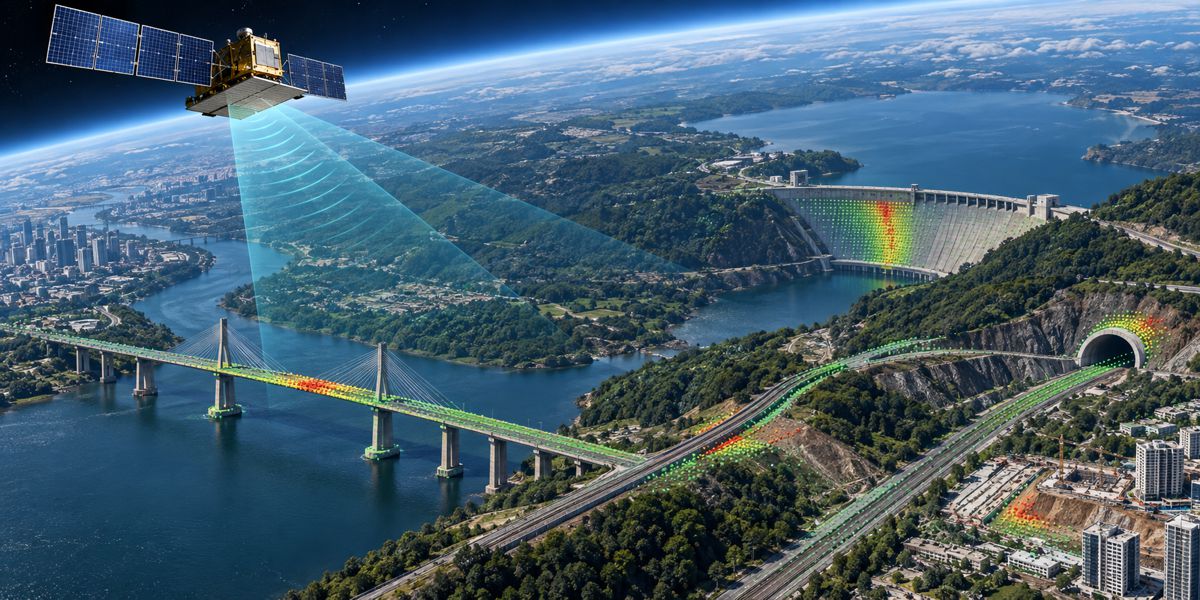
The expensive, awkward part of the system is no longer the satellite in the sky. It is the ground, where gateways and teleports must acquire, lock onto and hand off dozens of fast-moving spacecraft at once, across several orbits and a widening spread of frequencies. That is the problem MatSing has taken aim at, and its announcement of a proprietary manufacturing process for large-format Luneburg lenses matters less as a materials-science milestone than as an attempt to change what the ground segment costs to build.
MatSing, the Irvine, California company that has spent two decades commercialising radio-frequency lens antennas, says it can now produce high-performance Luneburg lenses at apertures and frequencies previously confined to the laboratory. The commercial logic is straightforward. A single passive lens forms many independent beams at once, tracking multiple satellites across a wide field of view without moving parts and without the tens of thousands of active electronic elements a phased array of comparable gain would demand.
For operators wrestling with the capital and power costs of scaling their ground infrastructure, that reads as a procurement argument rather than a curiosity, and it lands at a moment when the industry is openly hunting for an alternative to its two established antenna architectures.
Briefing
- MatSing has developed a proprietary manufacturing process for large-format Luneburg lens antennas, extending its RF lens technology into gateway-class apertures for satellite communications, defence sensing and radar.
- The platform spans apertures from 0.5 metres to 2.4 metres and frequencies from 1 to 30 GHz, covering the L through Ka bands, with the company citing gain exceeding 40 dBi at the top of each configuration’s operating range.
- A single Luneburg lens forms multiple simultaneous beams, allowing one static aperture to link and track several satellites across a wide field of view without mechanical steering or per-beam active electronics.
- The development is aimed at the ground segment, where analysts expect sustained growth as LEO constellations multiply and operators look past one-satellite-per-dish architectures and power-hungry phased arrays.
- The lenses will be offered within MatSing’s next-generation LensSAT satellite antennas, with custom frequency ranges, aperture sizes and integration available on request.
The Cost Of Space Has Moved To The Ground
The demand pressure behind this development is easy to underestimate. Analysts at IndexBox project that the number of active low Earth orbit satellites could exceed 30,000 by 2035, and that the ground station equipment market will expand at a compound annual rate of roughly nine per cent across the same period, driven by the constellation programmes run by SpaceX, Amazon and the OneWeb network now folded into Eutelsat.
Fortune Business Insights, tracking the narrower category of LEO tracking antennas, forecasts growth from around 3.6 billion dollars in 2026 to more than 14 billion dollars by 2034. The direction of travel is not in dispute even where the individual figures vary between research houses. Every new satellite that reaches orbit adds to the volume of traffic that has to come back down through a finite number of gateways.
Those gateways cannot simply multiply at will. They have to sit where reliable fibre backhaul, favourable weather and regulatory approval coincide, which means each site is expected to carry more of the load rather than being replicated freely across the map. As orbital density rises across multiple constellation planes, the requirement shifts from pointing a single antenna at a single geostationary satellite to servicing a churning population of spacecraft that each cross the sky in minutes.
The cost and complexity of the network have migrated from the launch pad to the teleport, and that migration is what makes antenna architecture on the ground a commercial question rather than an engineering footnote.
Why Dishes And Phased Arrays Each Reach A Limit
The industry has two incumbent answers to this problem, and each fails on a different axis. The parabolic dish remains the workhorse of the ground segment because it delivers excellent gain and directivity, but it is a fundamentally single-target instrument. A dish points at one satellite, and for fast-moving LEO spacecraft that pass overhead in well under two minutes, mechanical steering struggles to slew quickly enough for the frequent handoffs that continuous service requires. Scaling capacity by adding more dishes multiplies the land, power and backhaul bill at every site, which is precisely the outcome operators are trying to avoid as constellation traffic grows.
The phased array solves the agility problem and creates a cost one. By steering electronically in microseconds with no moving parts, an active array can hop between beams and hold multiple links at once, which is why the flat-panel array became the standard user terminal for consumer LEO broadband. Reaching gateway-class gain is another matter. Independent engineering analysis published on arXiv notes that matching the gain of a Starlink-class 1.85 metre dish, roughly 52 dBi at 28 GHz, would require an array of more than 50,000 elements, with the attendant power draw, thermal management and manufacturing cost that scale with element count.
The tension is real enough that established ground-segment operators have been openly experimenting with new architectures, as when the Norwegian operator KSAT, which runs a global footprint of more than 270 parabolic apertures, began exploring a phased-array gateway concept with ThinKom to cut total cost of ownership. Neither the dish nor the array, on its own, comfortably satisfies the scalability, agility and gain demands of a dense multi-orbit network.
What MatSing Has Actually Made Buildable
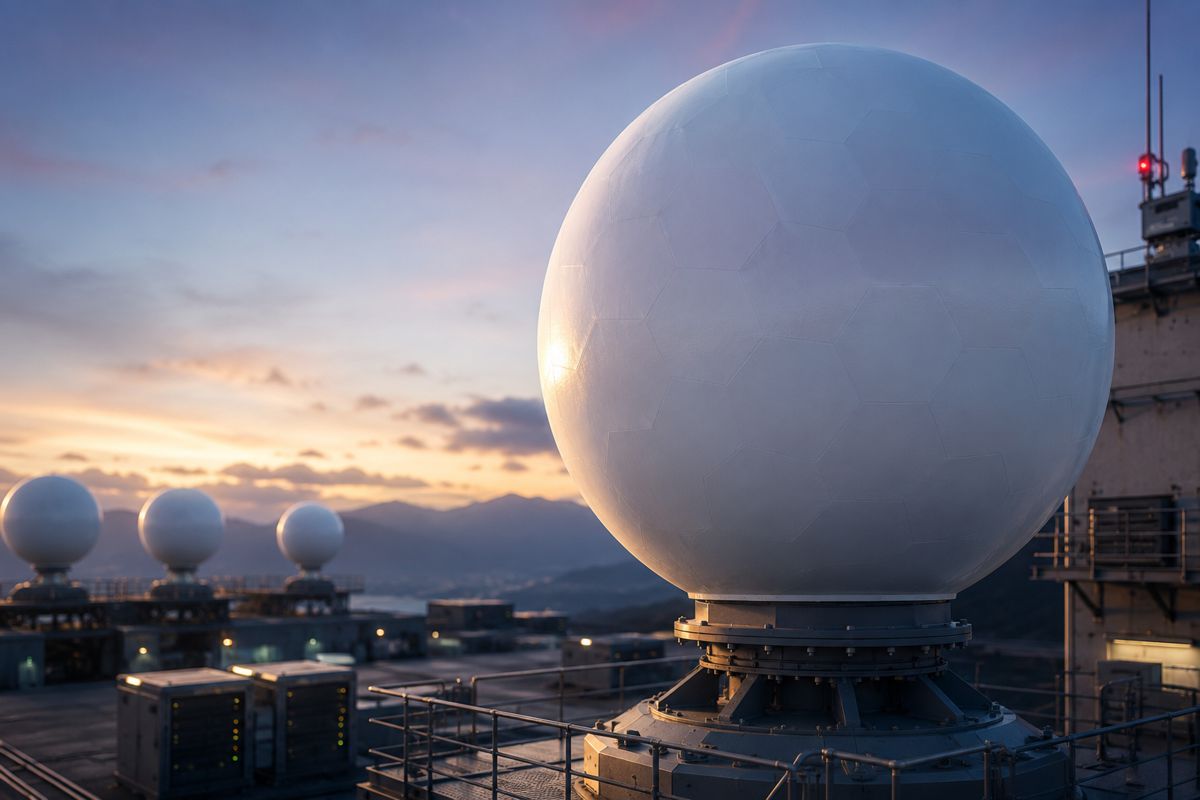
The Luneburg lens offers a third path, and its appeal has never been in doubt. A sphere of graded dielectric material focuses incoming radio waves to a point on its far surface, so placing multiple feeds around that surface produces multiple independent, high-gain beams from one passive structure, each pointing in a different direction. The concept has been understood for decades.
The obstacle has always been manufacturing, because building a large lens for high frequencies demands extremely low-loss dielectric materials, precise control of permittivity through the structure and tight dimensional tolerances that become punishing as the aperture grows. Small material variations translate into phase errors, and those errors compound across a larger aperture until gain and beam quality collapse.
That is the barrier MatSing says its process removes. The company reports it can now build lenses exceeding 50 wavelengths of aperture while holding high-gain multibeam performance, wideband operation and clean beam quality, using patented metamaterials in place of the heavy, hard-to-fabricate dielectric layers that made large lenses impractical.
According to Leo Matytsine, the company’s executive vice president and co-founder, “Even small material variations can introduce phase errors as aperture size increases, significantly reducing gain and beam quality. This MatSing manufacturing breakthrough overcomes these challenges, transforming the large-format Luneburg Lens from a laboratory concept into a practical engineering platform delivering superior performance and efficiency,” a claim that, if it holds at production scale, moves the lens from a demonstrated principle into a purchasable component.
The performance figures remain manufacturer specifications rather than independently verified benchmarks, but the manufacturing credibility is not idle, given a telecom track record that already includes more than two thousand macro lens deployments and installations at major stadiums and arenas worldwide.
One Aperture, Many Orbits, Less Infrastructure
Translated into operational terms, the proposition is that one static lens can do the work of several steered antennas. Because the lens forms its beams passively and simultaneously, a single aperture can link and track satellites spread across LEO, MEO and GEO at the same time, over a wide field of view and across multiple frequency bands, with no motors to maintain and no per-beam transmit and receive chains to power.
The platform spans apertures from 0.5 to 2.4 metres and the full 1 to 30 GHz range, and MatSing offers sample configurations that show the intended spread of use: a 1.2 metre lens covering 1 to 18 GHz for multi-band communications, a 2.4 metre lens covering 1 to 12 GHz for long-range low-frequency work, and a compact 0.5 metre lens tuned for the 12 to 30 GHz Ku, K and Ka bands used in high-throughput satellite links.
The commercial pull of that architecture follows directly from the ground-segment economics. If a single lens replaces a cluster of dishes, or sidesteps the element count and power budget of a gateway-scale phased array, the saving shows up in land, structure, energy and backhaul rather than in the antenna alone. Passive operation also removes failure points, since a lens has no gimbals to wear and no thousands of active components to fault, which matters for the reliability and lifecycle cost of remote teleports that are expensive to attend.
For gateway operators, satellite teleports and mobility providers serving maritime, airborne and land-mobile users, the attraction is a smaller physical footprint carrying more simultaneous links, which is the shape of the demand curve the ground segment is now facing.
Radar, Sensing And The Common-Aperture Advantage
The same wideband, multibeam behaviour that suits satellite gateways also lines up with where defence sensing is heading. A lens that captures energy across a wide angle and a broad frequency range is inherently a multi-function aperture, which is exactly the direction procurement has taken as programmes look to fold radar, satellite communications and electronic support into shared hardware rather than fielding a separate antenna for each task.
MatSing lists multifunction radar, passive RF sensing, radio astronomy and deep-space communications alongside its SATCOM applications, and the surrounding market gives that list weight. Analysts at SNS Insider value the passive radar market at around 4.7 billion dollars in 2025 and expect it to more than double by 2035, against a backdrop in which world military expenditure reached an estimated 2,887 billion dollars in 2025 and modernisation budgets increasingly prioritise passive and multi-static sensing that does not emit and betray its position.
For a passive, non-emitting lens, that is a natural fit. The device receives across a wide field without radiating, forms many beams for simultaneous tracking and carries no active electronics that a hostile system could detect, which aligns with the covert surveillance and resilient sensing priorities driving defence radar spend.
Matytsine framed the wider ambition in similar terms, arguing that “As satellite communications, defense sensing and advanced wireless infrastructure continue to evolve, RF lens technology has the potential to become a catalyst for the next generation of global connectivity.” The value of a wideband lens in this setting is that a single aperture can be pointed at several problems at once, which is the efficiency the common-aperture trend is chasing and one reason the technology is being courted beyond the pure communications market.
Where Value Moves In The Ground-Segment Supply Chain
For buyers, the significance of MatSing’s step is that it introduces genuine architectural competition into a market that had settled into a dish-versus-array debate. The incumbent supplier landscape, spanning names such as Kratos, Cobham Satcom, ThinKom, Viasat, L3Harris, Thales Alenia Space and Tesat-Spacecom, has largely organised itself around mechanical reflectors and active arrays, and a credible passive multibeam option changes the questions a procurement team should be asking.
The right comparison is no longer simply gain against agility but total cost of ownership across the antenna, the site and the operating life, weighed against the maturity of each technology at the scale a given gateway needs. That calculation will favour the lens most clearly where an operator needs many simultaneous links from a constrained footprint and values reliability over reconfigurability.
The sensible posture for infrastructure owners is therefore evaluation rather than commitment. MatSing’s manufacturing claims deserve independent validation at production volume, and the performance envelope will need to be proven against the specific band plans, coverage angles and environmental conditions of real gateway sites before it displaces established hardware. Even so, the direction is instructive.
As sovereignty programmes in Europe and elsewhere push operators to diversify their ground-segment supply chains, and as constellation traffic keeps rising faster than gateway real estate, the operators and integrators that understand where a passive multibeam lens fits, and where it does not, will be better placed to control the cost of the most expensive part of the modern satellite network, which is now firmly on the ground.
Key Industry Questions
- What problem does a large-format Luneburg lens actually solve for satellite operators? It addresses the ground-segment bottleneck created by dense low Earth orbit constellations. Where a parabolic dish tracks one satellite and struggles to slew fast enough for frequent LEO handoffs, a Luneburg lens forms many independent beams at once from a single passive structure. That lets one aperture link and track several satellites across LEO, MEO and GEO simultaneously, over a wide field of view and multiple frequency bands, without moving parts. For operators the practical value is fewer antennas, a smaller site footprint and lower power and backhaul costs, which matters because gateways can only be built where fibre, weather and regulation allow and must therefore carry more traffic per site.
- How does the lens compare with a phased array for gateway use? Both avoid mechanical steering and can hold multiple links at once, but they differ sharply on cost and complexity. A phased array steers electronically in microseconds using active elements, and reaching gateway-class gain demands very large element counts, with independent analysis suggesting more than 50,000 elements would be needed to match a Starlink-class dish at 28 GHz. That implies substantial power draw, thermal management and manufacturing expense. A Luneburg lens forms its beams passively, with no active electronics per beam and no per-element power budget, so its appeal is high simultaneous capacity and reliability at lower operating cost, though it lacks the instant reconfigurability of a fully electronic array.
- What are the headline technical specifications? MatSing states the platform spans apertures from 0.5 to 2.4 metres and frequencies from 1 to 30 GHz, covering the L through Ka bands, with gain exceeding 40 dBi at the top of each configuration’s range and aperture sizes beyond 50 wavelengths. Sample configurations include a 1.2 metre lens for 1 to 18 GHz multi-band communications, a 2.4 metre lens for 1 to 12 GHz long-range work and a 0.5 metre lens for the 12 to 30 GHz Ku, K and Ka bands. These are manufacturer figures rather than independently verified benchmarks, and full frequency-versus-gain data is available from the company on request.
- Why was manufacturing the barrier rather than the concept? The Luneburg lens principle has been understood for decades, but building large lenses for high frequencies is difficult. It requires extremely low-loss dielectric materials, precise control of permittivity through the structure and tight dimensional tolerances. Small material variations introduce phase errors, and those errors compound as the aperture grows until gain and beam quality degrade. MatSing says its patented metamaterials and proprietary process hold performance across apertures exceeding 50 wavelengths, replacing the heavy multi-layer dielectrics that made large lenses impractical. The company’s existing record of more than two thousand macro telecom deployments lends manufacturing credibility, though independent validation of the satellite-grade specifications at production scale remains the sensible next test.
- Where does this fit in the defence and radar market? A wideband lens that receives across a broad angle and frequency range without emitting is well suited to passive and multi-static sensing, which defence modernisation increasingly prioritises because non-emitting systems do not reveal their position. It also aligns with the common-aperture trend, in which programmes seek to combine radar, satellite communications and electronic support in shared hardware rather than separate antennas. Analysts value the passive radar market at roughly 4.7 billion dollars in 2025 with expectations of more than doubling by 2035, set against world military expenditure estimated at 2,887 billion dollars in 2025. MatSing lists multifunction radar, passive RF sensing, radio astronomy and deep-space communications among target applications.
- Does this signal that phased arrays and dishes are being displaced? Not directly. The more accurate reading is that the ground segment now has three architectures rather than two, and the choice becomes situational. Dishes retain an advantage in raw gain for single high-value links, phased arrays offer instant reconfigurability, and passive lenses offer high simultaneous capacity and reliability from a compact footprint. Each fits different site constraints, traffic profiles and budgets. The lens is most compelling where an operator needs many concurrent links from limited real estate and values lifecycle reliability over rapid reconfiguration. Established suppliers built around reflectors and active arrays will not vanish, but a credible passive option changes the questions procurement teams should be asking.
- What should ground-segment operators do with this information now? Evaluate rather than commit. Buyers should treat MatSing’s performance claims as specifications to be validated at production volume against their own band plans, coverage angles and environmental conditions before displacing proven hardware. The comparison to run is total cost of ownership across the antenna, the site and the operating life, not gain in isolation. Operators facing rising constellation traffic from constrained gateway locations have the strongest case to investigate the technology early. Those diversifying supply chains under sovereignty pressures also gain from understanding where a passive multibeam aperture fits, so that evaluation work is done before capacity pressure forces a hurried procurement decision.
- How mature is MatSing as a supplier? Founded in 2005 and headquartered in Irvine, California, MatSing has an established commercial record in terrestrial telecoms, where its lens antennas serve macro networks, fixed wireless access and high-density venues such as stadiums and arenas, with more than two thousand macro deployments cited. It first extended its lens portfolio to satellite applications in 2024, supporting L, S, C, X and Ku bands, and the large-format development builds on that move. The satellite ground-segment market is newer territory for the company than terrestrial telecoms, so its manufacturing credibility is well established while its track record specifically in gateway-scale satellite antennas is still being built through the LensSAT product line.
Strategic Takeaways
- The decisive cost in satellite networks has shifted from orbit to the ground, making gateway antenna architecture a commercial rather than purely technical decision, and any technology that reduces the number of antennas per site now carries direct balance-sheet significance.
- A passive multibeam lens introduces a genuine third option between the single-target dish and the element-heavy phased array, and procurement teams should reframe their evaluation around total cost of ownership across antenna, site and operating life rather than gain alone.
- The strongest case for the large-format lens is high simultaneous capacity from a constrained footprint with fewer failure points, which favours remote teleports and mobility gateways where reliability and land, power and backhaul costs dominate.
- Wideband, non-emitting, multibeam behaviour positions the technology for defence sensing and common-aperture radar programmes, opening a second addressable market that grows on defence modernisation budgets rather than commercial constellation traffic alone.
- Manufacturer specifications still require independent validation at production scale, so the prudent path for infrastructure owners is early evaluation against real site conditions, undertaken before rising constellation traffic turns antenna selection into an urgent procurement.