From Toilet Paper to Robots – How Road Crack Sealing Has Evolved
In November 2016, Highways.Today published one of those stories that sounded too ridiculous to ignore. Road maintenance crews in Littleton, Colorado, were repairing cracks in asphalt and then covering the fresh sealant with toilet paper.
There was nothing particularly sophisticated about it. The paper stopped hot crack sealant sticking to tyres and shoes while it cooled, allowing roads to return to traffic more quickly. Single-ply tissue was cheap, easy to apply and biodegradable. Within a few days, it disappeared.
Ten years later, an obvious question presents itself. Did road maintenance eventually find something better?
Apparently not everywhere. In June 2026, the City of Golden Valley in Minnesota began its annual crack-sealing programme across 9.84 miles of local streets. Its public information explained that crews apply hot elastic sealant to prevent water and debris entering the pavement and added that cover materials and blotting agents, “such as toilet paper”, are often used to prevent tracking while the sealant cures.
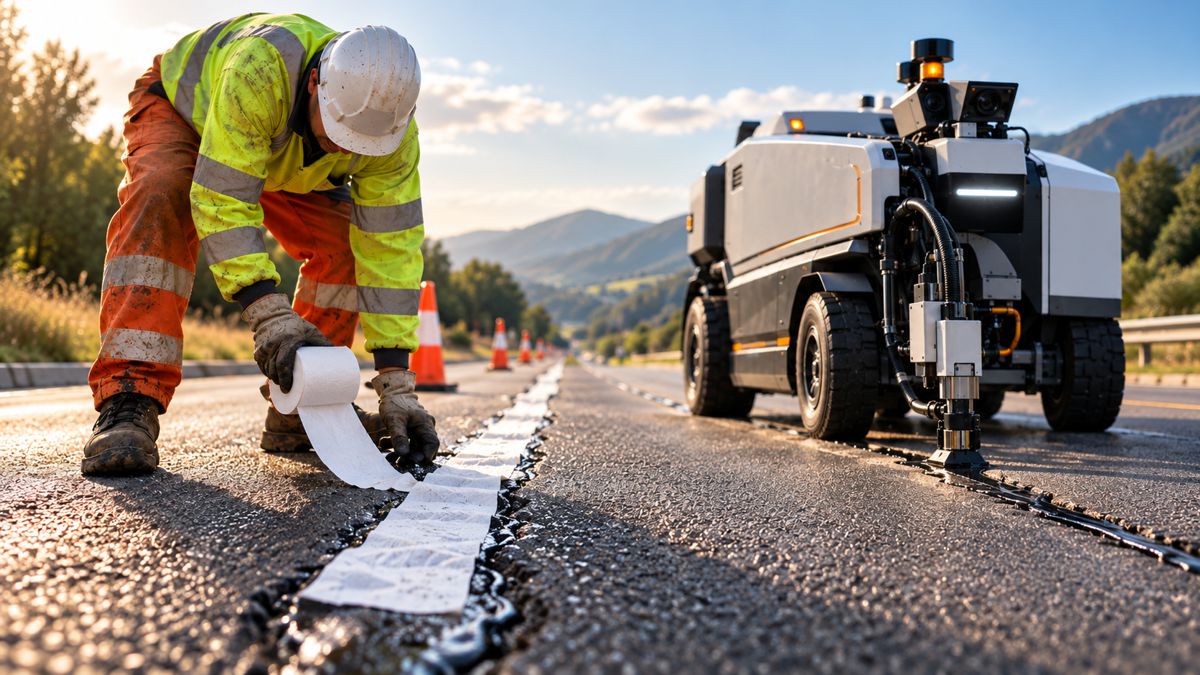
About 400 miles away in Lincoln, Nebraska, the practice is even more explicit. Lincoln Transportation and Utilities describes a five-stage crack-sealing process in which crews clean the crack with compressed air and a heat lance, fill it with hot-pour rubber, form an overband with a squeegee and then cover the repair with biodegradable toilet paper before traffic passes over it.
The toilet paper survived. What changed around it is considerably more interesting.
Briefing
- Toilet paper remains in active use as a biodegradable blotting material for fresh pavement crack sealant in parts of the United States.
- Commercial liquid detackifiers provide an alternative means of preventing freshly applied hot-pour sealant adhering to vehicle tyres.
- Crack-sealing materials have developed towards increasingly sophisticated polymer and rubber-modified formulations.
- Vision systems, deep learning and autonomous mobile robots are being developed to identify cracks and apply sealant automatically.
- Research into self-healing asphalt is exploring whether some pavement damage could eventually be treated before conventional crack sealing becomes necessary.
Why the Paper Was There
Crack sealing occupies an unglamorous but important position in pavement preservation. Cracks provide routes through which water and debris can enter a pavement structure. In climates exposed to repeated freezing and thawing, that water can become particularly destructive, while continued traffic loading and environmental exposure allow relatively minor defects to develop into more substantial failures.
The principle of preventative maintenance is straightforward. Deal with suitable cracks before deterioration reaches the point at which substantially more pavement has to be repaired or replaced.
The practical problem begins once hot-applied sealant reaches the road. It needs time to cool and set, but keeping a street closed while crews wait for every line of sealant to become sufficiently tack-free is inefficient. Reopening too quickly risks tyres picking up the material and pulling it from the crack. Toilet paper acts as a temporary barrier between the fresh material and traffic.
The idea itself was already old when Highways.Today encountered it in 2016. The original article traced the technique back to Minnesota Department of Transportation employee Fred Muellerleile, who received an award for the idea in 1970. According to that account, Muellerleile experimented with different papers before settling on single-ply toilet tissue as a cheap material that would stick to the sealant and quickly disappear.
More than half a century later, the principle remains recognisable. Lincoln’s current procedure shows how little the basic operation has changed. Crews remove debris and moisture with an air compressor and heat lance before applying hot-pour rubber. A squeegee pushes material into the crack, creates a wider protective band and removes excess material. Biodegradable toilet paper then protects the repair until the material hardens. The city specifically advises motorists that crack sealing covered with the paper is safe to drive over, whereas uncovered fresh sealant should be avoided.
This is not merely an eccentric local habit. Golden Valley’s crack-sealing specifications permit toilet paper as a blotting material while prohibiting sand or fine aggregate as cover material. Traffic is not to be allowed over fresh sealant until it has cured or been blotted sufficiently to prevent tracking.
The technique that looked wonderfully low-tech in 2016 has proved remarkably persistent.
The Detackifier Alternative
Toilet paper is no longer the only straightforward answer to the tracking problem. Specialist liquid detackifiers perform essentially the same operational job without leaving paper across the road.
SealMaster’s Tack Away, for example, is a water-based biodegradable liquid designed for hot-applied crack sealants. It is sprayed directly over freshly placed material to form a temporary barrier between the sealant and vehicle tyres. The manufacturer’s current technical information gives coverage of approximately 1,000 to 2,000 feet of cracks per gallon, depending on application rate.
The alternatives allow the sealant to be left to cool sufficiently before traffic returns, covered with an appropriate blotting material or treated with a purpose-made detackifier. Road maintenance, however, is governed as much by practicality, crew productivity, cost, availability and established working methods as by technological novelty.
A manufactured product does not automatically make the older method obsolete. Biodegradable paper that can be rolled directly onto hot sealant remains difficult to dismiss when it already performs the required task.
Better Materials Beneath the Paper
The apparent simplicity at the surface disguises considerably more development in the material underneath it.
Modern crack sealing covers a broad family of materials rather than a single form of hot tar. A 2025 review of asphalt pavement crack-sealing technologies examined emulsified asphalt, hot-applied asphalt, polymer-modified asphalt and rubber-modified asphalt systems, alongside additives intended to improve adhesion and durability.
Sealant operates in a difficult environment. It must adhere to the crack faces while accommodating movement in the pavement, remain sufficiently flexible at low temperatures, resist ageing and water ingress and survive repeated loading. Adhesive failure between sealant and pavement and cohesive failure within the material remain important failure mechanisms.
Recent research has also examined how ultraviolet ageing and freeze-thaw cycling affect crack sealants, including deterioration in their mechanical properties and self-healing ability. Other work is exploring nanomaterial additives and intelligent materials capable of sensing their condition.
The material underneath the toilet paper has become considerably more sophisticated, even if the temporary cover above it sometimes has not.
The Robot Finds the Crack
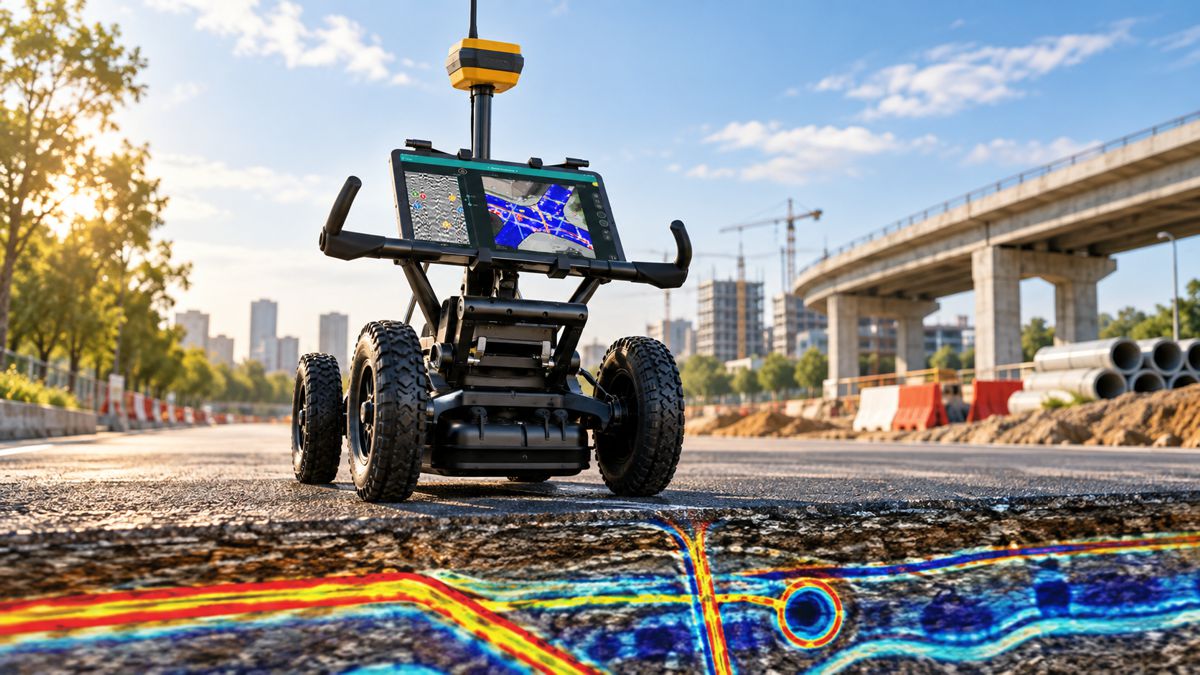
Automating pavement crack repair has been pursued for years because the task contains several characteristics suited to machines. It is repetitive, potentially hazardous for crews working beside live traffic and dependent upon following long, irregular lines accurately across the road surface.
The difficulty is that cracks are not conveniently engineered paths. They branch, disappear, change width and contrast poorly against dirty and damaged pavement. A machine must distinguish a genuine crack from joints, stains, patches, shadows and surface texture, then convert what it sees into a usable trajectory for the repair equipment.
Recent advances in computer vision and machine learning are beginning to address that problem. Research published in Automation in Construction in 2024 demonstrated an autonomous pavement crack-sealing robot known as APCSbot. Its CrackSegRefiner network uses a denoising diffusion model to refine crack trajectories detected in pavement images, while a control system guides the machine along the resulting path and an end effector dispenses emulsified asphalt. Tests reported segmentation precision of 84.48 per cent and an average sealing error of 6.22 mm when following discontinuous cracks.
Other researchers are tackling the route-planning problem itself. Work published by the American Society of Civil Engineers in 2024 examined path-planning algorithms for automated pavement crack sealing, treating the network of cracks as a routing problem that a machine must cover efficiently.
Commercial development is moving in the same direction. UK company Robotiz3d describes its ARRES Prevent system as a battery-powered autonomous road-repair vehicle capable of detecting and sealing surface cracks before they develop into potholes. The vehicle can patrol autonomously or under remote control and records the locations and details of repairs for quality control.
That additional data could become as useful as the physical repair. Conventional crack sealing leaves a sealed crack. An autonomous system can potentially leave the repair alongside a digital record of where and when the intervention took place, allowing subsequent inspections to build a maintenance history around individual defects.
Roads That Heal Themselves
Automation still assumes that a crack must be found and repaired. Another branch of pavement research is trying to intervene earlier.
Asphalt already possesses a limited natural capacity to heal microscopic damage under favourable conditions. Researchers have spent years investigating ways of enhancing that behaviour through induction heating, microwave heating and encapsulated rejuvenating agents.
A 2026 systematic review covering 66 studies published between 2011 and 2026 examined induction heating, microwave heating, microcapsule-based systems and microbial approaches. Induction heating has progressed to field testing, while other techniques remain at different stages between laboratory research and practical deployment.
These approaches are fundamentally different from sending a maintenance crew or robot along a visible crack. Conventional sealing treats damage that has already developed sufficiently to require intervention. Self-healing research seeks to influence deterioration at an earlier scale or give the pavement material an enhanced ability to recover.
That leaves an enormous installed road network built without such capabilities. Whatever eventually emerges from self-healing research, conventional pavement preservation will continue to deal with roads designed decades before autonomous repair or intelligent materials entered the conversation.
From Toilet Roll to Deep Learning
At one end of modern crack sealing is a maintenance worker with a roll of biodegradable single-ply toilet paper. At the other is a battery-powered machine using cameras, computing and automated control to identify pavement defects and follow them without somebody manually guiding a sealing wand.
Between them sit polymer chemistry, rubber-modified sealants, liquid detackifiers, machine vision, route optimisation and experimental self-healing materials. They are all addressing variations of the same basic problem. Pavements crack, water enters those cracks and contributes to deterioration, repairs need to be completed efficiently, and roads need to return to traffic.
The survival of toilet paper is therefore less surprising than it first appears. Infrastructure maintenance is full of compromises, and sophistication is useful where it improves productivity, safety, durability or cost. Complexity has no inherent engineering value of its own.
A roll of paper is inexpensive, portable, biodegradable and requires practically no training to deploy. If it prevents fresh sealant being pulled from a repair while allowing traffic to return sooner, replacing it with something more complicated needs to offer a genuine advantage.
Autonomous crack-sealing machines may eventually provide that advantage by changing the economics and safety of the entire operation rather than merely replacing the blotting material. Self-healing pavements could push intervention further upstream, dealing with some forms of damage before a maintenance crew would previously have arrived. For the enormous road networks already in service, however, old roads and new machines will coexist for a long time.
Which gives the 2016 Highways.Today story an unexpectedly durable ending. Ten years after road crews covering cracks with toilet paper looked like an amusing piece of highway ingenuity, cities are still doing it.
Around that roll of paper, almost everything else is beginning to change.
Key Industry Questions
- Is toilet paper really still used for road crack sealing? Yes. Current municipal information in the United States confirms that biodegradable toilet paper continues to be used as a blotting material over freshly applied crack sealant. Golden Valley, Minnesota, referenced the practice in its June 2026 maintenance programme, while Lincoln, Nebraska, includes it as a defined step in its crack-sealing procedure.
- Why put toilet paper over road sealant? Fresh hot-applied sealant can adhere to vehicle tyres or pedestrians before it has hardened. The paper creates a temporary barrier that reduces tracking while the material sets.
- Where did the idea come from? The 2016 Highways.Today article traced the technique to Minnesota Department of Transportation employee Fred Muellerleile, who received an award for the idea in 1970 after experimenting with different types of paper.
- What alternatives are available? Purpose-made liquid detackifiers can be sprayed onto freshly applied hot-pour sealant. Depending on the specification and process, other cover or blotting approaches may also be used.
- Has crack-sealing material changed since 2016? Research and product development continue across polymer-modified and rubber-modified asphalt systems, while experimental work includes nanomaterial additives, sensing capabilities and self-healing behaviour.
- Can robots seal road cracks autonomously? Experimental systems have demonstrated autonomous crack detection, trajectory generation and sealant application. APCSbot research published in 2024 reported an average sealing error of 6.22 mm on discontinuous cracks. Commercial autonomous road-repair systems are also emerging.
- What makes autonomous crack sealing difficult? Cracks have irregular shapes and can be difficult for vision systems to distinguish from pavement texture, patches, joints and other surface features. Once identified, their geometry must be converted into an accurate and efficient path for the sealing equipment.
- Can asphalt repair its own cracks? Asphalt has some inherent healing behaviour, and researchers are developing ways of enhancing it through technologies including induction heating, microwave heating and microcapsule systems. Practical maturity varies considerably between approaches.
- Will autonomous repair eliminate conventional crack-sealing crews? There is insufficient evidence to make that conclusion. Automated systems offer potential safety, consistency and productivity advantages, while conventional crack sealing remains widely used and emerging technologies still have technical and economic hurdles to overcome.
Strategic Takeaways
- Simple maintenance techniques can remain competitive for decades when they solve a narrowly defined operational problem cheaply and reliably.
- Liquid detackifiers offer an alternative to blotting paper, but the persistence of both approaches shows that road authorities do not necessarily converge on a single maintenance method.
- Materials development is improving the sealant itself while automation research addresses labour, safety, detection and application.
- Autonomous crack repair becomes more useful when defect detection, treatment and digital maintenance records form a single operation.
- Self-healing pavement research could eventually reduce some conventional interventions, but existing road networks ensure that preventative crack maintenance will remain relevant for years to come.