The Hardest Part of Innovation Is Getting Someone to Say Yes
In 2013, American contractor DPR Construction was working with surveying technology specialist Trimble on an unusual piece of construction equipment. Known as Project Lion, the collaboration produced a robotic layout machine capable of transferring information from digital drawings directly onto concrete floors, marking the positions of walls and other building elements without the extensive manual setting-out normally required.
The Laybot, as it became known, relied on a robotic total station for positioning and could produce floor markings at speeds that initially appeared promising. Contemporary reporting in Engineering News-Record described an accuracy of around one-eighth of an inch, although the technology required a clear line of sight between the machine and surveying equipment. Obstacles such as columns complicated its operation, and the developers continued refining its performance.
The project never delivered the productivity improvements DPR needed. A 2025 research paper comparing robotic and manual construction layout describes how the Laybot could accurately mark individual points but struggled with the straight lines required for practical building layouts. Despite producing two prototypes and securing a patent, DPR eventually shelved the development.
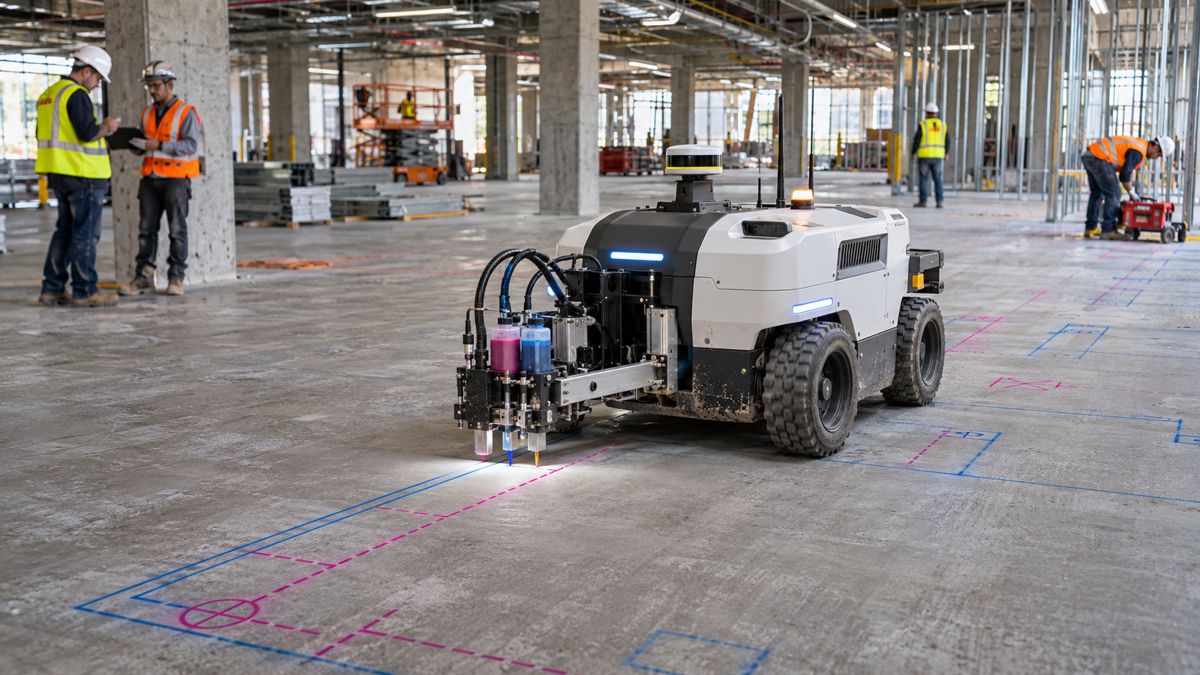
Several years later, the contractor licensed its Automated Construction Scribing Tools patent to California-based Dusty Robotics, a startup developing automated construction layout equipment. Dusty pursued its own engineering approach, creating a machine capable of printing coordinated building information directly onto floor slabs. Its FieldPrinter went on to become a commercial product used by contractors including DPR, Mortenson, McCarthy and Skanska.
By September 2025, Dusty reported that its technology had printed more than 225 million square feet of construction layout across thousands of projects. The company’s growth provided an outcome the original development team had been unable to achieve, although the licensing agreement does not establish that Dusty’s equipment incorporated the earlier Laybot mechanism.
DPR’s account of the collaboration describes how an unsuccessful development project eventually found another opportunity through a specialist technology business. The contractor understood the practical frustrations associated with manual layout, while Dusty possessed the focus and engineering capabilities needed to develop a commercial solution.
Independent inventors and small engineering businesses face similar difficulties, frequently without the resources or industry connections available to a major contractor. Developing a prototype can demand considerable ingenuity, determination and personal investment, while persuading another organisation to commit time, money and professional credibility to the invention requires a different set of skills.
Briefing
- A working prototype establishes technical potential, but construction businesses must also consider reliability, safety, cost, productivity and operational risk.
- DPR Construction’s Laybot experience and subsequent collaboration with Dusty Robotics demonstrate how unsuccessful developments can create opportunities for further innovation.
- Examples from the United States, China, India, France and Singapore reveal different approaches to industry engagement, technical testing and commercial adoption.
- Independent testing, realistic performance evidence and carefully planned trials can help small businesses establish credibility with prospective partners.
- Successful demonstrations do not guarantee commercial orders, making procurement, funding, intellectual property and follow-on arrangements essential considerations.
Understanding the Customer’s Problem
An inventor may spend months developing a device that solves a problem encountered during a particular construction activity. A machine attachment might simplify the positioning of heavy components, a road maintenance product could reduce installation time, or a software application might eliminate repetitive administrative work. Inside the workshop, the results can appear entirely convincing. The mechanism operates as intended, the materials perform satisfactorily, and the original problem seems to have been overcome.
A prospective customer must consider a much broader set of circumstances. A contractor purchasing an unfamiliar attachment needs to understand its compatibility with existing machinery, the competence required to operate it, possible damage to equipment and the availability of replacement parts. A highway authority evaluating a new surfacing material must consider durability, skid resistance, maintenance requirements and the consequences of premature failure. Neither organisation is necessarily questioning the inventor’s competence. They are assessing responsibilities that may continue long after the initial purchase.
Established methods can be inefficient, but their limitations are generally understood. Contractors know how much labour conventional equipment requires, how frequently it breaks down and what can be done when something goes wrong. Introducing unfamiliar technology creates uncertainty, especially where mistakes could cause injuries, disrupt a construction programme or expose a business to warranty claims. Understanding those concerns provides a stronger starting position than assuming an impressive demonstration should be sufficient.
The invention must solve a problem that somebody considers important enough to address, and the proposed improvement must justify the effort and risks involved in adopting it. An elegant engineering solution may have little commercial value if existing methods are inexpensive, the problem occurs infrequently or the customer cannot recover the cost of changing established working practices.
Finding the People Who Can Help
The first approach to a large construction company often proves unsuccessful for reasons unrelated to the invention. An introductory email might reach a general enquiries department, a marketing executive or a procurement team with no immediate requirement for the proposed technology. Even when it reaches an interested engineer, that individual may lack the authority to approve testing or allocate expenditure.
Construction businesses have complicated decision-making structures, and the most useful initial contact is frequently someone close to the activity being improved. A technology intended to improve asphalt compaction may interest a paving operations manager, while a device designed to simplify bridge inspection could attract the attention of an asset management team. Such people understand the operational problem and can provide technical criticism, although arranging a trial may still require agreement from project directors, equipment owners, safety personnel or infrastructure clients.
The Centre of Excellence for Decarbonising Roads addresses this difficulty in its 2026 Toolkit for Innovators Entering the Roads Industry. The practical market-entry guide identifies the presence of an internal champion as one of the strongest factors separating innovations that progress from those that struggle to gain acceptance.
It recommends beginning with technical personnel who understand the problem rather than approaching senior executives simply because they hold positions of authority. At the same time, it warns that enthusiastic supporters may lack control over budgets, procurement decisions or access to operational trials. An inventor therefore needs to understand how a potential partner makes decisions and who can authorise the next stage of development.
Although written for the British roads sector, the guidance addresses circumstances encountered internationally. Procurement arrangements and organisational structures vary considerably, yet inventors must still identify who experiences the problem, who carries the operational risk and who can make a decision. Establishing those relationships is often as important as preparing the initial technical presentation.
Industry Support in the United States
The relationship between DPR Construction and Dusty Robotics demonstrates how an established contractor can contribute to technology development without undertaking every stage internally. DPR understood site operations and the practical frustrations associated with manual layout, while Dusty could concentrate its engineering effort on creating equipment specifically for that application.
The FieldPrinter needed to maintain positional accuracy, work around site obstructions and accommodate differences between design information and actual construction conditions. It also had to produce markings that multiple trades could understand and use without introducing confusion or additional checking procedures.
By mid-2021, Dusty had reported completing more than one million square feet of production layout while refining its machines through successive hardware generations. Those deployments provided opportunities to evaluate accuracy, productivity and coordination against existing construction methods, while revealing problems that would have been difficult to identify in a workshop.
The American highway sector offers other pathways towards technology adoption. The Federal Highway Administration’s Every Day Counts programme has encouraged state transportation departments to introduce proven but underused technologies, supported by technical assistance and collaboration between authorities.
Its newer State Transportation Roadway Innovation Deployment Excellence programme, known as STRIDE, provides for up to US$51.1 million in federal funding to support state-led deployment of market-ready highway innovations. The programme is intended for technologies that have demonstrated their value but have not yet achieved widespread practical use.
Private contractors and technology providers can participate through partnerships with state transportation departments rather than treating STRIDE as an unrestricted startup grant. As of 14 November 2026, the Federal Highway Administration had not announced its formal call for proposals, with application dates and final submission requirements still to be published. The structure offers a potential route for businesses whose equipment or methods are sufficiently developed for practical evaluation, particularly where a state authority has identified an operational need and is prepared to support further deployment.
Construction Robotics in China
Access to real construction projects can substantially influence the development of unfamiliar equipment. China provides an example through Bright Dream Robotics, established in Foshan in 2018 as a subsidiary of the Country Garden property development group.
The company developed robotic systems for repetitive construction activities, including concrete finishing, grinding, surface treatment and decoration. Its position within a major developer provided opportunities to evaluate equipment on working projects and develop machines around operational requirements.
According to Bright Dream Robotics, by September 2022 it had put 32 construction robot types into commercial application across more than 600 projects in 30 Chinese provincial-level regions, with over 1,600 units delivered. These historical, company-reported figures do not independently establish the productivity or profitability of individual machines, but they indicate the scale of project access available to an engineering organisation supported by a substantial construction group.
Such support also creates dependencies. Country Garden subsequently experienced severe financial difficulties, with its approximately US$17.7 billion offshore debt restructuring sanctioned by the Hong Kong High Court on 4 December 2025 and becoming effective on 30 December. The company’s experience demonstrates that relying heavily on a single developer or construction pipeline can expose technology businesses to commercial circumstances beyond their control.
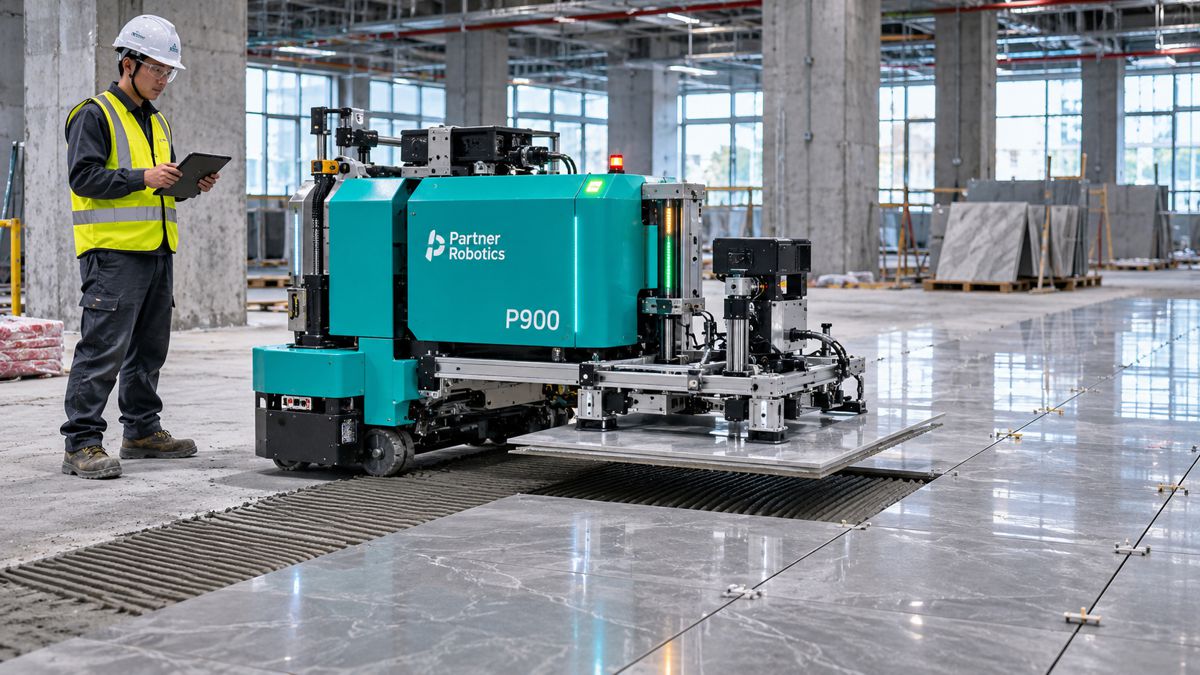
An alternative approach can be seen at Dongguan-based Partner Robotics, established in 2023 by Kecheng Wang, also known as Carson Wang, a former chief executive of Bright Dream Robotics. According to Partner Robotics’ corporate history, Bright Dream subsequently became a strategic shareholder, providing a direct connection between the two businesses.
Partner Robotics concentrates on commercialising specialist construction equipment, including floor-tiling and layout robots, while developing relationships with customers in China and international markets. Its November 2025 Series A funding round was led by China Growth Capital, with participation from Cowin Capital and Redpoint China Ventures. Including an earlier angel round, the company reported raising approximately RMB100 million, equivalent to around US$14 million, to support product development, international expansion and supply-chain improvements.
The company’s demonstration procedure describes what happens when unfamiliar equipment is introduced to a prospective customer’s construction site. Before testing begins, the manufacturer and customer agree success criteria, assess the working area and arrange the required materials. Operators receive training, the robot is tested with the intended tiles and mortar, and subsequent activity is recorded for performance analysis.
Partner Robotics aims to complete the demonstration over five working days and prefers approximately 300 m² of relatively open floor space. The requirements specify floor flatness tolerances, access dimensions and the availability of electricity and water, alongside restrictions involving tile dimensions and laying patterns. The published demonstration specification is narrower than some of the company’s general product information, so compatibility must be established for the particular machine and application.
A robot might install tiles efficiently across an unobstructed floor yet struggle to deliver equivalent productivity in a building with narrow doorways, stairs, extensive cutting requirements or difficult access. Its performance must therefore be evaluated alongside preparation time, materials handling, manual finishing and movement between work areas.
The two Chinese businesses have taken different approaches to commercialisation. Bright Dream originally benefited from its position within a major property development group, while Partner Robotics is pursuing a model based on specialist products, external investment and international customers. Both depend on access to practical construction environments where unfamiliar technology can be evaluated against existing methods.
University and Industry Collaboration in India
India demonstrates another route through the relationship between universities, startup businesses and specialist investors.
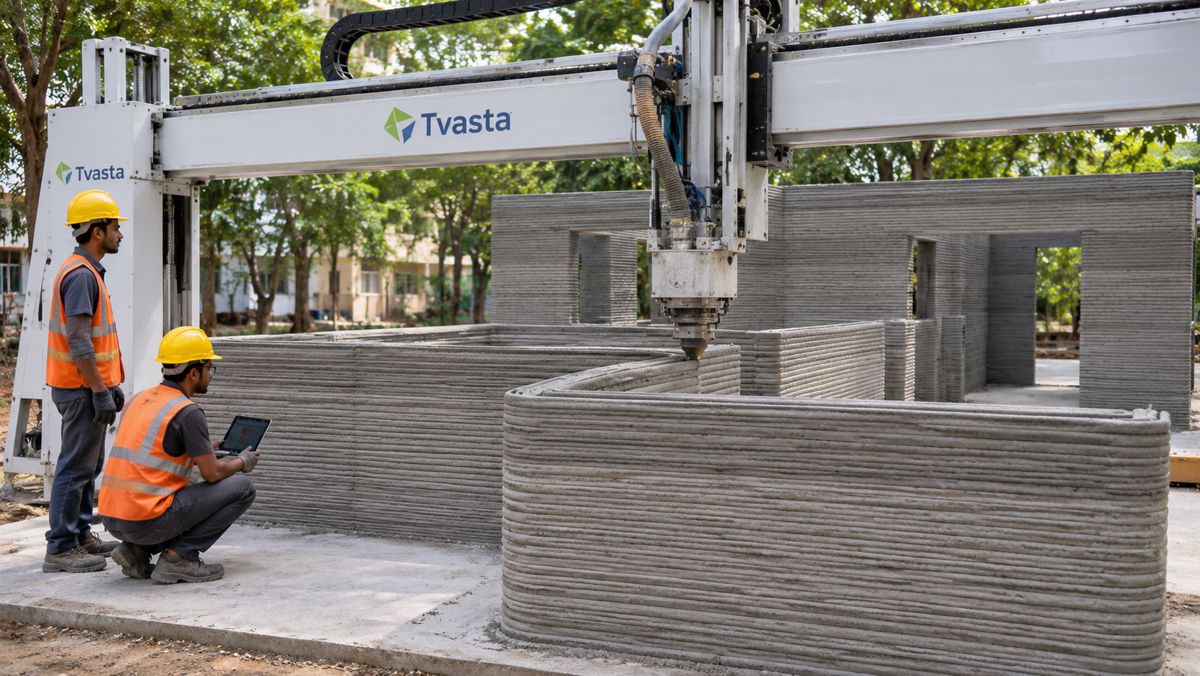
Founded in 2016 by alumni of the Indian Institute of Technology Madras, Tvasta Manufacturing Solutions developed concrete 3D printing equipment, software and material formulations intended to support automated building construction. The company was incubated at IIT Madras, giving its founders access to a research environment while developing the technology.
Its progress attracted support from Habitat for Humanity’s ShelterTech accelerator programme and the organisation’s Terwilliger Center for Innovation in Shelter. The Terwilliger Center subsequently provided design assistance and early financial support for the development of a 3D-printed demonstration house.
Completed on the IIT Madras campus in 2020, the approximately 600-square-foot building was formally inaugurated virtually on 27 April 2021 by India’s Finance Minister, Nirmala Sitharaman. The project provided a tangible demonstration of the technology’s capabilities and attracted attention beyond the university environment.
Habitat’s relationship with Tvasta subsequently developed into an investment opportunity. Its Shelter Venture Fund records describe a US$2.35 million investment round in August 2021, led by Habitat alongside other investors. In an October 2021 press release, Habitat confirmed that its own contribution amounted to approximately US$411,000, equivalent to ₹3 crore at the time.
Further industrial cooperation followed. In May 2022, India Cements and Tvasta signed a memorandum of understanding covering research and development, material formulations and potential applications of concrete 3D printing.
The company’s development involved several forms of assistance that an isolated inventor might struggle to obtain. University expertise supported technical investigation, an international housing organisation provided access to industry contacts and funding, and a major materials producer contributed knowledge relevant to practical construction applications.
Producing a successful demonstration building does not establish whether the same technology will be commercially competitive across different markets. Structural design requirements, materials availability, building approvals, labour costs and repeatability all influence its potential. The university and industrial relationships provide opportunities to investigate those questions with expertise and facilities that would otherwise be expensive to obtain.
Preparing Evidence That Contractors Can Trust
When an inventor finally reaches a prospective industry partner, enthusiasm for the technology can become a distraction. Engineers naturally want to explain the mechanism they have developed, the problems encountered during construction and the unusual features that make their invention possible. Those details will become important during technical evaluation, although the prospective customer generally wants to understand the operational benefit first.
A presentation for a new road maintenance attachment should establish what existing process it improves, the labour or equipment currently required, the expected operational advantage and the evidence supporting that expectation. Clear drawings, photographs, a concise technical summary and an honest account of remaining uncertainties will often communicate more effectively than an elaborate presentation filled with ambitious claims.
Performance figures require particular care. An inventor may achieve a 40% reduction in installation time during a controlled demonstration, but that does not establish a comparable improvement across normal construction operations. Equipment setup, materials handling, supervision, maintenance and interruptions can all change the outcome. Environmental claims similarly require meaningful comparisons and supporting evidence rather than general statements about sustainability.
A carefully designed trial can answer questions that a prototype demonstration cannot. Depending on the technology, testing may begin in an independent laboratory, a controlled engineering facility or a segregated area of a construction site. The parties should agree beforehand what will be measured, how results will be compared with existing methods and what constitutes a satisfactory outcome.
Relevant measures might include installation time, accuracy, material consumption, equipment availability, operator intervention or total operating cost. Responsibility for equipment, supervision, insurance and remedial work also needs to be established, especially where unfamiliar machinery will operate near employees or expensive infrastructure. Some established contractors have begun investing in dedicated environments specifically intended to make such evaluations easier.
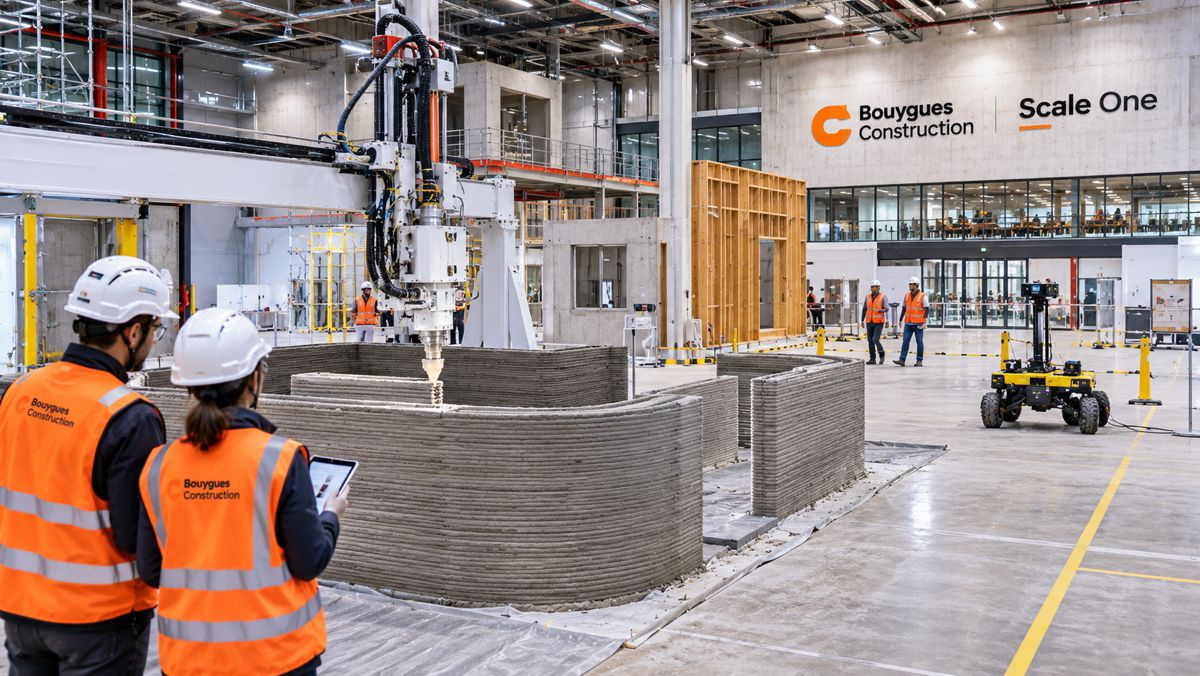
On 6 October 2026, Bouygues Construction officially opened Scale One, a 2,500 m² innovation platform at Chilly-Mazarin, south of Paris. The facility recreates aspects of new-build and renovation projects and includes areas for prototyping, concrete 3D printing and robotics training. Developers can evaluate unfamiliar materials, machinery and working methods under conditions more representative of construction operations than a conventional laboratory, while avoiding some of the complications associated with introducing experimental equipment onto a live project.
Access to suitable facilities can reduce the resources required to establish credible performance evidence. The arrangements still need careful consideration, including testing costs, intellectual property provisions and opportunities for subsequent deployment. A successful demonstration in a dedicated facility may establish technical credibility without necessarily creating a customer.
Singapore has been developing a related approach, connecting controlled testing environments with organisations responsible for infrastructure procurement. On 17 September 2026, JTC Corporation and Japanese contractor Kajima announced an autonomous construction equipment pilot at the Bulim Autonomous Yard in Jurong Innovation District.
The project involves JTC, Kajima, Singapore’s Housing & Development Board and other public-sector partners, alongside specialist technology providers and local equipment businesses. Swiss startup Gravis Robotics, based in Zurich, supplies a retrofit autonomy system for excavators, while Kajima contributes its A4CSEL autonomous construction technology for compactors, marking that system’s first deployment outside Japan.
Local contractor Kok Tong Construction and equipment provider Tractors Singapore Limited are involved in adapting conventional machinery, training personnel and developing operational procedures. Under the pilot arrangements, an operator assigns tasks and establishes virtual operating boundaries, allowing equipped machines to carry out work autonomously while being monitored remotely. The trial aims to reduce skilled operator requirements by 50%, with one operator overseeing two machines, although this remains a project objective rather than a demonstrated result.
Retrofitting could make the technology more commercially accessible because construction businesses already own substantial fleets of expensive machinery. Replacing those assets simply to introduce automation may be unrealistic, whereas adapting existing equipment offers another route if the systems can be installed, operated and maintained without unacceptable risks.
The collaboration gives a specialist robotics developer access to established contractors, public-sector testing facilities and equipment suppliers. The participating organisations can evaluate automation under controlled conditions while developing the skills and procedures needed for potential wider use.

Standards, Certification and Product Approval
Technical compliance can become one of the most expensive obstacles facing a small inventor, particularly when the intended product will operate in a safety-critical environment.
Consider a new roadside barrier component. The inventor might develop a promising mechanism, produce prototypes and demonstrate that the assembly behaves as intended during preliminary tests. A highway authority cannot accept the product simply because it appears strong or performs satisfactorily under limited loading conditions.
Depending on the intended application and jurisdiction, crashworthiness evidence, installation specifications, material properties and compatibility with existing roadside infrastructure may need to be established. Testing can require specialist facilities and substantial expenditure, with no guarantee that the first design will meet the relevant performance criteria.
Similar difficulties arise with unfamiliar construction materials, structural components and machinery. A laboratory test may establish strength or durability under particular conditions without providing sufficient evidence for every intended use. Customer specifications, national regulations and independent certification requirements can introduce additional obligations, particularly when products are intended for use in multiple countries.
In the United States, applicable standards and approval procedures depend on the product, intended use and responsible authority. China operates its own national and industry standards, while other Asian markets may apply different requirements. The European Union’s revised Construction Products Regulation, Regulation (EU) 2024/3110, began applying its main provisions on 8 January 2026, with transitional arrangements allowing elements of the previous framework to continue for relevant product families.
The applicable obligations depend on the product and its harmonised technical specifications rather than every construction invention automatically being subject to identical certification. CE marking should not be confused with universal approval for construction use, and conformity with a standard in one jurisdiction does not necessarily establish acceptance elsewhere. Investigating these requirements while a design remains flexible can prevent expensive mistakes, particularly where international manufacturing and distribution are contemplated.
An initial assessment from a qualified engineer, testing organisation or competent certification adviser may identify changes that would otherwise emerge only after substantial investment in tooling or production. A failed test need not end development, but repeated testing without understanding the underlying requirements can exhaust the resources of a small engineering business remarkably quickly.

Manufacturing, Intellectual Property and Funding
Manufacturers can offer expertise that independent inventors rarely possess. An established engineering company may understand production tolerances, materials selection, tooling, quality assurance and the compromises required to manufacture equipment reliably. It may also have suitable testing facilities, established suppliers and customer relationships that would take years to develop independently.
Consider an inventor who has developed a road maintenance attachment. An overseas manufacturer expresses interest and offers to finance further engineering work in exchange for exclusive commercial rights. The arrangement could provide access to design expertise, production machinery and international customers, allowing development to progress much faster than the inventor could achieve alone.
The details deserve careful consideration. Both parties need to understand who owns the original invention, what happens to improvements developed during collaboration and whether the manufacturer receives exclusive rights in particular countries or worldwide. Responsibility for testing, tooling, certification and development expenditure also needs to be established.
An agreement granting worldwide exclusivity without meaningful performance obligations could prevent the inventor from working with other manufacturers even if the proposed partner never brings the product to market. Conversely, a manufacturer investing substantial resources in development may reasonably seek commercial protection for that investment.
Confidentiality agreements can help establish expectations when technical information is shared, but they cannot guarantee protection against every intellectual property dispute. Patent rights, trade secrets, joint development arrangements and contractual enforcement require different considerations, particularly where development, manufacturing and sales take place in separate jurisdictions.
Appropriate legal and intellectual property advice can be valuable before substantial rights are transferred. Manufacturers should not automatically be regarded as threats to independent invention, since established businesses have legitimate reasons to seek external technology and often contribute capabilities essential to commercial development.
Financing presents a related challenge. A working prototype may have been developed using personal savings, borrowed equipment and workshop facilities, whereas formal testing can introduce expenses that cannot be avoided through ingenuity alone. Specialist laboratory work, engineering modifications, insurance, certification advice and attendance at trial sites all require funding, often before there is any prospect of a commercial order.
Grants may support specific technical investigations but commonly impose eligibility conditions and reporting requirements. Universities can provide research facilities, accelerators may introduce mentors and industry contacts, and private investors can contribute capital in exchange for equity or other commercial rights.
A manufacturer might finance development through a defined commercial arrangement, while a contractor could agree to fund a pilot if the technology addresses an immediate operational problem. A modest paid trial that produces credible performance evidence and an ongoing relationship with a genuine customer may be more valuable than substantial investment that creates unrealistic expectations about future growth.
Commercial Rejection and Adoption
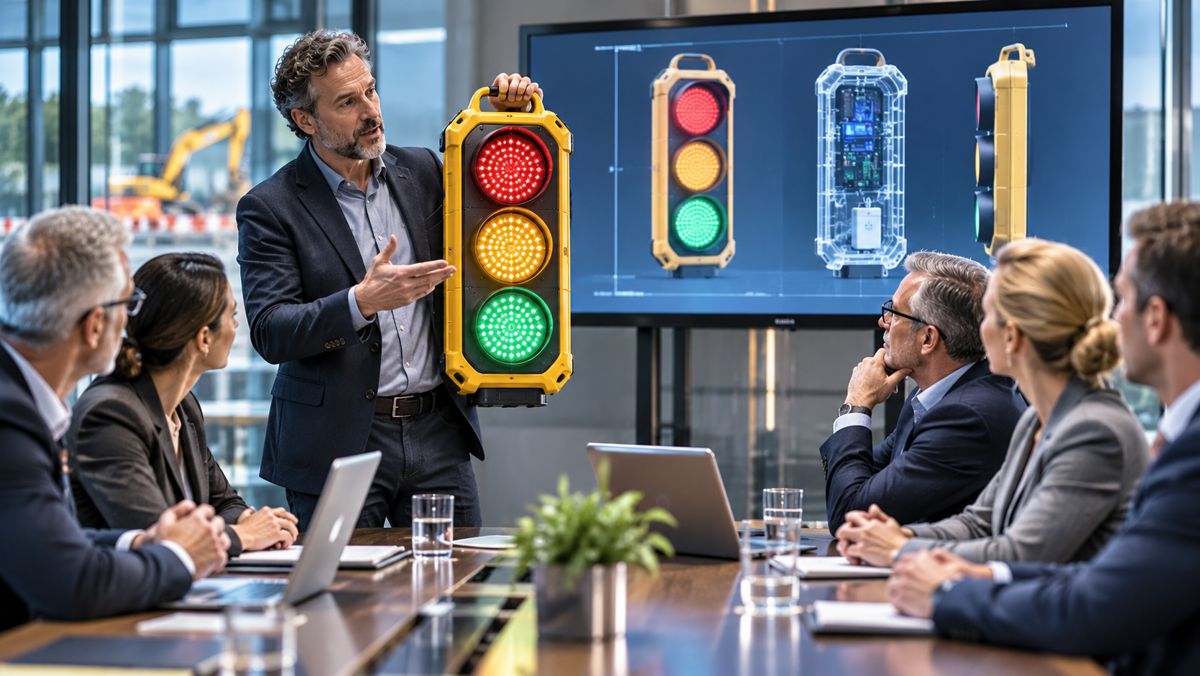
Rejection remains an unavoidable part of introducing unfamiliar technology. An inventor may receive no response to carefully prepared approaches, encounter months of internal discussion or discover that an interested organisation has no budget for experimentation.
A product can be technically sound but commercially unattractive, particularly when existing methods are inexpensive or the problem occurs too infrequently to justify specialised equipment. Some inventions require substantial changes to working practices, making them difficult to adopt even when the potential benefits are credible.
Understanding the reason for rejection helps determine what should happen next. A contractor declining a trial because a project is approaching completion might be worth approaching again under different circumstances. Repeated concerns about equipment cost, reliability or maintenance deserve closer investigation, while evidence that an invention solves a problem customers do not consider important may require a fundamental change of direction.
Persistence can be useful when it produces better evidence, improved technology or more suitable partners. Continuing indefinitely without responding to genuine technical and commercial objections is unlikely to help either the inventor or prospective customer. Even a successful field trial may leave an inventor some distance from a purchase order, particularly when procurement procedures require additional approvals, competitive tendering or commitments to equipment maintenance and support.
Singapore’s Innovative Procurement Partnership offers one approach to addressing the difficulty of converting successful trials into wider deployment. Introduced by the country’s Ministry of Finance, the procurement framework allows public agencies to award contracts covering an initial pilot, with an option for a one-time scale-up of the innovative solution within a defined period.
JTC is using the approach for specific construction technology tenders, including inspection robots and remote-controlled tower cranes. Under the arrangements announced in July 2026, awarded tenderers that complete successful pilots can apply to deploy their technologies on other JTC projects without the need for new tenders. The opportunity is linked to the original procurement award and successful completion of the pilot rather than being available automatically to any business undertaking a demonstration.
The framework also reduces some barriers faced by smaller businesses. A previous track record is not required by default, while security deposits and liquidated damages provisions are normally removed during the pilot stage. These arrangements reduce certain risks for suppliers without removing the need to demonstrate that their technologies meet the customer’s requirements.
An independent inventor should therefore consider what might happen after a trial before agreeing to undertake one. A prospective partner might be prepared to consider an initial purchase, undertake further evaluation on another project, introduce the developer to additional customers or permit trial results to be used when approaching other organisations.
Some companies can offer only technical feedback, which may still be worthwhile when the results are properly documented. A credible assessment from an established contractor or independent testing organisation can help secure further opportunities, provided confidentiality arrangements allow the evidence to be shared.
Industry Supporters
Construction inventions often depend on contributions that receive little attention in the final product announcement. An experienced engineer who recognises a useful idea can provide advice that saves months of development, while a project manager willing to arrange a controlled trial may create an opportunity that an inventor could never secure alone. A manufacturer might suggest a simpler mechanism or a more practical production method, and a university researcher could identify a technical limitation before substantial resources are committed.
The experiences of Tvasta in India and Partner Robotics in China demonstrate how university expertise, industrial partnerships, investment and construction trials can help specialist engineering businesses progress. The more recent collaboration involving Gravis Robotics in Singapore illustrates the opportunities that can arise when a startup gains access to established contractors, equipment suppliers and public-sector testing facilities, although the announced pilot has yet to demonstrate its intended operational results.
These relationships are not always easy to establish. Large organisations can be intimidating, formal procurement procedures unfamiliar and technical requirements expensive to satisfy. Yet the construction industry contains people who understand practical problems and have reasons to look for better ways of solving them. DPR Construction’s decision to work with Dusty Robotics provides one example of how established industry knowledge and specialist engineering capabilities can be brought together.
Progress may involve modifying an invention, changing its intended application or recognising that an early development has reached its limits. The willingness to accept knowledgeable criticism can be as useful as the determination that produced the original prototype, particularly when testing reveals limitations that were difficult to anticipate.
A serious opportunity to demonstrate an invention brings the technology into contact with the people and conditions that will determine whether it has a future. It is a milestone that may take an independent developer years to reach, particularly without the resources or connections of an established company.
A validated invention still needs a viable manufacturing or delivery model, appropriate pricing, customer support and a sustainable commercial strategy. Those decisions form the final stage of the innovation journey, when something that has been proven to work must become a product, service or business capable of standing on its own.
The first industry supporter cannot guarantee that outcome, but can provide something an inventor working alone may find impossible to obtain: a credible opportunity to discover whether the idea belongs in the wider world.
Key Industry Questions
- Why do construction companies hesitate to adopt new inventions? Contractors must consider safety, reliability, project schedules, insurance, liability and operating costs. Unfamiliar products introduce uncertainties that need to be assessed before they can be used on working projects.
- How can independent inventors approach large equipment manufacturers? The strongest approaches identify a specific operational problem and reach personnel responsible for that activity. Clear technical information, realistic performance evidence and an achievable trial proposal are generally more useful than an unsolicited general presentation.
- What should a construction innovation trial measure? Relevant measures may include productivity, accuracy, installation time, safety, reliability, material consumption and operating costs. Success criteria should be agreed beforehand and compared with an appropriate existing method.
- Can a startup test construction equipment without access to a live project? Universities, independent laboratories, innovation centres and specialist testing facilities may provide controlled environments. Their suitability depends on the equipment, risks and intended application.
- Are construction product regulations the same internationally? Requirements vary according to jurisdiction and product category. Compliance with an American, Chinese or European standard does not automatically establish acceptance in other markets.
- Should inventors use non-disclosure agreements when approaching manufacturers? Confidentiality agreements may provide useful contractual protection, but their effectiveness depends on their terms and enforceability. Inventors should also consider existing intellectual property rights, ownership of improvements and the scope of information being shared.
- What funding is available for construction innovation trials? Potential sources include research grants, university collaborations, accelerator programmes, private investment, manufacturer partnerships and paid commercial pilots. Availability and eligibility vary between countries and programmes.
- Why do successful construction technology trials sometimes fail to produce orders? Operational success may not resolve procurement, certification, maintenance, training or commercial requirements. Organisations also need suitable projects, budgets and internal approval before wider deployment becomes possible.
- How can construction companies support independent innovators? Contractors and infrastructure owners can provide technical feedback, access to suitable testing environments, clear evaluation requirements and realistic routes towards procurement. Such support does not require an obligation to purchase every invention tested.
Strategic Takeaways
- Identify the decision-maker as well as the technical supporter. Industry enthusiasm is useful, but progress depends on understanding who can approve trials, expenditure and subsequent deployment.
- Design trials around operational evidence. Contractors need relevant performance data, realistic comparisons and an understanding of technical limitations before accepting unfamiliar equipment or methods.
- Investigate compliance requirements early. Testing, certification and national market requirements can affect design decisions, development costs and opportunities for international commercialisation.
- Establish partnership terms before sharing substantial technical information. Manufacturing collaboration can accelerate development, but intellectual property ownership, improvements, exclusivity and expenditure responsibilities should be understood.
- Plan beyond the first demonstration. A successful trial becomes more valuable when there is an agreed pathway towards further testing, commercial purchasing or the legitimate use of performance evidence with other potential customers.