






AI Accelerates the Search for High-Performance Metal Alloys
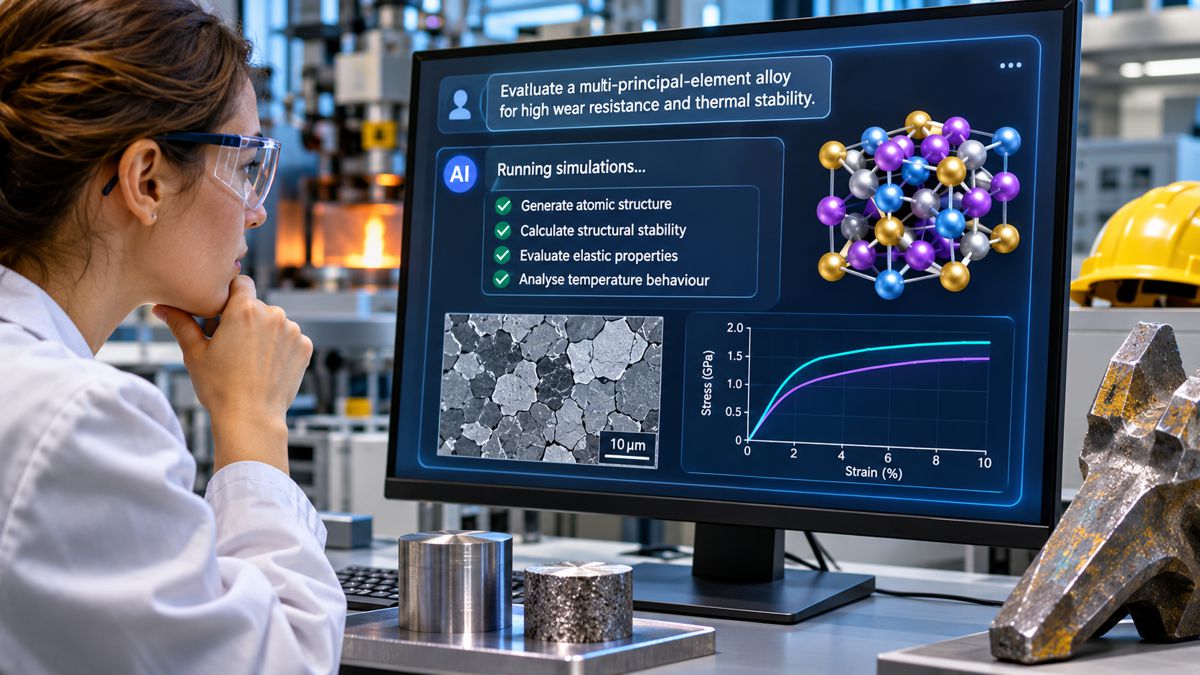
Swiss materials scientists have developed an artificial intelligence agent capable of running complex metallurgical simulations through a conversational interface, allowing experimental researchers to investigate new alloy compositions without having to master specialist computational software or programming languages.
Developed by Yang Hu and Vladyslav Turlo at Empa, the Swiss Federal Laboratories for Materials Science and Technology, OptiMat Alloys brings computational materials science closer to the laboratory bench. Its initial focus is on compositionally complex alloys, whose mechanical, thermal and electromagnetic properties offer opportunities for developing advanced engineering materials, industrial components and protective coatings.
For manufacturers working with materials exposed to abrasive wear, corrosive environments and extreme temperatures, computational screening could help identify promising alloy compositions before committing resources to experimental development.
Briefing
- Empa has developed OptiMat Chat, a conversational AI platform for computational materials science.
- Its first specialist agent, OptiMat Alloys, investigates multi-principal-element alloys using established computational tools.
- Researchers can initiate metallurgical simulations through natural-language instructions without writing code.
- Calculation records are retained in a database to support traceability, benchmarking and subsequent research.
- Future specialist agents could extend the platform to ceramics, metal oxides and amorphous materials.
Moving Beyond Conventional Metallurgy
For thousands of years, metallurgy has largely revolved around modifying the properties of a dominant metal through the introduction of other elements. Bronze combines copper with tin, while modern engineering steels use carefully controlled additions of carbon, chromium, nickel, manganese and other elements to achieve particular combinations of strength, hardness, toughness and corrosion resistance.
Multi-principal-element alloys depart from this established approach by combining several elements in substantial proportions. High-entropy alloys, conventionally associated with five or more principal elements, form part of this broader family of materials. Rather than beginning with a dominant base metal and progressively modifying its chemistry, researchers can investigate entirely different combinations of elements and the structures that emerge from their interaction.
The difficulty is the sheer number of possible compositions. Even within a relatively restricted selection of metals, variations in elemental proportions create a vast range of candidates. Manufacturing, heat treatment and cooling conditions introduce further variables that influence the resulting microstructure and material performance.
“There are an extremely large number of possible combinations,” explained Yang Hu, a researcher at Empa’s Advanced Metallurgy & Manufacturing of Metals laboratory in Thun. “Traditional methods of materials development, in which one produces and examines a few varieties of the material, quickly reach their limits here.”
Computational materials science provides a means of narrowing that search before researchers begin melting metals, preparing specimens and conducting physical tests. However, operating the specialist software requires expertise that experimental materials scientists may have neither the time nor the resources to develop.
Connecting Artificial Intelligence with Atomic Simulation
OptiMat Alloys combines a large language model with specialist scientific software. The language model interprets the researcher’s instructions, selects appropriate computational tools and coordinates the calculations required to investigate a particular material. Scientific predictions are generated by the connected computational models rather than by the language model itself.
The underlying technology is considerably more specialised than the conversational interface suggests. According to the project’s public software repository, the platform incorporates the Atomic Simulation Environment alongside machine-learning interatomic potentials, including ORB, MACE and NequIP. These models approximate the energies and forces associated with arrangements of atoms, allowing researchers to investigate material behaviour without relying exclusively on more computationally demanding electronic structure calculations.
Researchers can examine structural stability, elastic properties and temperature-dependent material characteristics, generate visualisations of atomic structures and investigate how elastic behaviour varies according to the direction in which a material is loaded. The conversational interface removes much of the software-related learning curve, although researchers still need sufficient metallurgical knowledge to formulate meaningful questions and interpret the results.
“We have designed our agent to use our simulation tools for high-entropy alloys, and to do so according to the best-practice protocols,” explained Turlo, who works in Empa’s Computational Engineering laboratory.
Building a Living Materials Database
The computational framework, described in a research paper published in npj Computational Materials, also addresses the preservation and reuse of computational knowledge. Conventional materials databases contain previously calculated or experimentally determined information, but their usefulness depends on whether the required composition, structure or material property has already been investigated. With compositionally complex alloys, substantial gaps are inevitable.
OptiMat Alloys allows researchers to generate additional computational records as questions arise, retaining results alongside information identifying the calculation methods, parameters and software involved. The approach follows FAIR scientific data principles, which seek to make research information findable, accessible, interoperable and reusable. Researchers can retrieve previous calculations, compare results and build upon existing work rather than repeatedly investigating the same compositions.
The system also incorporates methods for examining uncertainty by comparing predictions generated using different interatomic models and atomic configurations. Discrepancies can help identify areas requiring closer investigation, although agreement between models does not necessarily establish accuracy, particularly where those models share similar limitations.
The accompanying research datasets are available through the Materials Cloud Archive, while the agent itself has been released under the MIT open-source software licence. Universities and industrial research groups can examine the software and develop additional workflows around their own research requirements.
Engineering Materials for Demanding Environments
Construction and mining equipment manufacturers continually face difficult compromises between hardness, toughness, abrasion resistance and manufacturing cost. Excavator teeth, crusher liners, cutting tools and drilling equipment encounter combinations of impact loading and abrasive wear, while industrial pumps, marine equipment and offshore infrastructure can experience simultaneous mechanical wear and corrosion.
A published review of wear and corrosion in high-entropy alloys examines the potential of these materials in environments where mechanical and chemical deterioration interact. Their complex compositions offer opportunities to engineer particular combinations of properties, although performance remains dependent on alloy chemistry, microstructure, manufacturing conditions and the operating environment.
One potential route towards industrial adoption is through protective coatings applied to conventional steel substrates. Rather than manufacturing entire components from expensive alloy compositions, surface engineering allows specialist materials to be concentrated in areas experiencing the greatest deterioration. Computational screening could help identify candidate compositions for experimental coating development.
The commercial case would depend on whole-life operating economics. A mining operation regularly replacing crusher components may be prepared to pay substantially more for a material that demonstrably extends service life and reduces maintenance shutdowns. The economics of using similar alloys across entire machine structures would be very different.
From Simulation to Industrial Production
Identifying a promising alloy composition is only one stage in a longer engineering process. Materials must be manufactured consistently, machined or formed where necessary, joined to other components and subjected to realistic operating conditions. Manufacturing can also introduce unwanted phases, residual stresses, porosity and other defects that compromise the properties predicted through computational modelling.
A review of high-entropy alloy fabrication and phase formation identifies raw material costs, processing complexity and incomplete understanding of composition-property relationships as continuing barriers to industrial adoption. Alloys containing expensive or supply-constrained elements may prove unsuitable for large-volume applications regardless of their mechanical performance.
Advanced production methods, including metal additive manufacturing, powder metallurgy and precision surface engineering, expand the range of compositions and structures that researchers can investigate. Computational tools could help direct these manufacturing capabilities towards materials with a stronger theoretical basis for development, although physical testing and production economics will determine their suitability for commercial use.
Maintaining Scientific Reliability
Empa’s researchers have deliberately focused on reliability, traceability and human oversight. Structured interactions with computational software, predefined workflows and retained calculation records are intended to reduce the risk of fabricated or misleading results. Nevertheless, inappropriate assumptions, limitations within the underlying models and incorrect interpretation remain potential sources of error.
“However, we by no means recommend creating scientific publications based solely on this data,” cautioned Turlo. “The data are intended as starting points for expert interpretation and experimental planning rather than as standalone publishable scientific results.”
Physical testing remains essential for structural and safety-critical engineering applications. A predicted elastic modulus, for example, cannot establish whether a material will withstand years of cyclic loading, abrasive impact or exposure to aggressive chemicals. Laboratory investigations, component testing and, where appropriate, field trials remain necessary before new materials can be specified with confidence.
The agent’s role is to undertake computational work according to established procedures, leaving scientists to investigate the physical mechanisms behind the results and determine which predictions warrant experimental validation.
Extending Computational Research Beyond Metals
Empa intends to expand OptiMat Chat through additional specialist agents capable of investigating ceramics, metal oxides and amorphous materials. Advanced ceramics already have applications in cutting tools, wear-resistant linings and high-temperature components, while metal oxides are used in protective coatings, sensors, energy storage and catalytic processes.
A common conversational interface could allow multidisciplinary research teams to investigate different material families without requiring every scientist to become proficient in several specialist computational environments. The researchers also anticipate that AI will increasingly assist with scientific literature reviews, experimental design and data generation.
“Our agents handle routine calculations. This gives us more time to focus on the truly interesting research questions,” said Hu.
For experimental metallurgists, the opportunity extends beyond the automation of individual calculations. Investigations can become part of an accumulating body of computational knowledge, with earlier results available for comparison and reassessment as scientific understanding and simulation models improve. Researchers can begin a new experimental programme with access to the findings and methods of previous computational investigations, even when the alloys under consideration have yet to be manufactured.
Key Industry Questions
- What are high-entropy alloys? High-entropy alloys are a family of compositionally complex metallic materials containing multiple principal elements, conventionally five or more. Their chemistry offers opportunities to develop combinations of mechanical, thermal and chemical properties that differ from conventional alloys.
- What is OptiMat Alloys? OptiMat Alloys is an AI-powered computational materials research agent developed by Empa. It allows researchers to investigate alloy structures and properties using natural-language instructions.
- How does a computational AI agent differ from an ordinary chatbot? A computational AI agent can interact with specialist scientific software, execute calculations and retrieve structured results. Its scientific outputs originate from connected computational tools rather than solely from a language model.
- How can artificial intelligence accelerate alloy development? AI-assisted computational screening can help researchers investigate candidate compositions, compare predicted properties and prioritise materials for laboratory testing, reducing reliance on extensive trial-and-error experimentation.
- Could high-entropy alloys improve construction and mining machinery? Selected compositions may offer improved resistance to abrasion, corrosion or elevated temperatures. Potential applications include cutting tools, crusher liners, drilling components and protective coatings, subject to experimental validation and commercial feasibility.
- Can AI-generated material predictions replace physical testing? No. Computational predictions are influenced by model accuracy, assumptions and the properties being investigated. Experimental testing remains necessary to establish actual material performance and suitability for engineering applications.
- Is OptiMat Alloys open-source software? Yes. The agent is available under the MIT licence, allowing researchers and developers to examine, modify and extend its software, subject to separate licensing conditions associated with underlying models and dependencies.
- What other materials could benefit from AI-assisted simulation? Future specialist agents could investigate ceramics, metal oxides and amorphous materials, supporting research into protective coatings, energy systems, electronic components and advanced engineering materials.
Strategic Takeaways
- AI agents connected to established engineering software offer a practical route towards automating specialist computational work while retaining scientific oversight.
- Computational screening could improve research economics by directing laboratory resources towards alloy compositions with greater theoretical potential.
- Protective coatings and high-wear components offer potential routes to commercial adoption where material performance can justify higher production costs.
- Traceable computational databases allow research teams to preserve, reassess and build upon previous investigations as simulation methods improve.
- Industrial adoption remains dependent on manufacturing consistency, experimental validation, raw material availability and whole-life component economics.